

The supplement with the most advanced format isn’t automatically the one your body absorbs best. For many vitamins and minerals, the nutrient form matters more than whether it comes as a capsule, powder, gummy or liquid. Timing and nutrient interactions can also affect uptake. Choosing supplements for better nutrient absorption means considering what you take, what you take it with and how nutrients may affect one another.
It makes sense to look for a form that suits your needs, but no single option works best for every nutrient. This guide explains how bioavailability differs from the amount on a label, which forms and meal pairings can matter, and when nutrients may compete for absorption. You’ll also find practical timing considerations, such as taking fat-soluble vitamins with food containing fat and spacing minerals that can interfere with one another.
Key Takeaways
- Choose a supplement by its nutrient form as well as its delivery format, since a capsule or liquid alone doesn’t determine absorption.
- Pair fat-soluble vitamins with a meal containing some fat, and consider how water-soluble nutrients are handled differently by the body.
- Recognise that bioavailability depends on more than the amount shown on a label, including digestion and the nutrient’s form.
- Plan mineral combinations thoughtfully: calcium and iron taken 2 to 3 hours apart may reduce competition for absorption.
- Use meal timing and food pairings strategically, such as combining plant-based iron with a source of vitamin C.
Table of Contents
1. What Form of Vitamin Supplements Offers the Best Absorption?
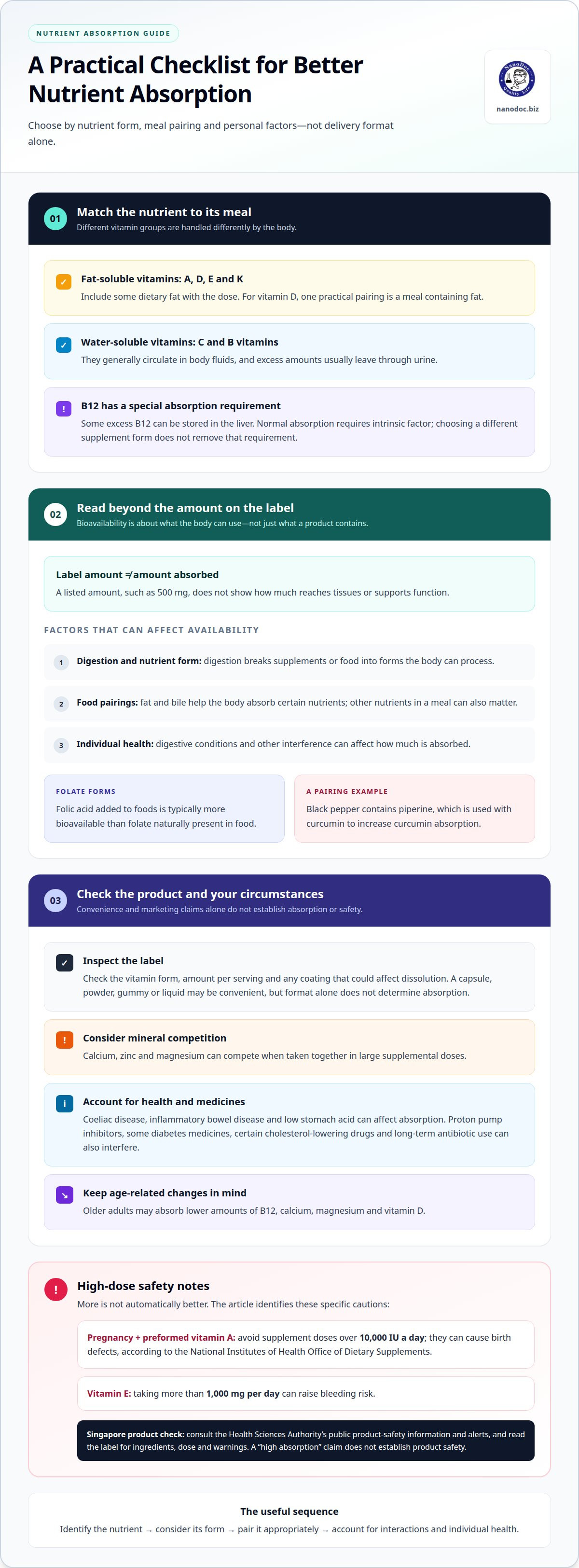
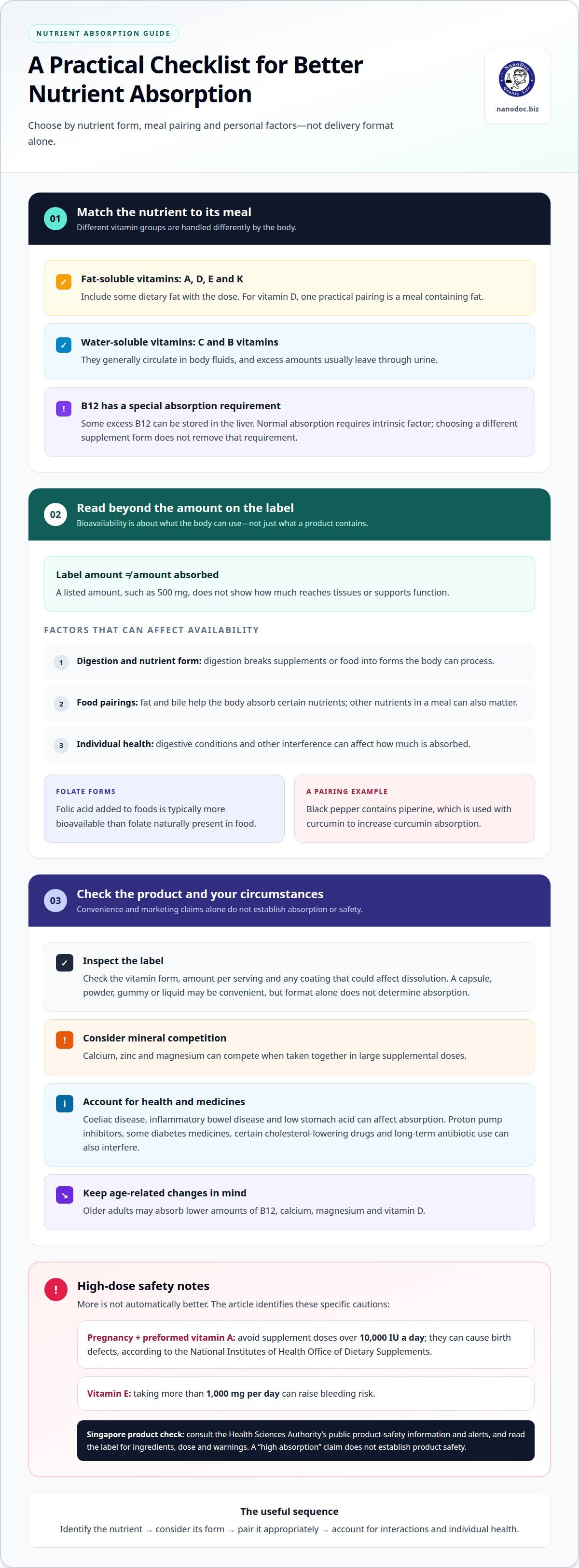
No single supplement format offers the best absorption for every vitamin. Fat-soluble vitamins A, D, E and K are absorbed differently from water-soluble vitamin C and B vitamins. A capsule, powder, gummy or liquid may be convenient, but nutrient form and timing can matter more for bioavailability. Choosing supplements for better nutrient absorption starts with the nutrient, not the delivery format.
For vitamins A, D, E and K, include some dietary fat with the dose. Taking vitamin D with a meal containing fat is one practical example. Vitamin D also supports calcium absorption, and roughly 30% of phosphorus absorption in the intestine has been observed to depend on vitamin D. These relationships don’t mean that taking more vitamin D automatically improves mineral status.
Water-soluble vitamins generally circulate in body fluids, and excess amounts usually leave through urine. Vitamin B12 is an exception: some excess can be stored in the liver. Normal B12 absorption requires intrinsic factor, a protein involved in its uptake. A supplement’s B12 form doesn’t remove that requirement for normal absorption.
In Singapore, consult the Health Sciences Authority’s public product-safety information and alerts, then read the label for ingredients, dose and warnings. A “high absorption” claim or a particular delivery format alone doesn’t establish product safety.
There isn’t one fixed Singapore price for common absorption-related supplements. Cost depends on the nutrient, formulation, dose and pack size. Compare the stated nutrient amount and serving count rather than relying only on bioavailability claims.
Vitamin D, B12, iron and calcium don’t automatically require supplements simply to improve absorption. Whether supplementation is relevant depends on dietary intake, the nutrient’s absorption and individual needs. For example, the reason someone considers B12 differs from the reason someone might consider iron.
High doses can carry risks. Pregnant people should avoid preformed vitamin A supplement doses over 10,000 IU a day because they can cause birth defects, according to the National Institutes of Health Office of Dietary Supplements. Taking more than 1,000 mg of vitamin E per day can raise bleeding risk.
Check the label for the vitamin form, amount per serving and any coating that could affect dissolution. For vitamin D, consider whether you’ll take it with a meal containing dietary fat. Older adults may absorb lower amounts of B12, calcium, magnesium and vitamin D. A useful approach to supplements for better nutrient absorption is to match the form and meal to the specific nutrient, rather than choosing by capsule size or marketing language.
2. How nutrient absorption and bioavailability work
Absorption is the movement of nutrients from digestion into circulation; bioavailability describes the body’s ability to use them. A supplement label may list 500 mg, but that amount doesn’t show how much reaches tissues or supports function. Digestion, nutrient form, food pairings and individual health all influence what becomes available.
Most nutrient absorption occurs in the small intestine, where specialised cells transport nutrients into the bloodstream. Digestion first breaks food or supplements into forms the body can process. For example, fat and bile help the body absorb certain nutrients, while mineral absorption can depend on the compound and what else is present in a meal.
Bioavailability helps explain why nutrient intake and nutrient status aren’t identical. A person can consume vitamins and minerals yet absorb less because of an intestinal condition or another interference. Coeliac disease and inflammatory bowel disease can affect absorption, and low stomach acid may also be a barrier. These factors can influence which supplement form is suitable, including for magnesium.
Folic acid and food folate illustrate how nutrient forms differ. Folic acid added to foods is typically more bioavailable than folate naturally present in food. That difference concerns how readily the form is available, not a guarantee that everyone needs a supplement. The relevant choice depends on dietary intake and individual circumstances.
Black pepper contains piperine, which is used with curcumin to increase curcumin absorption. This example shows how combining compounds can affect bioavailability, but it doesn’t establish that the pairing is necessary for everyone or that all formulations behave alike. The amount on a label remains distinct from the amount absorbed.
Probiotics occur in supplements and fermented foods such as kefir, kimchi, yogurt and tempeh. They can support gut health, while digestive enzymes help break down protein and fat. Enzyme supplements aren’t expected to enhance vitamin and mineral absorption, since they are themselves subject to gastric enzymes.
Medication and digestive conditions can affect absorption and supplement choices. Proton pump inhibitors, some diabetes medicines, certain cholesterol-lowering drugs and long-term antibiotic use can interfere with nutrient absorption. Coeliac disease and inflammatory bowel disease may also alter absorption. These factors make a supplement’s form and timing relevant to the person taking it.
For a practical assessment, consider the nutrient, its form, the digestive process and potential interactions together. A capsule’s delivery format alone doesn’t establish superior bioavailability. For example, a curcumin product paired with piperine differs from curcumin alone; the appropriate choice depends on the nutrient’s intended use and the person’s circumstances.
3. Mineral absorption and nutrient competition
Mineral absorption depends on the compound, the meal and other nutrients consumed alongside it. Calcium, zinc and magnesium can compete when taken together in large supplemental doses. Separating these minerals across different meals can reduce direct competition, especially when a routine includes several individual products.
Phytates in some high-fibre plant foods can bind iron, zinc and calcium, reducing absorption when eaten in large amounts. Beans, whole grains and seeds are examples of foods that may contain phytates. This doesn’t make them poor dietary choices overall; it means meal composition can influence how much of certain minerals becomes available.
Mineral supplements also interact with foods. High-calcium foods can interfere with iron absorption, while tannins in tea and coffee can hinder it. Pairing plant-based iron sources with vitamin C-rich foods may improve iron uptake. These examples show why the whole meal matters, not just the supplement serving.
Among common magnesium supplements, magnesium glycinate and magnesium citrate tend to be absorbed more efficiently than magnesium oxide. Magnesium bisglycinate is identified as the most bioavailable of these listed forms. The form can guide a comparison, but that doesn’t mean everyone needs magnesium or that one form suits every purpose.
Chelated minerals bind a mineral to another molecule, such as an amino acid. This form is often discussed for its potential bioavailability, but read the label for the specific mineral and amount. A chelated name alone doesn’t establish that a product will enhance absorption in every dietary context.
A multivitamin/mineral supplement combines nutrients, which can simplify intake but may also put competing minerals in one serving. Taking it with a meal or snack may support absorption of some vitamins and help avoid stomach upset. Check the ingredient panel for calcium, zinc and magnesium, and consider whether additional single-mineral supplements duplicate them.
Soluble vitamins and minerals behave differently during digestion, so a meal strategy that helps one nutrient may not help another. Dietary fat can support absorption of fat-soluble vitamins, but it doesn’t remove competition between calcium and iron. Match the meal or timing choice to the specific nutrient and its known interactions.
For a practical comparison, note the mineral form, serving amount and other ingredients. If a product contains magnesium oxide, compare it with glycinate or citrate forms rather than judging by capsule size. If your routine includes calcium and zinc, separate large supplemental doses instead of taking them simultaneously. Food sources also matter, since phytates and calcium-rich foods can alter mineral uptake.
4. Supplement timing and nutrient interactions
Timing can affect how nutrients are absorbed, tolerated and used alongside medicines. A practical starting point is to follow the product label and consider the nutrient’s known food interactions. For example, taking a multivitamin or mineral supplement with a meal or snack may improve absorption of some vitamins and help avoid an upset stomach.
Fat-soluble vitamins are best paired with food containing dietary fat. Vitamin D3, for example, can be taken with the largest meal that includes healthy fats. This doesn’t mean the meal must be unusually rich; it means that food composition can support uptake. A small study also found significantly improved lycopene bioavailability from cherry tomatoes with full-fat rather than low-fat dressing.
Iron timing involves several competing considerations. Iron is often absorbed better between meals or on an empty stomach, while vitamin C can support absorption of plant-based iron. Calcium can interfere, so take calcium and iron 2 to 3 hours apart. Tea and coffee contain tannins that can hinder iron uptake, making them poor pairings with an iron dose.
Vitamin C and B12 need separate timing in some guidance: keep supplements at least 2 hours apart because vitamin C can interfere with the body’s use of B12. Water-soluble B vitamins and vitamin C are often taken in the morning, either on an empty stomach or with light food if nausea occurs. B12 absorption may be better with a meal, so follow the product directions and consider the specific formulation.
Medication timing matters too. Calcium, magnesium or iron taken within 4 hours of thyroid medication can reduce the medication’s strength. Proton pump inhibitors, certain diabetes medicines, some cholesterol-lowering drugs and long-term antibiotic use can also affect nutrient absorption. Keep a written schedule of supplements and medicines to identify overlaps, then follow the medicine’s instructions.
Meal composition can change absorption beyond supplement-to-supplement interactions. With processed tomato products, 10g of fat has been observed to optimise lycopene absorption. Regular meals support stomach acid, digestive enzymes and bile production. Probiotics are available in supplements and fermented foods such as yogurt, kimchi and tempeh, but they don’t replace a nutrient-specific timing plan.
Research findings should be applied with context. A result from an American study population may not transfer directly to every Singapore diet or routine. National advice can also differ by country, so make decisions based on the nutrient, meal, medicine and product directions rather than assuming one schedule suits every supplement. A simple daily chart can help separate calcium and iron while pairing vitamin D3 with a suitable meal.
5. Interactions between competing nutrients
Supplement schedules can create competition even when each nutrient has a useful role. Large supplemental amounts of calcium, zinc and magnesium may compete for absorption when taken together. Dose and combination matter: a meal containing several nutrients isn’t automatically equivalent to combining concentrated supplements in one serving.
Calcium deserves particular attention in an iron routine. High-calcium foods can interfere with iron absorption, and calcium supplements should be separated from iron by 2 to 3 hours. Calcium and zinc should also be separated by at least two hours. For example, someone taking iron with breakfast could schedule calcium for another part of the day.
Plant foods bring a different interaction. Phytates in some high-fibre foods can bind iron, zinc and calcium when eaten in large amounts. Beans, whole grains and seeds can be nutritious sources, so this interaction doesn’t mean avoiding them. Instead, consider your overall eating pattern and avoid taking a concentrated mineral dose alongside a meal particularly high in phytates.
Iron has additional food interactions. Tannins in tea and coffee can hinder iron absorption, while vitamin C-rich foods may improve absorption from plant-based iron sources. For example, eat a vitamin C-containing food with a plant-based iron source, and have tea or coffee at a different time.
Supplement labels can reveal combinations that might otherwise be overlooked. Record the mineral name and amount per serving for each product, including multivitamins. A multivitamin may contain calcium, zinc or magnesium, and a separate product can add more of the same mineral. Reviewing the combined intake helps identify overlap before adding another supplement.
A simple schedule can make these interactions easier to manage. First, list each product and its minerals. Next, mark calcium, iron and zinc doses that need separation. Then assign them to different meals or times, leaving at least two hours between calcium and zinc, and 2 to 3 hours between calcium and iron. Keep the routine consistent with product directions.
Clinical context matters because a nutrient interaction doesn’t prove a deficiency or determine the right supplement. The goal is to prevent avoidable competition, not to eliminate calcium-rich foods or useful plant sources. If your schedule includes several minerals, use their labelled amounts and timing instructions to organise intake rather than taking every product together on an empty stomach.
The practical takeaway is to separate concentrated mineral supplements when they may compete, while keeping a varied eating pattern. For instance, pair plant-based iron with vitamin C, have tea away from that iron occasion, and schedule calcium separately. These steps address specific interactions without assuming that more supplements will improve absorption.
NanoDoc International Pte Ltd
NanoDoc International Pte Ltd offers Nano Cellular Essential Nutrition for readers considering supplements for better nutrient absorption. Its health products use LG Bionano’s patented bionano delivery technology, developed to enhance absorption through the gut. Formulation is one factor to consider alongside nutrient form, dietary intake and possible interactions.
The broader range includes Anti-Ageing Skin Care, Pain Relief Care and Oral & Immunity Care. For those considering supplements for better nutrient absorption, Nano Cellular Essential Nutrition is the closest fit among these offerings.
To explore the nutrition range, contact NanoDoc International Pte Ltd.
Make your next choice with intention
Before adding another supplement, identify the specific need you want to address and how it fits your existing routine. A clear purpose makes it easier to assess a product’s ingredients and formulation without assuming that a more complex formula is automatically more effective. If medicines or a health condition affect your choices, discuss supplement use with a healthcare professional.
For readers exploring nutrition-focused products, NanoDoc International Pte Ltd offers Nano Cellular Essential Nutrition. Its range also includes Anti-Ageing Skin Care and Pain Relief Care for different product interests. Consider which category aligns with your needs, then assess its relevance alongside your dietary intake and established routine. Choosing supplements for better nutrient absorption is a considered process, not simply a search for the strongest-sounding label.
When you’re ready to explore NanoDoc International Pte Ltd’s offerings, contact NanoDoc International Pte Ltd. Take the next step with a clear question and a thoughtful approach to your routine.
Frequently Asked Questions
What Form of Vitamin Supplements Offers the Best Absorption?
No single form is best for every vitamin; choose according to the nutrient and its absorption pathway. For example, lipid-based formulations may suit fat-soluble nutrients, while a vitamin’s chemical form can matter more than whether it comes as a capsule or liquid. Coatings can also influence dissolution. Compare the named nutrient form and serving information rather than treating a delivery format or “high absorption” label as proof of superior uptake.
What is bioavailability?
Bioavailability is the proportion of a nutrient that becomes available for the body to use after intake. It differs from the amount printed on a label: a serving may contain a stated quantity, but digestion and absorption affect what reaches circulation and tissues. For instance, the nutrient form and the meal consumed alongside it can influence availability. That’s why label quantity alone doesn’t describe the body’s usable exposure.
What is nutrient absorption?
Nutrient absorption is the passage of digested nutrients through the intestinal lining and into circulation. It follows digestion, which breaks food or supplements into forms the body can process. Absorption is distinct from bioavailability: absorption describes entry into the body, while bioavailability also considers whether the nutrient becomes available for use. A nutrient that remains unabsorbed in the digestive tract cannot contribute directly to the body’s nutrient supply.
How can I maximize my vitamin intake?
Start by identifying the amount and form in each product you already take, including multivitamins, to avoid accidental overlap. Then match each vitamin to its directions and food requirements instead of taking every product together. For example, take a fat-soluble vitamin with a meal containing fat, while a water-soluble product may have different instructions. Keep a written schedule and account for medicines that could affect nutrient handling.
Which supplements have evidence for improving nutrient absorption?
Some combinations and formulations may support uptake in specific contexts, but no supplement improves absorption of every nutrient. Vitamin C can support absorption of plant-based iron, and piperine is used with curcumin to increase curcumin absorption. Lipid-based formulations may affect the availability of some nutrients. Treat these as nutrient-specific approaches, not universal enhancers, and consider whether the nutrient is relevant to your dietary intake and circumstances.
What foods or supplements increase or reduce iron, calcium, and zinc absorption?
Vitamin C-rich foods can support absorption of plant-based iron, while tea and coffee may hinder iron uptake. Calcium-rich foods can interfere with iron absorption, and phytates in foods such as beans, seeds and whole grains can bind iron, zinc and calcium. This doesn’t make these foods unsuitable; it highlights meal context. For example, include vitamin C with plant-based iron and avoid pairing iron supplements with tea or coffee.
How should supplements be timed or combined to improve absorption?
Build timing around the specific nutrient, product directions and any medicines in your routine. Separate calcium and iron supplements by 2 to 3 hours, and keep vitamin C and B12 supplements at least 2 hours apart. If you take thyroid medication, calcium, magnesium or iron within 4 hours can reduce its strength. A daily schedule can make these intervals easier to follow without combining every supplement at one meal.
How much do common absorption-related supplements cost in Singapore?
There is no fixed price; cost depends on the nutrient, formulation, dose and pack size. Compare the nutrient amount and serving count.
Frequently Asked Questions
- What Form of Vitamin Supplements Offers the Best Absorption?
- No single form is best for every vitamin; choose according to the nutrient and its absorption pathway. For example, lipid-based formulations may suit fat-soluble nutrients, while a vitamin’s chemical form can matter more than whether it comes as a capsule or liquid. Coatings can also influence dissolution. Compare the named nutrient form and serving information rather than treating a delivery format or “high absorption” label as proof of superior uptake.
- What is bioavailability?
- Bioavailability is the proportion of a nutrient that becomes available for the body to use after intake. It differs from the amount printed on a label: a serving may contain a stated quantity, but digestion and absorption affect what reaches circulation and tissues. For instance, the nutrient form and the meal consumed alongside it can influence availability. That’s why label quantity alone doesn’t describe the body’s usable exposure.
- What is nutrient absorption?
- Nutrient absorption is the passage of digested nutrients through the intestinal lining and into circulation. It follows digestion, which breaks food or supplements into forms the body can process. Absorption is distinct from bioavailability: absorption describes entry into the body, while bioavailability also considers whether the nutrient becomes available for use. A nutrient that remains unabsorbed in the digestive tract cannot contribute directly to the body’s nutrient supply.
- How can I maximize my vitamin intake?
- Start by identifying the amount and form in each product you already take, including multivitamins, to avoid accidental overlap. Then match each vitamin to its directions and food requirements instead of taking every product together. For example, take a fat-soluble vitamin with a meal containing fat, while a water-soluble product may have different instructions. Keep a written schedule and account for medicines that could affect nutrient handling.
- Which supplements have evidence for improving nutrient absorption?
- Some combinations and formulations may support uptake in specific contexts, but no supplement improves absorption of every nutrient. Vitamin C can support absorption of plant-based iron, and piperine is used with curcumin to increase curcumin absorption. Lipid-based formulations may affect the availability of some nutrients. Treat these as nutrient-specific approaches, not universal enhancers, and consider whether the nutrient is relevant to your dietary intake and circumstances.
- What foods or supplements increase or reduce iron, calcium, and zinc absorption?
- Vitamin C-rich foods can support absorption of plant-based iron, while tea and coffee may hinder iron uptake. Calcium-rich foods can interfere with iron absorption, and phytates in foods such as beans, seeds and whole grains can bind iron, zinc and calcium. This doesn’t make these foods unsuitable; it highlights meal context. For example, include vitamin C with plant-based iron and avoid pairing iron supplements with tea or coffee.
- How should supplements be timed or combined to improve absorption?
- Build timing around the specific nutrient, product directions and any medicines in your routine. Separate calcium and iron supplements by 2 to 3 hours, and keep vitamin C and B12 supplements at least 2 hours apart. If you take thyroid medication, calcium, magnesium or iron within 4 hours can reduce its strength. A daily schedule can make these intervals easier to follow without combining every supplement at one meal.
- How much do common absorption-related supplements cost in Singapore?
- There is no fixed price; cost depends on the nutrient, formulation, dose and pack size. Compare the nutrient amount and serving count.