

Could bloating, diarrhoea, fatigue or brittle nails mean your supplements aren’t being absorbed? These symptoms can raise questions, but they don’t establish the cause. If you’re searching for signs of nutrient malabsorption from supplements, remember that similar changes may result from a supplement’s side effects, an underlying health condition or other factors.
It’s understandable to feel concerned when you’re taking a supplement and not noticing the benefit you expected. A symptom pattern that persists or worsens may deserve attention, but it isn’t a reason to diagnose yourself or assume absorption is the problem.
This article explains which symptoms may warrant discussion with a healthcare professional, how possible malabsorption differs from supplement side effects, and what details to record before an appointment. You’ll learn to track when symptoms began, how they relate to supplement use, and any changes in dose or routine. That information can help a healthcare professional assess what may be happening and discuss appropriate next steps.
Key Takeaways
- Persistent digestive changes or signs associated with a known deficiency may deserve attention, but symptoms alone can’t confirm malabsorption.
- Digestion, gut function, nutrient type and individual circumstances can all influence absorption.
- Timing and symptom patterns are useful clues to record, not diagnostic tests for supplement side effects or other causes.
- Track supplement names, ingredients, doses, timing and relation to meals to support a more informed discussion with a healthcare professional.
- Formulation can inform product evaluation, but it can’t diagnose or resolve unexplained symptoms. Suspected signs of nutrient malabsorption from supplements need professional assessment.
Table of Contents
- What signs of nutrient malabsorption from supplements might deserve attention?
- How nutrient absorption works, and where supplement-related problems can arise
- Malabsorption or supplement side effects: how to compare the possibilities
- What to Do if You Suspect Poor Nutrient Absorption
- How supplement formulation fits into a careful nutrition decision
What signs of nutrient malabsorption from supplements might deserve attention?
Symptoms may raise questions about nutrient absorption, but they can’t confirm malabsorption or show that a supplement is the cause. Bloating, gas, diarrhoea or constipation that persists or recurs is worth noticing, especially if it began after a change in your supplement routine. These digestive changes can also have many other explanations.
Which symptom patterns should a supplement user notice?
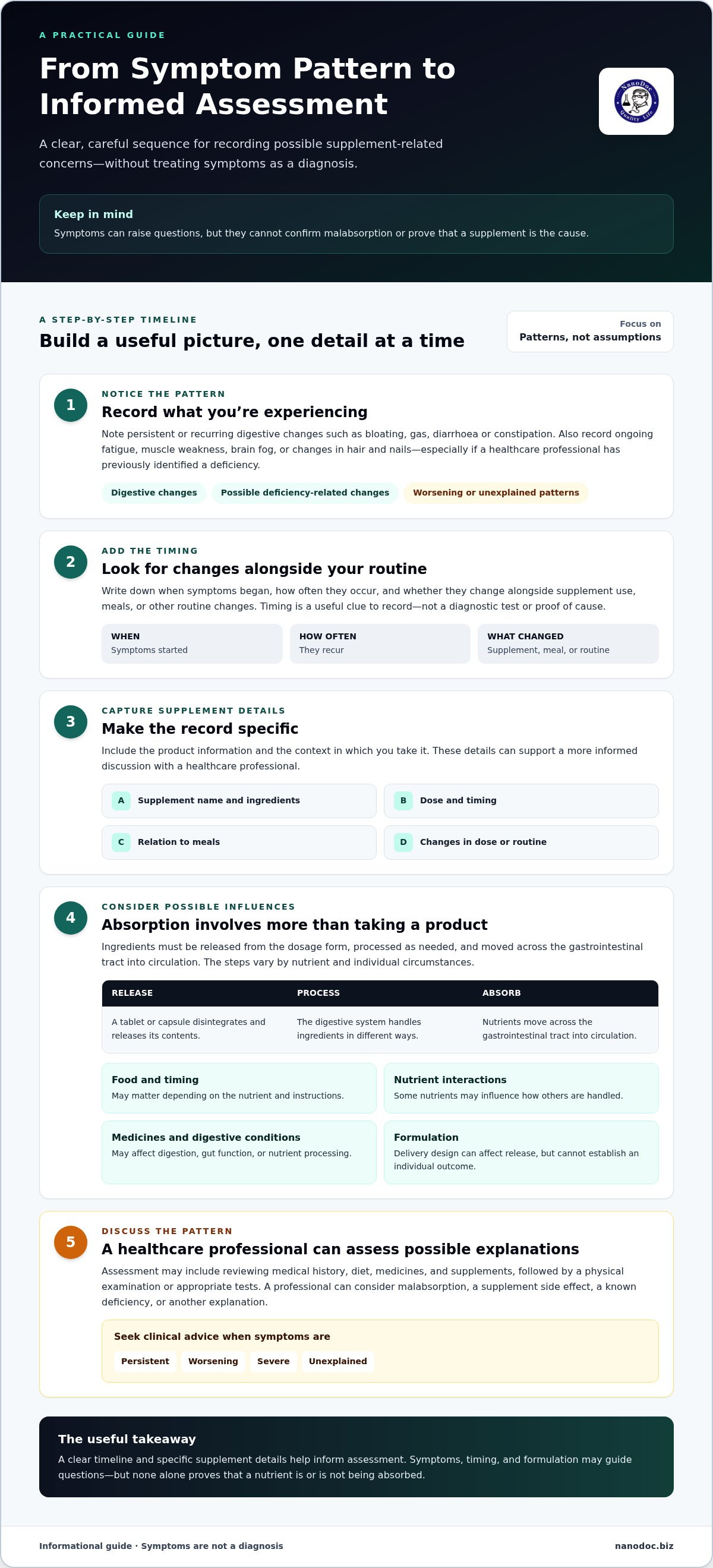
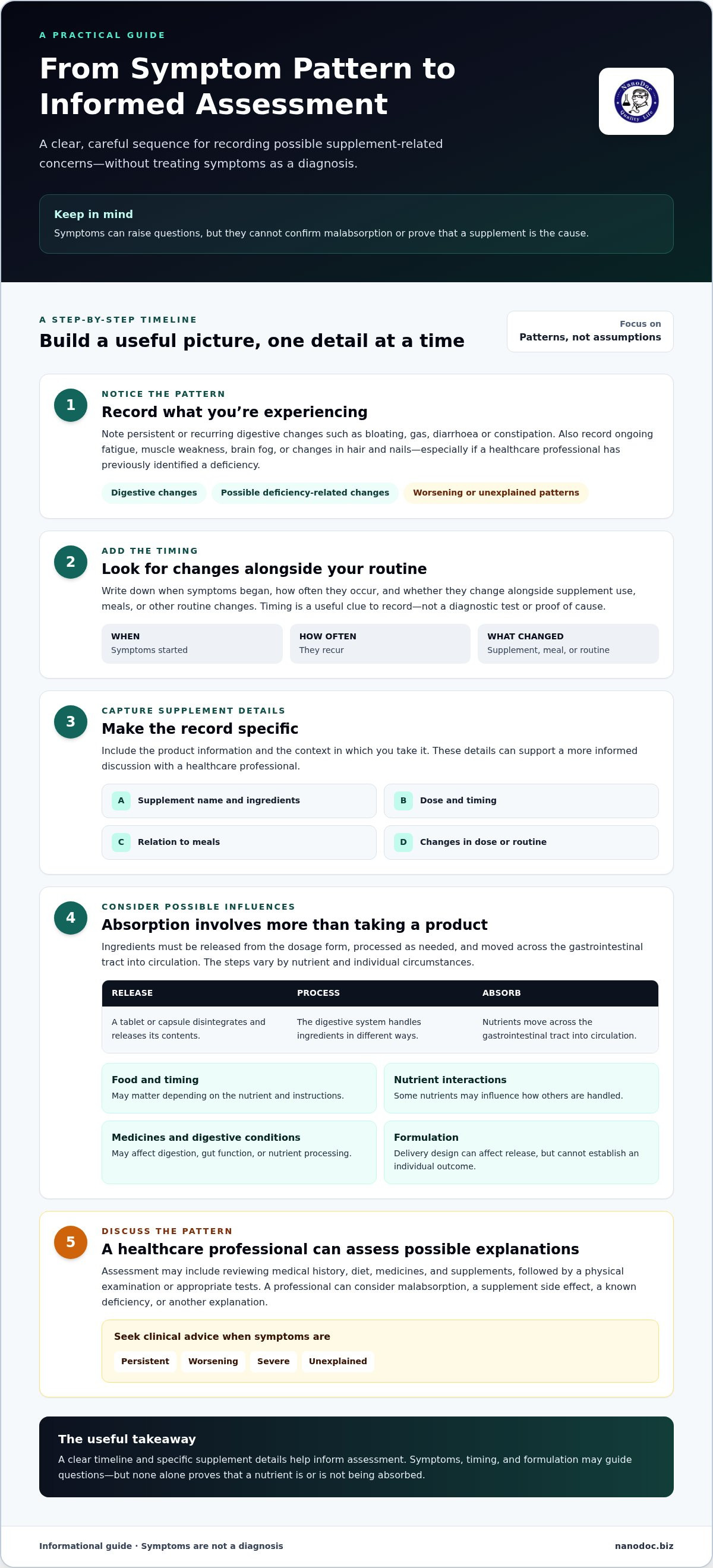
Look for a pattern rather than treating one symptom as a diagnosis. Note when symptoms started, how often they occur and whether they change alongside supplement use, meals or other routine changes.
- Persistent digestive changes: recurring bloating, gas, diarrhoea or constipation may be useful to record, but don’t identify a specific absorption disorder.
- Possible deficiency-related changes: ongoing fatigue, muscle weakness, brain fog, or changes in hair and nails may prompt questions, particularly if a healthcare professional has previously identified a nutrient deficiency.
- Symptoms that progress or occur together: a worsening or unexplained pattern deserves more attention than an isolated, short-lived change.
Possible deficiency symptoms vary by nutrient and may overlap with other health conditions. Fatigue, bowel changes and skin changes, for example, can arise for many reasons. Their presence alone doesn’t mean a supplement isn’t being absorbed.
Why symptoms alone cannot confirm malabsorption
Symptoms can suggest a concern, but they cannot diagnose malabsorption or identify which nutrient, if any, is poorly absorbed. As a general overview, Malabsorption can involve different causes and effects, so interpreting symptoms requires more than matching them to a list.
Assessment may involve reviewing your medical history, diet, medicines and supplements, followed by a physical examination or appropriate tests. A healthcare professional can consider whether the pattern fits malabsorption, a supplement side effect, a known deficiency or another explanation. Treat the signs of nutrient malabsorption from supplements as a reason to gather information, not as proof.
Seek clinical advice if symptoms are persistent, worsening, severe or unexplained. Record what you’re experiencing and when it occurs, then bring that information to the discussion. A clear timeline can support assessment without relying on self-diagnosis.
How nutrient absorption works, and where supplement-related problems can arise
Taking a supplement is only the first step. The body must release its ingredients from the dosage form, digest or otherwise process them as needed, and move them across the gastrointestinal tract into circulation. This movement is called absorption. The steps differ by nutrient: ingredients don’t all dissolve, interact with food or cross the gut in the same way.
What happens between taking a supplement and absorbing a nutrient?
A tablet or capsule must disintegrate and release its contents. A powder or liquid involves different physical steps, but its ingredients still need to be handled by the digestive system. Absorption then depends on the specific nutrient and its pathway, as well as gut function. The MedlinePlus overview of Malabsorption Syndromes describes how digestive conditions can interfere with the body’s ability to absorb nutrients.
Bioavailability describes how much of an ingredient becomes available for the body to use after it is taken. It is related to absorption, but the terms aren’t interchangeable in every context. A noticeable sensation after taking a product doesn’t show that a nutrient has been absorbed or is producing a particular effect. The absence of a sensation doesn’t prove the opposite, either.
What can affect absorption or cause similar symptoms?
Absorption can vary with the nutrient, the person and the circumstances in which a supplement is taken. Relevant factors may include:
- Food and timing: whether an ingredient is taken with food or at a particular time can matter, depending on the nutrient and instructions.
- Nutrient interactions: some nutrients may influence the handling of others when taken together.
- Medicines and digestive conditions: these may affect digestion, gut function or how nutrients are processed.
- Formulation: the ingredient’s form and delivery design can affect how it is released, but don’t establish what happens in one person.
A formulation’s delivery design describes how it is intended to release or present an ingredient. It does not prove that a particular person absorbs it effectively. That distinction matters when considering the signs of nutrient malabsorption from supplements: symptoms may relate to intolerance, another cause or an absorption issue, and formulation alone can’t resolve that uncertainty.
For broader context on delivery systems and nutrient availability, read this high-bioavailability nutrients guide. To compare formulation approaches, explore NanoDoc nutrition formulations as product information, not as a way to diagnose or treat unexplained symptoms.
Malabsorption or supplement side effects: how to compare the possibilities
Digestive discomfort after starting a supplement can make the cause seem obvious. Timing is useful to record, but symptoms that begin after taking a product don’t prove the product caused them or establish malabsorption. Consider the pattern and relevant health history as clues to discuss with a healthcare professional, not as a way to diagnose yourself.
| Possibility | Timing and symptom pattern to record | Relevant context |
|---|---|---|
| Possible malabsorption | Ongoing digestive changes or other persistent symptoms; timing may not closely follow each supplement dose. | A diagnosed nutrient deficiency or digestive condition may be relevant, but symptoms alone cannot establish the cause. |
| Supplement intolerance or side effect | Symptoms may appear in a recurring pattern after taking a supplement or changing its dose or formulation. | The ingredient list, amount taken, timing and whether it was taken with food can help provide context. |
| Unrelated cause | Symptoms may occur independently of supplement use or vary with other changes. | Illness, medicines, diet and other health circumstances may also be relevant. |
These patterns overlap. As Michigan State University Extension explains in its overview of nutrient bioavailability, how much of a nutrient is absorbed and used can depend on multiple factors. Neither a symptom nor its timing can show, by itself, whether a particular nutrient is being absorbed poorly.
Could the supplement itself be causing digestive symptoms?
An ingredient, dose or formulation may be associated with unwanted effects in some circumstances. If symptoms began after starting a supplement or changing how you take it, write down when you took it and when the symptoms appeared, along with any changes in dose or meals. A repeated timing pattern is useful information, not proof of cause.
When could an underlying absorption issue be considered?
Persistent symptoms, a diagnosed deficiency or a known digestive condition may be important context for clinical review. Conditions such as coeliac disease or Crohn’s disease can affect digestion, but symptoms cannot identify either condition. A clinician can review your history and determine whether an examination or testing is appropriate.
The signs of nutrient malabsorption from supplements can resemble intolerance or unrelated health concerns. Share your symptom timeline and supplement details with a healthcare professional. Don’t stop or change prescribed medicines based on a suspicion about supplement absorption; discuss medicine concerns with the prescriber or a pharmacist.
What to Do if You Suspect Poor Nutrient Absorption
If symptoms make you question whether a supplement is working as expected, focus first on clear records rather than trying to diagnose the cause. The signs of nutrient malabsorption from supplements can overlap with side effects and other health concerns, so a useful timeline can help a healthcare professional assess the possibilities.
- Document your symptoms. Record what you notice, when it began, how often it occurs, how long it lasts and how severe it feels.
- List every supplement. Note each product’s name, ingredients, dose, when you take it and whether it’s taken with a meal. Keep the packaging or take a clear image of the ingredient and dosage information.
- Review the timeline. Include meals, changes in routine and when symptoms occur in relation to each dose. Don’t deliberately restart a supplement to test a suspected reaction.
- Seek appropriate advice. Share your notes with a healthcare professional, along with relevant medicines, health history and any existing test results.
How to prepare a useful symptom and supplement record
A brief daily note can reveal details that are hard to recall during an appointment. Record symptom onset, frequency, duration and severity, plus meal and supplement timing. Note changes in dose or routine without assuming they explain the symptoms. Bring the original packaging or clear images so the ingredient list and dosage details can be reviewed accurately.
What assessment may involve
A healthcare professional may review your symptoms, diet, medicines, supplement use and medical history. An examination or tests may be considered, depending on your individual presentation and which nutrient or condition is being considered. Assessment should connect symptoms with history and appropriate clinical evidence. A symptom checklist alone can’t establish whether malabsorption is present.
Arrange clinical advice for symptoms that persist, worsen or remain unexplained. Severe or rapidly worsening symptoms call for prompt medical attention rather than routine self-monitoring. Don’t change prescribed medicines based on a suspicion about supplement absorption; discuss concerns with the prescriber or a pharmacist.
For product information as you compare nutrition formulations, explore NanoDoc nutrition formulations. Formulation details can inform product evaluation, but they can’t diagnose or resolve unexplained symptoms.
How supplement formulation fits into a careful nutrition decision
Formulation can help you understand how a supplement is designed, but it can’t explain an unexplained symptom pattern. A delivery system does not diagnose malabsorption or prove that a nutrient is absorbed effectively in an individual. If symptoms persist, discuss them with a healthcare professional before treating a change in supplement formulation as the solution.
What nano-encapsulation can, and cannot, tell a consumer
Nano-encapsulation is a delivery approach that uses very small-scale structures to carry or present ingredients. It describes a formulation strategy, not a guaranteed health benefit. A product’s delivery design alone cannot establish how it will behave in a particular person or show that it corrects an absorption problem.
NanoDoc’s formulations are independently laboratory-tested for nanoparticle size and quality. That information relates to product characteristics; it is not clinical evidence that a formulation improves symptoms, prevents a deficiency or resolves malabsorption. Keep these questions distinct when evaluating a supplement:
- Formulation: What delivery approach is used, and what does the product say about its ingredients?
- Quality information: What testing or other product details are described?
- Individual health: Have persistent symptoms or a suspected deficiency been assessed by a healthcare professional?
Ingredient transparency and quality information can support a more informed product comparison. They don’t replace an assessment of symptoms, health history, diet, medicines or test results.
A measured next step for learning about NanoDoc nutrition
Nano Cellular Essential Nutrition is a nutrition product category for readers exploring formulation differences. It isn’t a clinical recommendation for suspected malabsorption. The signs of nutrient malabsorption from supplements can’t be addressed by choosing a delivery system alone. Persistent or worsening symptoms should be discussed with a healthcare professional, who can determine whether further assessment is appropriate.
Once health concerns have been addressed, product information can be considered separately as part of a nutrition decision. For details about NanoDoc’s nutrition products and their formulation approach, explore NanoDoc’s nutrition products.
Take a measured next step with your nutrition
Digestive changes, fatigue or other symptoms may prompt questions about supplement absorption, but they don’t confirm the cause. The signs of nutrient malabsorption from supplements can overlap with side effects and unrelated health concerns. Persistent, worsening or unexplained symptoms deserve professional assessment, supported by a clear record of your symptoms, supplements, medicines and relevant health history.
Formulation is a separate consideration. NanoDoc distributes nutraceutical formulations using LG Bionano nano-delivery technology, and its formulations are independently laboratory-tested for nanoparticle size and quality. These details offer product and quality context, not proof of an individual health outcome or a solution to malabsorption.
After addressing health concerns with a healthcare professional, you can explore formulation information at your own pace. Explore NanoDoc’s nutrition products to learn more about its nutrition range.
Frequently Asked Questions
What are the common signs of nutrient malabsorption?
Possible signs include persistent digestive changes, such as bloating, gas, diarrhoea or constipation, and symptoms associated with a nutrient deficiency, such as fatigue or muscle weakness. The signs of nutrient malabsorption from supplements are not specific: these symptoms can also have other causes and don’t identify which nutrient may be affected. A persistent, worsening or unexplained pattern is a reason to seek clinical advice, not to self-diagnose.
Can supplements cause symptoms that feel like malabsorption?
Yes. A supplement’s ingredients, dose or formulation may be associated with unwanted symptoms, including digestive discomfort. A symptom that starts after taking a supplement is useful to record, but timing alone doesn’t prove the supplement caused it. Note the product, dose, timing, meals and symptom pattern. If symptoms persist or concern you, discuss the record with a healthcare professional rather than assuming poor absorption.
How can I tell whether a supplement is being absorbed?
You generally can’t tell from how you feel after taking a supplement. Not noticing an effect doesn’t prove that it wasn’t absorbed, and feeling a sensation doesn’t confirm absorption or a health benefit. Assessment depends on the nutrient and your circumstances. A healthcare professional can consider your symptoms, health history and, where appropriate, relevant tests to evaluate a suspected deficiency or absorption concern.
Can nutrient malabsorption happen without digestive symptoms?
Yes, digestive symptoms aren’t the only possible clue, and their absence doesn’t rule out an absorption issue. Some concerns may come to attention through a diagnosed nutrient deficiency or other persistent changes, such as fatigue or weakness. These signs also have many possible causes. If you have a known deficiency or unexplained symptoms, discuss them with a healthcare professional rather than relying on digestive symptoms alone.
What conditions can affect nutrient absorption?
Some digestive conditions can interfere with the body’s ability to absorb nutrients. Coeliac disease and Crohn’s disease are examples that may be relevant, but symptoms alone can’t establish either diagnosis. Medicines, nutrient interactions and individual digestive function may also matter. If you have a diagnosed condition or ongoing concerns, share your health history and supplement details with a healthcare professional for individual guidance.
How is nutrient malabsorption assessed?
Assessment may begin with a review of symptoms, diet, medicines, supplements and medical history, followed by an examination or appropriate tests. The approach depends on the person’s presentation and the nutrient or condition being considered. Bring a record of symptom timing and supplement name, ingredients, dose and use with meals, as well as relevant existing test results. A symptom list alone cannot confirm malabsorption.
Should I stop taking a supplement if I suspect poor absorption?
Don’t change prescribed medicines based on a suspicion about supplement absorption. For a supplement, the next step depends on its use and your symptoms, so discuss concerns with a healthcare professional or pharmacist, particularly if symptoms persist or worsen. Keep the product packaging and note when symptoms occur. Severe or rapidly worsening symptoms need prompt medical attention rather than a self-directed trial of stopping and restarting.
Frequently Asked Questions
- Which symptom patterns should a supplement user notice?
- Look for a pattern rather than treating one symptom as a diagnosis. Note when symptoms started, how often they occur and whether they change alongside supplement use, meals or other routine changes. Possible deficiency symptoms vary by nutrient and may overlap with other health conditions. Fatigue, bowel changes and skin changes, for example, can arise for many reasons. Their presence alone doesn’t mean a supplement isn’t being absorbed.
- What happens between taking a supplement and absorbing a nutrient?
- A tablet or capsule must disintegrate and release its contents. A powder or liquid involves different physical steps, but its ingredients still need to be handled by the digestive system. Absorption then depends on the specific nutrient and its pathway, as well as gut function. The MedlinePlus overview of Malabsorption Syndromes describes how digestive conditions can interfere with the body’s ability to absorb nutrients. Bioavailability describes how much of an ingredient becomes available for the body to use after it is taken. It is related to absorption, but the terms aren’t interchangeable in every context. A noticeable sensation after taking a product doesn’t show that a nutrient has been absorbed or is producing a particular effect. The absence of a sensation doesn’t prove the opposite, either.
- What can affect absorption or cause similar symptoms?
- Absorption can vary with the nutrient, the person and the circumstances in which a supplement is taken. Relevant factors may include: A formulation’s delivery design describes how it is intended to release or present an ingredient. It does not prove that a particular person absorbs it effectively. That distinction matters when considering the signs of nutrient malabsorption from supplements: symptoms may relate to intolerance, another cause or an absorption issue, and formulation alone can’t resolve that uncertainty. For broader context on delivery systems and nutrient availability, read this high-bioavailability nutrients guide. To compare formulation approaches, explore NanoDoc nutrition formulations as product information, not as a way to diagnose or treat unexplained symptoms. Digestive discomfort after starting a supplement can make the cause seem obvious. Timing is useful to record, but symptoms that begin after taking a product don’t prove the product caused them or establish malabsorption. Consider the pattern and relevant health history as clues to discuss with a healthcare professional, not as a way to diagnose yourself. These patterns overlap. As Michigan State University Extension explains in its overview of nutrient bioavailability, how much of a nutrient is absorbed and used can depend on multiple factors. Neither a symptom nor its timing can show, by itself, whether a particular nutrient is being absorbed poorly.
- Could the supplement itself be causing digestive symptoms?
- An ingredient, dose or formulation may be associated with unwanted effects in some circumstances. If symptoms began after starting a supplement or changing how you take it, write down when you took it and when the symptoms appeared, along with any changes in dose or meals. A repeated timing pattern is useful information, not proof of cause.
- When could an underlying absorption issue be considered?
- Persistent symptoms, a diagnosed deficiency or a known digestive condition may be important context for clinical review. Conditions such as coeliac disease or Crohn’s disease can affect digestion, but symptoms cannot identify either condition. A clinician can review your history and determine whether an examination or testing is appropriate. The signs of nutrient malabsorption from supplements can resemble intolerance or unrelated health concerns. Share your symptom timeline and supplement details with a healthcare professional. Don’t stop or change prescribed medicines based on a suspicion about supplement absorption; discuss medicine concerns with the prescriber or a pharmacist. If symptoms make you question whether a supplement is working as expected, focus first on clear records rather than trying to diagnose the cause. The signs of nutrient malabsorption from supplements can overlap with side effects and other health concerns, so a useful timeline can help a healthcare professional assess the possibilities.
- What are the common signs of nutrient malabsorption?
- Possible signs include persistent digestive changes, such as bloating, gas, diarrhoea or constipation, and symptoms associated with a nutrient deficiency, such as fatigue or muscle weakness. The signs of nutrient malabsorption from supplements are not specific: these symptoms can also have other causes and don’t identify which nutrient may be affected. A persistent, worsening or unexplained pattern is a reason to seek clinical advice, not to self-diagnose.
- Can supplements cause symptoms that feel like malabsorption?
- Yes. A supplement’s ingredients, dose or formulation may be associated with unwanted symptoms, including digestive discomfort. A symptom that starts after taking a supplement is useful to record, but timing alone doesn’t prove the supplement caused it. Note the product, dose, timing, meals and symptom pattern. If symptoms persist or concern you, discuss the record with a healthcare professional rather than assuming poor absorption.
- How can I tell whether a supplement is being absorbed?
- You generally can’t tell from how you feel after taking a supplement. Not noticing an effect doesn’t prove that it wasn’t absorbed, and feeling a sensation doesn’t confirm absorption or a health benefit. Assessment depends on the nutrient and your circumstances. A healthcare professional can consider your symptoms, health history and, where appropriate, relevant tests to evaluate a suspected deficiency or absorption concern.
- Can nutrient malabsorption happen without digestive symptoms?
- Yes, digestive symptoms aren’t the only possible clue, and their absence doesn’t rule out an absorption issue. Some concerns may come to attention through a diagnosed nutrient deficiency or other persistent changes, such as fatigue or weakness. These signs also have many possible causes. If you have a known deficiency or unexplained symptoms, discuss them with a healthcare professional rather than relying on digestive symptoms alone.
- What conditions can affect nutrient absorption?
- Some digestive conditions can interfere with the body’s ability to absorb nutrients. Coeliac disease and Crohn’s disease are examples that may be relevant, but symptoms alone can’t establish either diagnosis. Medicines, nutrient interactions and individual digestive function may also matter. If you have a diagnosed condition or ongoing concerns, share your health history and supplement details with a healthcare professional for individual guidance.
- How is nutrient malabsorption assessed?
- Assessment may begin with a review of symptoms, diet, medicines, supplements and medical history, followed by an examination or appropriate tests. The approach depends on the person’s presentation and the nutrient or condition being considered. Bring a record of symptom timing and supplement name, ingredients, dose and use with meals, as well as relevant existing test results. A symptom list alone cannot confirm malabsorption.
- Should I stop taking a supplement if I suspect poor absorption?
- Don’t change prescribed medicines based on a suspicion about supplement absorption. For a supplement, the next step depends on its use and your symptoms, so discuss concerns with a healthcare professional or pharmacist, particularly if symptoms persist or worsen. Keep the product packaging and note when symptoms occur. Severe or rapidly worsening symptoms need prompt medical attention rather than a self-directed trial of stopping and restarting.