

What if “professional grade” sounds reassuring but tells you little about what’s inside the bottle? The phrase isn’t proof of a product’s quality or effectiveness. It’s reasonable to look beyond potency claims, especially when delivery technology and laboratory testing can be difficult to interpret. Professional grade nutraceuticals are best assessed by examining the formula, how its quality is evaluated and whether its intended use fits your needs.
This guide explains practical ways to compare formulations, testing, research evidence and labels. It also clarifies an important distinction: verifying a technical feature, such as nanoparticle size, is a quality measure, not proof of absorption or a health outcome. NanoDoc International Pte Ltd reports independent laboratory testing for nanoparticle size and quality, and its Oral & Immunity Care category provides an example of how to assess an immune-support option responsibly. You’ll learn what to look for in the evidence, how to keep claims in perspective and when to seek guidance from a healthcare professional.
Key Takeaways
- “Professional grade” is a label, not proof of effectiveness. Look for specific quality details instead.
- Use a consistent checklist to assess ingredient identity, labelled amounts, testing and research on the specific formulation.
- Compare conventional and nano-delivery formats by their disclosed ingredients, intended use and directions, not technology claims alone.
- Choose immune-support nutraceuticals by considering your goal, the evidence, ingredient suitability and responsible use. “Immune support” doesn’t mean infection prevention or treatment.
- Consider how NanoDoc’s bionano focus and reported nanoparticle testing fit into an evidence-led assessment of professional grade nutraceuticals.
Table of Contents
- What Are Professional Grade Nutraceuticals, and What Does the Term Actually Tell You?
- How to Assess Nutraceutical Quality: Evidence, Testing, and Ingredient Transparency
- How to Compare Nutraceutical Formats and Nano-Delivery Claims
- How to Choose Immune-Support Nutraceuticals for Your Circumstances
- NanoDoc’s Nutraceutical Approach: Technology, Testing, and Immune-Care Options
What Are Professional Grade Nutraceuticals, and What Does the Term Actually Tell You?
Nutraceuticals are products associated with nutrition that supplement the diet or support a health-related goal. They may contain nutrients or other bioactive ingredients in formats such as capsules, powders or liquids. The term is used broadly, and its meaning can vary by context. The Nutraceutical overview offers a general introduction, but it shouldn’t be treated as a guide to how a specific product is classified in Singapore.
Ordinary foods are primarily consumed as part of the diet, while nutraceuticals are presented for a more specific nutritional purpose. Medicines, by contrast, are intended for medical purposes such as diagnosing, preventing or treating disease. These broad distinctions help explain a product’s intended use, but they don’t establish the evidence behind its claims. A supplement should not replace diagnosis, prescribed treatment or appropriate professional care.
Does “professional grade” have a standard definition?
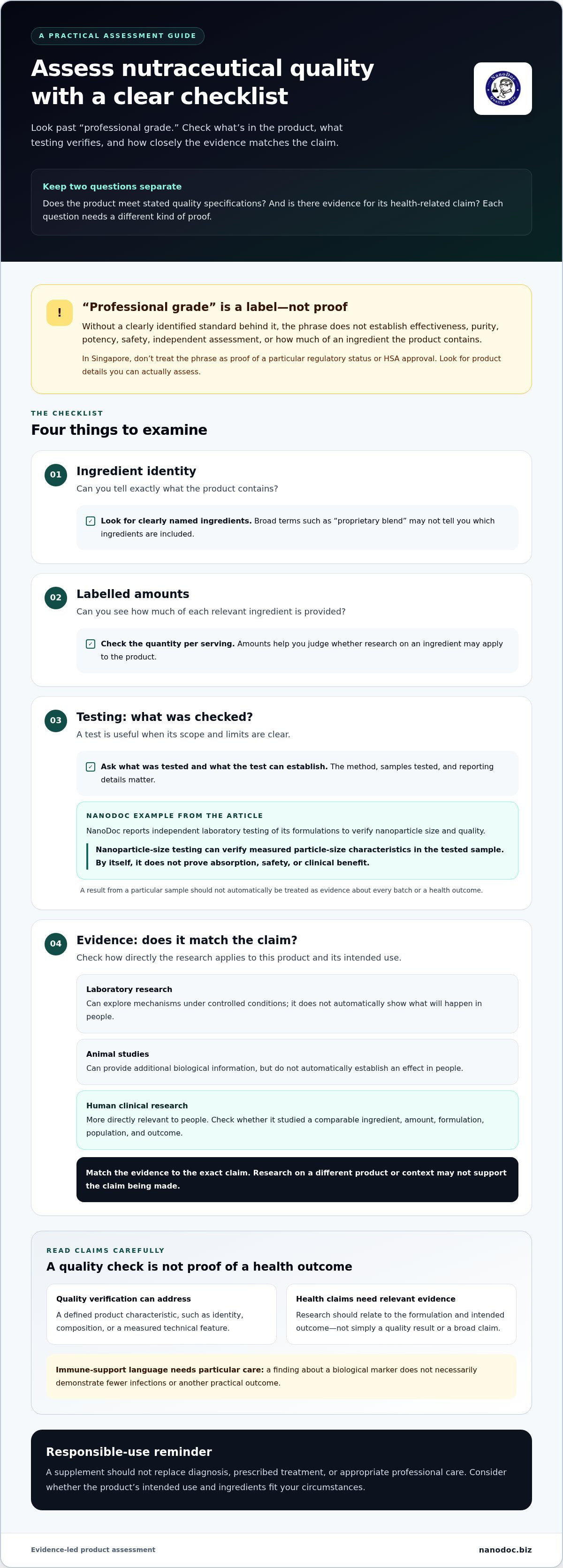
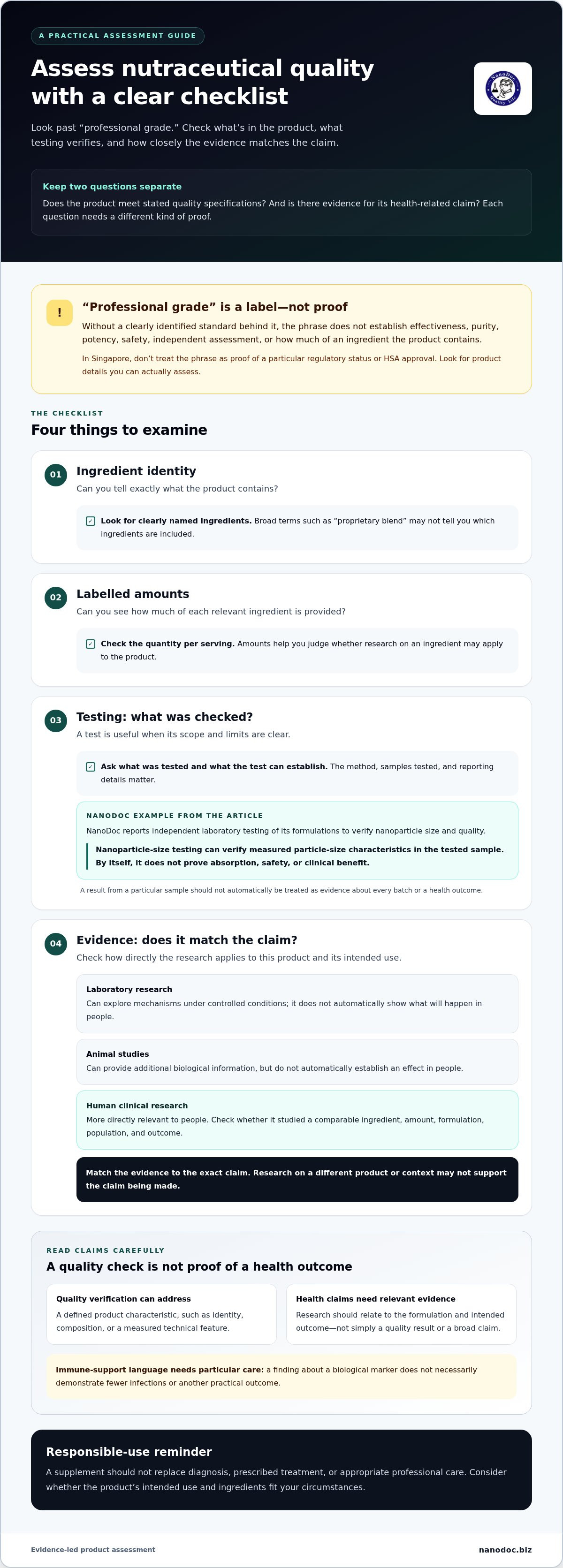
“Professional grade” is a positioning phrase, not a guarantee of clinical effectiveness. Without a clearly identified standard behind it, the label doesn’t tell you whether a product has been independently assessed, how much of an ingredient it contains or whether the finished formulation has been studied in people. It doesn’t establish purity, potency or safety on its own.
In Singapore, don’t read the phrase as proof of a particular regulatory status or HSA approval. Look instead for assessable details: ingredient names and amounts, intended use, directions and relevant quality checks. These are more useful than the label alone, although quality controls still don’t prove a health outcome.
How are nutraceuticals different from medicines?
The distinction depends partly on what a product is intended to do and how its claims are presented. A nutrition-oriented product may be chosen to complement dietary intake, while a medicine is used for a medical purpose. Don’t infer a product’s category from polished packaging or technical language; interpret its claims in context.
This is why professional grade nutraceuticals should be judged by more than their name or presentation. A quality test may verify a defined product characteristic, but it isn’t the same as human research showing that a formulation produces a particular benefit. Keep the questions separate: What does the product contain, and how is its quality checked? Then ask: What evidence supports its intended use? This distinction helps prevent a quality signal from being mistaken for proof of effectiveness.
How to Assess Nutraceutical Quality: Evidence, Testing, and Ingredient Transparency
Assess a product by separating two questions: Does it meet stated quality specifications? and Is there evidence for the health-related claim? Each requires a different kind of proof. A laboratory result may verify a product characteristic, while research involving people is needed to evaluate whether a particular formulation supports a claimed outcome.
Use this checklist to examine the information provided:
- Ingredient identity: Are the ingredients named clearly, rather than hidden behind broad terms such as “proprietary blend”?
- Amounts: Does the label state the quantity of each relevant ingredient per serving?
- Testing: Does the available information explain what was tested and what the test can establish?
- Evidence: Does research relate to the ingredient, amount, formulation and intended population, or is the claim based on a different product or context?
This approach is more informative than relying on the phrase professional grade nutraceuticals. A quality check can help verify identity, composition or a defined technical feature, but it can’t by itself show that taking the product produces a health benefit.
What can independent laboratory testing demonstrate?
NanoDoc reports that its formulations are independently laboratory-tested to verify nanoparticle size and quality. The meaning of a result depends on the method, samples tested and reporting details. Nanoparticle-size testing can verify measured particle-size characteristics in the tested sample; it doesn’t, by itself, prove absorption, safety or clinical benefit.
Testing can provide useful quality information, but it isn’t a substitute for human research. A result from a particular sample also shouldn’t automatically be treated as evidence about every batch or a health outcome.
Which evidence supports a health-related claim?
Evidence varies in how directly it applies. Laboratory research can explore mechanisms under controlled conditions, and animal studies can provide additional biological information. Neither automatically shows what will happen in people. Human clinical research is more directly relevant, but check whether it studied a comparable ingredient, amount, formulation and population, and whether its measured outcome matches the claim.
Broad immune language deserves particular care. A finding about a biological marker, for example, doesn’t necessarily demonstrate fewer infections or another practical outcome. Read claims at the level the evidence supports, and keep quality verification separate from proof of efficacy. For a closer look at the company’s delivery-technology focus, explore NanoDoc’s bionano approach.
How to Compare Nutraceutical Formats and Nano-Delivery Claims
After reviewing ingredients and quality information, consider how the format fits its intended use. Capsules, tablets, powders and liquids can differ in serving instructions, convenience and formulation details. One format isn’t automatically more effective than another. Look for enough information to assess what you’re taking and how it’s meant to be used.
What should readers compare on supplement labels?
Review the whole label instead of comparing products by one headline ingredient amount. Check:
- Active ingredients and amounts: Look for clear ingredient names and quantities per serving.
- Serving directions: Note how much to take, how often and any instructions relevant to the format.
- Other formulation details: Check whether excipients and other ingredients are clearly disclosed.
- Warnings: Read cautions and suitability information, not just the front label.
Two products listing the same ingredient quantity may still differ in formulation, directions and supporting evidence. A higher amount alone doesn’t establish that a product better suits your needs. For more context on how delivery relates to nutrient use, see this high bioavailability nutrients guide.
Does nano-encapsulation automatically mean better absorption?
No. Nano-encapsulation describes a delivery approach; the term alone doesn’t show that an ingredient is absorbed more effectively or produces a better health outcome. A delivery system may affect formulation properties, but its relevance depends on the specific ingredient and the evidence for that formulation.
Bioavailability is a measurable concept, not a general product promise. Depending on the ingredient and research question, studies may assess how much of a substance reaches circulation or becomes available to the body, and over what period. A result for one ingredient or formulation can’t automatically be applied to another. Look for evidence that matches the product’s ingredient, delivery system and intended use.
When assessing professional grade nutraceuticals, distinguish a technical description from demonstrated performance. Nano-related quality checks may verify a defined feature of the formulation, while human research is needed to assess absorption or health outcomes. Treat claims such as “advanced delivery” as a reason to look for relevant evidence, not as evidence in themselves.
How to Choose Immune-Support Nutraceuticals for Your Circumstances
Start with a specific, realistic purpose rather than a broad promise of “stronger immunity.” A nutraceutical marketed for immune support isn’t a proven way to prevent or treat infections. Choose carefully by considering the evidence and label alongside your health circumstances.
Use this five-step process:
- Define your goal. Identify what you want to address, and avoid relying on vague promises of stronger immunity.
- Check the evidence. Look for support relevant to the ingredients, formulation and intended use, rather than a claim based only on general research.
- Review the ingredients. Read the full label, including amounts per serving, other ingredients, directions and warnings. Consider what you already get from food and other supplements.
- Assess suitability. Consider allergies, health conditions, pregnancy and medicines. These factors can affect whether a product is appropriate for you.
- Follow the directions. Use the product as labelled, and check for overlapping ingredients if you’re considering more than one supplement.
What questions help clarify your supplement goal?
Ask what you hope the product will support and what information would make that goal credible. Check whether the product’s intended use and evidence align with your purpose. A “high-strength” or “premium” label doesn’t establish suitability, and choosing the product with the largest listed amount isn’t a substitute for assessing the full formulation.
Take your diet and current products into account. If you have a medical condition, are pregnant, have allergies or take medicines, seek guidance from a qualified healthcare professional before using a supplement. They can help consider individual factors and possible interactions.
How can readers use supplements responsibly?
Follow the product directions and avoid unintentionally doubling up on ingredients across multiple products. Keep the label information available when discussing a supplement with a healthcare professional, especially if you take medicines or have a health condition.
Supplements can complement appropriate care, but they don’t replace diagnosis, prescribed treatment or professional medical advice. For related context on oral health and immunity, read this oral hygiene and immunity guide.
If you’re exploring professional grade nutraceuticals for immune support, review NanoDoc’s Oral & Immunity Care options with these considerations in mind.
NanoDoc’s Nutraceutical Approach: Technology, Testing, and Immune-Care Options
NanoDoc International Pte Ltd represents LG Bionano and focuses on nutraceutical and cosmeceutical formulations using patented bionano delivery technology. For readers assessing professional grade nutraceuticals, this is a specific technology approach to examine, but the technology itself shouldn’t be taken as proof of a health benefit. As with any formulation, consider what is disclosed about its ingredients, intended use and directions.
NanoDoc International Pte Ltd’s relevant offering categories include Nano Cellular Essential Nutrition and Oral & Immunity Care. The latter is an immune-care category, not a promise to prevent or treat infection. Reviewing the categories alongside the questions raised earlier can help focus your assessment: what does the product contain, what quality information is available and what evidence supports its claims?
What does NanoDoc’s reported testing cover?
NanoDoc International Pte Ltd reports that its formulations are independently laboratory-tested to verify nanoparticle size and quality. This describes the reported scope of the testing. It doesn’t establish absorption, safety, individual suitability or clinical efficacy, and it shouldn’t be presented as proof of a health outcome. Those questions require different information and, for efficacy, relevant evidence on the formulation and its intended use.
That distinction is central to interpreting delivery claims. Testing a technical characteristic can contribute to quality verification, while research on health effects asks whether a product produces a meaningful outcome. Keeping these forms of evidence separate allows readers to assess the technology without overstating what a laboratory check demonstrates.
How can readers explore the relevant product categories?
Use the same practical approach across both categories. Review the ingredient names and amounts, serving directions, warnings and any product information relevant to your circumstances. For Oral & Immunity Care, interpret “immune support” as a description of intended use, not assurance that a product prevents or treats illness. If you have a health condition, take medication, are pregnant or have allergies, seek guidance from a qualified healthcare professional before use.
NanoDoc International Pte Ltd’s bionano focus and reported testing offer specific details to include in a product assessment, not a substitute for checking formulation information and evidence. To view the categories and product information, Explore NanoDoc’s nutraceutical range.
Choose With Clarity, Not Labels
“Professional grade” can sound authoritative, but the label alone doesn’t establish quality or effectiveness. A sound assessment looks at ingredient disclosure, relevant quality checks and evidence that matches the formulation and intended use. Delivery technology may be worth understanding, but a technical feature or test result shouldn’t be mistaken for proof of a health outcome.
For immune-support options, define your goal, review the ingredients and directions, and consider your health circumstances. “Immune support” doesn’t mean infection prevention or treatment, and supplements shouldn’t replace appropriate medical care.
NanoDoc International Pte Ltd represents LG Bionano. The company reports independent laboratory testing for nanoparticle size and quality, a defined quality-check scope that doesn’t establish clinical efficacy. Its relevant categories include Nano Cellular Essential Nutrition and Oral & Immunity Care. Assess each option against your needs using the available product information.
Explore NanoDoc’s nutraceutical and immunity-care range and review the product information to find an option that fits your needs.
Frequently Asked Questions
What does professional grade mean for nutraceuticals?
For nutraceuticals, “professional grade” is generally a marketing or positioning phrase, not a universal guarantee of quality or effectiveness. The phrase alone doesn’t confirm purity, ingredient amounts, safety or clinical benefit. Look instead for clear ingredient and quantity information, relevant quality testing and evidence that relates to the product’s intended use. In Singapore, don’t interpret the wording by itself as proof of a particular regulatory status or approval.
Are professional grade nutraceuticals more effective than regular supplements?
Not necessarily. The “professional grade” label doesn’t show that a product works better than another supplement. Effectiveness depends on factors such as the ingredients, amounts, formulation, intended use and supporting evidence. Research on an ingredient may not prove that a specific finished product produces the same result. Compare the disclosed formulation and relevant human research rather than assuming a premium label or higher ingredient amount means greater benefit.
How can I tell whether a nutraceutical has been independently tested?
Look for a clear statement identifying what was tested and what the results can establish. Useful information may describe the tested characteristic, the sample or batch scope, and relevant methods or reporting. A general phrase such as “third-party tested” offers limited detail by itself. NanoDoc reports independent laboratory testing to verify nanoparticle size and quality. That information concerns those quality characteristics, not clinical benefit or individual suitability.
Does nano-encapsulation improve nutrient absorption?
Nano-encapsulation may change properties of a formulation, but the term alone doesn’t establish improved absorption. To assess an absorption claim, look for relevant evidence on the specific ingredient and formulation, ideally research in people that measures absorption directly. A particle-size result is a technical quality measure, not proof that a nutrient reaches the body in greater amounts or produces a better health outcome. Results shouldn’t be assumed to apply across different ingredients or products.
Can nutraceuticals prevent infections or replace medical treatment?
No. An “immune support” description shouldn’t be interpreted as proof that a nutraceutical prevents or treats infections. Supplements also shouldn’t replace diagnosis, prescribed treatment or appropriate medical care. If you have symptoms or a health concern, seek guidance from a qualified healthcare professional. Treat health claims carefully, and check whether the evidence supports the specific outcome being described rather than relying on broad statements about immunity.
Can I take immune-support nutraceuticals with prescription medicines?
Possibly, but suitability depends on the supplement, medicine and your health circumstances. Some ingredients may affect how a medicine works or cause unwanted effects, so check with a qualified healthcare professional or pharmacist before combining them. Share the product label and the medicines you take, including other supplements. Don’t stop, replace or change a prescribed medicine because of a nutraceutical without guidance from the professional responsible for your care.
What should I compare when choosing an immune-support supplement?
Compare the ingredient names and amounts per serving, serving directions, other ingredients and warnings. Then consider whether the evidence relates to the formulation and intended use, and whether the product fits your dietary context, allergies, medicines and health circumstances. Quality testing can help verify specific product characteristics, but it doesn’t establish immune benefits. Avoid choosing on “high-strength” or “premium” wording alone, and follow the product directions if you decide to use it.
Frequently Asked Questions
- Does “professional grade” have a standard definition?
- “Professional grade” is a positioning phrase, not a guarantee of clinical effectiveness. Without a clearly identified standard behind it, the label doesn’t tell you whether a product has been independently assessed, how much of an ingredient it contains or whether the finished formulation has been studied in people. It doesn’t establish purity, potency or safety on its own. In Singapore, don’t read the phrase as proof of a particular regulatory status or HSA approval. Look instead for assessable details: ingredient names and amounts, intended use, directions and relevant quality checks. These are more useful than the label alone, although quality controls still don’t prove a health outcome.
- How are nutraceuticals different from medicines?
- The distinction depends partly on what a product is intended to do and how its claims are presented. A nutrition-oriented product may be chosen to complement dietary intake, while a medicine is used for a medical purpose. Don’t infer a product’s category from polished packaging or technical language; interpret its claims in context. This is why professional grade nutraceuticals should be judged by more than their name or presentation. A quality test may verify a defined product characteristic, but it isn’t the same as human research showing that a formulation produces a particular benefit. Keep the questions separate: What does the product contain, and how is its quality checked? Then ask: What evidence supports its intended use? This distinction helps prevent a quality signal from being mistaken for proof of effectiveness. Assess a product by separating two questions: Does it meet stated quality specifications? and Is there evidence for the health-related claim? Each requires a different kind of proof. A laboratory result may verify a product characteristic, while research involving people is needed to evaluate whether a particular formulation supports a claimed outcome. Use this checklist to examine the information provided: This approach is more informative than relying on the phrase professional grade nutraceuticals. A quality check can help verify identity, composition or a defined technical feature, but it can’t by itself show that taking the product produces a health benefit.
- What can independent laboratory testing demonstrate?
- NanoDoc reports that its formulations are independently laboratory-tested to verify nanoparticle size and quality. The meaning of a result depends on the method, samples tested and reporting details. Nanoparticle-size testing can verify measured particle-size characteristics in the tested sample; it doesn’t, by itself, prove absorption, safety or clinical benefit. Testing can provide useful quality information, but it isn’t a substitute for human research. A result from a particular sample also shouldn’t automatically be treated as evidence about every batch or a health outcome.
- Which evidence supports a health-related claim?
- Evidence varies in how directly it applies. Laboratory research can explore mechanisms under controlled conditions, and animal studies can provide additional biological information. Neither automatically shows what will happen in people. Human clinical research is more directly relevant, but check whether it studied a comparable ingredient, amount, formulation and population, and whether its measured outcome matches the claim. Broad immune language deserves particular care. A finding about a biological marker, for example, doesn’t necessarily demonstrate fewer infections or another practical outcome. Read claims at the level the evidence supports, and keep quality verification separate from proof of efficacy. For a closer look at the company’s delivery-technology focus, explore NanoDoc’s bionano approach. After reviewing ingredients and quality information, consider how the format fits its intended use. Capsules, tablets, powders and liquids can differ in serving instructions, convenience and formulation details. One format isn’t automatically more effective than another. Look for enough information to assess what you’re taking and how it’s meant to be used.
- What should readers compare on supplement labels?
- Review the whole label instead of comparing products by one headline ingredient amount. Check: Two products listing the same ingredient quantity may still differ in formulation, directions and supporting evidence. A higher amount alone doesn’t establish that a product better suits your needs. For more context on how delivery relates to nutrient use, see this high bioavailability nutrients guide.
- Does nano-encapsulation automatically mean better absorption?
- No. Nano-encapsulation describes a delivery approach; the term alone doesn’t show that an ingredient is absorbed more effectively or produces a better health outcome. A delivery system may affect formulation properties, but its relevance depends on the specific ingredient and the evidence for that formulation. Bioavailability is a measurable concept, not a general product promise. Depending on the ingredient and research question, studies may assess how much of a substance reaches circulation or becomes available to the body, and over what period. A result for one ingredient or formulation can’t automatically be applied to another. Look for evidence that matches the product’s ingredient, delivery system and intended use. When assessing professional grade nutraceuticals, distinguish a technical description from demonstrated performance. Nano-related quality checks may verify a defined feature of the formulation, while human research is needed to assess absorption or health outcomes. Treat claims such as “advanced delivery” as a reason to look for relevant evidence, not as evidence in themselves. Start with a specific, realistic purpose rather than a broad promise of “stronger immunity.” A nutraceutical marketed for immune support isn’t a proven way to prevent or treat infections. Choose carefully by considering the evidence and label alongside your health circumstances. Use this five-step process:
- What questions help clarify your supplement goal?
- Ask what you hope the product will support and what information would make that goal credible. Check whether the product’s intended use and evidence align with your purpose. A “high-strength” or “premium” label doesn’t establish suitability, and choosing the product with the largest listed amount isn’t a substitute for assessing the full formulation. Take your diet and current products into account. If you have a medical condition, are pregnant, have allergies or take medicines, seek guidance from a qualified healthcare professional before using a supplement. They can help consider individual factors and possible interactions.
- How can readers use supplements responsibly?
- Follow the product directions and avoid unintentionally doubling up on ingredients across multiple products. Keep the label information available when discussing a supplement with a healthcare professional, especially if you take medicines or have a health condition. Supplements can complement appropriate care, but they don’t replace diagnosis, prescribed treatment or professional medical advice. For related context on oral health and immunity, read this oral hygiene and immunity guide. If you’re exploring professional grade nutraceuticals for immune support, review NanoDoc’s Oral & Immunity Care options with these considerations in mind. NanoDoc International Pte Ltd represents LG Bionano and focuses on nutraceutical and cosmeceutical formulations using patented bionano delivery technology. For readers assessing professional grade nutraceuticals, this is a specific technology approach to examine, but the technology itself shouldn’t be taken as proof of a health benefit. As with any formulation, consider what is disclosed about its ingredients, intended use and directions. NanoDoc International Pte Ltd’s relevant offering categories include Nano Cellular Essential Nutrition and Oral & Immunity Care. The latter is an immune-care category, not a promise to prevent or treat infection. Reviewing the categories alongside the questions raised earlier can help focus your assessment: what does the product contain, what quality information is available and what evidence supports its claims?
- What does NanoDoc’s reported testing cover?
- NanoDoc International Pte Ltd reports that its formulations are independently laboratory-tested to verify nanoparticle size and quality. This describes the reported scope of the testing. It doesn’t establish absorption, safety, individual suitability or clinical efficacy, and it shouldn’t be presented as proof of a health outcome. Those questions require different information and, for efficacy, relevant evidence on the formulation and its intended use. That distinction is central to interpreting delivery claims. Testing a technical characteristic can contribute to quality verification, while research on health effects asks whether a product produces a meaningful outcome. Keeping these forms of evidence separate allows readers to assess the technology without overstating what a laboratory check demonstrates.
- How can readers explore the relevant product categories?
- Use the same practical approach across both categories. Review the ingredient names and amounts, serving directions, warnings and any product information relevant to your circumstances. For Oral & Immunity Care, interpret “immune support” as a description of intended use, not assurance that a product prevents or treats illness. If you have a health condition, take medication, are pregnant or have allergies, seek guidance from a qualified healthcare professional before use. NanoDoc International Pte Ltd’s bionano focus and reported testing offer specific details to include in a product assessment, not a substitute for checking formulation information and evidence. To view the categories and product information, Explore NanoDoc’s nutraceutical range. “Professional grade” can sound authoritative, but the label alone doesn’t establish quality or effectiveness. A sound assessment looks at ingredient disclosure, relevant quality checks and evidence that matches the formulation and intended use. Delivery technology may be worth understanding, but a technical feature or test result shouldn’t be mistaken for proof of a health outcome. For immune-support options, define your goal, review the ingredients and directions, and consider your health circumstances. “Immune support” doesn’t mean infection prevention or treatment, and supplements shouldn’t replace appropriate medical care. NanoDoc International Pte Ltd represents LG Bionano. The company reports independent laboratory testing for nanoparticle size and quality, a defined quality-check scope that doesn’t establish clinical efficacy. Its relevant categories include Nano Cellular Essential Nutrition and Oral & Immunity Care. Assess each option against your needs using the available product information. Explore NanoDoc’s nutraceutical and immunity-care range and review the product information to find an option that fits your needs.
- What does professional grade mean for nutraceuticals?
- For nutraceuticals, “professional grade” is generally a marketing or positioning phrase, not a universal guarantee of quality or effectiveness. The phrase alone doesn’t confirm purity, ingredient amounts, safety or clinical benefit. Look instead for clear ingredient and quantity information, relevant quality testing and evidence that relates to the product’s intended use. In Singapore, don’t interpret the wording by itself as proof of a particular regulatory status or approval.
- Are professional grade nutraceuticals more effective than regular supplements?
- Not necessarily. The “professional grade” label doesn’t show that a product works better than another supplement. Effectiveness depends on factors such as the ingredients, amounts, formulation, intended use and supporting evidence. Research on an ingredient may not prove that a specific finished product produces the same result. Compare the disclosed formulation and relevant human research rather than assuming a premium label or higher ingredient amount means greater benefit.
- How can I tell whether a nutraceutical has been independently tested?
- Look for a clear statement identifying what was tested and what the results can establish. Useful information may describe the tested characteristic, the sample or batch scope, and relevant methods or reporting. A general phrase such as “third-party tested” offers limited detail by itself. NanoDoc reports independent laboratory testing to verify nanoparticle size and quality. That information concerns those quality characteristics, not clinical benefit or individual suitability.
- Does nano-encapsulation improve nutrient absorption?
- Nano-encapsulation may change properties of a formulation, but the term alone doesn’t establish improved absorption. To assess an absorption claim, look for relevant evidence on the specific ingredient and formulation, ideally research in people that measures absorption directly. A particle-size result is a technical quality measure, not proof that a nutrient reaches the body in greater amounts or produces a better health outcome. Results shouldn’t be assumed to apply across different ingredients or products.
- Can nutraceuticals prevent infections or replace medical treatment?
- No. An “immune support” description shouldn’t be interpreted as proof that a nutraceutical prevents or treats infections. Supplements also shouldn’t replace diagnosis, prescribed treatment or appropriate medical care. If you have symptoms or a health concern, seek guidance from a qualified healthcare professional. Treat health claims carefully, and check whether the evidence supports the specific outcome being described rather than relying on broad statements about immunity.
- Can I take immune-support nutraceuticals with prescription medicines?
- Possibly, but suitability depends on the supplement, medicine and your health circumstances. Some ingredients may affect how a medicine works or cause unwanted effects, so check with a qualified healthcare professional or pharmacist before combining them. Share the product label and the medicines you take, including other supplements. Don’t stop, replace or change a prescribed medicine because of a nutraceutical without guidance from the professional responsible for your care.
- What should I compare when choosing an immune-support supplement?
- Compare the ingredient names and amounts per serving, serving directions, other ingredients and warnings. Then consider whether the evidence relates to the formulation and intended use, and whether the product fits your dietary context, allergies, medicines and health circumstances. Quality testing can help verify specific product characteristics, but it doesn’t establish immune benefits. Avoid choosing on “high-strength” or “premium” wording alone, and follow the product directions if you decide to use it.