

Could a patented delivery system still be the wrong fit? A patent can protect an invention, but it doesn’t prove that a formulation is more effective, safer or better absorbed. If you’re comparing patented nano-delivery alternatives, similar-sounding terms can make it hard to tell what a product uses and what evidence supports its claims.
Look beyond the label. This guide explains how common delivery approaches differ, what product-level evidence to check, and how to assess particle-size and absorption claims without assuming one formulation suits everyone. It also explains why patent information and independent testing answer different questions. NanoDoc International offers products using LG Bionano’s patented bionano nano-delivery technology. The company states that its formulations undergo independent laboratory testing for nanoparticle size and quality. As you compare products, check what documentation is available for the specific product and what each test measures. The goal is a clearer, evidence-led comparison, not medical advice.
Key Takeaways
- Learn how conventional formulations, liposomes, nanoemulsions and micelles differ, and why no delivery system is best for every ingredient or product.
- Use a practical checklist to assess the ingredient, formulation, route, directions and evidence behind a product’s claims.
- Compare patented nano-delivery alternatives by separating patent information, laboratory characterization, ingredient research and finished-product studies.
- Keep evidence specific to its application: findings for topical skincare don’t automatically apply to oral supplements, or vice versa.
- When assessing NanoDoc, check product-level documentation to confirm which formulations were tested and what nanoparticle size and quality tests measured.
Table of Contents
- What Are Patented Nano-Delivery Alternatives, and What Is Being Compared?
- How Do Nano-Delivery and Other Formulation Systems Differ?
- How Can You Compare Alternatives Without Treating a Patent as Proof?
- Which Delivery Approach Fits Your Product and Priorities?
- How Does NanoDoc Fit Into a Careful Comparison of Delivery Alternatives?
What Are Patented Nano-Delivery Alternatives, and What Is Being Compared?
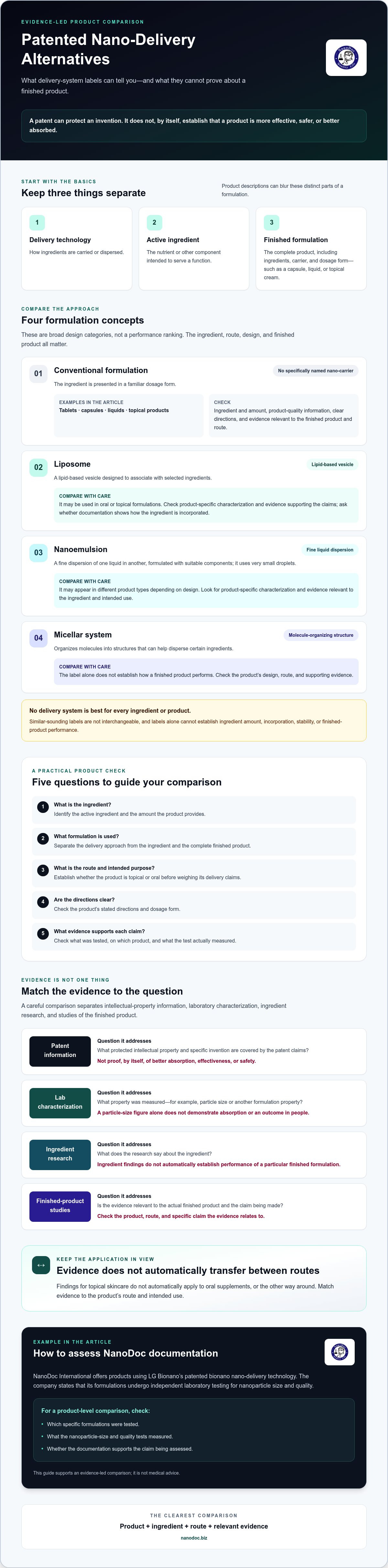
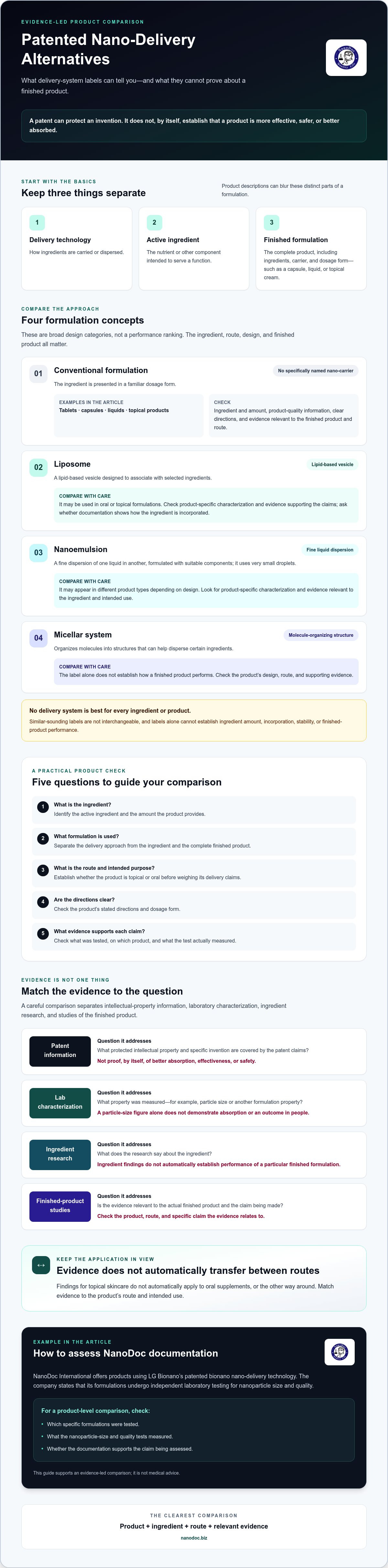
To compare patented nano-delivery alternatives, first separate three things that product descriptions can blur: the delivery technology, the active ingredient and the finished formulation. Delivery technology describes how ingredients are carried or dispersed. The active ingredient is the nutrient or other component intended to serve a function. The finished formulation is the complete product, including its ingredients, carrier and dosage form, such as a capsule, liquid or topical cream.
A patent relates to protected intellectual property and the specific invention covered by its claims. It doesn’t, by itself, establish that a finished product is better absorbed, more effective or safer. Those questions require relevant evidence about the ingredient, delivery approach and final product.
What does nano-delivery mean in a health or skincare formulation?
Nano-delivery generally refers to a formulation approach that uses very small-scale carriers or structures to transport, protect or disperse selected ingredients. A design may aim to address challenges such as an ingredient’s solubility or stability, but its potential depends on the carrier, ingredient, route of use and finished formulation. An overview of nanoparticle drug delivery systems describes different platform types and targeting strategies. For consumer comparisons, the key point is that a particle-size figure alone doesn’t demonstrate absorption or an outcome in people.
Match evidence to the claim. A laboratory measurement may characterize particle size or another property, but it doesn’t automatically show how a skincare product performs on skin or how an oral supplement behaves after ingestion. Product-level information helps clarify what was tested and whether the result is relevant to the intended use.
What counts as an alternative to a patented system?
Alternatives depend on the ingredient and application. A conventional formulation may use a standard tablet, capsule, liquid or topical base without a specialised nano-carrier. Other approaches include liposomes, which use lipid-based vesicles; nanoemulsions, which disperse one liquid in another using very small droplets; and micellar systems, which organise molecules into structures that can help disperse certain ingredients. These categories differ in composition and design, so they aren’t interchangeable labels or guaranteed performance rankings.
For a useful comparison, identify the product’s route and intended purpose before weighing delivery claims. Topical skincare and oral nutrition involve different formulations and contexts, so evidence for one shouldn’t be assumed to apply to the other. For broader context on absorption factors, see this guide to high bioavailability nutrients.
How Do Nano-Delivery and Other Formulation Systems Differ?
Delivery-system names describe broad formulation concepts, not guaranteed results. A conventional capsule, liposome, nanoemulsion or micellar formulation may behave differently depending on its active ingredient, delivery route, design and intended use. Labels alone can’t predict finished-product performance. They don’t establish how much ingredient is present, whether it is incorporated as described, how stable the formulation is or what evidence supports its use.
| Approach | Carrier concept | Typical formulation context | Evidence to look for | Questions to ask |
|---|---|---|---|---|
| Conventional formulation | The ingredient is presented in a familiar dosage form without a specifically named nano-carrier. | Tablets, capsules, liquids or topical products. | Ingredient amount, product quality information and evidence relevant to the finished product and route. | What ingredient and amount does it provide? Are the directions clear? |
| Liposome | A lipid-based vesicle designed to associate with selected ingredients. | May be used in oral or topical formulations; the specific product matters. | Product-specific characterization and evidence that supports claims about the ingredient and use. | Does documentation show how the ingredient is incorporated? |
| Nanoemulsion | A fine dispersion of one liquid in another, formulated with suitable components. | May appear in different product types, depending on design. | Information on the finished formulation, stability and claims made for its intended route. | What is dispersed, and what does the product evidence establish? |
| Micellar system | Structures formed by molecules that can organise around or associate with selected substances. | Used in some formulations to disperse particular ingredients. | Evidence that identifies the formulation and supports the specific product claims. | Is the named system present in this product, and how was it assessed? |
How do the carrier concepts compare?
Liposomes, nanoemulsions and micelles have different formulation architectures. Their names aren’t interchangeable. A category label alone doesn’t confirm that a particular active ingredient is encapsulated, remains stable or is delivered as intended. Ask for product-specific technical information and check comparative claims against relevant evidence. The U.S. FDA outlines its regulatory approach to nanotechnology. This can help explain the US context, but it isn’t proof of a product’s performance or a statement about Singapore requirements.
Why compare conventional formulations too?
A conventional formulation can be a reasonable option. Compare the actual ingredient, amount, dosage or application directions, and relevant evidence instead of assuming a nano-formulated product is superior. Suitability depends on the product and its intended use. For a focused discussion of nutrient absorption, read about bioavailable nano vitamins. Readers comparing nutrition or skincare options can also review the relevant categories on NanoDoc’s website.
How Can You Compare Alternatives Without Treating a Patent as Proof?
A patent can show that an invention is protected, but it doesn’t establish that a product is more effective, safer or suitable for you. A sound comparison asks what the patent covers, what the finished product contains and whether evidence supports the claims made for its intended use.
Use this checklist for each product you’re considering:
- Ingredient: What active ingredient is present, and in what amount?
- Formulation: What carrier or delivery approach is used, and is it described clearly?
- Route: Is the product intended to be swallowed or applied to skin? Evidence for one route doesn’t automatically apply to another.
- Evidence: Does it concern the ingredient, carrier or finished product? Does the measured outcome match the product’s claim?
- Testing: What was tested, by which method, and was the testing laboratory independent?
- Directions and cautions: Are the serving or application instructions clear, and are relevant warnings provided?
These checks separate four kinds of information that marketing can blend together: patent documentation describes intellectual property; laboratory characterization measures properties of a material or formulation; ingredient research examines an active ingredient; and finished-product studies assess the actual formulation. Each answers a different question, so don’t treat one type as a substitute for another.
What evidence should you look for in a delivery-system claim?
Match the evidence to the claim. If a company says a carrier has a particular property, look for characterization of that carrier. If it claims a specific finished product supports an outcome, seek evidence relevant to that product, its route and the stated outcome. A laboratory measurement can support a claim about the property measured, but it shouldn’t be extended into a claim about human absorption or benefit unless appropriate evidence supports that connection.
What does independent particle-size testing tell you?
Particle-size testing may help describe a formulation’s measured characteristics, but interpretation depends on the test method, sample and reporting details. Check which product or batch was examined, what “quality” means in the report and whether the results are accessible. NanoDoc states that its formulations undergo independent laboratory testing for nanoparticle size and quality. Ask whether documentation applies to the specific product you’re assessing and what each test measures.
That’s the practical standard for comparing patented nano-delivery alternatives: verify the scope of the claim, then look for evidence that answers your specific question. If documentation isn’t available, treat the claim as unverified rather than assuming the patent fills the gap.
Which Delivery Approach Fits Your Product and Priorities?
Choose by application, not by technology label. Start with the product category, then consider the active ingredient, route of use, intended purpose and evidence available for that specific formulation. This sequence helps you decide whether a delivery claim is relevant to your needs without assuming that patented nano-delivery alternatives are automatically the right choice.
- Identify the category: Is it skincare applied to the skin, or an oral supplement?
- Name the active ingredient: Check which ingredient the product contains and how it is presented.
- Confirm the route and purpose: Establish how the product is used and what purpose its claims address.
- Review the evidence: Look for information relevant to the finished product and its route, alongside any available quality or testing disclosures.
- Check directions and restrictions: Read serving or application instructions, warnings and ingredient details against your personal requirements.
How should you compare topical and oral delivery claims?
For skincare, assess the finished topical formulation and evidence relevant to use on skin. A delivery claim for a topical product doesn’t establish how an ingredient behaves when swallowed. For supplements, examine the nutrient, serving directions and evidence relevant to oral use. Findings or proposed mechanisms for one route can’t simply be transferred to another. For a more focused framework, see this guide to cosmeceutical skin care products.
Consider details that affect your own decision, including ingredient sensitivities, dietary restrictions, other products you use and any relevant health concerns. If you’re unsure whether a supplement is suitable for you, or have an individual medical concern, consult a qualified healthcare professional.
Which questions help narrow down the options?
Before choosing, ask: What ingredient is being delivered? By which route? What is the product’s stated purpose? Is the evidence about this finished product, rather than only an ingredient or delivery concept? Can you access and understand product-specific testing and quality information? Clear answers make it easier to compare options based on relevant details instead of broad claims.
For readers assessing NanoDoc’s categories, including anti-ageing skincare and nano-nutrient supplements, product-level documentation can help clarify which information applies to a particular formulation. Explore NanoDoc’s skincare and nutrition categories as one point of comparison, then review the relevant product details and directions.
How Does NanoDoc Fit Into a Careful Comparison of Delivery Alternatives?
NanoDoc International offers products across anti-ageing skincare, nano-nutrient supplements, pain-relief care, and oral and immunity care, using LG Bionano’s patented bionano nano-delivery technology. This makes NanoDoc one option to include when comparing patented nano-delivery alternatives, not a universal recommendation or proof that every product is suitable for every person.
Evaluate the finished product, not just the technology associated with it. A topical skincare formulation and an oral supplement have different routes of use, so information about one shouldn’t be treated as evidence for the other. The delivery technology is part of a formulation, not a separate product to assess in isolation.
What does NanoDoc offer within these product categories?
NanoDoc’s product categories cover skincare, nutrition, pain-relief care, and oral and immunity care. To assess a specific item, look for its ingredient information, intended use, directions and evidence relevant to that finished formulation. A general description of patented delivery technology can help explain the approach, but it doesn’t establish a product’s outcomes, safety or suitability.
NanoDoc states that its formulations undergo independent laboratory testing for nanoparticle size and quality. Check whether documentation is available for the particular product you’re considering. Review which product or sample was tested, what the test measured and whether the reported information relates to the claim you want to assess. Don’t assume testing applies to every product unless the product-level scope is clear.
What is a sensible next step before choosing?
Review the product information against your needs. Confirm the active ingredients, route of use and directions, then look for accessible quality or testing details and evidence relevant to that formulation. If a technical claim is unclear, ask the company what documentation supports it and which products the information covers. For questions about personal medical concerns or whether a supplement is suitable for you, consult a qualified healthcare professional.
A measured comparison is more useful than a promise based on a patent or delivery-system label. Explore NanoDoc’s product categories to review the available formulations and their product information.
Make Your Next Comparison Evidence-Led
The most useful comparison starts with the product you’re considering: its ingredient, formulation, route and intended use. Delivery-system names can help describe an approach, but they don’t rank products or predict results. A patent protects intellectual property; it isn’t proof that a finished formulation is more effective, safer or right for everyone.
For patented nano-delivery alternatives, look for evidence that matches the specific product and the claim being made. NanoDoc International offers LG Bionano products using patented bionano nano-delivery technology and states that its formulations are independently laboratory-tested for nanoparticle size and quality. Check whether documentation is available for the product you’re considering, which sample was tested and what the test measured. These details help put technical claims in context.
To review the available categories and product information, explore NanoDoc’s product categories. Compare relevant evidence and choose an option that aligns with your priorities. Explore the product categories and review the details for the formulations you’re considering.
Frequently Asked Questions
What are the alternatives to patented nano-delivery?
Alternatives include conventional tablets, capsules, liquids or topical formulations, as well as other carrier systems such as liposomes, nanoemulsions and micelles. These approaches differ in composition and design, and their relevance depends on the ingredient and how the product is used. Compare the finished product’s ingredients, route, directions and supporting evidence rather than assuming one system outperforms another. The term “alternative” describes options to assess, not a ranking.
Does a patent prove that a nano-delivery product works better?
No. A patent protects intellectual property within the scope of its claims; it doesn’t independently prove that a finished product is more effective, safer or suitable. To assess an outcome claim, look for evidence relevant to the specific ingredient, formulation, route and intended use. Patent details can help clarify what technology is described, but product performance requires separate evidence. Treat claims that rely on patent status alone as unverified.
Are liposomes and nanoemulsions the same as nano-delivery?
They’re distinct formulation approaches that may be used within nano-delivery, but the terms aren’t interchangeable. Liposomes are lipid-based vesicles, while nanoemulsions are fine dispersions of one liquid in another. Their composition and behaviour can differ, and a label alone doesn’t confirm how an ingredient is incorporated or whether a product claim is supported. Check product-specific information and evidence rather than inferring performance from the carrier name.
How can I compare nano-delivery with conventional supplements?
Compare the active nutrient, amount per serving, directions, other ingredients and evidence relevant to each finished product. Check that the evidence relates to oral use and to the claim being made, rather than only to an ingredient or delivery concept. A conventional supplement isn’t automatically ineffective, and a nano-formulated product isn’t automatically superior. Consider product quality disclosures and relevant cautions, then discuss personal suitability with a qualified healthcare professional if needed.
Does smaller nanoparticle size always mean better absorption?
No. A particle-size result describes a measured property under particular testing conditions; it doesn’t by itself establish absorption or a health outcome. Interpretation depends on details such as the test method, sample and formulation, as well as the ingredient and route of use. To evaluate an absorption claim, look for evidence that directly supports it for the relevant product and intended route, rather than relying on a size figure alone.
What does independent nanoparticle testing verify?
Independent testing may characterize nanoparticle size or other specified quality properties in the sample tested. Its meaning depends on the method, sample or batch, and reported scope. NanoDoc states that its formulations undergo independent laboratory testing for nanoparticle size and quality. For a particular product, check whether documentation is available, which formulation or sample it covers, and what each test measured. Such testing doesn’t automatically prove clinical benefit or suitability.
Can evidence for a nano-formulated skincare product apply to an oral supplement?
Not automatically. Topical skincare and oral supplements use different routes, so evidence about a skincare formulation can’t establish how an oral product behaves or performs. Check whether research concerns the same route, ingredient and finished formulation as the product you’re assessing. Even evidence about the same ingredient may not answer questions about a different product’s design or intended use. Keep comparisons specific to the formulation and route.
How do I choose a delivery system for a specific ingredient?
Start by identifying the ingredient, product category, route and stated purpose. Then compare the finished formulations, directions, ingredient information and product-specific evidence. Look for testing details that explain what was assessed, and consider relevant cautions or personal restrictions. A delivery-system label can guide further questions, but it can’t determine suitability on its own. If you have medical concerns or aren’t sure a supplement is appropriate, consult a qualified healthcare professional.
Frequently Asked Questions
- What does nano-delivery mean in a health or skincare formulation?
- Nano-delivery generally refers to a formulation approach that uses very small-scale carriers or structures to transport, protect or disperse selected ingredients. A design may aim to address challenges such as an ingredient’s solubility or stability, but its potential depends on the carrier, ingredient, route of use and finished formulation. An overview of nanoparticle drug delivery systems describes different platform types and targeting strategies. For consumer comparisons, the key point is that a particle-size figure alone doesn’t demonstrate absorption or an outcome in people. Match evidence to the claim. A laboratory measurement may characterize particle size or another property, but it doesn’t automatically show how a skincare product performs on skin or how an oral supplement behaves after ingestion. Product-level information helps clarify what was tested and whether the result is relevant to the intended use.
- What counts as an alternative to a patented system?
- Alternatives depend on the ingredient and application. A conventional formulation may use a standard tablet, capsule, liquid or topical base without a specialised nano-carrier. Other approaches include liposomes, which use lipid-based vesicles; nanoemulsions, which disperse one liquid in another using very small droplets; and micellar systems, which organise molecules into structures that can help disperse certain ingredients. These categories differ in composition and design, so they aren’t interchangeable labels or guaranteed performance rankings. For a useful comparison, identify the product’s route and intended purpose before weighing delivery claims. Topical skincare and oral nutrition involve different formulations and contexts, so evidence for one shouldn’t be assumed to apply to the other. For broader context on absorption factors, see this guide to high bioavailability nutrients. Delivery-system names describe broad formulation concepts, not guaranteed results. A conventional capsule, liposome, nanoemulsion or micellar formulation may behave differently depending on its active ingredient, delivery route, design and intended use. Labels alone can’t predict finished-product performance. They don’t establish how much ingredient is present, whether it is incorporated as described, how stable the formulation is or what evidence supports its use.
- How do the carrier concepts compare?
- Liposomes, nanoemulsions and micelles have different formulation architectures. Their names aren’t interchangeable. A category label alone doesn’t confirm that a particular active ingredient is encapsulated, remains stable or is delivered as intended. Ask for product-specific technical information and check comparative claims against relevant evidence. The U.S. FDA outlines its regulatory approach to nanotechnology. This can help explain the US context, but it isn’t proof of a product’s performance or a statement about Singapore requirements.
- Why compare conventional formulations too?
- A conventional formulation can be a reasonable option. Compare the actual ingredient, amount, dosage or application directions, and relevant evidence instead of assuming a nano-formulated product is superior. Suitability depends on the product and its intended use. For a focused discussion of nutrient absorption, read about bioavailable nano vitamins. Readers comparing nutrition or skincare options can also review the relevant categories on NanoDoc’s website. A patent can show that an invention is protected, but it doesn’t establish that a product is more effective, safer or suitable for you. A sound comparison asks what the patent covers, what the finished product contains and whether evidence supports the claims made for its intended use. Use this checklist for each product you’re considering: These checks separate four kinds of information that marketing can blend together: patent documentation describes intellectual property; laboratory characterization measures properties of a material or formulation; ingredient research examines an active ingredient; and finished-product studies assess the actual formulation. Each answers a different question, so don’t treat one type as a substitute for another.
- What evidence should you look for in a delivery-system claim?
- Match the evidence to the claim. If a company says a carrier has a particular property, look for characterization of that carrier. If it claims a specific finished product supports an outcome, seek evidence relevant to that product, its route and the stated outcome. A laboratory measurement can support a claim about the property measured, but it shouldn’t be extended into a claim about human absorption or benefit unless appropriate evidence supports that connection.
- What does independent particle-size testing tell you?
- Particle-size testing may help describe a formulation’s measured characteristics, but interpretation depends on the test method, sample and reporting details. Check which product or batch was examined, what “quality” means in the report and whether the results are accessible. NanoDoc states that its formulations undergo independent laboratory testing for nanoparticle size and quality. Ask whether documentation applies to the specific product you’re assessing and what each test measures. That’s the practical standard for comparing patented nano-delivery alternatives: verify the scope of the claim, then look for evidence that answers your specific question. If documentation isn’t available, treat the claim as unverified rather than assuming the patent fills the gap. Choose by application, not by technology label. Start with the product category, then consider the active ingredient, route of use, intended purpose and evidence available for that specific formulation. This sequence helps you decide whether a delivery claim is relevant to your needs without assuming that patented nano-delivery alternatives are automatically the right choice.
- How should you compare topical and oral delivery claims?
- For skincare, assess the finished topical formulation and evidence relevant to use on skin. A delivery claim for a topical product doesn’t establish how an ingredient behaves when swallowed. For supplements, examine the nutrient, serving directions and evidence relevant to oral use. Findings or proposed mechanisms for one route can’t simply be transferred to another. For a more focused framework, see this guide to cosmeceutical skin care products. Consider details that affect your own decision, including ingredient sensitivities, dietary restrictions, other products you use and any relevant health concerns. If you’re unsure whether a supplement is suitable for you, or have an individual medical concern, consult a qualified healthcare professional.
- Which questions help narrow down the options?
- Before choosing, ask: What ingredient is being delivered? By which route? What is the product’s stated purpose? Is the evidence about this finished product, rather than only an ingredient or delivery concept? Can you access and understand product-specific testing and quality information? Clear answers make it easier to compare options based on relevant details instead of broad claims. For readers assessing NanoDoc’s categories, including anti-ageing skincare and nano-nutrient supplements, product-level documentation can help clarify which information applies to a particular formulation. Explore NanoDoc’s skincare and nutrition categories as one point of comparison, then review the relevant product details and directions. NanoDoc International offers products across anti-ageing skincare, nano-nutrient supplements, pain-relief care, and oral and immunity care, using LG Bionano’s patented bionano nano-delivery technology. This makes NanoDoc one option to include when comparing patented nano-delivery alternatives, not a universal recommendation or proof that every product is suitable for every person. Evaluate the finished product, not just the technology associated with it. A topical skincare formulation and an oral supplement have different routes of use, so information about one shouldn’t be treated as evidence for the other. The delivery technology is part of a formulation, not a separate product to assess in isolation.
- What does NanoDoc offer within these product categories?
- NanoDoc’s product categories cover skincare, nutrition, pain-relief care, and oral and immunity care. To assess a specific item, look for its ingredient information, intended use, directions and evidence relevant to that finished formulation. A general description of patented delivery technology can help explain the approach, but it doesn’t establish a product’s outcomes, safety or suitability. NanoDoc states that its formulations undergo independent laboratory testing for nanoparticle size and quality. Check whether documentation is available for the particular product you’re considering. Review which product or sample was tested, what the test measured and whether the reported information relates to the claim you want to assess. Don’t assume testing applies to every product unless the product-level scope is clear.
- What is a sensible next step before choosing?
- Review the product information against your needs. Confirm the active ingredients, route of use and directions, then look for accessible quality or testing details and evidence relevant to that formulation. If a technical claim is unclear, ask the company what documentation supports it and which products the information covers. For questions about personal medical concerns or whether a supplement is suitable for you, consult a qualified healthcare professional. A measured comparison is more useful than a promise based on a patent or delivery-system label. Explore NanoDoc’s product categories to review the available formulations and their product information. The most useful comparison starts with the product you’re considering: its ingredient, formulation, route and intended use. Delivery-system names can help describe an approach, but they don’t rank products or predict results. A patent protects intellectual property; it isn’t proof that a finished formulation is more effective, safer or right for everyone. For patented nano-delivery alternatives, look for evidence that matches the specific product and the claim being made. NanoDoc International offers LG Bionano products using patented bionano nano-delivery technology and states that its formulations are independently laboratory-tested for nanoparticle size and quality. Check whether documentation is available for the product you’re considering, which sample was tested and what the test measured. These details help put technical claims in context. To review the available categories and product information, explore NanoDoc’s product categories. Compare relevant evidence and choose an option that aligns with your priorities. Explore the product categories and review the details for the formulations you’re considering.
- What are the alternatives to patented nano-delivery?
- Alternatives include conventional tablets, capsules, liquids or topical formulations, as well as other carrier systems such as liposomes, nanoemulsions and micelles. These approaches differ in composition and design, and their relevance depends on the ingredient and how the product is used. Compare the finished product’s ingredients, route, directions and supporting evidence rather than assuming one system outperforms another. The term “alternative” describes options to assess, not a ranking.
- Does a patent prove that a nano-delivery product works better?
- No. A patent protects intellectual property within the scope of its claims; it doesn’t independently prove that a finished product is more effective, safer or suitable. To assess an outcome claim, look for evidence relevant to the specific ingredient, formulation, route and intended use. Patent details can help clarify what technology is described, but product performance requires separate evidence. Treat claims that rely on patent status alone as unverified.
- Are liposomes and nanoemulsions the same as nano-delivery?
- They’re distinct formulation approaches that may be used within nano-delivery, but the terms aren’t interchangeable. Liposomes are lipid-based vesicles, while nanoemulsions are fine dispersions of one liquid in another. Their composition and behaviour can differ, and a label alone doesn’t confirm how an ingredient is incorporated or whether a product claim is supported. Check product-specific information and evidence rather than inferring performance from the carrier name.
- How can I compare nano-delivery with conventional supplements?
- Compare the active nutrient, amount per serving, directions, other ingredients and evidence relevant to each finished product. Check that the evidence relates to oral use and to the claim being made, rather than only to an ingredient or delivery concept. A conventional supplement isn’t automatically ineffective, and a nano-formulated product isn’t automatically superior. Consider product quality disclosures and relevant cautions, then discuss personal suitability with a qualified healthcare professional if needed.
- Does smaller nanoparticle size always mean better absorption?
- No. A particle-size result describes a measured property under particular testing conditions; it doesn’t by itself establish absorption or a health outcome. Interpretation depends on details such as the test method, sample and formulation, as well as the ingredient and route of use. To evaluate an absorption claim, look for evidence that directly supports it for the relevant product and intended route, rather than relying on a size figure alone.
- What does independent nanoparticle testing verify?
- Independent testing may characterize nanoparticle size or other specified quality properties in the sample tested. Its meaning depends on the method, sample or batch, and reported scope. NanoDoc states that its formulations undergo independent laboratory testing for nanoparticle size and quality. For a particular product, check whether documentation is available, which formulation or sample it covers, and what each test measured. Such testing doesn’t automatically prove clinical benefit or suitability.
- Can evidence for a nano-formulated skincare product apply to an oral supplement?
- Not automatically. Topical skincare and oral supplements use different routes, so evidence about a skincare formulation can’t establish how an oral product behaves or performs. Check whether research concerns the same route, ingredient and finished formulation as the product you’re assessing. Even evidence about the same ingredient may not answer questions about a different product’s design or intended use. Keep comparisons specific to the formulation and route.
- How do I choose a delivery system for a specific ingredient?
- Start by identifying the ingredient, product category, route and stated purpose. Then compare the finished formulations, directions, ingredient information and product-specific evidence. Look for testing details that explain what was assessed, and consider relevant cautions or personal restrictions. A delivery-system label can guide further questions, but it can’t determine suitability on its own. If you have medical concerns or aren’t sure a supplement is appropriate, consult a qualified healthcare professional.