
Nano-Delivery vs Liposomal: The Scientific Comparison of Nutrient Delivery Systems
24 September 2026
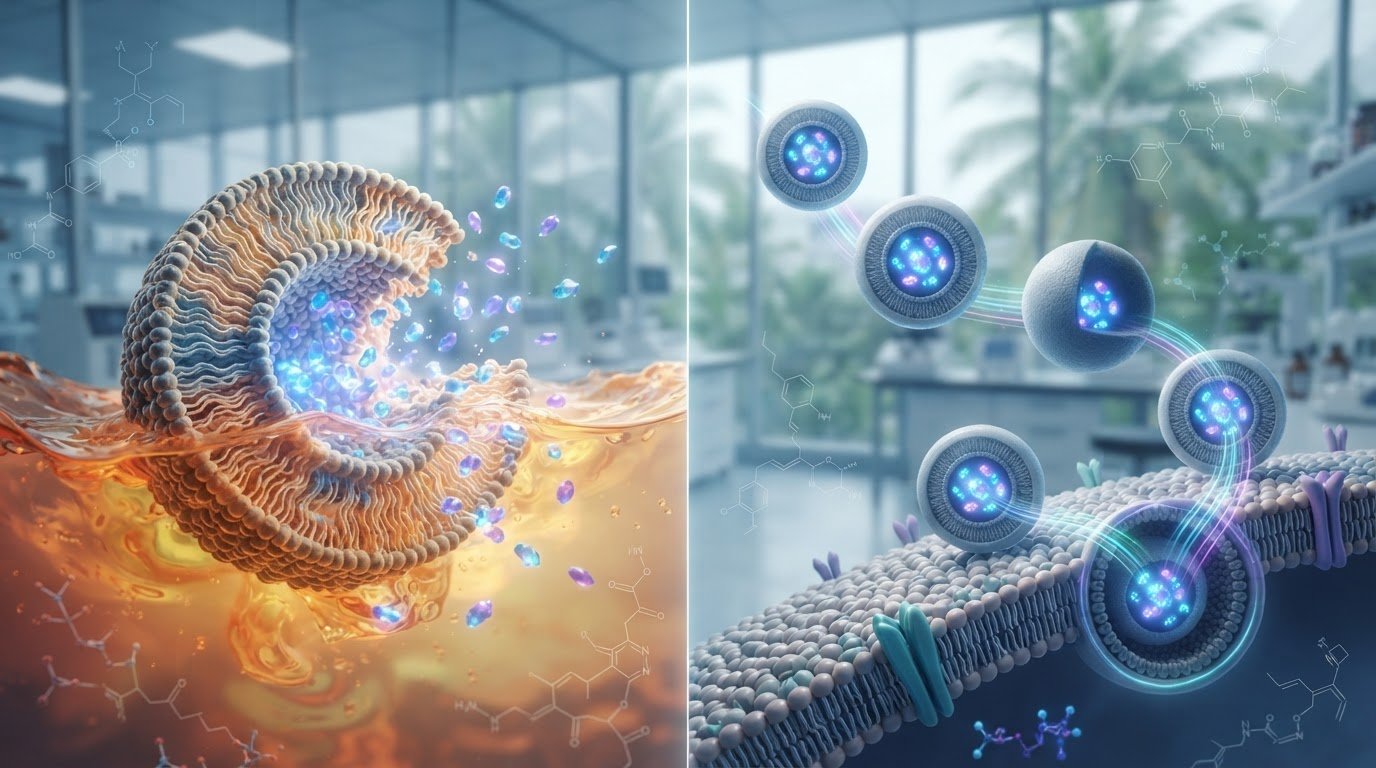
The standard liposomal encapsulation widely marketed as the peak of nutrient bioavailability often fails to survive the human digestive tract intact. If you feel confused by conflicting claims regarding particle sizing or frustrated by premium supplements that don't produce measurable results, your skepticism is justified. Many consumers assume any lipid-wrapped compound guarantees rapid cellular entry. However, evaluating nano-delivery vs liposomal architectures reveals critical biophysical differences that dictate whether an active ingredient degrades under gastric acid or successfully reaches systemic circulation.
In this technical evaluation, we examine the distinct thermodynamic stability profiles, structural mechanisms, and cellular uptake kinetics governing both delivery platforms. Ahead, you'll discover how authentic sub-100nm engineering resolves the physical limitations of conventional lipid bilayers, giving you the clinical clarity needed to identify laboratory-verified formulations with total confidence.
Key Takeaways
- Understand the structural distinctions between conventional phospholipid bilayers and engineered sub-100nm nanospheres to see how carrier architecture dictates biological fate.
- A direct comparison of nano-delivery vs liposomal platforms reveals why sub-100nm particulate dimensions provide superior thermodynamic stability against destructive gastric conditions.
- Discover how authentic nanoscale engineering leverages distinct endocytic uptake pathways to transport active payloads across biological barriers far more efficiently than standard lipid vesicles.
- Learn a clinical evaluation protocol for auditing particle size distribution reports, allowing you to separate legitimate nano-carriers from unstable, crude lipid emulsions.
- Explore how next-generation bionano systems eliminate common shelf-life degradation and payload leakage issues to maximize systemic nutrient absorption.
Table of Contents
- Understanding Advanced Bioavailability: Nano-Delivery Systems vs. Conventional Liposomes
- Biophysical Mechanisms: Particle Diameter, Cellular Uptake, and Membrane Transport
- Comparative Matrix: Nano-Delivery vs. Liposomal Across Core Clinical Metrics
- Evaluation Protocol: How to Identify Authentically Engineered Nano-Formulations
- The Future of Cellular Absorption: Transitioning to Patented Bionano Systems
Understanding Advanced Bioavailability: Nano-Delivery Systems vs. Conventional Liposomes
Therapeutic efficacy depends entirely on cellular uptake rather than gross milligram dosage. In the clinical assessment of nano-delivery vs liposomal platforms, research demonstrates that unabsorbed active ingredients simply exit the body without exerting their intended biological effect. Standard liposomes rely on vesicular encapsulation, wrapping payloads inside hollow phospholipid envelopes. Advanced nano-delivery shifts this paradigm entirely. By utilizing sub-100nm engineered carriers such as stable nano-emulsions and solid nanospheres, modern platforms achieve uniform molecular dispersion. This operational distinction separates passive transit from active, targeted cellular delivery.
The Evolution of Targeted Delivery Systems
Early nutraceutical manufacturing relied on unencapsulated crystalline powders, which suffered severe enzymatic breakdown within the digestive tract. First-generation liposomes provided a major historical leap forward by shielding fragile payloads within protective phospholipid spheres. Yet, scaling this technology created persistent manufacturing constraints, including batch-to-batch variability and premature cargo leakage under mechanical shear. Patented bionano systems represent the next evolutionary phase. By calibrating particles at the true nanoscale, modern engineering maximizes active bioavailability across targeted applications like cellular nutrition and cosmeceutical skincare.
Anatomy of a Liposome: Architecture, Capabilities, and Constraints
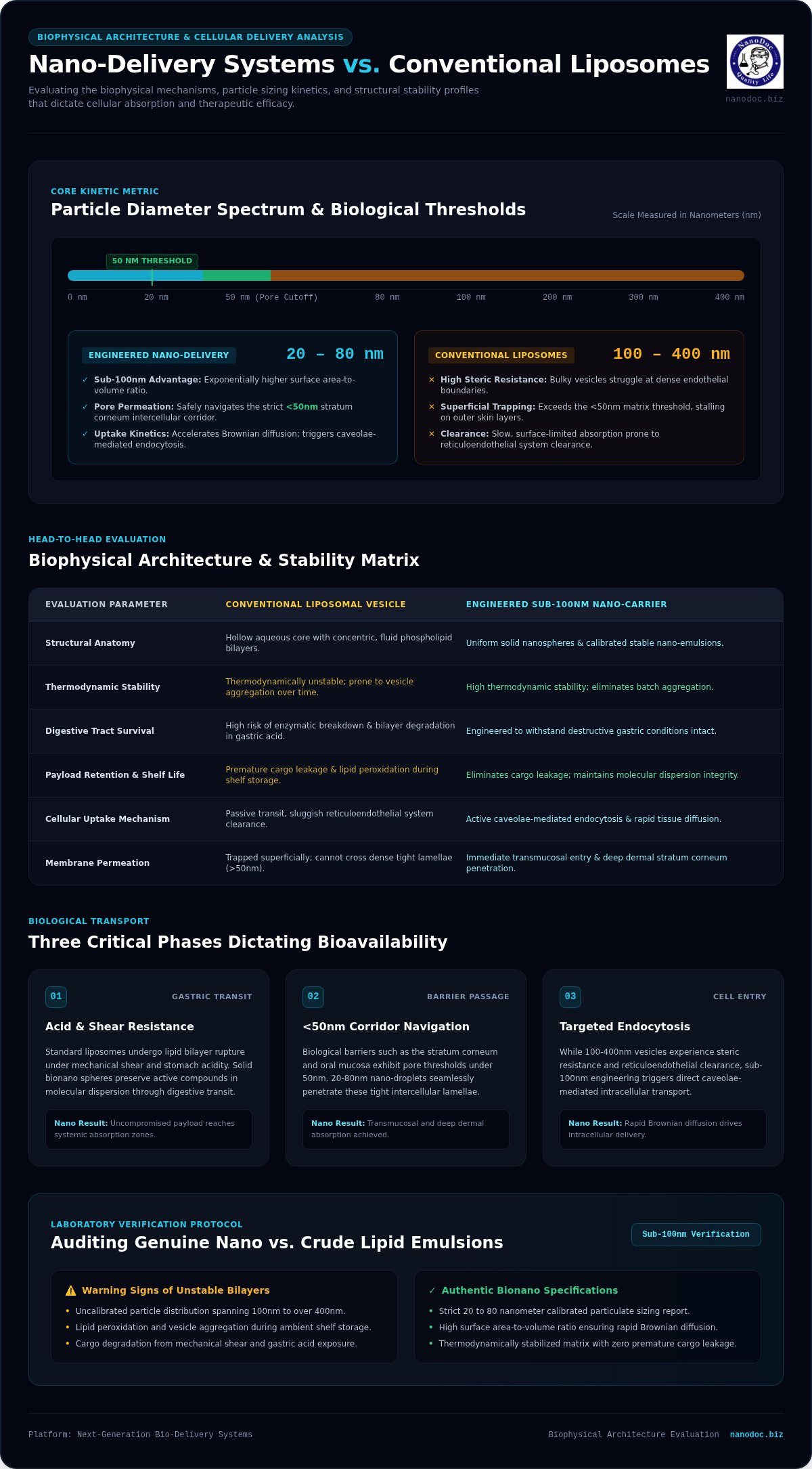
Structurally, conventional liposomes consist of an aqueous core enclosed by one or more concentric phospholipid bilayers. This amphiphilic architecture allows them to transport both water-soluble nutrients within the interior core and fat-soluble compounds inside the lipid membrane. However, these vesicles carry significant biophysical limitations. Standard commercial liposomes typically measure between 100 and 400 nanometers in diameter, a sizing profile that restricts their ability to cross dense biological barriers. Because phospholipid bilayers remain fluid and thermodynamically unstable, they frequently suffer from vesicle aggregation, rapid lipid peroxidation, and premature payload leakage during shelf storage.
Biophysical Mechanisms: Particle Diameter, Cellular Uptake, and Membrane Transport
Particulate geometry dictates cellular uptake kinetics. When comparing nano-delivery vs liposomal mechanisms, the physical diameter of the carrier fundamentally alters its biological fate. While conventional lipid vesicles depend on slower, surface-limited absorption, engineered sub-100nm carriers bypass physiological clearance filters to initiate immediate membrane interaction, rapid tissue diffusion, and targeted intracellular transit.
The Sub-100 Nanometer Kinetic Advantage
Standard liposomal vesicles generally span 100 to 300 nanometers, creating high steric resistance at endothelial boundaries. Conversely, precision nano-encapsulation operates within an ultra-fine 20 to 80 nanometer range. This structural reduction yields an exponentially higher surface area-to-volume ratio. Brownian diffusion rates accelerate dramatically, driving rapid transport across biological fluids and triggering caveolae-mediated endocytosis rather than passive, sluggish clearance by the reticuloendothelial system.
Epithelial and Transdermal Permeation Pathways
The stratum corneum presents an intercellular lipid corridor with an effective pore threshold below 50 nanometers. Bulky liposomes remain trapped on superficial skin layers, unable to breach the dense lipid matrix between corneocytes. In contrast, ultra-small nano-droplets navigate these tight lamellae to reach viable dermal layers. Reviewing the science behind anti-ageing dermal technology reveals how microscopic dimensions drive authentic tissue repair. The same physical principle applies to oral mucosal membranes, where nanoscale dispersion ensures immediate transmucosal entry. Formulations built on advanced bio-delivery platforms leverage this exact transport dynamic across both dermal and systemic applications.
Gastric Acid Survival and Enzymatic Breakdown
In oral pathways, conventional phospholipid bilayers face aggressive biochemical destruction. Gastric acid, pancreatic lipases, and bile salts rapidly hydrolyze ordinary liposomal membranes, triggering premature payload release in the stomach cavity. Engineered nano-matrices resolve this vulnerability. By utilizing rigid surfactant architectures and dense lipid cores, sub-100nm carriers resist enzymatic hydrolysis and low-pH degradation. This integrity ensures the payload reaches the brush border membrane of the small intestine intact for sustained systemic uptake.
Comparative Matrix: Nano-Delivery vs. Liposomal Across Core Clinical Metrics
Direct comparisons between nano-delivery vs liposomal systems highlight distinct pharmaceutical divergences. While conventional liposomes represented a pivotal baseline for nutrient encapsulation, modern engineering addresses persistent challenges such as premature active ingredient precipitation and fragile carrier integrity. Clinical investigations into high bioavailability nutrients confirm that sustained biological outcomes require delivery platforms capable of preserving structural integrity through gastrointestinal transit and prolonged shelf storage.
| Metric | Conventional Liposomal | Advanced Nano-Delivery |
|---|---|---|
| Mean Particle Diameter | 100 to 400 nm | Sub-100 nm (typically 20 to 80 nm) |
| Thermodynamic Stability | Low to moderate (prone to fusion) | High (thermodynamically favored dispersion) |
| Gastric Acid Resistance | Vulnerable to bile salt degradation | Engineered resistance to low-pH gastric breakdown |
| Primary Absorption Route | Macropinocytosis, reticuloendothelial processing | Rapid endocytosis, mucosal direct permeation |
| Shelf-Life Durability | Refrigeration required; oxidation risks | Room temperature stability; low aggregation risk |
Kinetic Stability, Fusion, and Shelf-Life Degradation
Phospholipid vesicles are kinetically rather than thermodynamically stable. Over time, liposomal membranes tend toward coalescence, where adjacent spheres merge into larger, macro-scale lipid droplets that precipitate out of liquid suspension. In contrast, sub-100nm nano-emulsions and nanospheres exhibit robust thermodynamic stability. Their compact physical radius creates high steric hindrance, preventing particle agglomeration and cargo leakage under thermal stress or temperature fluctuations.
Comparative Bioavailability and Systemic Absorption Profiles
Pharmacokinetic curves demonstrate sharper peak serum concentrations (Cmax) and greater total area-under-the-curve (AUC) values for nano-encapsulated compounds than for standard liposomes. Because sub-100nm particles pass swiftly through the gut-blood barrier via direct cellular internalization, they partially bypass extensive hepatic first-pass metabolism. This direct lymphatic and vascular entry delivers a higher fraction of the intact active molecule to systemic circulation.
Payload Compatibility: Hydrophilic versus Lipophilic Molecules
Liposomal vehicles effectively shield polar, water-soluble nutrients inside their aqueous core, but they struggle to incorporate dense hydrophobic payloads without destabilizing the surrounding phospholipid envelope. Nano-delivery matrices solve this hydrophobic limitation. Solid nanospheres and specialized nano-emulsions dissolve lipophilic molecules, such as fat-soluble vitamins, botanical polyphenols, and active peptides, into stable oily cores, protecting their biological potency until cellular delivery is complete.
Evaluation Protocol: How to Identify Authentically Engineered Nano-Formulations
Marketing jargon often obscures the technical boundary between standard lipid mixtures and authentic nanotechnology. Discerning practical nano-delivery vs liposomal capabilities requires looking past front-label claims to inspect analytical documentation. Without independent verification confirming physical particle dimensions, commercial formulas often turn out to be crude emulsions with unpredictable biological absorption. To evaluate formulations objectively, insist on the following criteria:
- Certified Particle Sizing: Verifiable mean diameter consistently falling below 100 nanometers.
- Uniform Distribution: Polydispersity index scores demonstrating tight size clustering.
- Excipient Integrity: Biocompatible surfactant matrices free from aggressive synthetic chemical solvents.
- Independent Batch Validation: Third-party analytical testing confirming carrier stability over time.
Verifying Particle Sizing via Dynamic Light Scattering
Demanding analytical documentation remains the only reliable method to separate genuine carriers from crude mixtures. Dynamic Light Scattering (DLS) and Transmission Electron Microscopy (TEM) supply verifiable proof of carrier dimensions. When reviewing analytical reports, prioritize the Polydispersity Index (PDI). A PDI below 0.2 indicates narrow, monodisperse size distribution, ensuring uniform biological transit. Broad PDI values or the total absence of DLS readouts signal unrefined manufacturing where oversized, unstable droplets dominate.
Assessing Excipient Purity and Surfactant Biocompatibility
Carrier stability shouldn't rely on synthetic compounds that trigger biological stress. While standard industrial formulations often rely on synthetic PEGylated emulsifiers, clinical-grade formulations utilize food-grade phospholipids and non-irritating natural lipid complexes. Clean excipient profiles safeguard delicate mucosal tissue, which proves vital when addressing oral hygiene for immunity and systemic wellness. Non-toxic lipid interfaces allow sustained daily usage without cellular irritation or structural barrier degradation.
Matching Delivery Architecture to Targeted Wellness Objectives
Selecting between these systems depends entirely on target tissue depth and compound solubility. Traditional liposomes remain viable for basic oral nutrients that tolerate partial digestive degradation and don't require rapid systemic transport. Conversely, deep dermal penetration, rapid mucosal absorption, and fragile botanical extraction require true sub-100nm encapsulation. When targeted cellular uptake is essential, explore independently verified nano-formulations engineered to meet rigorous laboratory standards across essential cellular nutrition, topical care, and restorative wellness.
The Future of Cellular Absorption: Transitioning to Patented Bionano Systems
Evaluating nano-delivery vs liposomal architectures demonstrates that the science of nutrient delivery has entered a more sophisticated phase. First-generation liposomes proved that encapsulation could protect vulnerable compounds from instant enzymatic clearance. However, ongoing issues with structural fragility, payload leakage, and inconsistent particle dimensions exposed the limits of standard lipid bilayers. Patented bionano engineering resolves these bottlenecks, providing a repeatable bridge between laboratory precision and systemic cellular performance.
Overcoming the Biological Barriers of Conventional Supplementation
Traditional unencapsulated powders and coarse oral suspensions face steep biological hurdles. Digestive enzymes, low gastric pH, and hepatic first-pass elimination destroy sensitive molecules before they reach systemic circulation. Sub-100nm bionano carriers escort these fragile payloads intact through hostile gastrointestinal fluids directly to cellular receptor sites. Minimizing metabolic waste doesn't just improve efficiency; it fundamentally changes the therapeutic utility of active compounds by ensuring the payload reaches its biological target intact.
Clinical Precision Across Cosmeceuticals and Cellular Nutrition
Precision nanoscale engineering translates directly into predictable physiological outcomes. In anti-ageing skincare, sub-100nm carriers navigate intercellular corridors to deliver restorative peptides deep into dermal layers. Across internal applications, including nano cellular essential nutrition, pain relief care, and oral and immunity care, uniform nanospheres protect concentrated botanical extracts and cellular cofactors. When particle dimensions remain uniform, cellular absorption curves become consistent rather than erratic.
Selecting Verified Bionano Innovations for Optimal Health
Transitioning beyond outdated liposomal formulations requires strict reliance on verifiable analytical metrics. Patented platforms, such as the LG Bionano delivery technology represented by NanoDoc International, subject every batch to independent laboratory verification to confirm authentic nanoscale dimensions. Choosing certified, laboratory-tested formulations ensures your wellness strategy relies on validated biophysical science rather than unproven marketing claims, unlocking the true cellular potential of your daily regimen.
Elevating Bioavailability Through Verified Nanoscale Engineering
Resolving the debate of nano-delivery vs liposomal platforms comes down to physical scale and thermodynamic stability. While standard liposomes introduced meaningful protection against digestive breakdown, their bulky dimensions and fragile bilayers restrict deep tissue uptake. Modern sub-100nm engineering doesn't leave cellular entry to chance. By eliminating vesicle fusion and gastric cargo leakage, advanced nanocarriers transport intact active compounds directly across cellular membranes for predictable biological performance.
Achieving measurable physiological results requires relying on certified analytical metrics rather than speculative branding. As the exclusive South East Asia representative for patented LG Bionano technology, NanoDoc International subjects every batch to independent laboratory testing to confirm exact nanoparticle sizing and excipient purity across Anti-Ageing Skin Care and Nano Cellular Essential Nutrition. Explore Clinically Verified Nano-Delivery Formulations and bring validated scientific precision to your daily wellness protocol.
Frequently Asked Questions
Is nano-delivery fundamentally more effective than traditional liposomal encapsulation?
Yes, engineered nano-delivery provides demonstrably superior bioavailability and structural stability compared to traditional liposomal systems. In the scientific evaluation of nano-delivery vs liposomal carriers, the sub-100nm footprint allows particles to bypass clearance mechanisms that trap larger vesicles. Standard liposomes frequently struggle with bile degradation and cargo leakage. Advanced nano-carriers ensure active compounds reach cellular targets intact, resulting in consistent biological uptake rather than erratic nutrient excretion.
How does particle size influence the cellular uptake of active nutrients?
Particle diameter directly determines which biological transport pathway a nutrient carrier can access. While large vesicles above 100 nanometers face physical exclusion at mucosal boundaries and rely on slow phagocytic clearance, sub-100nm particles utilize rapid receptor-mediated endocytosis. This compact dimension creates a higher surface area-to-volume ratio, accelerating passive diffusion across tight cellular junctions and driving swift transport into systemic circulation and peripheral target tissues.
Can traditional liposomes withstand the high-acid environment of the stomach?
Most conventional liposomes cannot survive the harsh gastric environment intact without suffering significant degradation. Gastric hydrochloric acid, pepsin, and bile salts hydrolyze standard phospholipid bilayers, causing early vesicle rupture and dumping active ingredients into the stomach cavity. Once ruptured, these active compounds become vulnerable to enzymatic destruction before reaching absorption sites. Engineered nano-matrices use stabilized core architectures to resist acidic breakdown and ensure sustained intestinal delivery.
What is the ideal nanometer size for maximal cellular and dermal absorption?
The optimal size profile for deep transdermal and systemic absorption falls between 20 and 80 nanometers. Biological barriers, such as the skin's stratum corneum and intestinal mucosal linings, feature intercellular channel widths that naturally exclude particles exceeding 100 nanometers. Maintaining particulate uniformity within this sub-100nm threshold enables direct cellular entry via caveolae-mediated pathways, avoiding rapid immune clearance and optimizing tissue uptake.
Are nano-delivery systems safe for long-term daily dietary supplementation?
Authentically engineered nano-delivery systems are completely safe for daily use when formulated with biocompatible excipients. Evaluating safety in nano-delivery vs liposomal supplements depends on the ingredients forming the carrier matrix. Clinical-grade platforms utilize natural, food-grade phospholipids and clean surfactants that metabolize into harmless dietary fats. Choosing independently tested formulations ensures the absence of synthetic solvents, industrial stabilizers, or chemical emulsifiers that could cause cellular stress.
What laboratory tests verify whether a supplement is truly nano-encapsulated?
Dynamic Light Scattering and Transmission Electron Microscopy are the definitive analytical standards used to confirm true nanoscale encapsulation. Dynamic Light Scattering measures hydrodynamic diameter and calculates the Polydispersity Index, confirming that particles cluster uniformly below 100 nanometers with a score under 0.2. Transmission Electron Microscopy provides direct morphological imaging of the carrier architecture. Reputable manufacturers always provide third-party Certificates of Analysis detailing these exact measurements.
Why do conventional liposomal supplements often degrade quickly on store shelves?
Conventional liposomes degrade rapidly because their phospholipid bilayers are thermodynamically unstable liquid suspensions. Over time, Brownian motion drives adjacent lipid spheres to collide, resulting in vesicle fusion, aggregation, and physical phase separation. Exposure to ambient temperatures, oxygen, and light also accelerates lipid peroxidation, causing the carrier to break down and leak its active payload. Without specialized stabilizing technology or refrigeration, traditional liposomes lose structural integrity before consumption.
Frequently Asked Questions
- Is nano-delivery fundamentally more effective than traditional liposomal encapsulation?
- Yes, engineered nano-delivery provides demonstrably superior bioavailability and structural stability compared to traditional liposomal systems. In the scientific evaluation of nano-delivery vs liposomal carriers, the sub-100nm footprint allows particles to bypass clearance mechanisms that trap larger vesicles. Standard liposomes frequently struggle with bile degradation and cargo leakage. Advanced nano-carriers ensure active compounds reach cellular targets intact, resulting in consistent biological uptake rather than erratic nutrient excretion.
- How does particle size influence the cellular uptake of active nutrients?
- Particle diameter directly determines which biological transport pathway a nutrient carrier can access. While large vesicles above 100 nanometers face physical exclusion at mucosal boundaries and rely on slow phagocytic clearance, sub-100nm particles utilize rapid receptor-mediated endocytosis. This compact dimension creates a higher surface area-to-volume ratio, accelerating passive diffusion across tight cellular junctions and driving swift transport into systemic circulation and peripheral target tissues.
- Can traditional liposomes withstand the high-acid environment of the stomach?
- Most conventional liposomes cannot survive the harsh gastric environment intact without suffering significant degradation. Gastric hydrochloric acid, pepsin, and bile salts hydrolyze standard phospholipid bilayers, causing early vesicle rupture and dumping active ingredients into the stomach cavity. Once ruptured, these active compounds become vulnerable to enzymatic destruction before reaching absorption sites. Engineered nano-matrices use stabilized core architectures to resist acidic breakdown and ensure sustained intestinal delivery.
- What is the ideal nanometer size for maximal cellular and dermal absorption?
- The optimal size profile for deep transdermal and systemic absorption falls between 20 and 80 nanometers. Biological barriers, such as the skin's stratum corneum and intestinal mucosal linings, feature intercellular channel widths that naturally exclude particles exceeding 100 nanometers. Maintaining particulate uniformity within this sub-100nm threshold enables direct cellular entry via caveolae-mediated pathways, avoiding rapid immune clearance and optimizing tissue uptake.
- Are nano-delivery systems safe for long-term daily dietary supplementation?
- Authentically engineered nano-delivery systems are completely safe for daily use when formulated with biocompatible excipients. Evaluating safety in nano-delivery vs liposomal supplements depends on the ingredients forming the carrier matrix. Clinical-grade platforms utilize natural, food-grade phospholipids and clean surfactants that metabolize into harmless dietary fats. Choosing independently tested formulations ensures the absence of synthetic solvents, industrial stabilizers, or chemical emulsifiers that could cause cellular stress.
- What laboratory tests verify whether a supplement is truly nano-encapsulated?
- Dynamic Light Scattering and Transmission Electron Microscopy are the definitive analytical standards used to confirm true nanoscale encapsulation. Dynamic Light Scattering measures hydrodynamic diameter and calculates the Polydispersity Index, confirming that particles cluster uniformly below 100 nanometers with a score under 0.2. Transmission Electron Microscopy provides direct morphological imaging of the carrier architecture. Reputable manufacturers always provide third-party Certificates of Analysis detailing these exact measurements.
- Why do conventional liposomal supplements often degrade quickly on store shelves?
- Conventional liposomes degrade rapidly because their phospholipid bilayers are thermodynamically unstable liquid suspensions. Over time, Brownian motion drives adjacent lipid spheres to collide, resulting in vesicle fusion, aggregation, and physical phase separation. Exposure to ambient temperatures, oxygen, and light also accelerates lipid peroxidation, causing the carrier to break down and leak its active payload. Without specialized stabilizing technology or refrigeration, traditional liposomes lose structural integrity before consumption.