
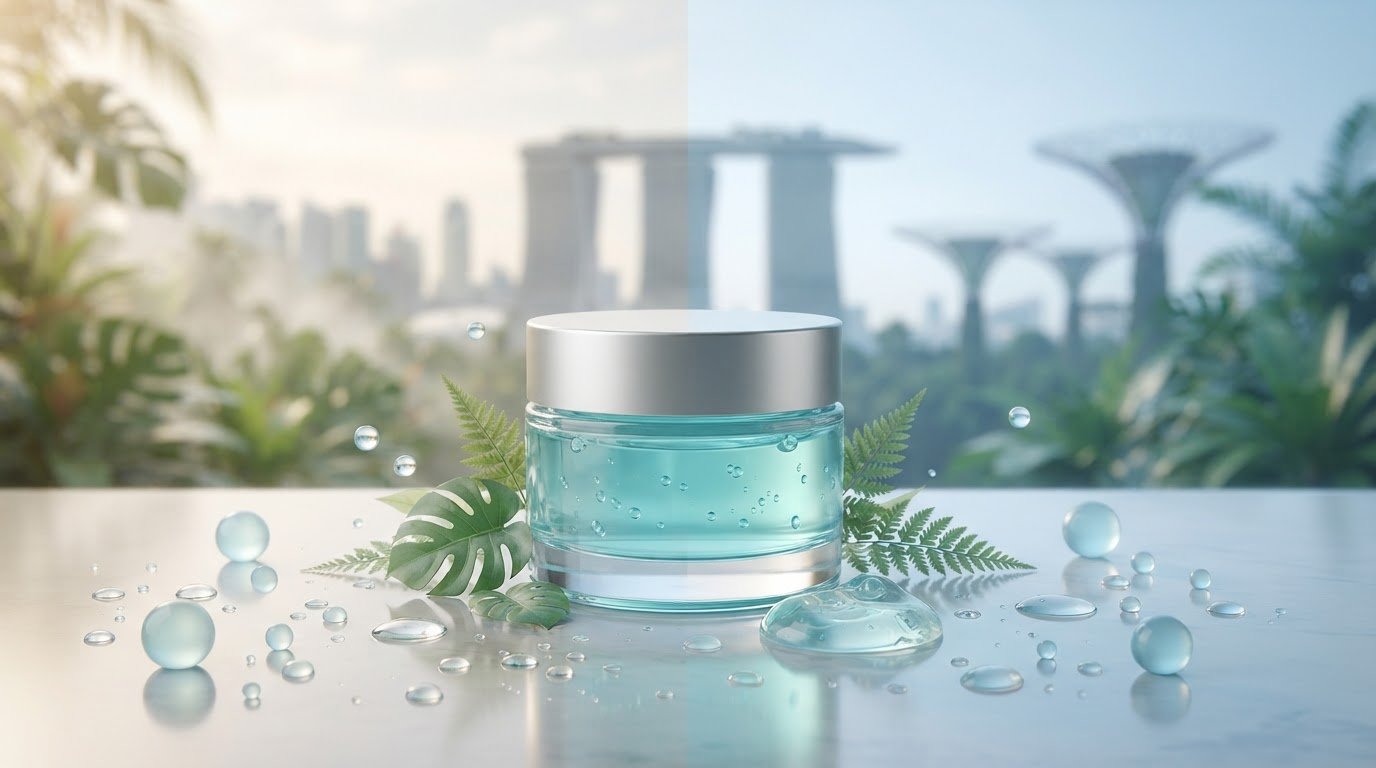
Humidity doesn’t mean skin is hydrated. A lightweight moisturizer for Singapore weather should provide water-attracting humectants and enough emollient support without leaving a heavy film. Singapore’s mean annual relative humidity is around 82%, according to the Meteorological Service Singapore, yet long hours in air-conditioning can still challenge skin moisture while oil remains visible on the surface.
If your skin feels shiny outdoors but tight or uncomfortable indoors, choosing a moisturiser can be confusing. A richer formula may feel uncomfortable in the heat, while one that is too light may not give your skin enough support.
This guide explains how oily and dehydrated skin can occur together and how to assess a moisturiser’s texture and ingredients. Learn what humectants, emollients and occlusives do, then choose a practical formula for Singapore’s humid outdoor conditions and air-conditioned spaces.
Key Takeaways
- Skin can feel oily and dehydrated at the same time, especially when outdoor humidity and air-conditioned indoor spaces affect it differently.
- Look for humectants such as glycerin to attract water, then consider how the formula supports the skin barrier.
- Choose a texture that feels comfortable in Singapore’s heat; gel-based moisturisers can be a practical option for daytime use.
- Emollients and occlusives serve different roles, so consider your skin’s needs before choosing how rich a moisturiser should feel.
- Compare how your skin feels indoors and outdoors when deciding whether your routine needs more hydration or a more protective finish.
Table of Contents
- 1. Why does my skin feel oily but still dehydrated in humid climates?
- 2. What Ingredients Should You Look for in a Moisturizer for Humid Weather?
- 3. Hydrating ingredients such as glycerin and ceramides
- 4. Occlusive and emollient ingredients in tropical weather
- 5. Moisturisers for Singapore’s weather
- NanoDoc International Pte Ltd: Anti-Ageing Skin Care
1. Why does my skin feel oily but still dehydrated in humid climates?
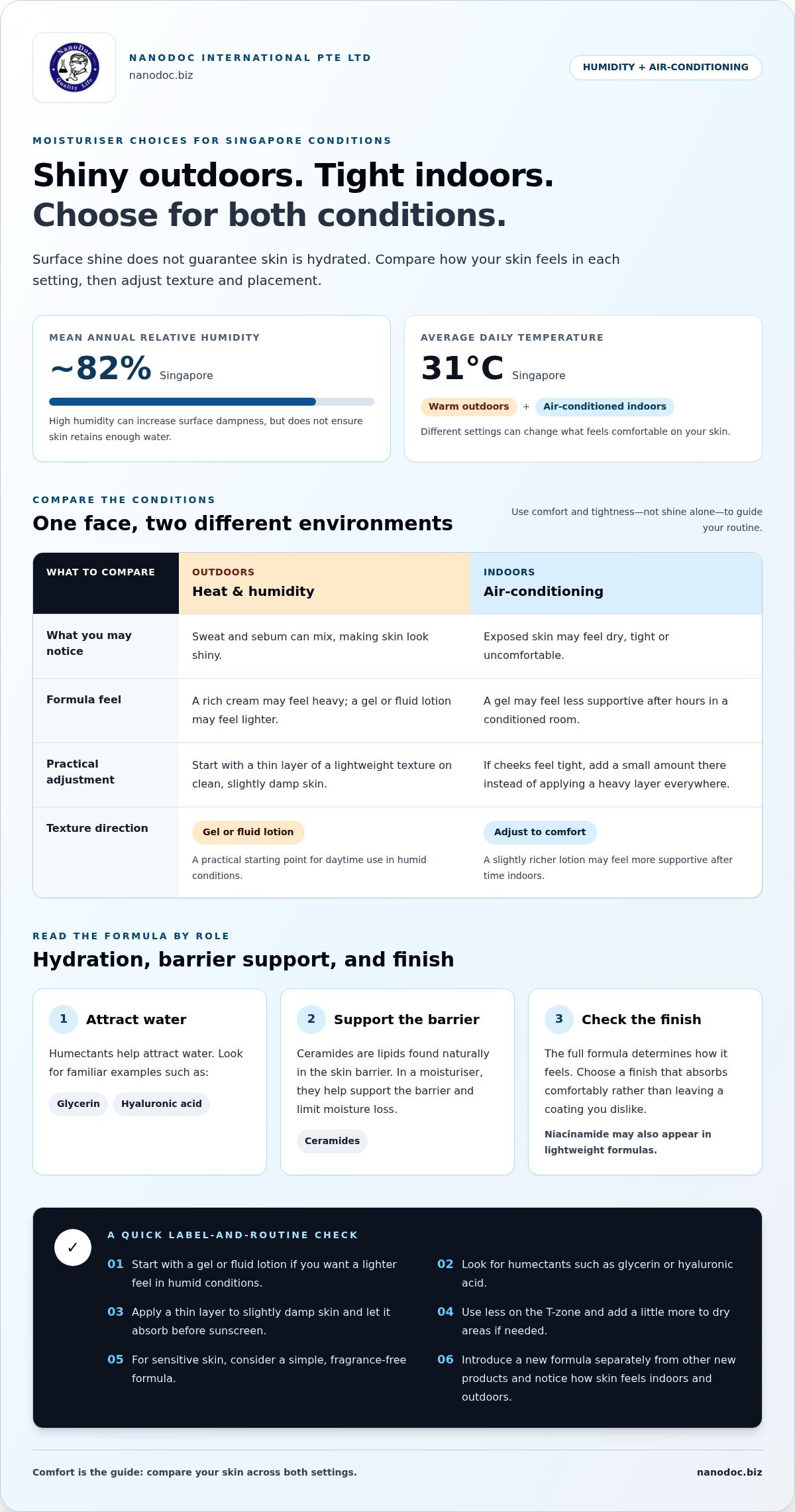
Singapore’s mean annual relative humidity is around 82%, according to Meteorological Service Singapore. The mean annual relative humidity is around 82%, according to World Meteorological Organization. High humidity can increase surface dampness, but it doesn’t guarantee that skin retains enough water. Sebum and sweat can make the face look shiny while tightness signals that its moisture balance needs attention.
Singapore’s average daily temperature is 31°C, and humidity often exceeds 80%. Outdoors, sweat and sebum can mix on the skin, making rich creams feel heavy. Indoors, air-conditioning can leave exposed skin feeling dry, even after a comfortable morning routine. A lightweight moisturizer for Singapore weather should suit both environments, rather than relying on shine as a hydration indicator.
Humidity also affects how a formula feels as it settles. A gel may feel less occlusive than a thick cream, while a heavy layer can remain noticeable in warm conditions. Ingredients and texture both matter: a water-based formula can deliver hydration without the same weight, while the skin barrier still needs appropriate support. Give a new product time to fit your routine. Comfort and shine may improve within 1–3 days after switching formulas.
Your skin type can guide your choice. Oily skin may feel more comfortable with a light gel or lotion; combination skin may need less product on the T-zone and more on dry areas. For sensitive skin, a simple, fragrance-free formula can limit exposure to potential irritants. If you have acne-prone skin, choose a lighter texture that sits comfortably with your existing skincare instead of adding several rich layers at once.
Skin booster treatments call for extra care. Follow the treating clinician’s aftercare directions before applying moisturiser or resuming active ingredients. When those directions permit skincare, choose a gentle, familiar formula and avoid trying several new products during recovery.
A moisturiser may not provide sun protection, so use a separate sunscreen when needed. Apply a separate sunscreen in the morning. Moisturiser alone does not provide sun protection unless it is formulated and labelled for that purpose.
In Singapore, lightweight moisturisers are available through drugstores and online retailers. Compare ingredient lists and textures, and choose a product suited to your skin’s needs and routine.
For Singapore’s heat and humidity, spread a thin layer over clean skin. Apply it while your skin is slightly damp, then let it absorb before sunscreen. If air-conditioning leaves your cheeks feeling tight, add a small amount there instead of applying a heavy layer across your whole face.
2. What Ingredients Should You Look for in a Moisturizer for Humid Weather?
Start with the formula’s texture and ingredient list, not just the word “lightweight” on the label. In Singapore’s humidity, a water-based gel or fluid lotion may feel less occlusive than a dense cream. Look for humectants such as hyaluronic acid or glycerin, which attract water, and consider whether the full formula feels comfortable on your skin. A lightweight moisturizer for Singapore weather should hydrate without leaving a persistently greasy finish.
Humectant-rich formulas can provide hydration without a rich coating. Hyaluronic acid and glycerin are familiar examples, and niacinamide may also appear in lightweight moisturisers. Assess the full ingredient list: one featured ingredient cannot tell you the formula’s texture or how it will feel after application. If your skin is sensitive, start with a gentle, simple formula and introduce it separately from other new products.
Use these label-reading steps to narrow your options:
- Check the first impression: A gel or fluid lotion is often a practical starting texture for humid conditions.
- Identify humectants: Look for hyaluronic acid or glycerin among the ingredients.
- Consider niacinamide: It can be included in lightweight formulas, alongside other moisturising ingredients.
- Assess the finish: Choose a formula that absorbs comfortably rather than leaving a coating you dislike.
Gel moisturisers are worth considering for daytime use because they tend to spread easily and feel light. Apply a thin layer and let it absorb before adding sunscreen. If your face still feels tight, adjust the amount or try a lotion with a more nourishing feel. The best texture depends on your skin as well as the weather; oily, combination and dry areas may respond differently.
Time in air-conditioning can change what feels comfortable. A gel may suit your morning routine outdoors, while a slightly richer lotion may feel more supportive after hours in a conditioned room. You can apply a lighter layer across the T-zone and a little more to dry cheeks. This targeted approach avoids treating every part of your face as if it had identical needs.
Keep the routine simple while evaluating a new formula. Use it consistently alongside familiar products, and notice whether your skin feels comfortable after application and later indoors. For a complementary perspective on ingredient-led skincare, explore this approach to skin care.
3. Hydrating ingredients such as glycerin and ceramides
Look beyond a moisturiser’s “hydrating” label to understand its ingredients. Glycerin is a humectant that attracts water and helps skin feel less tight. Ceramides are lipids found naturally in the skin barrier; in a moisturiser, they help support the barrier, which limits moisture loss. The ingredients have different roles, so a formula containing both may provide hydration and barrier support.
If your skin feels dehydrated but gets greasy easily, consider a lightweight lotion or gel containing glycerin. Hyaluronic acid is another humectant to look for. The full formula determines how heavy a product feels, so assess it after application rather than judging by one ingredient. For example, a glycerin moisturiser with a comfortable finish may work better for daytime than a richer cream.
Ceramides may be useful when skin feels dry or rough, including after time in air-conditioning. They’re often combined with moisturising ingredients such as glycerin. Adjust the amount to your skin: apply a thin layer over oily areas, then add a little more to dry patches. This lets you tailor the finish without switching products across your whole face.
Other ingredients can complement humectants and ceramides:
- Hyaluronic acid: A water-attracting ingredient that can feature in serums, gels, and lotions.
- Glycerin: A humectant that helps provide hydration in a lightweight formula.
- Ceramides: Barrier-supporting lipids that pair well with hydrating ingredients.
- Niacinamide: An ingredient found in some moisturisers; assess the complete formula and your skin’s response.
Hydrating toners and serums can add another light layer. Apply a serum containing glycerin or hyaluronic acid to clean, slightly damp skin, then follow with moisturiser. A milky toner may feel more substantial than a watery one. If your skin is sensitive, choose a fragrance-free option and introduce one new product at a time.
Keep the routine simple: cleanse, apply a hydrating toner or serum if you use one, then moisturise. In the morning, finish with sunscreen. You don’t need every product type; if a glycerin moisturiser already leaves your skin comfortable, adding a toner and serum may create unnecessary layers. Judge the result by whether your skin feels hydrated without a greasy residue.
4. Occlusive and emollient ingredients in tropical weather
Occlusives and emollients support skin in different ways. Occlusives, such as petrolatum, form a surface layer that slows moisture loss. Emollients soften and smooth rough-feeling areas. Neither category is automatically unsuitable for Singapore’s climate; the amount, formula and application area all affect how skincare feels in humidity.
A rich occlusive layer may feel heavy on oily skin or during the day, especially across the T-zone. Shea butter and petrolatum are examples of richer occlusive ingredients. They may still suit dry patches or an evening routine. Rather than avoiding them altogether, match their texture and amount to your skin’s needs.
Emollients can soften the skin’s surface and improve the feel of dry or flaky areas. Ceramides are barrier-supporting lipids; squalane and fatty alcohols are examples of emollient ingredients used in skincare. A moisturiser may combine emollients with humectants such as glycerin to support both softness and hydration. Assess the complete formula, not one ingredient in isolation.
Use this approach to choose a comfortable balance:
- For daytime shine: Start with a light lotion or gel, and use a smaller amount of rich cream.
- For dry patches: Apply a more emollient or occlusive product only where skin feels rough or tight.
- For air-conditioned rooms: Adjust the amount on dry areas rather than adding a heavy layer everywhere.
- For nighttime: Consider a richer finish if your skin feels dry and tolerates it comfortably.
Singapore’s heat and humidity can make a dense layer feel more noticeable outdoors, while prolonged time in air-conditioning may leave some areas feeling dry. Adjust your routine to the conditions: use a lighter layer before going outside, then add emollient support to dry cheeks if needed.
Sensitive skin calls for a careful approach to ingredients. Choose a gentle, fragrance-free moisturiser if fragrance tends to bother your skin, and introduce one new formula at a time. If a product causes redness or discomfort, stop using it and simplify your routine. Skin varies, so a texture that feels comfortable on dry cheeks may feel greasy on an oily forehead.
You don’t need to exclude every occlusive ingredient from tropical skincare. Check the label for petrolatum or shea butter, consider the full formula, and try a small amount on the area that needs support. For daytime comfort, start by using a thinner layer. If dryness persists, consider whether your routine provides enough barrier support.
5. Moisturisers for Singapore’s weather
Choose by texture and routine, not by a “tropical” label alone. In the morning, a gel moisturiser may feel cooling and absorb quickly before sunscreen. If you want hydration without a dense finish, look for a formula with glycerin. A comfortable texture should leave skin feeling balanced, not coated or tight.
Consider how you’ll spend the day. A light gel may suit humid outdoor conditions, while air-conditioning can leave cheeks feeling dry. Adjust the amount by area: apply a thin layer across your forehead and nose, then add a little more to dry patches. This avoids using unnecessary product on areas that already feel comfortable.
Let your skin’s response guide your next choice. If a gel leaves your skin tight, try a lotion with more emollient support. If a cream feels greasy outdoors, use less or reserve it for dry areas at night. Glycerin attracts water, while ceramides support the skin barrier. The balance of ingredients and the overall texture matter more than a single label claim.
A simple morning sequence makes it easier to assess the texture:
- Cleanse gently, then leave skin slightly damp.
- Apply a thin layer of moisturiser and let it absorb.
- Finish with sunscreen, since moisturiser does not replace sun protection.
If your day takes you between outdoor heat and air-conditioned rooms, carry one familiar moisturiser rather than adding several new layers. If your cheeks feel dry later, apply a small amount there. Avoid putting a heavy occlusive layer over your whole face when only one area feels uncomfortable.
How much do popular lightweight moisturisers cost in Singapore? There’s no single standard price: costs vary by product size, formula, ingredients and retailer promotions. Compare the container size and ingredient list, then choose according to texture and your skin concerns rather than assuming a higher price means a better fit.
Use a consistent formula long enough to assess its finish and comfort. Keep other skincare steps stable while testing it, so you can identify what suits your skin. If you’re refining an anti-ageing skincare routine, explore skincare options as part of your product research.
NanoDoc International Pte Ltd: Anti-Ageing Skin Care
NanoDoc International Pte Ltd offers Anti-Ageing Skin Care for readers exploring skincare beyond moisturising. Its nano-encapsulated formulations are designed to support the delivery of active ingredients through the skin. Consider this range as an option to complement your routine with anti-ageing skincare.
Consider how any new product fits with your existing moisturiser and daytime sunscreen. NanoDoc International Pte Ltd also offers Nano Cellular Essential Nutrition, Pain Relief Care, and Oral & Immunity Care, each in a distinct product category.
Explore NanoDoc International Pte Ltd’s Anti-Ageing Skin Care range to learn more.
Choose your next skincare step with intention
Let comfort guide your next choice. Rather than rebuilding your routine all at once, focus on what you want from a lightweight moisturizer for Singapore weather, then make one considered adjustment. A consistent approach makes it easier to identify which products fit your daily skincare priorities.
If you’re exploring care beyond moisturising, NanoDoc International Pte Ltd offers Anti-Ageing Skin Care, Nano Cellular Essential Nutrition, and Pain Relief Care. These ranges address different needs, so choose according to your goals rather than treating them as substitutes for a moisturiser or sunscreen.
For readers considering Anti-Ageing Skin Care, NanoDoc International Pte Ltd can be a next point of exploration alongside the skincare guidance in this article. You can learn about the company’s offerings and decide whether they suit your interests.
Contact NanoDoc International Pte Ltd to explore its offerings and take your next step with confidence.
Frequently Asked Questions
Why does my skin feel oily but still dehydrated in humid climates?
Oiliness and dehydration describe different skin conditions, so they can occur together. Sebum creates surface shine, while dehydration can leave skin feeling tight or uncomfortable. In Singapore, you might notice shine after walking outdoors, followed by tightness after sitting in an air-conditioned room. Pay attention to both sensations rather than assuming visible oil means your skin doesn’t need moisturiser.
Why does my skincare feel heavy in humid weather?
Skincare can feel heavy when several layers combine or when a rich cream sits over other products. For example, serum, moisturiser, sunscreen and makeup may leave a noticeable film if applied in quick succession. Try using fewer products in the morning, applying each in a thin layer and letting it settle before the next step. If the heaviness persists, change one formula at a time.
How do I choose the best moisturizer for Singapore weather?
Choose a moisturiser by matching its finish to your skin and routine. If you dislike residue, start with a gel or fluid lotion; if your cheeks feel dry, consider a more nourishing lotion on those areas. Read the full ingredient list, not just the front-label claims. Use the product consistently with familiar skincare to see whether its texture suits you.
What Ingredients Should You Look for in a Moisturizer for Humid Weather?
Look for humectants such as glycerin or hyaluronic acid, which attract water, and consider ceramides for barrier support. The full formula determines how a moisturiser feels, so weigh ingredients alongside texture. For instance, a glycerin gel may suit someone who dislikes a rich finish. If your skin is sensitive, choose a simple formula and introduce it separately from other new products.
What Is the Real Reason Your Moisturizer Feels Greasy by 10am?
A greasy finish by mid-morning may mean you’ve applied too much product or layered formulas that don’t sit comfortably together. Sweat and sebum can also make moisturiser more noticeable after time outdoors. Try a thinner layer, especially over your forehead and nose, and let it settle before applying sunscreen or makeup. Change one step at a time to identify the cause.
Why Does SPF Moisturizer Feel Even Heavier When It's Hot and Humid?
An SPF moisturiser combines moisturising and sun-protective ingredients, and its finish may feel richer than that of a separate gel moisturiser. Heat, sweat and additional skincare layers can make that sensation more noticeable. If the texture bothers you, choose a moisturiser that feels comfortable under a separate sunscreen. Keep sun protection in your morning routine rather than skipping it because a product feels heavy.
What moisturizer textures work best in Singapore’s hot, humid weather?
Gel moisturisers and fluid lotions are useful starting points if you prefer a light finish. A gel may suit oily areas, while a lotion may feel more comfortable on dry patches. Texture is personal, so see how a formula feels once it settles and under your usual sunscreen. If you spend long periods in air-conditioning, adjust the amount on dry areas rather than applying a heavy layer everywhere.
Which lightweight moisturizers are suitable for oily or acne-prone skin in Singapore?
For oily or acne-prone skin, consider a lightweight gel or fluid lotion that feels comfortable under sunscreen and makeup. A simple formula can also make it easier to identify what suits your skin. Apply a thin layer first, especially over areas that become shiny, and avoid adding multiple new products at once. If a product causes persistent discomfort, stop using it and simplify your routine.
Frequently Asked Questions
- Why does my skin feel oily but still dehydrated in humid climates?
- Oiliness and dehydration describe different skin conditions, so they can occur together. Sebum creates surface shine, while dehydration can leave skin feeling tight or uncomfortable. In Singapore, you might notice shine after walking outdoors, followed by tightness after sitting in an air-conditioned room. Pay attention to both sensations rather than assuming visible oil means your skin doesn’t need moisturiser.
- Why does my skincare feel heavy in humid weather?
- Skincare can feel heavy when several layers combine or when a rich cream sits over other products. For example, serum, moisturiser, sunscreen and makeup may leave a noticeable film if applied in quick succession. Try using fewer products in the morning, applying each in a thin layer and letting it settle before the next step. If the heaviness persists, change one formula at a time.
- How do I choose the best moisturizer for Singapore weather?
- Choose a moisturiser by matching its finish to your skin and routine. If you dislike residue, start with a gel or fluid lotion; if your cheeks feel dry, consider a more nourishing lotion on those areas. Read the full ingredient list, not just the front-label claims. Use the product consistently with familiar skincare to see whether its texture suits you.
- What Ingredients Should You Look for in a Moisturizer for Humid Weather?
- Look for humectants such as glycerin or hyaluronic acid, which attract water, and consider ceramides for barrier support. The full formula determines how a moisturiser feels, so weigh ingredients alongside texture. For instance, a glycerin gel may suit someone who dislikes a rich finish. If your skin is sensitive, choose a simple formula and introduce it separately from other new products.
- What Is the Real Reason Your Moisturizer Feels Greasy by 10am?
- A greasy finish by mid-morning may mean you’ve applied too much product or layered formulas that don’t sit comfortably together. Sweat and sebum can also make moisturiser more noticeable after time outdoors. Try a thinner layer, especially over your forehead and nose, and let it settle before applying sunscreen or makeup. Change one step at a time to identify the cause.
- Why Does SPF Moisturizer Feel Even Heavier When It's Hot and Humid?
- An SPF moisturiser combines moisturising and sun-protective ingredients, and its finish may feel richer than that of a separate gel moisturiser. Heat, sweat and additional skincare layers can make that sensation more noticeable. If the texture bothers you, choose a moisturiser that feels comfortable under a separate sunscreen. Keep sun protection in your morning routine rather than skipping it because a product feels heavy.
- What moisturizer textures work best in Singapore’s hot, humid weather?
- Gel moisturisers and fluid lotions are useful starting points if you prefer a light finish. A gel may suit oily areas, while a lotion may feel more comfortable on dry patches. Texture is personal, so see how a formula feels once it settles and under your usual sunscreen. If you spend long periods in air-conditioning, adjust the amount on dry areas rather than applying a heavy layer everywhere.
- Which lightweight moisturizers are suitable for oily or acne-prone skin in Singapore?
- For oily or acne-prone skin, consider a lightweight gel or fluid lotion that feels comfortable under sunscreen and makeup. A simple formula can also make it easier to identify what suits your skin. Apply a thin layer first, especially over areas that become shiny, and avoid adding multiple new products at once. If a product causes persistent discomfort, stop using it and simplify your routine.