

Does “nano” technology tell you enough to judge a health or beauty product? Not on its own. If you’re researching LG Bionano products South East Asia, start by comparing the product categories, the stated delivery approach and the quality information available. Then look at the description and directions for the specific product you’re considering.
LG Bionano’s portfolio covers anti-ageing skin care, nano cellular essential nutrition, pain relief care, and oral and immunity care. NanoDoc International states that its formulations are independently laboratory-tested for nanoparticle size and quality. These details can help you understand the range, but they don’t establish a personal result or tell you whether a product is suitable for you.
This guide explains the categories and the stated technology in practical terms, while distinguishing laboratory measurements from evidence of clinical outcomes. You’ll also find a checklist for researching individual products, so you can set clear expectations before exploring the range.
Key Takeaways
- Use the four-category overview to focus your research on the area that best matches your interest.
- Compare products by category and product-specific information, not by nano terminology alone.
- Distinguish nanoparticle size and quality measurements from ingredient evidence and human clinical outcomes.
- Use individual product labels and directions to guide your research; nano-delivery language alone doesn’t establish a personal result.
Table of Contents
What Are LG Bionano Products in South East Asia?
LG Bionano’s consumer health and beauty range is organised into four areas: anti-ageing skin care, nano cellular essential nutrition, pain relief care, and oral and immunity care. These category names give you a useful starting point, but they don’t describe every individual product or establish its suitability for a particular person. Check the product’s own information to understand its stated purpose and directions.
NanoDoc International Pte Ltd is LG Bionano’s exclusive representative in South East Asia. Through NanoDoc, customers can explore the range and its product information. Start with the category that matches your interest, then review the label and directions for any specific item.
How NanoDoc and LG Bionano are connected
NanoDoc International represents LG Bionano and offers its consumer health and beauty range. This relationship makes NanoDoc the place to explore the products described in this guide. The name is distinct from LG Electronics, whose NanoCell display technology and medical monitors are separate, and from Bionano Genomics, a different biotechnology company. Similar wording doesn’t mean the businesses or their products are connected.
Which product categories are in the range?
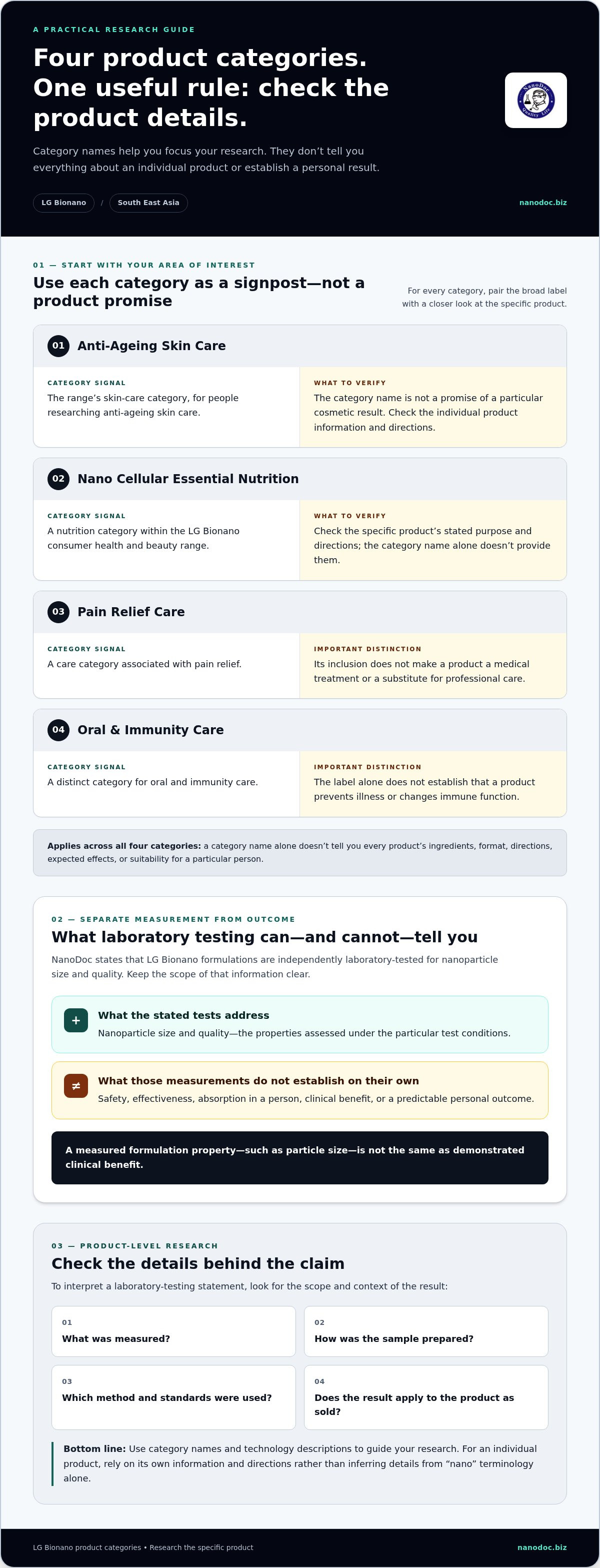
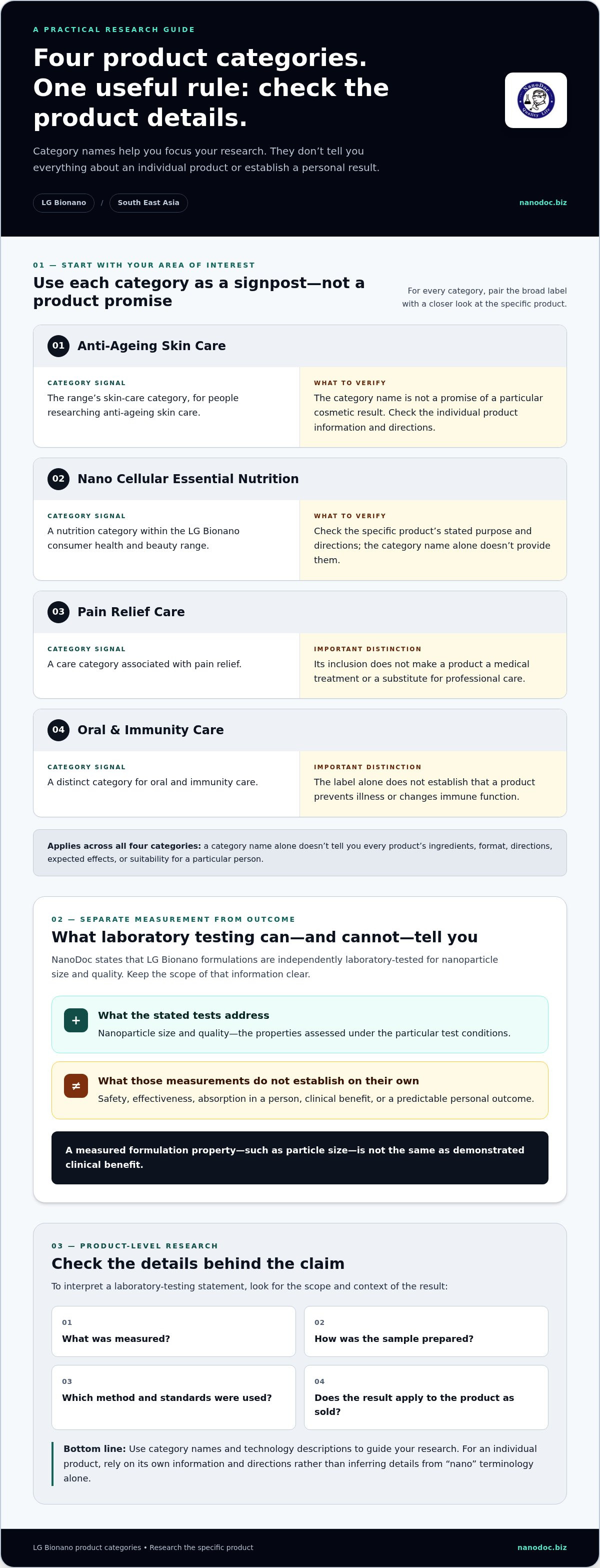
The portfolio includes four categories. Treat each as a broad signpost, then read the information for the specific product you’re considering. A category name alone doesn’t tell you the ingredients, format, directions or expected effects.
- Anti-Ageing Skin Care: The skin-care category. Its name indicates a general area of interest, not a promise of a particular cosmetic result.
- Nano Cellular Essential Nutrition: A nutrition category. Check individual product information for its stated purpose and directions.
- Pain Relief Care: A care category associated with pain relief. Its inclusion doesn’t make a product a medical treatment or a substitute for professional care.
- Oral & Immunity Care: A distinct category for oral and immunity care. The label alone doesn’t establish that a product prevents illness or changes immune function.
The term “nano” also appears in wider discussions of cosmetic formulation. The overview of Nanotechnology in cosmetics offers general context about nanomaterials and skincare, but it isn’t product-specific evidence about LG Bionano formulations or their effects. For an individual product decision, use its own label and directions rather than inferring details from a category or technology term.
This section provides product information, not medical advice or treatment recommendations. The categories can help you decide what to investigate, but they can’t diagnose a concern or determine whether a product is suitable for you. Use the available product information to guide further research, and seek qualified health advice for personal medical questions.
How LG Bionano’s Nano-Delivery Approach Is Described
LG Bionano describes its formulations as using patented bionano nano-delivery technology. That wording identifies the stated approach, but it doesn’t explain the precise formulation, demonstrate how a particular product behaves in the body or establish a health outcome. Patent terminology also needs context: without specific patent details and claims, it can’t show which technology or application is covered.
When researching LG Bionano products South East Asia, distinguish a formulation description from evidence of a result. NanoDoc’s formulations are independently laboratory-tested for nanoparticle size and quality. Those measurements relate to the properties assessed; they don’t alone demonstrate safety, effectiveness, absorption or a clinical benefit.
What nano-delivery terminology means for consumers
In general, nano-encapsulation refers to enclosing or associating a substance with a very small carrier, while nano-delivery describes a formulation approach involving nanoscale materials. These terms can refer to different technologies, so they shouldn’t be treated as proof of a specific mechanism in any individual product. For wider context on nanotechnology’s use in cosmetics, see the National Nanotechnology Initiative’s overview of Applications of Nanotechnology in Cosmetics.
Ingredients, formulation details and directions depend on the individual product. A broad technology description doesn’t tell you which ingredients are present or how to use them. For a general discussion of absorption, the guide to high bioavailability nutrients offers additional context, but product-specific labels remain the practical reference for use.
What independent laboratory testing can establish
LG Bionano formulations are independently tested for nanoparticle size and quality. Such testing can provide information about the properties assessed under the particular test conditions. To interpret a result, look at what was measured, how the sample was prepared, which method and standards were used, and whether the result applies to the product as sold. A general statement that a product is laboratory-tested doesn’t answer those questions by itself.
A measured formulation property, such as particle size, is not the same as demonstrated clinical benefit. Size and quality measurements don’t alone establish safety, effectiveness, absorption in a person or a predictable outcome. Those are distinct questions that require evidence relevant to each claim.
Use technology language as one part of your research, alongside the product’s ingredients and usage directions. To explore the range and its product information, visit NanoDoc’s product categories.
Compare the Four LG Bionano Product Categories by Intended Interest
The category names offer a first way to sort the range by broad area of interest. They aren’t rankings, and they don’t establish which option is suitable for a particular person. To compare LG Bionano products South East Asia, start with the category, then use individual product information to understand its stated purpose and directions.
Use this table as a research framework. It identifies the broad focus of each category and the details to look for in product-specific information, without assuming ingredients, formats or outcomes.
| Category | Broad area of interest | Information to review |
|---|---|---|
| Anti-Ageing Skin Care | Skin care | Product description, intended cosmetic use and directions |
| Nano Cellular Essential Nutrition | Nutrition | Product description, intended use and label directions |
| Pain Relief Care | Pain relief care | Product description, intended use and any usage guidance |
| Oral & Immunity Care | Oral and immunity care | Product description, intended use and label directions |
Start with the category, then check the individual product’s label information. This keeps your comparison grounded in what the product information actually says, rather than assumptions based on a category name.
Skin care and nutrition categories
Anti-Ageing Skin Care is the range’s skin-care category. Its name signals the area of interest, but it doesn’t guarantee a visible change or specify what an individual product will do. For a separate discussion of skin science, the anti-ageing dermal technology guide provides broader educational context; it should not be treated as evidence for a specific product.
Nano Cellular Essential Nutrition is a distinct nutrition category. Review the individual product description and directions to understand its stated purpose. Nutrition products shouldn’t be treated as substitutes for medical care or as a response to a diagnosed condition.
Pain relief and oral and immunity categories
Pain Relief Care is a category for readers interested in pain relief. The category name alone doesn’t establish a particular product form or make it a medical treatment. Refer to the individual product information for its stated use and directions, and avoid inferring more than the label supports.
Oral & Immunity Care is a separate category. Its name doesn’t establish that a product prevents illness or strengthens immunity. For related educational context, the guide to oral hygiene for immunity discusses the broader topic, while product decisions should rest on individual product information.
This comparison helps narrow your research without ranking the categories. Once you’ve identified the area that matches your interest, read the relevant product description and directions before deciding whether to explore it further.
What Nano-Technology Can, and Cannot, Tell You About Results
A nano-scale formulation description can tell you something about how a product is presented or formulated. It can’t predict what one person will experience. The term “nano” is not, by itself, proof of improved absorption, faster action, greater effectiveness or a specific health benefit.
When considering LG Bionano products South East Asia, keep three kinds of information distinct: measurements of product quality, evidence about ingredients, and clinical outcomes in people. Each answers a different question. A measurement may describe a property of a tested sample; ingredient research may provide context about a component; human clinical studies assess outcomes in people under defined conditions. One type of evidence doesn’t automatically establish the others.
How to read product and evidence claims
Start by identifying who is making a statement. A company description explains how the company characterises its formulation. An independent laboratory result can report what a particular test measured. Neither should be confused with a human clinical finding. LG Bionano formulations are independently tested for nanoparticle size and quality, but those measurements alone don’t demonstrate a personal health outcome.
For any product claim, look for evidence that matches the actual formulation and the outcome being discussed. If a study is cited, check what product or ingredient was studied, who took part, and under what conditions. Findings apply to the formulation, population and study conditions involved; they don’t automatically transfer to a different product or to every individual. General ingredient research isn’t proof of a finished product’s effects.
Be cautious with broad claims about absorption, speed or efficacy unless reliable evidence specific to the product supports them. Read the label and directions to understand the stated use, ingredients and instructions. Marketing language can prompt further research, but it shouldn’t be the basis for diagnosing a concern or making a medical decision.
When professional guidance matters
Supplements may not be appropriate for everyone. If you have an existing health condition, are pregnant, or take prescribed medication, consult a qualified health professional before use. They can consider your circumstances and help assess whether a product is suitable alongside your care. Don’t stop, change or replace prescribed treatment based on a consumer product description or technology claim.
Formulation technology alone cannot establish a clinical benefit; that requires relevant evidence of outcomes in people. Keeping this distinction clear allows you to assess product information without dismissing quality measurements or overstating what they prove. For category and product information, explore NanoDoc’s product range and use each product’s label and directions as part of your research.
Explore LG Bionano Products Through NanoDoc
NanoDoc International Pte Ltd is LG Bionano’s exclusive South East Asia representative. Start with the area that best matches your interest, then assess any individual product using its own description and label. This takes you from a broad category to relevant product information without assuming that a category name guarantees a particular result or suitability.
The portfolio is organised into four categories:
- Anti-Ageing Skin Care for those researching skin care.
- Nano Cellular Essential Nutrition for those exploring nutrition products.
- Pain Relief Care for those interested in this care category.
- Oral & Immunity Care for those researching oral and immunity care.
These categories are starting points, not rankings or medical recommendations. When exploring LG Bionano products South East Asia, review the specific product information rather than infer ingredients, directions or outcomes from a category title. Use the details provided for the product and relevant market when considering a purchase.
A practical product-research checklist
Before deciding whether an individual product is right for you, work through this review:
- Identify whether your interest is skin care, nutrition, pain relief, or oral and immunity care.
- Read the relevant product label and description, including any listed ingredients.
- Follow the product’s usage instructions, and don’t infer a dose or method of use from general technology claims.
- If you have a health-related question, an existing condition, are pregnant, or take prescribed medication, discuss product use with a qualified health professional.
This approach keeps the decision grounded in product-specific information. A category can help you find the right area to explore, but it can’t determine whether an individual product suits your circumstances. Consumer wellness products also don’t replace diagnosis or prescribed treatment.
Explore the range with NanoDoc
NanoDoc’s role as LG Bionano’s exclusive South East Asia representative provides a starting point for learning about the range. Explore the categories, compare information for products that match your interest, and use labels and directions to guide any individual decision. The aim is informed product research, not an assumption of guaranteed outcomes.
Explore LG Bionano products with NanoDoc to review the range and continue your research.
Take the Next Step in Your Product Research
Turn your area of interest into a focused product review. As you explore LG Bionano products South East Asia, note what you want to learn about a product, then compare that with its own label and usage directions. This keeps your decision anchored in product-specific information rather than broad category names or technology language.
NanoDoc is LG Bionano’s exclusive South East Asia representative, and LG Bionano formulations are independently tested for nanoparticle size and quality. Those details can inform your research, but they don’t determine whether a product is suitable for you or establish a personal result. For health-related questions, consider discussing the product and its information with a qualified health professional.
A measured approach makes it easier to explore the range with clear expectations. Explore LG Bionano products with NanoDoc and continue your research at a pace that works for you.
Frequently Asked Questions
Is nano-delivery proof that an LG Bionano product will work better?
No. Nano-delivery describes a formulation approach, not a guaranteed improvement in a person’s results. When considering LG Bionano products South East Asia, look for evidence relating to the specific product and the outcome being claimed. A laboratory measurement of nanoparticle size or quality answers a different question from whether people experienced a particular benefit. Treat broad technology language as a prompt to read product information, not as a reason to expect a guaranteed effect.
Are LG Bionano products medicines?
The portfolio is described in health and beauty categories, including skin care, nutrition, pain relief care, and oral and immunity care. These descriptions don’t establish that products diagnose, prevent, treat or cure disease. If you’re looking for treatment or managing a health condition, seek guidance from an appropriately qualified health professional. Use product descriptions to understand the stated category and directions, not to replace a medical assessment.
Can LG Bionano supplements replace prescribed medication?
No. The product information described here doesn’t support replacing prescribed medication with a supplement. Continue following your clinician’s instructions, and discuss supplement use with a qualified health professional, especially if you take medication or are managing a condition. For a practical discussion, bring the product label or ingredient information to that conversation. Don’t change a prescribed dose or stop treatment based on a wellness product’s category or technology claims.
What should I consider before using a wellness product during pregnancy?
Ask a qualified health professional before using a wellness product during pregnancy. Suitability can depend on the particular product, its ingredients and your circumstances, so don’t infer that a product is suitable from its category or a general description of its formulation. Read the specific label and directions, and share that information with your health professional when seeking advice. Avoid starting a product based only on broad brand or technology claims.
Does nanoparticle-size testing prove that a product is safe?
No. A nanoparticle-size result describes a measured characteristic; it doesn’t automatically establish every aspect of safety. Interpretation depends on the product and the test method, among other factors. LG Bionano formulations undergo independent testing for nanoparticle size and quality, but those measurements alone shouldn’t be treated as proof of safety or clinical effectiveness. Avoid drawing conclusions beyond what the test actually measured and reported.
Can skin-care and nutrition products be used together?
The category names alone can’t establish whether two specific products are suitable for combined use. Read each product’s label and directions, and consider your personal circumstances and any other products you use. For example, if you have a sensitivity, medical condition or ongoing treatment, ask a qualified health professional for individual guidance before combining products. Don’t assume that products can be paired simply because they belong to different categories.
How can I check whether an LG Bionano product is genuine?
Start with NanoDoc’s product information, since NanoDoc is LG Bionano’s South East Asia representative. Compare the packaging and label of the item you’re considering with the information provided for that specific product, including its name and directions. Branding or nano-technology language alone doesn’t verify authenticity or quality. If a detail differs, don’t guess what it means; rely on official product information relevant to that item.
Frequently Asked Questions
- Which product categories are in the range?
- The portfolio includes four categories. Treat each as a broad signpost, then read the information for the specific product you’re considering. A category name alone doesn’t tell you the ingredients, format, directions or expected effects. The term “nano” also appears in wider discussions of cosmetic formulation. The overview of Nanotechnology in cosmetics offers general context about nanomaterials and skincare, but it isn’t product-specific evidence about LG Bionano formulations or their effects. For an individual product decision, use its own label and directions rather than inferring details from a category or technology term. This section provides product information, not medical advice or treatment recommendations. The categories can help you decide what to investigate, but they can’t diagnose a concern or determine whether a product is suitable for you. Use the available product information to guide further research, and seek qualified health advice for personal medical questions. LG Bionano describes its formulations as using patented bionano nano-delivery technology. That wording identifies the stated approach, but it doesn’t explain the precise formulation, demonstrate how a particular product behaves in the body or establish a health outcome. Patent terminology also needs context: without specific patent details and claims, it can’t show which technology or application is covered. When researching LG Bionano products South East Asia, distinguish a formulation description from evidence of a result. NanoDoc’s formulations are independently laboratory-tested for nanoparticle size and quality. Those measurements relate to the properties assessed; they don’t alone demonstrate safety, effectiveness, absorption or a clinical benefit.
- Is nano-delivery proof that an LG Bionano product will work better?
- No. Nano-delivery describes a formulation approach, not a guaranteed improvement in a person’s results. When considering LG Bionano products South East Asia, look for evidence relating to the specific product and the outcome being claimed. A laboratory measurement of nanoparticle size or quality answers a different question from whether people experienced a particular benefit. Treat broad technology language as a prompt to read product information, not as a reason to expect a guaranteed effect.
- Are LG Bionano products medicines?
- The portfolio is described in health and beauty categories, including skin care, nutrition, pain relief care, and oral and immunity care. These descriptions don’t establish that products diagnose, prevent, treat or cure disease. If you’re looking for treatment or managing a health condition, seek guidance from an appropriately qualified health professional. Use product descriptions to understand the stated category and directions, not to replace a medical assessment.
- Can LG Bionano supplements replace prescribed medication?
- No. The product information described here doesn’t support replacing prescribed medication with a supplement. Continue following your clinician’s instructions, and discuss supplement use with a qualified health professional, especially if you take medication or are managing a condition. For a practical discussion, bring the product label or ingredient information to that conversation. Don’t change a prescribed dose or stop treatment based on a wellness product’s category or technology claims.
- What should I consider before using a wellness product during pregnancy?
- Ask a qualified health professional before using a wellness product during pregnancy. Suitability can depend on the particular product, its ingredients and your circumstances, so don’t infer that a product is suitable from its category or a general description of its formulation. Read the specific label and directions, and share that information with your health professional when seeking advice. Avoid starting a product based only on broad brand or technology claims.
- Does nanoparticle-size testing prove that a product is safe?
- No. A nanoparticle-size result describes a measured characteristic; it doesn’t automatically establish every aspect of safety. Interpretation depends on the product and the test method, among other factors. LG Bionano formulations undergo independent testing for nanoparticle size and quality, but those measurements alone shouldn’t be treated as proof of safety or clinical effectiveness. Avoid drawing conclusions beyond what the test actually measured and reported.
- Can skin-care and nutrition products be used together?
- The category names alone can’t establish whether two specific products are suitable for combined use. Read each product’s label and directions, and consider your personal circumstances and any other products you use. For example, if you have a sensitivity, medical condition or ongoing treatment, ask a qualified health professional for individual guidance before combining products. Don’t assume that products can be paired simply because they belong to different categories.
- How can I check whether an LG Bionano product is genuine?
- Start with NanoDoc’s product information, since NanoDoc is LG Bionano’s South East Asia representative. Compare the packaging and label of the item you’re considering with the information provided for that specific product, including its name and directions. Branding or nano-technology language alone doesn’t verify authenticity or quality. If a detail differs, don’t guess what it means; rely on official product information relevant to that item.