

What if the most useful first step for joint discomfort isn’t a quick fix, but a few sensible measures used consistently? When pain or stiffness interferes with movement, sleep, or everyday tasks, it’s understandable to look for relief at home. Online claims can make it difficult to tell which home remedies for joint pain and inflammation may offer comfort and which promises go beyond the evidence.
This guide covers practical measures such as gentle movement, heat or cold, and changes to daily routines. It also explains how to weigh claims about supplements and topical products without mistaking product information for proof that a treatment addresses inflammation or a diagnosed condition. Most importantly, it outlines signs that self-care may not be enough and symptoms that call for prompt medical assessment. Use it as a measured starting point, not a substitute for care when joint symptoms need professional attention.
Key Takeaways
- Home remedies for joint pain and inflammation may support comfort, but they don’t diagnose or resolve every underlying cause.
- Compare heat, cold, movement, topical products, and supplements by their intended use, evidence, and safety considerations.
- Protect your skin when using heat or cold, and stop any measure that worsens pain or causes irritation or another concerning reaction.
- Use a simple routine: note your symptoms, try one suitable measure, monitor the response, and reassess.
- Know when ongoing or concerning symptoms call for medical assessment rather than continued self-care alone.
Table of Contents
- What home remedies for joint pain and inflammation can, and cannot, do
- Home remedies for joint pain: practical measures to consider
- Comparing popular remedies: evidence, expectations, and safety
- A safe home-care routine: monitor symptoms and know when to stop
- Choosing a measured next step for joint comfort
What home remedies for joint pain and inflammation can, and cannot, do
Home remedies for joint pain and inflammation are self-care measures intended to support comfort and everyday function. They may help manage symptoms, but they cannot identify why a joint hurts or reliably treat every underlying cause. A measure that feels soothing is not, by itself, evidence that inflammation has been reduced or a disease has changed.
Joint pain describes a symptom; inflammation is a biological process that may involve swelling, warmth, and tenderness. The terms are related, but they aren’t interchangeable diagnoses. The Arthralgia (joint pain) overview distinguishes arthralgia from arthritis, a condition involving joint inflammation. Similar discomfort can have different causes, so pain intensity alone can’t reveal the cause or determine the right care.
In brief: home remedies may ease symptoms temporarily, but symptom relief is not the same as treating the condition causing them. The cause, duration, severity, and accompanying symptoms all affect whether self-care is suitable. A brief ache after unusual activity may call for a different response than persistent or worsening pain.
What does joint inflammation feel like?
Inflammation may be associated with visible swelling, warmth around a joint, tenderness to touch, stiffness, or difficulty moving through your usual range. Symptoms vary: one person may notice stiffness, while another mainly experiences swelling or restricted movement. These signs can occur with different conditions and don’t confirm a diagnosis on their own. Pain intensity also doesn’t reliably show how serious the cause is.
When should home remedies be viewed as supportive care?
Think of self-care as support, not a replacement for assessment or prescribed treatment. If you already have a care plan, don’t stop or change it because a home measure seems to help. Comfort may improve while the underlying cause remains, and limited relief doesn’t establish that a condition is worsening. Keeping this distinction in mind helps set realistic expectations.
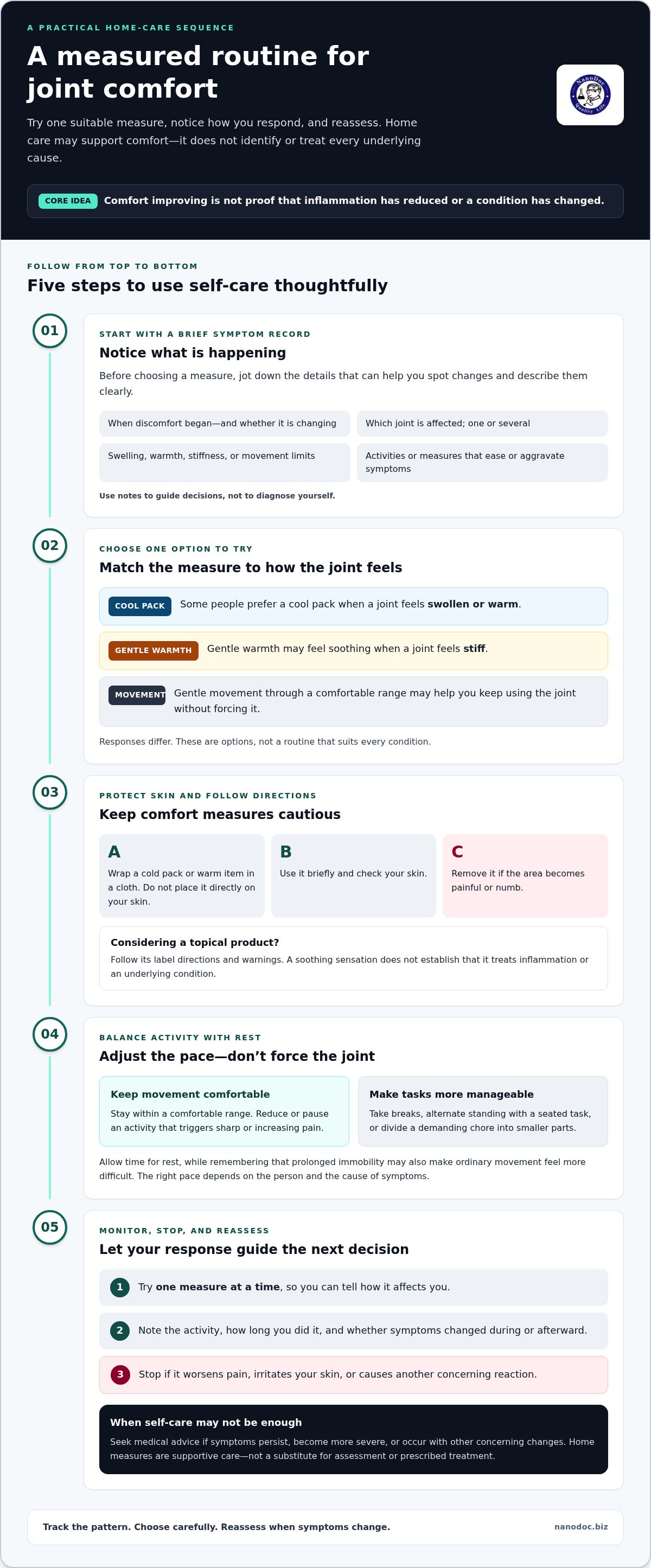
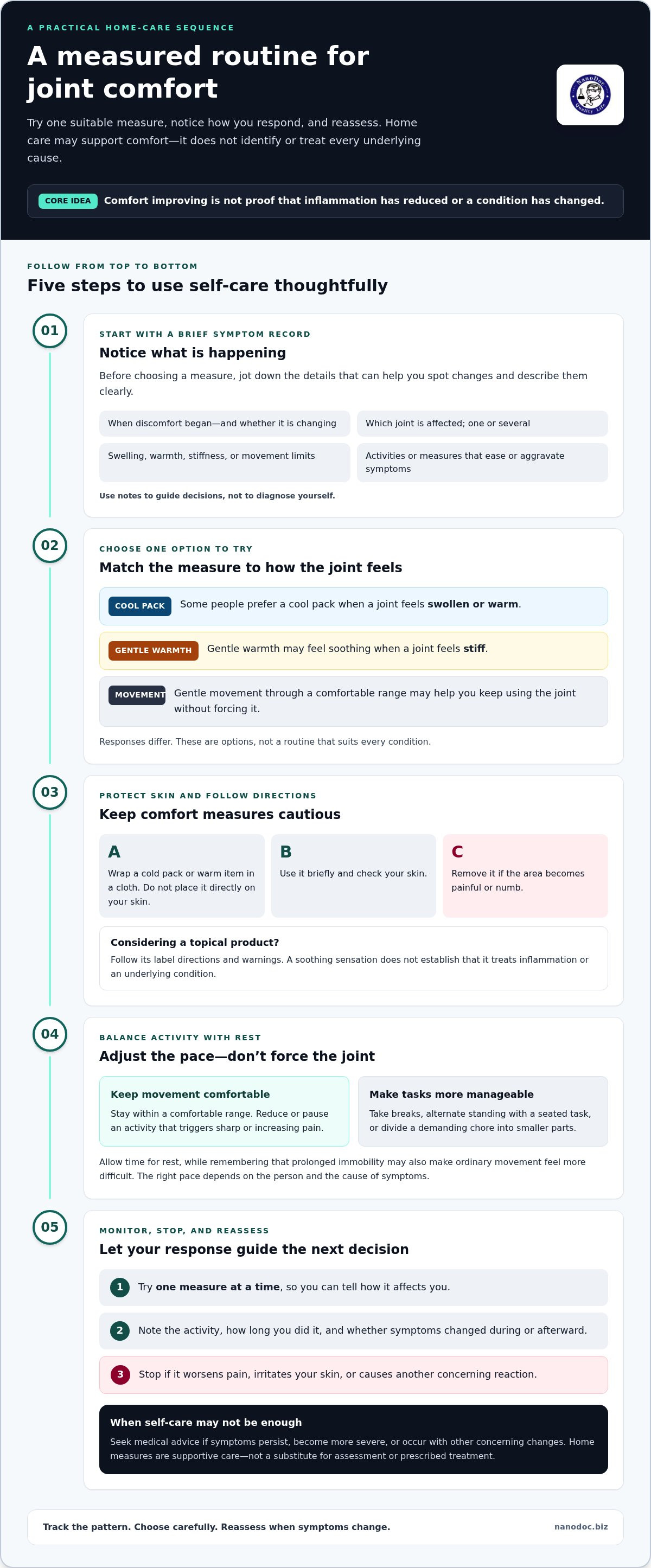
Tracking symptoms can make changes easier to describe and patterns easier to notice. Briefly record:
- When the discomfort began and whether it is changing
- Which joint is affected and whether one or several are involved
- Swelling, warmth, stiffness, or limits on movement
- Which activities or measures seem to ease or aggravate symptoms
Use these notes to guide decisions, not to diagnose yourself. If symptoms persist, become more severe, or occur with other concerning changes, seek medical advice rather than relying on home remedies alone. The next sections cover practical comfort measures and how to weigh their evidence and safety.
Home remedies for joint pain: practical measures to consider
Some home measures may make movement or daily tasks more comfortable, but results vary. The aim of home remedies for joint pain and inflammation is to support symptoms, not to guarantee reduced inflammation or treat its cause. Start with an option that suits the joint and your symptoms, then adjust based on how you respond.
Heat, cold, gentle movement, and careful pacing may offer comfort for some people. Protect your skin, stay within a comfortable range, and stop if symptoms worsen. These approaches aren’t suitable for every joint problem, so treat them as options rather than a substitute for prescribed care.
Heat, cold, and topical comfort measures
Some people prefer a cool pack when a joint feels swollen or warm, while gentle warmth may feel soothing for stiffness. Responses differ. Wrap a cold pack or warm item in a cloth rather than placing it directly on your skin. Use it briefly, check your skin, and remove it if the area becomes painful or numb.
Topical products are another possible comfort option. Follow the product label for directions and warnings, and don’t assume that a soothing sensation means the product treats inflammation or an underlying condition. Harvard Health’s overview of ways to relieve osteoarthritis pain also discusses practical measures such as heat, cold, and exercise.
Gentle movement, rest, and daily pacing
Gentle movement through a comfortable range can help you keep using a joint without forcing it. That’s different from pushing through sharp or increasing pain. Reduce or pause an activity that triggers that response, and allow time for rest. Prolonged immobility may also make ordinary movement feel more difficult, so balance activity with breaks as your symptoms allow.
Adjust tasks rather than abandoning all movement. For example, alternate standing with a seated task, or break a demanding chore into smaller parts. The right pace depends on the person and the cause of symptoms, so a general routine won’t suit every condition.
- Choose one measure at a time so you can tell how it affects you.
- Note the activity, how long you did it, and whether symptoms changed during or afterward.
- Stop a measure if it worsens pain, irritates your skin, or causes another concerning reaction.
A simple activity record may reveal which tasks or approaches tend to aggravate or ease discomfort. It can also help you explain changes to a healthcare professional if you need further assessment. NanoDoc’s Pain Relief Care category includes topical comfort options. Consider the product’s intended use and label information when deciding whether it fits your needs.
Comparing popular remedies: evidence, expectations, and safety
Different approaches have different aims. Heat or cold may change how a joint feels; movement may support mobility and function; topical products and supplements depend on their ingredients and the evidence for a particular use. These effects shouldn’t be treated as proof that a remedy reduces inflammation or changes the course of joint disease. The best fit depends on your symptoms, the product or activity, and individual health factors.
Natural origin doesn’t guarantee safety or effectiveness. Consider the evidence and possible risks, not just a remedy’s source or popularity.
| Approach | Possible purpose | What evidence can suggest | Key caution |
|---|---|---|---|
| Heat | Temporary comfort for stiffness | Some people find warmth soothing, but responses vary; comfort isn’t proof of reduced inflammation. | Protect skin with a cloth barrier and stop if it becomes painful or numb. |
| Cold | Temporary comfort when a joint feels swollen or warm | May feel helpful to some people; it doesn’t identify or treat the cause of swelling. | Avoid direct skin contact and stop if the area becomes painful or numb. |
| Movement | Maintain mobility and support everyday function | Appropriate activity may help function, but needs to suit the person and symptoms. | Don’t push through sharp or worsening pain; seek advice if movement aggravates symptoms. |
| Topical products | Local comfort, depending on the formulation | Evidence relates to specific ingredients and uses, not every product in this category. | Read the full label, active ingredients, directions, and warnings. |
| Supplements | Intended nutritional support | Evidence varies by ingredient, dose, condition, and study quality; claims aren’t interchangeable. | Potential interactions are possible. Discuss use with a healthcare professional, especially if you take medicines. |
Do supplements or dietary changes reduce joint pain?
A balanced eating pattern can support general health, but describing a diet as “anti-inflammatory” doesn’t establish that it treats joint disease. Supplement research is not uniform: findings for glucosamine and chondroitin, for example, have been inconsistent, while omega-3 evidence for supporting a healthy inflammatory response is more robust but modest. Neither a label nor an ingredient alone guarantees an effect for a particular person. Before starting a supplement, review it with a healthcare professional or pharmacist, since ingredients may interact with medicines or be unsuitable in some circumstances.
How should readers assess topical products and online claims?
Check the full product label, including active ingredients, directions, warnings, and relevant precautions. Be cautious of cure-all language, guaranteed timelines, or claims that a product reverses joint disease. NanoDoc International’s Pain Relief Care category includes topical comfort options. When weighing a product, focus on its specific ingredients and intended use, and don’t let an unverified claim delay assessment of persistent or concerning symptoms.
A safe home-care routine: monitor symptoms and know when to stop
A simple routine can help you make deliberate choices rather than adding remedies one after another. Home remedies for joint pain and inflammation are most appropriate when symptoms are mild and there are no warning signs that need prompt assessment. They shouldn’t delay care for severe, sudden, or rapidly changing symptoms.
Use this sequence:
- Note what’s happening. Record when symptoms began, which joint is affected, and whether there’s swelling, stiffness, or restricted movement.
- Choose one suitable measure. Select an approach that fits the symptoms and follow relevant product instructions.
- Observe the response. Note whether comfort or movement changes, and whether the measure causes a new symptom.
- Reassess. Stop a measure that worsens pain, irritates the skin, or causes another concerning reaction. Seek medical advice if symptoms persist, recur, or worsen.
What symptoms should be recorded?
Keep a brief record of the symptom pattern, not just a pain score. Include when symptoms began, where they occur, whether there’s swelling or stiffness, and how movement is affected. Note activities before symptoms changed, the self-care measure used, and what happened afterward. Record new symptoms or changes, too. These details can help a healthcare professional assess the problem and its possible causes, but they can’t confirm a diagnosis on their own.
When is medical assessment more appropriate than self-care?
Seek prompt medical assessment for sudden, severe pain; marked swelling; a joint that feels hot; fever alongside joint symptoms; or difficulty moving the joint normally. Get assessed promptly after a significant injury or if symptoms are worsening quickly. These signs can have different causes, and a healthcare professional can evaluate them rather than relying on self-treatment.
Recurring or persistent symptoms also deserve attention, especially if they interfere with sleep, movement, or everyday activities. Repeating a remedy may temporarily change how a joint feels without addressing why symptoms continue. Arrange an assessment instead of extending self-care indefinitely, and bring your symptom notes and a list of any products or supplements you’ve used.
For less urgent discomfort, reassess whether your chosen measure is helping and remains comfortable and safe to use. NanoDoc’s Pain Relief Care options include topical comfort products. Consider their intended use and safety information alongside your symptoms, and seek medical assessment when needed.
Choosing a measured next step for joint comfort
Use a consistent decision process rather than choosing a remedy by popularity. Consider the symptom pattern, whether a measure suits the joint and your circumstances, its safety instructions, your response, and whether the symptoms call for medical assessment. Home care is most useful when it helps you make a thoughtful next choice, not when it delays attention to a problem that needs evaluation.
- Start with the pattern. Consider where discomfort occurs, what brings it on, how long it has lasted, and whether swelling, warmth, stiffness, or movement limits are present.
- Match the measure to the goal. A comfort strategy may help you manage a symptom without addressing its cause. Don’t treat temporary relief as proof that inflammation or disease has changed.
- Check safety and suitability. Follow product directions, consider skin sensitivity and other health factors, and seek professional advice if you’re unsure about a product or supplement.
- Review the response. Continue only if a measure remains comfortable and doesn’t cause a concerning reaction. Reassess or seek medical assessment if symptoms persist, recur, or worsen.
Topical pain-relief care is one option for local comfort. Whether a product suits you depends on its ingredients, intended use, and safety information. The relevant evidence also depends on the quality of research for that specific use.
What to look for in a topical pain-relief product
Read the complete label before use. Check the ingredients, directions, warnings, and stated intended use, then follow the instructions. A product may not suit everyone: skin sensitivity, existing health conditions, or medicines you take can affect whether it’s appropriate. If the label doesn’t answer a safety question, discuss it with a healthcare professional or pharmacist rather than guessing or applying more than directed.
How should delivery technology inform expectations?
Formulation and delivery characteristics describe how a product is designed; they don’t independently establish symptom relief or clinical benefit. NanoDoc states that its formulations are independently laboratory-tested for nanoparticle size and quality. This testing concerns those characteristics, not proof that a topical product reduces inflammation or treats a joint condition. The article on high bioavailability nutrients offers further context on delivery technology, which should be distinguished from evidence of a specific health outcome.
For a measured next step, compare a product’s intended use with your comfort goals and personal safety considerations. If you’d like to review topical comfort options, explore NanoDoc’s Pain Relief Care category. Use product information to understand the option, and seek assessment if your symptoms warrant it.
Choose a next step that fits your needs
Set a practical goal for your next step. It might be making a daily task more comfortable, understanding what tends to aggravate a joint, or deciding that symptoms need professional assessment. This keeps home remedies for joint pain and inflammation in perspective: the aim is informed support, not proof that an underlying cause has been resolved.
If you’re considering a topical option, review its intended use and safety information, and treat any comfort benefit as separate from evidence of disease treatment. NanoDoc states that its formulations are independently laboratory-tested for nanoparticle size and quality. This describes formulation testing, not proof of clinical effectiveness.
Explore NanoDoc’s Pain Relief Care for topical comfort options. Keep your next choice measured, and seek medical assessment if your symptoms warrant it.
Frequently Asked Questions
What are the best home remedies for joint pain?
The best home remedies for joint pain and inflammation depend on the symptom pattern, the joint involved, and your health circumstances. For example, discomfort after an unusually active day may call for a different approach than recurring stiffness that limits routine tasks. Choose one measure at a time and judge it by comfort and function, not by claims that it can cure a condition. Stop if symptoms worsen.
Does heat or ice help joint inflammation?
Cold may feel more soothing when a joint is swollen or warm, while heat may feel more comfortable for stiffness. Neither option works for everyone, and a change in sensation doesn’t show that inflammation has resolved. Avoid applying extreme temperatures directly to skin, and don’t use heat or cold on an area with reduced sensation unless a healthcare professional has advised you how to do so.
Can walking or exercise make joint pain better?
Gentle activity may help preserve mobility, but the suitable type and intensity depend on what is causing the pain. If ordinary walking feels comfortable, an easy walk on level ground may be a reasonable way to observe how the joint responds. Don’t use exercise to test how much pain you can tolerate. If discomfort increases during activity or remains worse afterward, pause and seek advice before continuing.
Do supplements reduce joint pain and inflammation?
Some supplements are promoted for joint symptoms, but evidence varies by ingredient, dose, condition, and research quality. Before trying one, note the exact product and ingredient amounts, then review them with a doctor or pharmacist alongside your current medicines. Avoid starting several supplements at once, since that can make it harder to identify a reaction or determine which product may be affecting your symptoms.
Are topical pain-relief gels safe to use on joints?
Safety depends on the gel’s ingredients, label instructions, skin condition, and individual health factors. Check the intended use and warnings, and avoid combining topical products unless a healthcare professional says it’s appropriate. Delivery technology or a product’s presence in a pain-relief category doesn’t establish that it reduces inflammation or treats a joint condition. Stop using it and seek advice if you develop a concerning skin or other reaction.
When should I see a doctor for joint pain?
Seek prompt medical assessment for sudden, severe pain, substantial swelling, a hot joint with fever, a significant injury, or inability to move the joint normally. Arrange an assessment if symptoms are worsening, keep returning, or continue to interfere with everyday activities. A clinician can examine the joint and consider possible causes; home care alone can’t determine what is responsible. Don’t delay assessment to try additional remedies if symptoms are concerning.
Frequently Asked Questions
- What does joint inflammation feel like?
- Inflammation may be associated with visible swelling, warmth around a joint, tenderness to touch, stiffness, or difficulty moving through your usual range. Symptoms vary: one person may notice stiffness, while another mainly experiences swelling or restricted movement. These signs can occur with different conditions and don’t confirm a diagnosis on their own. Pain intensity also doesn’t reliably show how serious the cause is.
- When should home remedies be viewed as supportive care?
- Think of self-care as support, not a replacement for assessment or prescribed treatment. If you already have a care plan, don’t stop or change it because a home measure seems to help. Comfort may improve while the underlying cause remains, and limited relief doesn’t establish that a condition is worsening. Keeping this distinction in mind helps set realistic expectations. Tracking symptoms can make changes easier to describe and patterns easier to notice. Briefly record: Use these notes to guide decisions, not to diagnose yourself. If symptoms persist, become more severe, or occur with other concerning changes, seek medical advice rather than relying on home remedies alone. The next sections cover practical comfort measures and how to weigh their evidence and safety. Some home measures may make movement or daily tasks more comfortable, but results vary. The aim of home remedies for joint pain and inflammation is to support symptoms, not to guarantee reduced inflammation or treat its cause. Start with an option that suits the joint and your symptoms, then adjust based on how you respond. Heat, cold, gentle movement, and careful pacing may offer comfort for some people. Protect your skin, stay within a comfortable range, and stop if symptoms worsen. These approaches aren’t suitable for every joint problem, so treat them as options rather than a substitute for prescribed care.
- Do supplements or dietary changes reduce joint pain?
- A balanced eating pattern can support general health, but describing a diet as “anti-inflammatory” doesn’t establish that it treats joint disease. Supplement research is not uniform: findings for glucosamine and chondroitin, for example, have been inconsistent, while omega-3 evidence for supporting a healthy inflammatory response is more robust but modest. Neither a label nor an ingredient alone guarantees an effect for a particular person. Before starting a supplement, review it with a healthcare professional or pharmacist, since ingredients may interact with medicines or be unsuitable in some circumstances.
- How should readers assess topical products and online claims?
- Check the full product label, including active ingredients, directions, warnings, and relevant precautions. Be cautious of cure-all language, guaranteed timelines, or claims that a product reverses joint disease. NanoDoc International’s Pain Relief Care category includes topical comfort options. When weighing a product, focus on its specific ingredients and intended use, and don’t let an unverified claim delay assessment of persistent or concerning symptoms. A simple routine can help you make deliberate choices rather than adding remedies one after another. Home remedies for joint pain and inflammation are most appropriate when symptoms are mild and there are no warning signs that need prompt assessment. They shouldn’t delay care for severe, sudden, or rapidly changing symptoms. Use this sequence:
- What symptoms should be recorded?
- Keep a brief record of the symptom pattern, not just a pain score. Include when symptoms began, where they occur, whether there’s swelling or stiffness, and how movement is affected. Note activities before symptoms changed, the self-care measure used, and what happened afterward. Record new symptoms or changes, too. These details can help a healthcare professional assess the problem and its possible causes, but they can’t confirm a diagnosis on their own.
- When is medical assessment more appropriate than self-care?
- Seek prompt medical assessment for sudden, severe pain; marked swelling; a joint that feels hot; fever alongside joint symptoms; or difficulty moving the joint normally. Get assessed promptly after a significant injury or if symptoms are worsening quickly. These signs can have different causes, and a healthcare professional can evaluate them rather than relying on self-treatment. Recurring or persistent symptoms also deserve attention, especially if they interfere with sleep, movement, or everyday activities. Repeating a remedy may temporarily change how a joint feels without addressing why symptoms continue. Arrange an assessment instead of extending self-care indefinitely, and bring your symptom notes and a list of any products or supplements you’ve used. For less urgent discomfort, reassess whether your chosen measure is helping and remains comfortable and safe to use. NanoDoc’s Pain Relief Care options include topical comfort products. Consider their intended use and safety information alongside your symptoms, and seek medical assessment when needed. Use a consistent decision process rather than choosing a remedy by popularity. Consider the symptom pattern, whether a measure suits the joint and your circumstances, its safety instructions, your response, and whether the symptoms call for medical assessment. Home care is most useful when it helps you make a thoughtful next choice, not when it delays attention to a problem that needs evaluation. Topical pain-relief care is one option for local comfort. Whether a product suits you depends on its ingredients, intended use, and safety information. The relevant evidence also depends on the quality of research for that specific use.
- How should delivery technology inform expectations?
- Formulation and delivery characteristics describe how a product is designed; they don’t independently establish symptom relief or clinical benefit. NanoDoc states that its formulations are independently laboratory-tested for nanoparticle size and quality. This testing concerns those characteristics, not proof that a topical product reduces inflammation or treats a joint condition. The article on high bioavailability nutrients offers further context on delivery technology, which should be distinguished from evidence of a specific health outcome. For a measured next step, compare a product’s intended use with your comfort goals and personal safety considerations. If you’d like to review topical comfort options, explore NanoDoc’s Pain Relief Care category. Use product information to understand the option, and seek assessment if your symptoms warrant it. Set a practical goal for your next step. It might be making a daily task more comfortable, understanding what tends to aggravate a joint, or deciding that symptoms need professional assessment. This keeps home remedies for joint pain and inflammation in perspective: the aim is informed support, not proof that an underlying cause has been resolved. If you’re considering a topical option, review its intended use and safety information, and treat any comfort benefit as separate from evidence of disease treatment. NanoDoc states that its formulations are independently laboratory-tested for nanoparticle size and quality. This describes formulation testing, not proof of clinical effectiveness. Explore NanoDoc’s Pain Relief Care for topical comfort options. Keep your next choice measured, and seek medical assessment if your symptoms warrant it.
- What are the best home remedies for joint pain?
- The best home remedies for joint pain and inflammation depend on the symptom pattern, the joint involved, and your health circumstances. For example, discomfort after an unusually active day may call for a different approach than recurring stiffness that limits routine tasks. Choose one measure at a time and judge it by comfort and function, not by claims that it can cure a condition. Stop if symptoms worsen.
- Does heat or ice help joint inflammation?
- Cold may feel more soothing when a joint is swollen or warm, while heat may feel more comfortable for stiffness. Neither option works for everyone, and a change in sensation doesn’t show that inflammation has resolved. Avoid applying extreme temperatures directly to skin, and don’t use heat or cold on an area with reduced sensation unless a healthcare professional has advised you how to do so.
- Can walking or exercise make joint pain better?
- Gentle activity may help preserve mobility, but the suitable type and intensity depend on what is causing the pain. If ordinary walking feels comfortable, an easy walk on level ground may be a reasonable way to observe how the joint responds. Don’t use exercise to test how much pain you can tolerate. If discomfort increases during activity or remains worse afterward, pause and seek advice before continuing.
- Do supplements reduce joint pain and inflammation?
- Some supplements are promoted for joint symptoms, but evidence varies by ingredient, dose, condition, and research quality. Before trying one, note the exact product and ingredient amounts, then review them with a doctor or pharmacist alongside your current medicines. Avoid starting several supplements at once, since that can make it harder to identify a reaction or determine which product may be affecting your symptoms.
- Are topical pain-relief gels safe to use on joints?
- Safety depends on the gel’s ingredients, label instructions, skin condition, and individual health factors. Check the intended use and warnings, and avoid combining topical products unless a healthcare professional says it’s appropriate. Delivery technology or a product’s presence in a pain-relief category doesn’t establish that it reduces inflammation or treats a joint condition. Stop using it and seek advice if you develop a concerning skin or other reaction.
- When should I see a doctor for joint pain?
- Seek prompt medical assessment for sudden, severe pain, substantial swelling, a hot joint with fever, a significant injury, or inability to move the joint normally. Arrange an assessment if symptoms are worsening, keep returning, or continue to interfere with everyday activities. A clinician can examine the joint and consider possible causes; home care alone can’t determine what is responsible. Don’t delay assessment to try additional remedies if symptoms are concerning.