

What if the wellness product with the most impressive claims isn’t the one that best suits your needs? Claims about advanced delivery, bioavailability and testing can make high performance wellness products difficult to compare. Focus instead on the formulation, quality information and label directions, then ask what each detail actually tells you.
It’s reasonable to look for evidence behind a product’s claims, but every technical term and test result has a specific scope. Testing for nanoparticle size and quality, for example, provides information about those properties. It doesn’t by itself establish a product’s effects or suitability for you. NanoDoc International states that its formulations undergo independent laboratory testing for nanoparticle size and quality.
This practical 2026 checklist will help you assess formulation, quality evidence, intended use and directions without overstating what any one detail proves. You’ll also learn how to compare topical care, nutrition, pain-relief care, and oral and immunity care, and how to choose a category that fits your intended use.
Key Takeaways
- Start with the product’s intended purpose and label directions. Check that the format fits how you plan to use it.
- Assess high performance wellness products by reviewing formulation details and relevant quality evidence, not technical language alone.
- Compare products within the same category, considering their route of use and the quality information available.
- Keep test results within their stated scope: a result about one formulation property doesn’t prove a particular consumer outcome.
- Treat delivery technology as one factor in your evaluation, not a guarantee of suitability or effect.
Table of Contents
- What Makes a Wellness Product High-Performance? Start with Its Purpose
- Assess Formulation, Delivery Technology, and Quality Evidence
- Compare Topical, Nutritional, and Oral Wellness Products Fairly
- Use This Checklist Before Choosing a Wellness Product
- Explore NanoDoc’s Formulation-Led Approach to Wellness
What Makes a Wellness Product High-Performance? Start with Its Purpose
Assess a wellness product against the purpose it is designed to serve, not the intensity of its marketing. “High-performance” can signal a formulation-led approach, but it isn’t a standard measure of results or proof that a product will work for every person. First identify what the product is intended for, then check whether its format and directions fit that use.
A high-performance wellness product is one whose intended use, formulation and relevant quality evidence are clearly described, so consumers can judge whether it fits their needs. This definition focuses on attributes you can assess. It separates them from promotional language and claims that every person will experience a particular result.
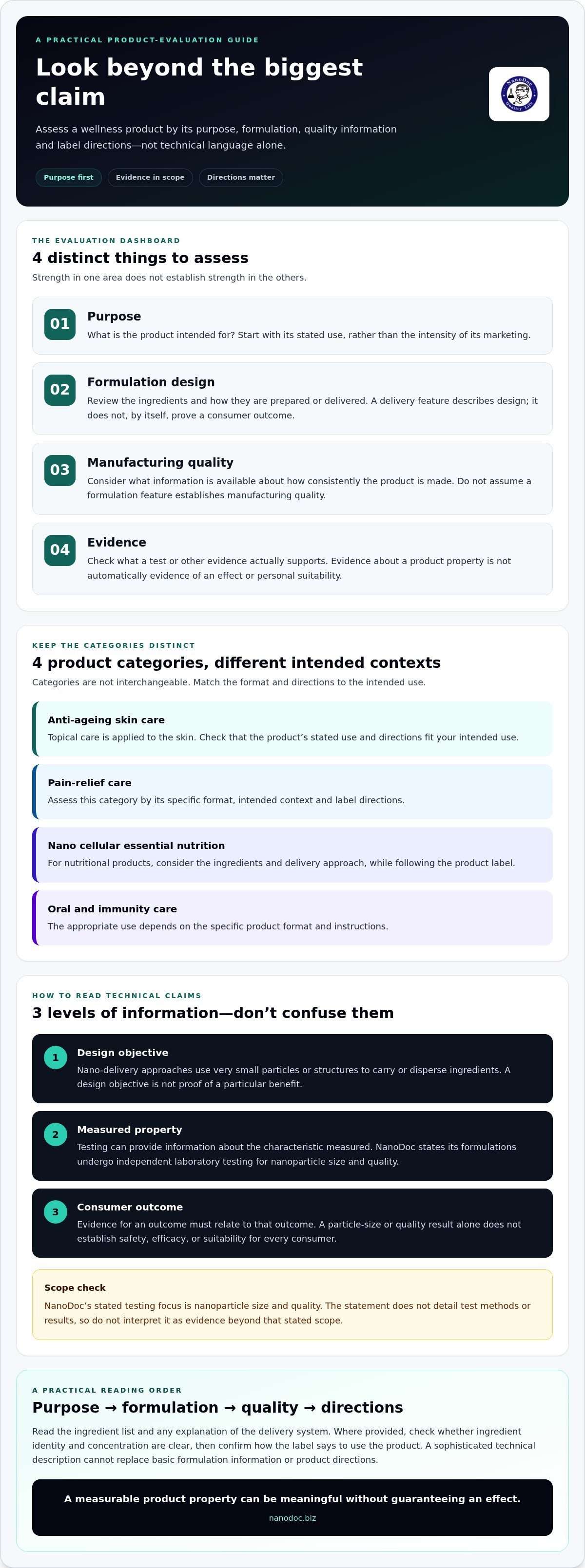
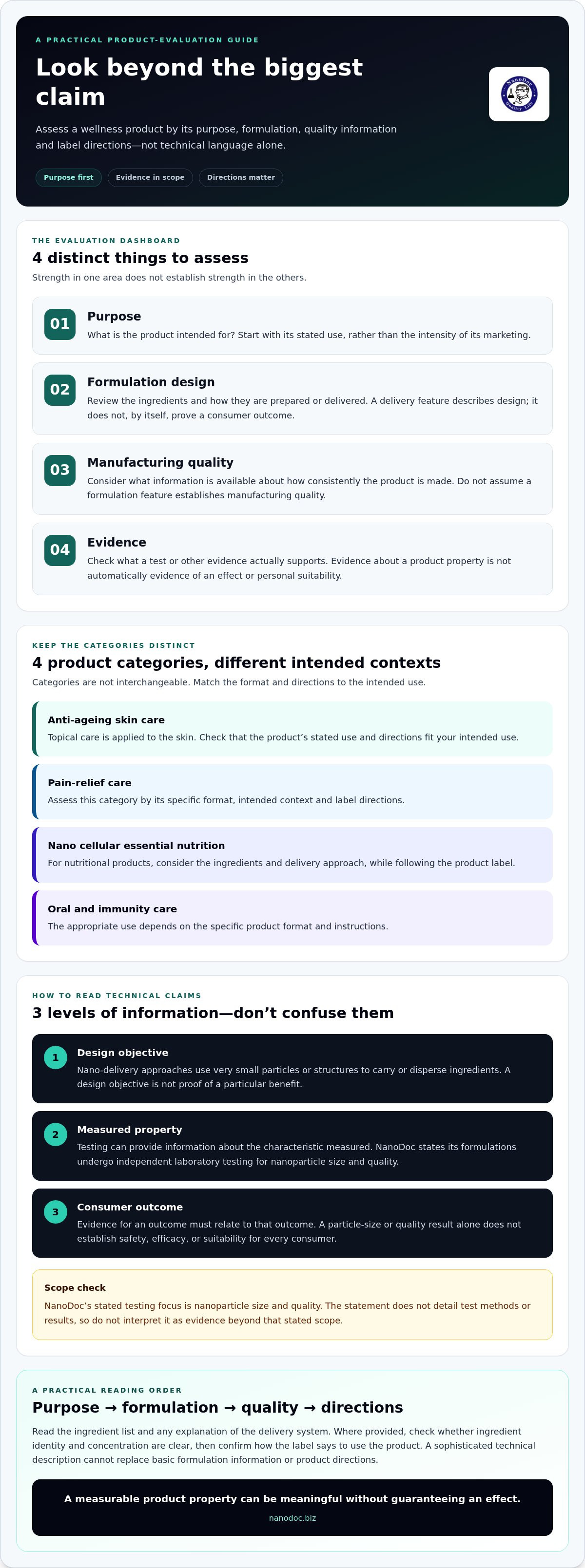
Keep four criteria distinct. Purpose describes the product’s intended use. Formulation design covers its ingredients and how they are prepared or delivered. Manufacturing quality concerns how consistently the product is made. Evidence is information supporting specific statements about its properties or effects. Strength in one area doesn’t establish strength in the others: a formulation feature, for example, isn’t proof of clinical efficacy or personal suitability.
How to interpret the term high-performance
“High-performance” may describe a product’s positioning rather than a standardised measure of results. Before comparing technical features, identify the intended use and read the product’s label directions. Then distinguish measurable attributes, such as a tested formulation property, from evidence that users experience a specific benefit. The first describes what a product is or how it is made; the second requires evidence relevant to that outcome.
Match the product category to the intended use
Format helps clarify use. Topical care is applied to the skin, while nutritional supplements are taken as directed on their labels. Oral and immunity care is a separate category, and the appropriate use depends on the specific product format and instructions. These categories aren’t interchangeable. NanoDoc offers anti-ageing skin care, pain-relief care, nano cellular essential nutrition, and oral and immunity care. Each has a different intended context, so don’t assume one category can substitute for another.
For nutritional products, the ingredients and delivery approach can be useful comparison points, but neither alone establishes a personal outcome. The overview of Dietary Supplements provides background on common supplement forms and purposes. For a closer look at delivery considerations, the high bioavailability nutrients guide explores the supplement context. Use such information to frame questions about formulation, then return to the product’s stated purpose and directions.
This purpose-first approach gives you a practical comparison: identify what the product is for, how its formulation relates to that use, and what its quality information establishes. A technical feature can be meaningful without guaranteeing an effect. The goal is a well-matched choice, not the most impressive-sounding label.
Assess Formulation, Delivery Technology, and Quality Evidence
Once you know a product’s purpose, examine how its formulation is designed and what quality information supports its description. Technical terms can point to specific characteristics, but they don’t automatically show that a product will deliver a particular benefit. When evaluating high performance wellness products, ask whether the formulation details and evidence are relevant to the intended use.
What formulation technology can tell you
Nano-delivery broadly refers to approaches that use very small particles or structures to carry or disperse ingredients. Depending on the system, techniques such as nano-encapsulation or nano-emulsification may be designed to influence how an ingredient is presented in a formulation. That describes a design objective, not proof that a person will absorb more of an ingredient or experience a specific health or skincare result.
Separate three kinds of information: what the delivery system is designed to do, what properties have been measured, and what evidence supports a consumer outcome. A stated particle-size feature may help describe a formulation; evidence for an outcome must relate to that outcome. The high bioavailability nutrients guide offers more context on nutrient delivery. Use it to understand the topic, not as a substitute for product-specific evidence.
Read the ingredient list alongside any explanation of the delivery system. Where provided, check whether ingredient identity and concentration are clear and whether the label explains how to use the product. A sophisticated delivery description can’t replace basic formulation information or product directions.
What product testing can and cannot establish
Testing is meaningful in relation to what was tested and how the result is described. NanoDoc states that its formulations undergo independent laboratory testing for nanoparticle size and quality. This indicates a focus on those specified formulation characteristics. The statement doesn’t detail test methods or results, so it shouldn’t be interpreted as evidence beyond that stated scope.
A test result supports only the characteristic it measures; it doesn’t, by itself, establish a product’s safety, efficacy, or suitability for every consumer. Particle-size testing, for example, can provide information about particle size under the conditions of the test. It doesn’t alone show that an ingredient produces a clinical effect, that the complete product performs as claimed, or that it is appropriate for every individual.
Use this practical reading sequence:
- Identify the ingredient and its stated concentration, where disclosed.
- Read the directions and check that they match the intended use.
- Note exactly which formulation property a test addresses.
- Keep quality results separate from evidence of a health or skincare outcome.
These distinctions make technical claims easier to assess without dismissing useful formulation details. NanoDoc’s formulation-led wellness range includes nutrition and topical care. The company’s stated independent testing focuses on nanoparticle size and quality.
Compare Topical, Nutritional, and Oral Wellness Products Fairly
A fair comparison starts with a product’s format and intended use, not a broad promise such as “supports wellness.” Topical formulations are applied to the skin; nutritional supplements are taken by mouth according to their labels; oral and immunity care includes products intended for oral use, with directions that depend on the specific format. These categories serve different roles. A supplement isn’t a substitute for skin care, and a topical product isn’t interchangeable with one intended for oral use.
| Category | Format and intended use | Route | Label guidance | Relevant quality information |
|---|---|---|---|---|
| Topical care | Skin-care formulations, including anti-ageing skin care, or products intended for pain-relief care | Applied to the skin | Follow the specific product’s instructions for application and use | Review ingredient information and any stated formulation or testing details |
| Nutritional supplements | Nutrition products intended to supplement the diet | Taken by mouth in the stated form | Follow the product’s directions and serving information | Review ingredient identity, concentration where disclosed, and relevant testing information |
| Oral and immunity care | Products intended for oral or immunity care; formats and intended uses may vary | Use by the route specified on the label | Read the product-specific directions rather than assuming all products are used alike | Assess disclosed ingredients, directions, and any quality evidence relevant to the formulation |
When a topical wellness product may fit your routine
A topical product may fit a routine when its intended application and directions align with how you plan to use it. Check the label for where and how to apply it, along with any stated frequency or precautions. Skin-care and pain-relief products have distinct purposes, so don’t assume their application instructions or intended uses are the same. NanoDoc offers anti-ageing skin care and pain-relief care; use each product’s specific directions as your guide.
For readers assessing skin-care formulation, the anti-ageing dermal technology discussion explores the subject further. Formulation language can explain design, but it shouldn’t be read as a promise about speed, depth, or results unless product-specific evidence supports that claim.
When a nutritional or oral-care format may fit better
A product taken by mouth may suit a routine that accommodates its stated format and directions, while a topical option may better match an application-based routine. Compare ingredient and use information, not broad category claims. Individual needs and relevant health circumstances can affect suitability. If you have questions about how a product fits your circumstances, seek guidance from a qualified healthcare professional.
For high performance wellness products, compare options that serve a similar purpose and use the same route. Treat format, directions, ingredient disclosure and quality information as separate criteria. This keeps unlike products from seeming equivalent just because they share broad wellness language.
Use This Checklist Before Choosing a Wellness Product
A consistent review makes comparisons more useful than relying on a headline claim or a single technical feature. Use the checks below for topical care, nutritional supplements, and oral or immunity care. If a product’s purpose, directions, or evidence are unclear, pause rather than filling gaps with assumptions.
Five checks to make before purchase
- Identify the category and intended use. Start with the product format and its stated purpose. Check that the category matches your intended use. Topical care, nutrition, and oral care aren’t interchangeable just because they share wellness language.
- Review the ingredient information. Read the ingredient list and, where disclosed, the amount or concentration of relevant ingredients. Check whether the information makes clear what the formulation contains, rather than relying on broad terms such as “advanced” or “potent.”
- Read directions and warnings. Check the route of use, serving or application instructions, precautions, and other label guidance. Make sure the directions fit your routine and circumstances. Don’t assume similar products should be used in the same way.
- Examine the quality information. Look for details about what was tested and which product or formulation characteristics the test covers. Testing information is most useful when its scope is clear and relevant to the product attribute being described.
- Match evidence to the claim. Ask whether the information supports a measurable formulation feature, a quality characteristic, or a specific user outcome. These are different kinds of evidence. Don’t treat a result about one property as proof of broader effects.
Apply the same questions to each product you compare. This helps separate useful details from persuasive wording and makes gaps in the information easier to spot without assuming what additional information would show. For high performance wellness products, transparency supports an informed evaluation, but it can’t guarantee an individual result.
Set realistic expectations and use products responsibly
Advanced delivery technology may describe how a formulation is designed; it doesn’t guarantee a particular personal outcome. Follow product-specific label directions and don’t exceed the stated use. Consider your circumstances, including existing health concerns and medicines you take, when assessing suitability. If you have health concerns, questions about medication, or persistent symptoms, seek advice from a qualified healthcare professional.
Use the checklist to focus your comparison on products whose purpose, ingredients, directions, and quality information you can understand. To explore NanoDoc’s wellness categories through this formulation-led lens, view NanoDoc’s wellness range.
Explore NanoDoc’s Formulation-Led Approach to Wellness
With a comparison framework in place, assess NanoDoc’s categories by their format and intended use. NanoDoc International represents LG Bionano and offers topical care, nutrition, pain-relief care, and oral and immunity care. Its nano-delivery approach is one formulation feature to consider, not a guarantee of superior results or personal suitability.
Where NanoDoc’s wellness categories fit
Each category has a distinct context. Identify the format first, then review the specific product information and label directions to understand its intended use.
- Anti-ageing skin care: topical formulations intended for application to the skin. Follow the relevant product directions.
- Nano cellular essential nutrition: nutritional formulations intended for oral use as directed by the product label.
- Pain-relief care: a separate care category. Follow the specific product’s stated format, intended use, and directions rather than assuming they match skin-care instructions.
- Oral and immunity care: products in an oral-care category, with the appropriate route and use determined by product-specific information.
These categories aren’t interchangeable. A topical formulation and a product intended to be taken orally differ in route, directions, and intended context. Within a category, don’t assume products share the same ingredients, instructions, or purpose. Nano-delivery describes a formulation approach; it doesn’t, by itself, establish a particular outcome for every user.
What to review on a NanoDoc product page
Use the product information to assess whether its stated purpose and format align with your needs. Review the ingredient details and directions, then note any warnings or other product-specific guidance. Where quality information is provided, identify exactly what it covers rather than treating a technical statement as evidence for every product claim.
NanoDoc states that its formulations undergo independent laboratory testing for nanoparticle size and quality. This describes the stated testing scope: those formulation characteristics. It doesn’t, on its own, demonstrate a specific health or skincare result, establish suitability for every individual, or provide details about methods or results beyond what is stated.
For a considered review, keep these questions together:
- What is the product’s stated purpose and format?
- Are its ingredients and directions clear?
- What quality information is available, and which characteristic does it address?
- Are any claims about outcomes supported by evidence relevant to those outcomes?
This approach keeps formulation features in perspective while recognising their relevance. Use the same criteria to assess high performance wellness products across NanoDoc’s topical and oral-use categories, then evaluate each formulation on its own information. Explore NanoDoc’s wellness formulations and review the product details to choose a category that aligns with your intended use.
Make Your Next Wellness Choice Deliberately
Start by choosing the category that best matches what you want a product to do, then compare options using the same criteria. A short note on purpose, routine fit, and questions about the product can help you make a considered decision, especially when comparing high performance wellness products with different formats or formulation approaches.
You don’t need to select the most technically complex option by default. Prioritise information you can interpret and directions you can follow consistently. If your circumstances raise questions about suitability, discuss them with a qualified healthcare professional before adding a product to your routine.
NanoDoc International represents LG Bionano and offers topical and nutritional wellness categories. The company states that its formulations are independently laboratory-tested for nanoparticle size and quality. Consider those details alongside the product-specific information for each formulation.
Explore NanoDoc’s wellness formulations and take the next step with a clear purpose and thoughtful expectations.
Frequently Asked Questions
Is “high-performance wellness product” a regulated or standardised term?
Generally, the phrase alone doesn’t identify a standardised measure of performance. Treat it as a description that needs context, not proof of a particular result. A product page might use “high-performance” to describe its formulation approach; you’ll still need to assess the stated purpose, ingredients, directions and evidence behind any outcome claims. Check product-specific information and relevant official guidance rather than relying on the phrase itself.
Can nano-delivery technology guarantee better absorption or results?
No. Nano-delivery describes a formulation approach, not a guarantee that an ingredient will be better absorbed or produce a specific result in every person. Outcomes depend on the particular formulation, ingredient, route of use and evidence relevant to the claim. A technical explanation may help you understand how a product is designed, but it doesn’t replace evidence about the outcome you’re considering or a review of the product’s directions.
What does nanoparticle-size testing tell me about a wellness formulation?
It can provide information about particle size under the conditions and methods used for the test. To interpret a result, look for what material was tested, how the measurement is described and whether it applies to the finished formulation. Size data alone doesn’t establish absorption, effectiveness, safety for every user or performance in real-world use. Consider it one quality detail, not a complete assessment.
How should I compare topical wellness products with supplements?
Compare products serving a similar purpose, and first separate them by route: topical products are applied to the skin, while supplements are taken by mouth as directed. For a topical product, review its application instructions and skin-related precautions. For a supplement, check ingredients, serving directions and relevant warnings. Don’t rank them as substitutes based only on shared ingredients or broad wellness language, since their formats and intended uses differ.
Can I use a topical wellness gel and a supplement at the same time?
Possibly, but whether that combination is appropriate depends on the specific products, their ingredients, directions and your circumstances. Check both labels, including warnings, and don’t assume that separate application and oral use eliminate the possibility of a concern. If you take medication, have a health condition, or are uncertain about combining products, ask a qualified healthcare professional or pharmacist before using them together.
How much topical wellness product should I apply?
Use the amount and frequency stated on that product’s label. There isn’t one appropriate quantity for every topical gel or skin-care formulation, because directions depend on the individual product and its intended application. Don’t apply extra to intensify an effect, and follow any instructions about where the product should be used or avoided. If directions are unclear, seek guidance from a qualified healthcare professional.
What should I do if a wellness product causes skin irritation or discomfort?
Stop using the product and gently rinse the affected area with water if it remains on your skin. Avoid reapplying it while irritation continues. If symptoms are severe, persistent or worsening, or include marked swelling, seek medical care promptly. Keep the product packaging and note when the reaction began; the ingredient list and use details may help a healthcare professional assess what happened. Don’t test it again on irritated skin.
Frequently Asked Questions
- Is “high-performance wellness product” a regulated or standardised term?
- Generally, the phrase alone doesn’t identify a standardised measure of performance. Treat it as a description that needs context, not proof of a particular result. A product page might use “high-performance” to describe its formulation approach; you’ll still need to assess the stated purpose, ingredients, directions and evidence behind any outcome claims. Check product-specific information and relevant official guidance rather than relying on the phrase itself.
- Can nano-delivery technology guarantee better absorption or results?
- No. Nano-delivery describes a formulation approach, not a guarantee that an ingredient will be better absorbed or produce a specific result in every person. Outcomes depend on the particular formulation, ingredient, route of use and evidence relevant to the claim. A technical explanation may help you understand how a product is designed, but it doesn’t replace evidence about the outcome you’re considering or a review of the product’s directions.
- What does nanoparticle-size testing tell me about a wellness formulation?
- It can provide information about particle size under the conditions and methods used for the test. To interpret a result, look for what material was tested, how the measurement is described and whether it applies to the finished formulation. Size data alone doesn’t establish absorption, effectiveness, safety for every user or performance in real-world use. Consider it one quality detail, not a complete assessment.
- How should I compare topical wellness products with supplements?
- Compare products serving a similar purpose, and first separate them by route: topical products are applied to the skin, while supplements are taken by mouth as directed. For a topical product, review its application instructions and skin-related precautions. For a supplement, check ingredients, serving directions and relevant warnings. Don’t rank them as substitutes based only on shared ingredients or broad wellness language, since their formats and intended uses differ.
- Can I use a topical wellness gel and a supplement at the same time?
- Possibly, but whether that combination is appropriate depends on the specific products, their ingredients, directions and your circumstances. Check both labels, including warnings, and don’t assume that separate application and oral use eliminate the possibility of a concern. If you take medication, have a health condition, or are uncertain about combining products, ask a qualified healthcare professional or pharmacist before using them together.
- How much topical wellness product should I apply?
- Use the amount and frequency stated on that product’s label. There isn’t one appropriate quantity for every topical gel or skin-care formulation, because directions depend on the individual product and its intended application. Don’t apply extra to intensify an effect, and follow any instructions about where the product should be used or avoided. If directions are unclear, seek guidance from a qualified healthcare professional.
- What should I do if a wellness product causes skin irritation or discomfort?
- Stop using the product and gently rinse the affected area with water if it remains on your skin. Avoid reapplying it while irritation continues. If symptoms are severe, persistent or worsening, or include marked swelling, seek medical care promptly. Keep the product packaging and note when the reaction began; the ingredient list and use details may help a healthcare professional assess what happened. Don’t test it again on irritated skin.