

Rest is usually the main treatment for delayed onset muscle soreness (DOMS), and intense exercise using sore muscles is best avoided while they hurt. If you’re deciding what to take for delayed onset muscle soreness (DOMS), know that cold may ease pain and inflammation, while heat may help with stiffness. After the first day, gentle, controlled movement such as walking or easy cycling can support recovery.
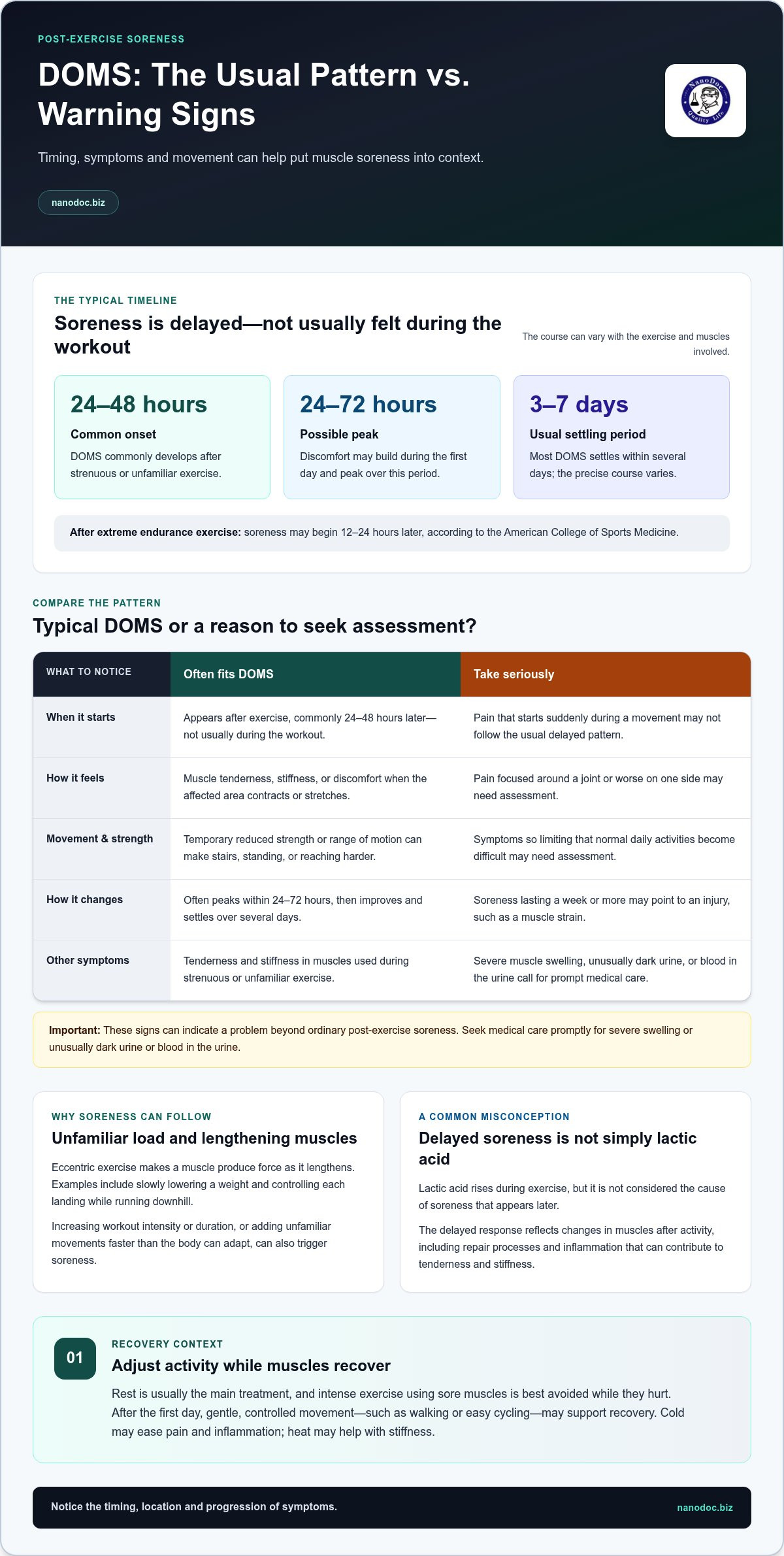
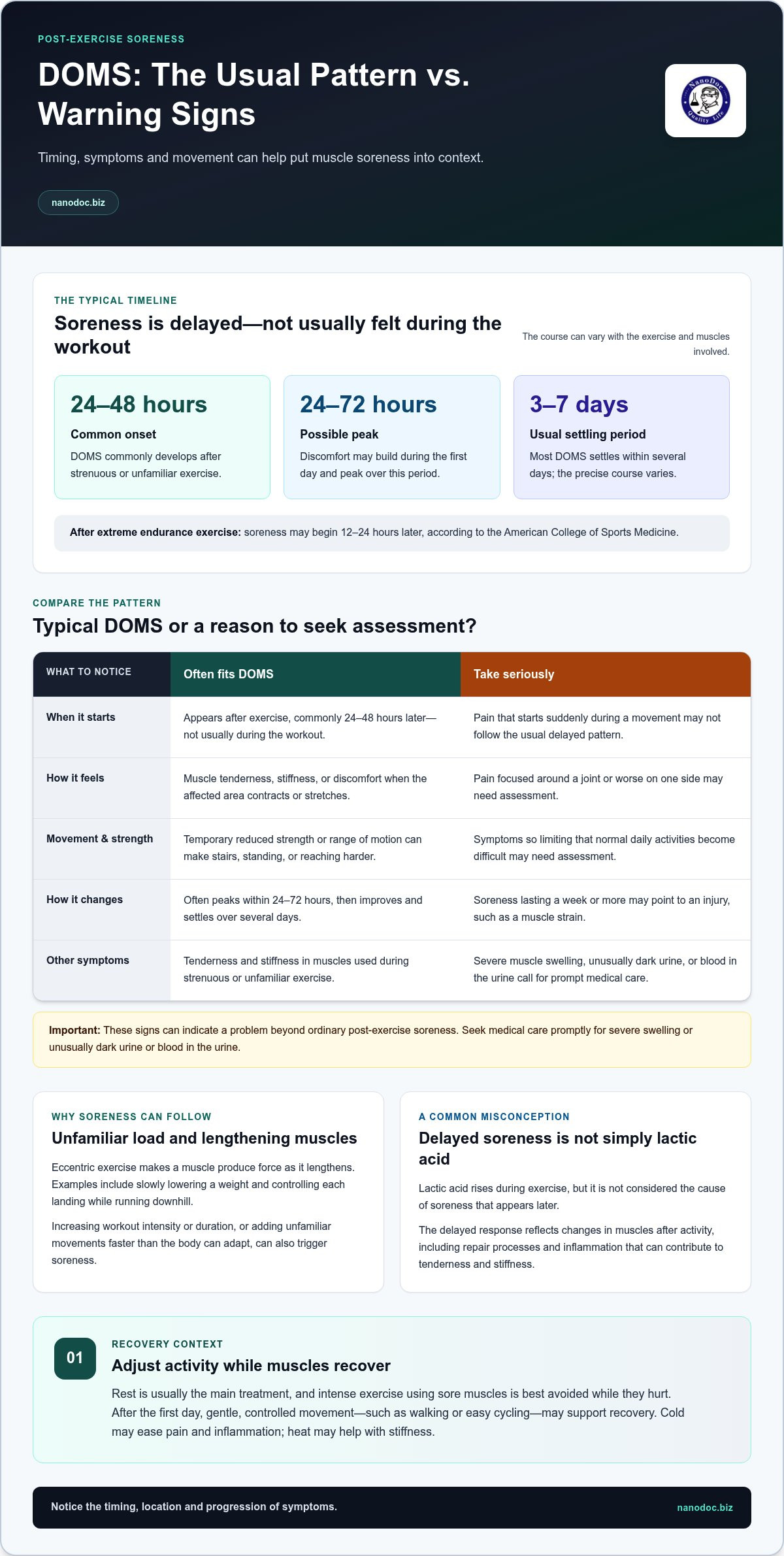
Soreness that appears after a demanding or unfamiliar workout can feel like a sign that something has gone wrong. DOMS commonly develops 24 to 48 hours after exercise, may peak within 24 to 72 hours, and usually resolves within several days.
This guide explains what DOMS is, why soreness can become intense, and how to manage it without rushing back into hard training. You’ll also learn how gentle movement and gradual increases in exercise can help you return to activity more confidently.
From recognising typical post-exercise soreness to spotting signs that may need medical attention, the sections ahead offer practical ways to understand what your muscles are telling you.
Key Takeaways
- Learn why unfamiliar or intense exercise, especially movements that lengthen muscles under load, can trigger soreness.
- Recognise how tenderness, stiffness, and temporary changes in strength or movement may fit the usual pattern of post-exercise soreness.
- Find out how to adjust activity while recovering, and why building new workouts gradually can reduce the risk of soreness.
- Understand how rest, temperature-based comfort measures, and other approaches may help manage symptoms.
- Know which warning signs, including severe swelling or unusually dark urine, call for prompt medical attention.
Table of Contents
How bad can post-exercise muscle soreness get?
Post-exercise soreness can range from tenderness when you press a muscle to pain that makes stairs or reaching overhead difficult. With delayed onset muscle soreness (DOMS), discomfort often increases during the first 24 hours and peaks 24 to 72 hours after exercise. Severe soreness can temporarily reduce strength and range of motion, making everyday movement harder for a few days. The intensity depends partly on the exercise and how unfamiliar the load was.
DOMS usually follows strenuous or unaccustomed exercise, rather than appearing during the workout itself. After extreme endurance exercise, soreness may begin 12 to 24 hours later, according to the American College of Sports Medicine. It commonly settles over several days; soreness lasting a week or more may point to an injury, such as a muscle strain. That timing helps distinguish delayed soreness from sudden pain during a movement.
One important cause is eccentric exercise, where a muscle produces force as it lengthens. Slowly lowering a weight is a clear example: the biceps remains active as the elbow opens. Running downhill also puts eccentric demands on the leg muscles as they control each landing. These contractions can cause microscopic disruption in muscle fibres, triggering repair processes and inflammation that contribute to tenderness and stiffness.
Other causes include increasing workout intensity, duration, or unfamiliar movements faster than your body can adapt. A new strength routine, more demanding hill running, or a longer cardio session may expose muscles to a different load. Lactic acid rises during exercise, but it is not considered the cause of soreness that appears later. The delayed response reflects changes in the muscles after activity, not simply a build-up of exercise by-products.
Severe DOMS can limit movement and strength, but certain symptoms call for prompt attention rather than routine recovery. Seek medical care for severe muscle swelling, unusually dark urine, or blood in your urine. Pain focused around a joint, worse on one side, or so limiting that normal daily activities become difficult may also need assessment. These signs can indicate a problem beyond ordinary post-exercise soreness.
A simple exercise journal can help you spot patterns without treating every ache the same way. Record the workout, including unfamiliar movements such as downhill running, and note when soreness starts and how it affects movement. If symptoms worsen rather than ease, persist for a week, or include the warning signs above, use that timeline when describing the problem to a healthcare professional. The type, location, and progression of the pain all matter.
What is Delayed Onset Muscle Soreness (DOMS)?
DOMS is muscle soreness that develops after strenuous or unfamiliar exercise, rather than during the activity. Its timing and symptoms help distinguish this delayed response from discomfort that starts with a sudden movement.
DOMS Symptoms
DOMS commonly causes muscle tenderness, stiffness, and discomfort when the affected area contracts or stretches. For example, sore thigh muscles may make standing up from a chair or walking downstairs uncomfortable. Soreness can sometimes affect strength or range of motion, making ordinary actions feel harder.
Symptoms are usually felt in the muscles used during exercise, such as the shoulders after an unfamiliar lifting session. Severe soreness can interfere with daily activities for a few days. Changes in strength or movement matter because they can affect how safely you manage routine tasks and resume training.
DOMS Timing
DOMS typically develops 24 to 48 hours after unaccustomed or high-intensity exercise, and may begin one to three days after the session. Soreness can increase during the first 24 hours, then peak within 24 to 72 hours. The delay explains why a workout can feel manageable at the time, while stiffness appears the following day.
Most DOMS settles within 3-7 days, although the precise course varies with the exercise and the muscles involved. Tracking when symptoms begin, peak, and ease can help you judge whether they follow a familiar pattern. Persistent or unusually severe symptoms deserve attention, particularly if movement remains limited.
The delayed timing reflects the body’s response to strenuous or unfamiliar muscle work, not simply the immediate sensation of exertion. Eccentric movements, such as lowering a weight, put tension on muscles as they lengthen. This helps explain why a new exercise may cause soreness later, even if the session itself didn’t cause sharp pain.
DOMS can also temporarily affect performance. Reduced strength or flexibility may make familiar movements, such as lifting a bag or climbing stairs, feel more demanding. This doesn’t identify the cause by itself, but noting which muscles hurt and which actions are affected gives a clearer picture of your symptoms.
Observe how symptoms change over the recovery period rather than judging them from one moment alone. For example, compare tenderness and movement after waking with how they feel later in the day. DOMS generally improves over several days. Pain that starts suddenly during exercise, worsens, or remains severe may not fit that pattern. Tracking the timing and impact can guide a measured return to activity.
Active recovery and gentle movement
After the first day of DOMS, light, controlled activity may feel more comfortable than complete rest. Walking, easy cycling, or relaxed swimming lets sore muscles move without repeating a demanding workout. This may ease stiffness and support recovery by encouraging blood flow, while avoiding another high-load session that could further challenge the affected muscles.
Choose movement that keeps effort low and motion controlled. For example, walk easily on level ground instead of running hills, or cycle gently without adding resistance. If ordinary movement feels manageable, try a short bout and notice whether stiffness eases or worsens. Stop or reduce your effort if pain rises sharply or muscle function becomes more limited.
Gentle movement is not the same as training through significant soreness. Avoid intense exercise that heavily loads affected muscles while they remain sore. If your thighs are tender after squats, choose an easy walk instead of another lower-body strength session. The aim is comfortable activity, not a performance target or a test of how much soreness you can tolerate.
Massage and foam rolling may also help with stiffness. They can improve local blood flow and ease the tight sensation in sore muscles. Use light pressure over the muscle rather than forcing a painful stretch. A few minutes of gentle stretching or light cardio can also prepare your body for more intensive exercise, but static stretching alone doesn’t prevent DOMS.
Plan movement around your symptoms, not a fixed workout schedule. After a rest period, try an easy activity such as walking or swimming, then assess how comfortable it feels during and afterward. If soreness makes stairs difficult, choose a route that avoids repeated stair climbing. As your normal range of motion returns, increase activity gradually instead of jumping straight back to your previous intensity.
Preparation can help make the next session more measured. A warm-up lasting 5 to 10 minutes before exercise gives you time to move through the motions at a comfortable pace. After training, a 10-minute light cardio finish or a 20-minute low-intensity cool-down are approaches described for winding down. Keep the effort easy, especially when the session included unfamiliar movements.
Gradual progression matters when introducing a new routine or increasing training load. Increase weekly exercise activity by no more than 10%, and allow your muscles to adapt before adding further demands. For example, avoid raising both workout duration and intensity in the same week. Repeated muscle contractions during light activity can maintain movement without recreating the heavy loading that contributed to soreness.
Active recovery is not appropriate for every symptom. Severe swelling, unusually dark urine, or blood in your urine calls for medical care, not a walk or foam rolling. If normal daily activities remain difficult, prioritise assessment over returning to exercise. These warning signs shift the focus from choosing gentle movement to addressing a possible problem beyond routine post-exercise soreness.
What delayed onset muscle soreness (DOMS) is
DOMS is a temporary response to exercise that challenges muscles in an unfamiliar way. It is best understood as a group of symptoms during recovery, not a direct measure of workout quality. Soreness after a new movement, for example, doesn’t prove that the session was more effective than a familiar one. Muscle repair and easing symptoms are related, but they are not the same outcome.
During demanding exercise, muscle fibres experience mechanical stress, especially when they contract while lengthening. The body’s response includes local inflammation and repair processes, which can contribute to tenderness and stiffness. This helps explain why symptoms develop after activity rather than necessarily during it. A single sensation, such as soreness after lunges, cannot reveal the precise extent of tissue change.
DOMS can involve more than pain. Reduced strength, limited range of motion, and elevated blood creatine kinase levels may occur. These effects can make familiar tasks, such as reaching overhead or lowering into a chair, feel different. The practical takeaway is to judge recovery by both discomfort and function: note whether movement remains controlled and everyday tasks are becoming easier.
Several techniques may ease symptoms, but that doesn’t prove muscle repair is complete. Massage and foam rolling can help manage stiffness, while low-intensity activity may feel more comfortable than staying completely still. Treat these as options for managing symptoms, not as a test of readiness for intense exercise. If gentle movement increases pain or limits normal function, reduce the demand rather than pushing through.
The repeated-bout effect offers another useful perspective. A small exposure to eccentric exercise may help protect against soreness during a later, similar effort. Protection has been observed after as few as two eccentric contractions and may persist for several weeks; it becomes undetectable after about one year. This doesn’t mean a hard first session is advisable. Instead, it supports gradual exposure, giving the body time to adapt before exercise demands rise.
One study found that an initial bout of 10, 20, or 50 contractions provided equal protection against a later bout of 50 contractions three weeks afterward. That finding illustrates why more work in an introductory session isn’t automatically better. A modest, controlled introduction to an unaccustomed movement can create an adaptation without requiring a large volume of repetitions.
DOMS symptoms need context. Pain that starts suddenly during a lift, stays focused around a joint, or comes with severe swelling differs from ordinary delayed soreness. Record the exercise, the affected muscles, and how your function changes over the following days. This can help distinguish a familiar recovery pattern from symptoms that warrant medical attention.
What helps relieve delayed onset muscle soreness (DOMS)?
Rest is usually the best treatment for DOMS. Avoid intense exercise that loads sore muscles, such as another hard leg session when your thighs hurt. This gives symptoms time to settle without adding another demanding bout. Rest doesn’t have to mean avoiding all movement, but it does mean limiting activities that sharply increase pain or reduce normal function.
Cold and heat offer different forms of symptom relief. Cold therapy may reduce pain and inflammation, while heat can increase blood flow and ease stiffness. A 2016 review found that cold-water baths could help ease soreness and stiffness. One suggested approach is immersion for 10 to 15 minutes in water between 10 and 15°C. Choose a measure based on whether pain or stiffness is the main concern.
Massage may also reduce soreness after intense or eccentric exercise. People who received massage 24 to 72 hours after exercise reported less soreness than those who did not. A 2017 review associated post-exercise massage with significantly less DOMS soreness than no massage. Massage after 48 hours may work best. Use comfortable pressure, and stop if the technique increases pain rather than easing it.
Recovery methods are not equally well supported. Evidence does not support whole-body cryotherapy as an effective way to reduce DOMS or improve recovery timing compared with passive rest or no whole-body cryotherapy. Static stretching before or after exercise also doesn’t prevent DOMS. These distinctions matter: a method may feel soothing without preventing soreness or speeding muscle repair.
Sleep and supplement choices deserve care, too. Aim for at least 7 hours of sleep to support recovery from exercise. Before starting magnesium supplements for DOMS, talk with a healthcare provider or dietitian. That conversation can consider your health needs and other supplements or medicines. Don’t treat a supplement as a substitute for rest when sore muscles remain painful during everyday movement.
For occasional DOMS discomfort, focus on comfort measures and avoid repeating the workout that aggravated your muscles. Cold may help with pain, while warmth may ease stiffness; gentle massage is another option. If soreness is severe, worsening, or accompanied by significant swelling or unusually dark urine, seek medical care instead of relying on self-care.
If you’re considering topical support alongside rest and sensible activity adjustments, explore Pain Relief Care options. Choose care as one part of a measured recovery approach, rather than a reason to resume intense exercise while the affected muscles remain sore.
NanoDoc International Pte: Anti-Ageing Skin Care
NanoDoc International Pte Ltd offers Pain Relief Care for readers considering topical support alongside rest and a gradual return to activity. The company also offers Anti-Ageing Skin Care, Nano Cellular Essential Nutrition, and Oral & Immunity Care. These are distinct categories, so choose according to your needs rather than treating them as interchangeable approaches to post-exercise soreness.
NanoDoc International Pte Ltd’s health and skincare formulations use nano-encapsulation technology designed to enhance absorption through the skin and gut. For DOMS, Pain Relief Care is the offering most closely related to comfort during recovery. It does not replace rest or medical attention for severe symptoms.
For information about NanoDoc International Pte Ltd’s offerings, contact the company or visit nanodoc.biz.
Make your next recovery choice with care
Make recovery part of your training plan, not an afterthought. Notice how your body responds to new movements, and let comfort and function guide your return to more demanding exercise. Choosing what to take for delayed onset muscle soreness (DOMS) should complement sensible rest and movement, not replace them.
For product support, NanoDoc International Pte Ltd offers Pain Relief Care, as well as Anti-Ageing Skin Care and Nano Cellular Essential Nutrition. These offerings serve different needs, so focus on the category that aligns with your priorities. For severe symptoms or warning signs, product support is not a substitute for medical care.
Explore NanoDoc International Pte Ltd’s offerings and choose your next step with confidence. A measured approach can help you return to activity thoughtfully and keep building a sustainable exercise routine.
Frequently Asked Questions
What Is DOMS?
DOMS is delayed muscle soreness after strenuous or unfamiliar exercise. Unlike a sudden strain, it typically becomes noticeable after the session rather than during a specific movement. For example, soreness that develops the day after a new workout can fit this pattern. Track which muscles hurt, which activities trigger discomfort, and whether function improves. This record can help you describe your symptoms if you seek medical advice.
Can over-the-counter pain relief medication help with DOMS?
Over-the-counter pain relief may help with occasional discomfort, but it doesn’t repair muscle tissue or replace recovery. If you’re considering what to take for delayed onset muscle soreness (DOMS), first check whether the medicine is suitable for you and follow its package directions. Avoid taking multiple products with the same active ingredient. Rest from intense exercise that loads sore muscles, and seek medical care for severe swelling or unusually dark urine.
When should I see my healthcare provider?
Seek medical care for severe muscle swelling, unusually dark urine, or blood in your urine. Arrange an assessment if soreness makes ordinary tasks, such as walking or dressing, difficult, or if symptoms persist for a week or more. Sudden pain during exercise, pain focused around a joint, or symptoms that worsen instead of easing also deserve attention. These patterns may need assessment rather than routine self-care.
Is paracetamol or ibuprofen better for DOMS?
Neither medicine is universally better for DOMS; suitability depends on the person and the medicine’s warnings. Paracetamol and ibuprofen are different medicines, so don’t assume they can be used interchangeably or combined safely. Consider your health conditions, other medicines, and previous reactions before choosing. Follow the specific product label, and ask a pharmacist if you’re unsure which option is appropriate for you.
What is the safe dose of paracetamol for muscle soreness in adults in Singapore?
There isn’t one dose that suits every adult or product. Follow the directions and maximum daily amount on the specific paracetamol pack sold in Singapore, because product strength and formulation can differ. Check whether other medicines you take contain paracetamol as an active ingredient, so you don’t accidentally double up. If you have a health condition or take regular medication, ask a pharmacist about the product’s suitability.
What is the safe dose of ibuprofen for muscle soreness, and who should avoid it?
Use the dose and maximum stated on the specific ibuprofen product label; formulations and directions can differ. Avoid ibuprofen if you have a known allergy to it or another NSAID, or if a healthcare professional has told you to avoid it. Check with a pharmacist before use if you have a health condition, take other medicines, or are unsure about the label warnings. Don’t exceed the package directions.
Do topical pain-relief gels or patches help DOMS?
Topical pain-relief products may be considered for local comfort, but their ingredients and directions vary. Read the label for where and how to apply a gel or patch, and don’t use it in ways the instructions prohibit. Using a topical product doesn’t establish that a muscle is ready for strenuous exercise. If pain is severe, worsening, or accompanied by swelling, seek medical care rather than relying on a topical product alone.
Does stretching, massage, foam rolling, or heat help DOMS?
Gentle massage or foam rolling may help manage stiffness, and heat may ease tightness. Keep pressure and movement comfortable, and stop if symptoms worsen. Static stretching before or after exercise doesn’t prevent DOMS, so don’t treat it as a guarantee against soreness. After the first day, controlled, low-intensity activity such as easy cycling is another option. Choose a technique for comfort, not as a test of recovery.
Frequently Asked Questions
- What Is DOMS?
- DOMS is delayed muscle soreness after strenuous or unfamiliar exercise. Unlike a sudden strain, it typically becomes noticeable after the session rather than during a specific movement. For example, soreness that develops the day after a new workout can fit this pattern. Track which muscles hurt, which activities trigger discomfort, and whether function improves. This record can help you describe your symptoms if you seek medical advice.
- Can over-the-counter pain relief medication help with DOMS?
- Over-the-counter pain relief may help with occasional discomfort, but it doesn’t repair muscle tissue or replace recovery. If you’re considering what to take for delayed onset muscle soreness (DOMS), first check whether the medicine is suitable for you and follow its package directions. Avoid taking multiple products with the same active ingredient. Rest from intense exercise that loads sore muscles, and seek medical care for severe swelling or unusually dark urine.
- When should I see my healthcare provider?
- Seek medical care for severe muscle swelling, unusually dark urine, or blood in your urine. Arrange an assessment if soreness makes ordinary tasks, such as walking or dressing, difficult, or if symptoms persist for a week or more. Sudden pain during exercise, pain focused around a joint, or symptoms that worsen instead of easing also deserve attention. These patterns may need assessment rather than routine self-care.
- Is paracetamol or ibuprofen better for DOMS?
- Neither medicine is universally better for DOMS; suitability depends on the person and the medicine’s warnings. Paracetamol and ibuprofen are different medicines, so don’t assume they can be used interchangeably or combined safely. Consider your health conditions, other medicines, and previous reactions before choosing. Follow the specific product label, and ask a pharmacist if you’re unsure which option is appropriate for you.
- What is the safe dose of paracetamol for muscle soreness in adults in Singapore?
- There isn’t one dose that suits every adult or product. Follow the directions and maximum daily amount on the specific paracetamol pack sold in Singapore, because product strength and formulation can differ. Check whether other medicines you take contain paracetamol as an active ingredient, so you don’t accidentally double up. If you have a health condition or take regular medication, ask a pharmacist about the product’s suitability.
- What is the safe dose of ibuprofen for muscle soreness, and who should avoid it?
- Use the dose and maximum stated on the specific ibuprofen product label; formulations and directions can differ. Avoid ibuprofen if you have a known allergy to it or another NSAID, or if a healthcare professional has told you to avoid it. Check with a pharmacist before use if you have a health condition, take other medicines, or are unsure about the label warnings. Don’t exceed the package directions.
- Do topical pain-relief gels or patches help DOMS?
- Topical pain-relief products may be considered for local comfort, but their ingredients and directions vary. Read the label for where and how to apply a gel or patch, and don’t use it in ways the instructions prohibit. Using a topical product doesn’t establish that a muscle is ready for strenuous exercise. If pain is severe, worsening, or accompanied by swelling, seek medical care rather than relying on a topical product alone.
- Does stretching, massage, foam rolling, or heat help DOMS?
- Gentle massage or foam rolling may help manage stiffness, and heat may ease tightness. Keep pressure and movement comfortable, and stop if symptoms worsen. Static stretching before or after exercise doesn’t prevent DOMS, so don’t treat it as a guarantee against soreness. After the first day, controlled, low-intensity activity such as easy cycling is another option. Choose a technique for comfort, not as a test of recovery.