
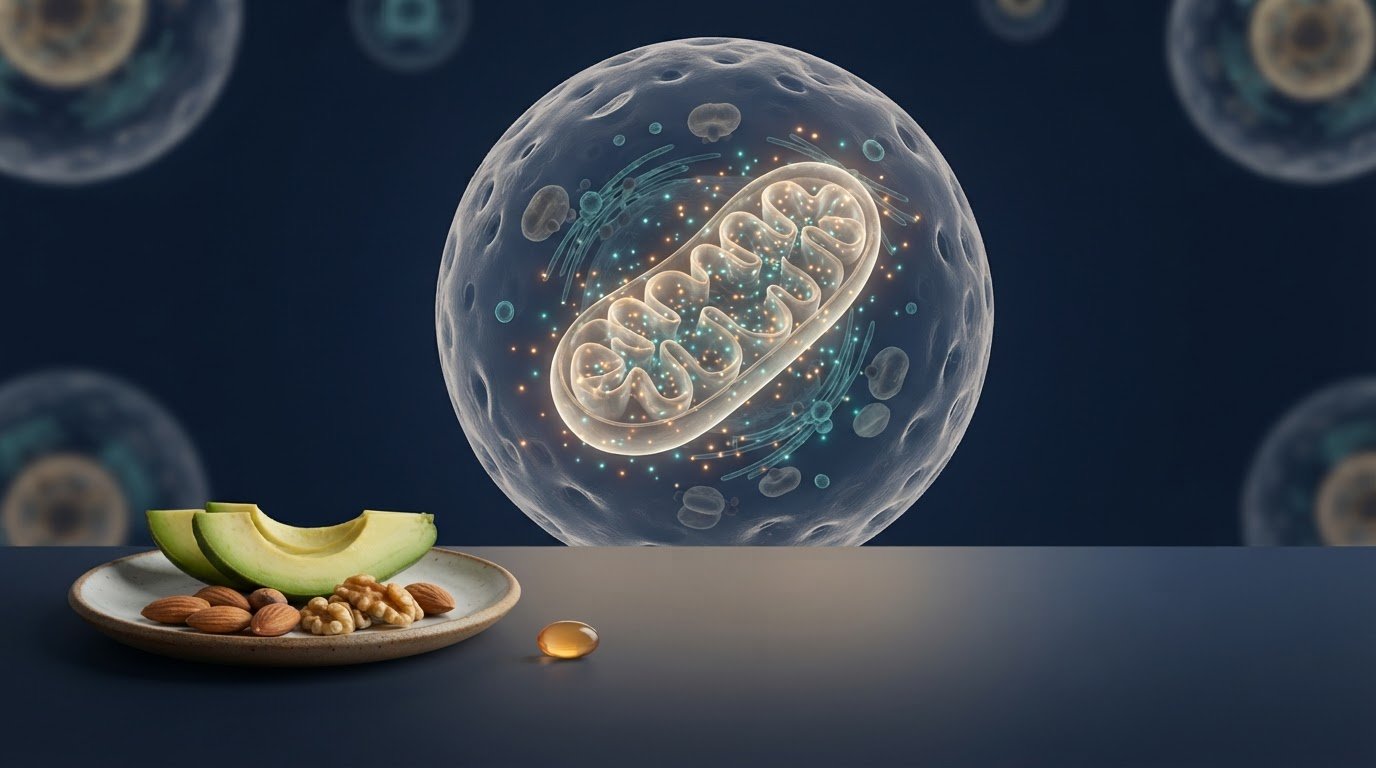
Cellular energy support isn’t the same as an instant energy boost. CoQ10 is an antioxidant the body naturally makes, and cells use it in energy production, particularly in mitochondria. In healthy adults, three out of four studies found no effect on energy levels, so the best CoQ10 supplement for energy depends on more than a promise of feeling energised.
It’s understandable to look for a clear choice, especially when supplements come in different forms and absorption can vary. This article explains how CoQ10 contributes to cellular energy, how ubiquinol compares with ubiquinone, and why taking it with food may matter. It also covers timing and what the evidence can, and can’t, tell you about energy and exercise, so you can assess a supplement with realistic expectations.
Key Takeaways
- CoQ10 supports cellular energy production in mitochondria, but supplementation doesn’t reliably increase energy in healthy adults.
- Ubiquinol and ubiquinone are two forms of CoQ10; age and individual circumstances can influence which form may suit you.
- Because CoQ10 is fat-soluble, taking it with a meal that contains fat may support absorption.
- Evidence for migraine benefits differs from the limited findings on exercise performance, so consider the intended use when assessing expectations.
- CoQ10 can interact with some medicines and may cause side effects, making timing and suitability important to consider.
Table of Contents
How Long Does it Take for a Ubiquinol Supplement to Work?
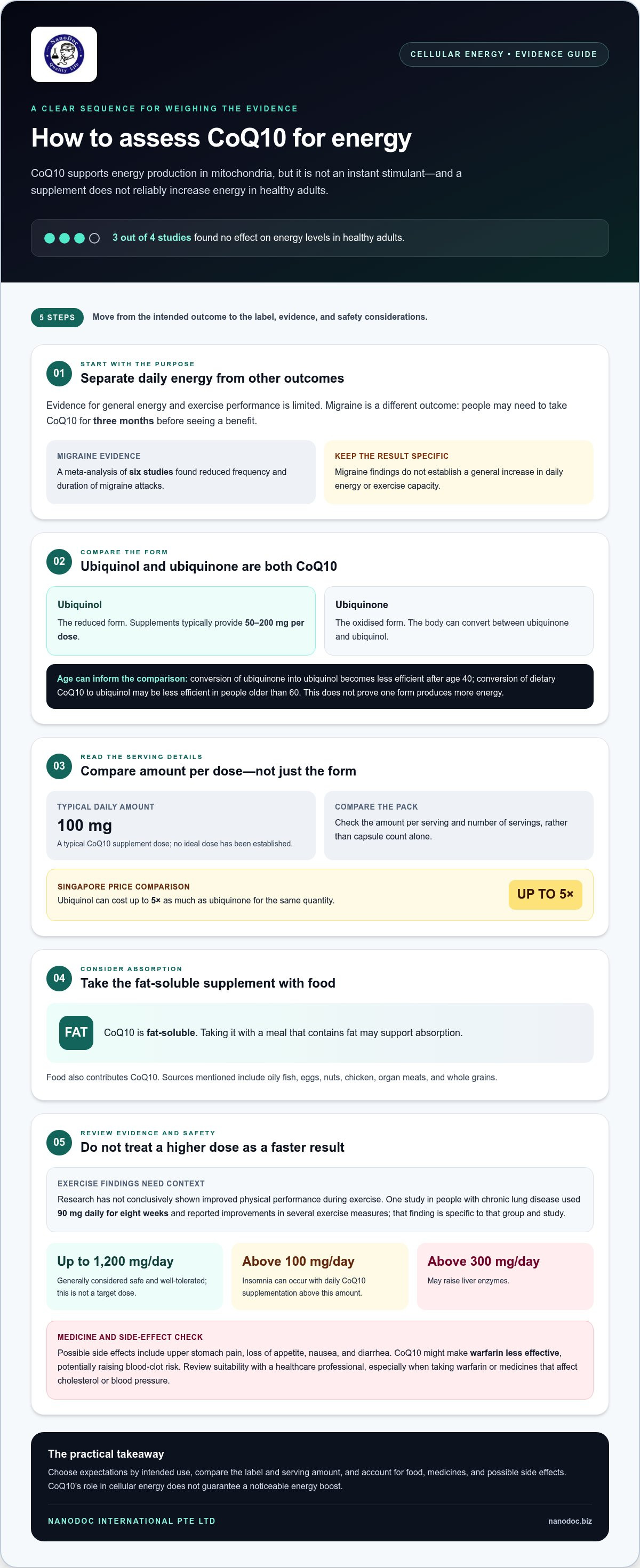
Ubiquinol isn’t an instant stimulant, and the time to notice effects depends on the reason for taking it. For migraine, people may need to take CoQ10 for three months before seeing a benefit. A meta-analysis of six studies found CoQ10 reduced the frequency and duration of migraine attacks. That evidence concerns migraine outcomes, not a general increase in daily energy or exercise capacity.
For healthy adults, evidence on fatigue is less encouraging. Three studies found no effect on energy levels, and three out of four studies reported no energy effect. Taking a supplement consistently doesn’t guarantee a noticeable change when studies have not found one. CoQ10 also isn’t a vitamin or a substitute for care for a disease. Persistent fatigue can have different causes, so it shouldn’t automatically be attributed to low CoQ10.
Exercise results also require measured expectations. Research has not conclusively shown that CoQ10 improves physical performance during exercise. One study involving people with chronic lung disease used 90 mg daily for eight weeks and reported improvements in several exercise measures. That finding applies to a specific group and study, not every healthy person seeking more stamina. The best CoQ10 supplement for energy cannot be identified by dose alone when the intended outcome and evidence differ.
Dosage varies by purpose, and there is no established ideal dose. A typical CoQ10 supplement dose is 100 milligrams per day, while healthy-adult ubiquinol labels typically list 100 mg daily. CoQ10 is generally considered safe and well-tolerated at doses up to 1,200 milligrams per day. That upper figure is not a target dose. Higher intake may increase side-effect concerns, so follow product directions rather than assuming more will work faster.
Possible side effects include mild stomach problems, such as upper stomach pain, loss of appetite, nausea, and diarrhea. Insomnia can occur when daily CoQ10 supplementation exceeds 100 mg; daily intake above 300 mg may raise liver enzymes. CoQ10 might also make warfarin less effective, potentially raising the risk of a blood clot. Mayo Clinic advises asking a healthcare professional before taking CoQ10. This matters especially when using warfarin or medicines that affect cholesterol or blood pressure. Dietary choices and other medicines may also affect what is appropriate, so note your dose and timing when discussing supplementation.
Ubiquinol versus ubiquinone
For energy, neither form is proven best for everyone. Ubiquinol is the reduced form of CoQ10; ubiquinone is the oxidised form, and the body can convert between them. Ubiquinol supplements typically provide 50 to 200 mg per dose, while a typical CoQ10 supplement dose is 100 milligrams per day. Those figures describe common amounts, not a personalised recommendation.
The forms differ in how they enter the body’s CoQ10 cycle, not in their core function. Cells use CoQ10 in energy production, and both forms can contribute after the body processes them. CoQ10 levels decrease with age. The body’s conversion of ubiquinone into ubiquinol becomes less efficient after age 40, while conversion of dietary CoQ10 to ubiquinol may be less efficient in people older than 60. Age can inform a choice, but it doesn’t establish that one form will produce more energy.
In Singapore, ubiquinol can cost up to five times as much as ubiquinone for the same quantity. The cost per dose depends on the amount per serving and the number of servings in the pack, so compare these label details rather than capsule count alone.
There isn’t a single named supplement that can be called the best CoQ10 supplement for energy based on form alone. Compare ubiquinone and ubiquinol by the amount per serving, stated daily dosage, and intended use; ubiquinol products typically provide 50 to 200 mg per dose. A typical CoQ10 supplement dose is 100 milligrams per day, although no ideal dose has been established.
Taking ubiquinol with other supplements doesn’t automatically make a combination more effective. Check each label for overlapping ingredients and total daily amounts, especially if a multinutrient product already contains CoQ10. For heart health or another specific purpose, the relevant factors include the chosen form, the dose, and any medicines being taken. CoQ10 can interact with warfarin, so combining supplements is a reason to review the full list with a healthcare professional.
Kaneka Ubiquinol® supplements are available in thousands of health food stores, pharmacies and grocers. This describes the ingredient’s distribution, not a guarantee that every retailer in Singapore carries it. Labels may say “ubiquinol” or “ubiquinone,” so check the form and compare the amount per serving before deciding.
Food also contributes CoQ10: about half of average dietary CoQ10 intake is estimated to be ubiquinol. Oily fish, eggs, nuts, chicken, organ meats, and whole grains are among its food sources. A supplement therefore adds to dietary intake, while the choice between forms depends on the label, dosage, and the individual’s reason for considering CoQ10.
CoQ10's role in cellular energy production
CoQ10 helps connect mitochondrial activity with the energy cells use. It’s found in nearly every cell, with most concentrated in mitochondria. There, CoQ10 supports the processes that produce cellular energy. Cells also use it for growth. This function explains why CoQ10 is discussed for energy, but it doesn’t establish that supplements relieve fatigue.
CoQ10 also acts as an antioxidant, helping protect cells from oxidative stress. That role is distinct from providing an immediate energy boost. A supplement’s antioxidant function doesn’t by itself show that it improves stamina, cardiovascular health, or blood pressure. Those are separate outcomes that require evidence for the specific effect. CoQ10 may improve symptoms of congestive heart failure, while research findings are mixed on whether it lowers blood pressure.
Evidence for energy and fatigue in healthy adults is limited. Three studies of CoQ10 for fatigue found no effect on energy levels; three out of four studies also reported no effect. These findings don’t support treating CoQ10 as a reliable energy enhancer. If fatigue persists, consider its possible causes rather than assuming a CoQ10 deficiency. A statin is another example of why context matters: muscle cramping and pain are experienced by 10-15% of patients taking statins, but that statistic doesn’t establish CoQ10 as a remedy.
Product quality is a separate question from biological function. ConsumerLab analyzed 16 CoQ10 and ubiquinol products, assessing label claims and quality. Third-party testing can help assess whether a product meets the specific criteria tested; it doesn’t prove that the supplement will increase energy. Read what the test covers, such as ingredient identity or label accuracy, rather than treating every testing mark as equivalent. A product certification also applies only to its stated scope and criteria.
For a practical comparison, examine the form, amount per serving, and testing details on the label. Forbes Health’s supplement ratings assign 30% of the score to third-party testing and 40% to price per serving. Those weights describe that rating method, not a universal measure of effectiveness. In Singapore, check whether the label clearly identifies CoQ10 and its serving amount. A test report can inform quality, while the evidence on fatigue remains the key consideration for energy expectations.
Supplement absorption and taking CoQ10 with food
CoQ10 is fat-soluble, so taking it with a meal containing fat may support absorption. A meal should provide at least one tablespoon of fat to support CoQ10 absorption. This is a practical guide to the meal, not a guarantee of a specific effect. The food, supplement formulation, and individual digestion all influence how much CoQ10 becomes available for the body to use.
For a simple routine, take the supplement with a meal that already contains fat, such as eggs or oily fish. One study found that taking CoQ10 soft-gel capsules with soy oil improved absorption. This supports the role of an oil carrier, but doesn’t show that every oil-based capsule behaves identically. Check the product’s format and directions, since the presence of oil alone doesn’t tell you the amount absorbed.
Carrier oils can help disperse fat-soluble CoQ10 during digestion. An oil-based capsule may be convenient when meals vary, while another capsule can be taken alongside a fat-containing meal. Formulation and food both matter. Bioavailability describes how much of an ingested nutrient reaches circulation and can be used. It does not establish whether CoQ10 will relieve fatigue or improve vascular function. For this reason, the best CoQ10 supplement for energy cannot be selected by capsule type alone.
Absorption may be relevant for people considering CoQ10 for migraine or heart failure, but it doesn’t establish treatment effectiveness. Research on heart failure and blood pressure measures different outcomes from research on energy. CoQ10 may lower blood pressure, so people taking medication that also lowers blood pressure should consider the potential interaction with a healthcare professional. CoQ10 may also affect blood sugar levels, which is relevant for people living with diabetes.
CoQ10 has antioxidant activity, but better absorption doesn’t prove a clinical benefit for oxidative stress, cardiovascular health, or exercise. Assess the intended outcome separately from the delivery method. A more absorbable product isn’t automatically the best CoQ10 supplement for energy, particularly because studies haven’t consistently found improved energy in healthy adults.
When comparing labels, note the CoQ10 form, serving amount, capsule type, and instructions for taking it with food. A regular meal containing fat is a practical pairing. If you use warfarin or medicines affecting blood pressure or blood sugar, discuss CoQ10 use with a healthcare professional. Food may support absorption, but it doesn’t resolve possible medication interactions.
Potential benefits for heart health and exercise performance
Coenzyme Q10 is studied for cardiovascular outcomes and physical performance, but findings vary by purpose. Distinguish evidence for a specific condition from claims about everyday energy.
Potential Cardiovascular Benefits
CoQ10 may improve symptoms of congestive heart failure, while research findings are mixed on whether it lowers blood pressure. This distinction matters because a possible effect on heart failure symptoms doesn’t establish that CoQ10 prevents cardiovascular disease or replaces prescribed treatment. CoQ10 may lower blood pressure, so people taking medication that also lowers blood pressure should consider the potential interaction with a healthcare professional.
Exercise Performance Effects
Research has not conclusively shown that CoQ10 improves physical performance during exercise. One study of people with chronic lung disease used 90 mg daily for eight weeks and reported improvements in several exercise measures. That result comes from a specific group, not a general finding for healthy adults. If your goal is greater stamina, don’t interpret a study in chronic lung disease as proof of an exercise benefit for everyone.
Other proposed benefits also depend on the outcome studied. A small study found reduced liver fat in people taking CoQ10 compared with people who did not take it, but more studies are needed. A randomized, double-blind, placebo-controlled trial examined six-month supplementation in people with metabolic dysfunction-associated steatotic liver disease. These findings concern liver health, not exercise performance, and don’t establish a general cardiovascular effect.
CoQ10 levels decrease with age, and the body naturally makes this antioxidant. That biological role helps explain research interest, but it doesn’t show that adults with lower levels will necessarily feel more energetic after supplementation. Absorption also matters: CoQ10 is fat-soluble and may be better absorbed with food containing fat. A product’s form or absorption cannot, by itself, prove benefits for heart health or exercise.
For a practical decision, match the evidence to your reason for considering CoQ10. Heart failure symptoms, blood pressure, and exercise capacity are distinct outcomes. The findings for one shouldn’t be used to predict another. Consider your current medicines and intended outcome when discussing supplementation, especially if you take blood pressure medication or have a cardiovascular condition.
For readers exploring nutrition alongside this evidence, explore cellular nutrition options as part of a broader approach to everyday wellbeing.
NanoDoc International Pte Ltd: Anti-Ageing Skin Care
NanoDoc International Pte Ltd offers Anti-Ageing Skin Care and Nano Cellular Essential Nutrition for readers considering complementary skincare and nutrition priorities. Its nano-delivery technology is used in health products designed to enhance absorption through the skin and gut. These offerings are distinct from choosing a CoQ10 supplement, so consider them for their relevant needs rather than as a substitute for evaluating CoQ10 evidence, form, and dosage.
For skincare, explore Anti-Ageing Skin Care; for nutritional support, consider Nano Cellular Essential Nutrition. NanoDoc International Pte Ltd also offers Pain Relief Care and Oral & Immunity Care, each focused on a different area of wellbeing.
For information about these offerings, visit NanoDoc International Pte Ltd.
Choose Your Next Step With Clear Intent
Before selecting the best CoQ10 supplement for energy, define what you want to address and compare that goal with the evidence. A supplement choice should account for your current medicines and health needs, not just a label’s claims. If you’re taking prescription medication, discuss CoQ10 use with a healthcare professional before adding it.
For needs beyond CoQ10, NanoDoc International Pte Ltd offers Anti-Ageing Skin Care, Nano Cellular Essential Nutrition, and Pain Relief Care. These offerings address distinct wellness priorities; they aren’t substitutes for choosing or assessing a CoQ10 supplement. A considered next step is to focus on the area that matches your needs and learn about the relevant option.
Contact NanoDoc International Pte Ltd to explore its offerings and take your next step with clarity.
Frequently Asked Questions
What Is CoQ10?
CoQ10 is a naturally produced compound that supports cellular energy processes and antioxidant activity. It’s present in nearly every cell, particularly in mitochondria, where cells generate usable energy. CoQ10 is also available from foods such as oily fish, eggs, nuts, chicken, organ meats, and whole grains. These foods contribute to dietary intake, while supplements provide a concentrated amount in either ubiquinone or ubiquinol form.
The bottom line?
CoQ10 has a clear role in cell function, but taking it doesn’t reliably increase energy in healthy adults. Use the reason for considering it to guide your decision: a supplement for a specific health goal should be assessed against evidence for that outcome. Compare the form and amount on the label, and account for medicines you take. Treat claims of a rapid energy boost cautiously.
What is coenzyme Q10?
Coenzyme Q10, commonly shortened to CoQ10, is the same compound discussed throughout this article. The name describes a substance the body makes naturally and uses in cellular energy production. It also functions as an antioxidant. “CoQ10” may appear on supplement labels, while “ubiquinone” and “ubiquinol” identify its two forms. Checking the exact label wording helps distinguish the compound from other nutrients in a combination product.
What's the difference between coenzyme Q10 and ubiquinol?
Coenzyme Q10 is the umbrella name; ubiquinol is its reduced form, while ubiquinone is its oxidised form. The body can convert between them, so ubiquinol isn’t a separate nutrient. Age may affect conversion: the body’s conversion of ubiquinone into ubiquinol becomes less efficient after age 40. Ubiquinol can cost up to five times as much as CoQ10 for the same quantity, making serving amounts relevant when comparing labels.
Does ubiquinol or ubiquinone work better for energy?
Evidence doesn’t establish either form as better for energy in healthy adults. The best CoQ10 supplement for energy is therefore not identified by choosing ubiquinol over ubiquinone alone. Compare the amount per serving, formulation, and intended use instead. Ubiquinol is often presented as a more readily usable form, but that description doesn’t establish superior energy effects. If you’re comparing products, focus on clear labels and realistic claims.
What daily CoQ10 dose is commonly used, and when should it be taken?
A typical CoQ10 supplement dose is 100 milligrams per day, although there’s no established ideal dose for everyone. CoQ10 is fat-soluble and may be better absorbed with a meal containing fat, such as eggs or oily fish. Follow the product label rather than increasing the amount to seek faster effects. People taking medicines or managing a health condition should consider dose suitability with a healthcare professional.
How long does CoQ10 take to work for energy?
There isn’t a reliable timetable for an energy effect, because studies in healthy adults haven’t consistently found improved energy levels. Migraine is a separate outcome: people who take CoQ10 for migraines may need three months before noticing a benefit. If tracking your experience, record your energy, dose, and timing consistently. That can help you describe any changes accurately without mistaking a short-term fluctuation for a supplement effect.
What are the side effects and medication interactions of CoQ10?
Possible side effects include nausea, diarrhea, upper stomach pain, and loss of appetite. CoQ10 might make warfarin less effective, potentially increasing blood-clot risk, and it may affect blood sugar levels. It may also lower blood pressure, which matters alongside blood-pressure medication. Mayo Clinic advises asking a healthcare professional before taking CoQ10. Mention all medicines and supplements you use, especially warfarin, before adding it to your routine.
Frequently Asked Questions
- What Is CoQ10?
- CoQ10 is a naturally produced compound that supports cellular energy processes and antioxidant activity. It’s present in nearly every cell, particularly in mitochondria, where cells generate usable energy. CoQ10 is also available from foods such as oily fish, eggs, nuts, chicken, organ meats, and whole grains. These foods contribute to dietary intake, while supplements provide a concentrated amount in either ubiquinone or ubiquinol form.
- The bottom line?
- CoQ10 has a clear role in cell function, but taking it doesn’t reliably increase energy in healthy adults. Use the reason for considering it to guide your decision: a supplement for a specific health goal should be assessed against evidence for that outcome. Compare the form and amount on the label, and account for medicines you take. Treat claims of a rapid energy boost cautiously.
- What is coenzyme Q10?
- Coenzyme Q10, commonly shortened to CoQ10, is the same compound discussed throughout this article. The name describes a substance the body makes naturally and uses in cellular energy production. It also functions as an antioxidant. “CoQ10” may appear on supplement labels, while “ubiquinone” and “ubiquinol” identify its two forms. Checking the exact label wording helps distinguish the compound from other nutrients in a combination product.
- What's the difference between coenzyme Q10 and ubiquinol?
- Coenzyme Q10 is the umbrella name; ubiquinol is its reduced form, while ubiquinone is its oxidised form. The body can convert between them, so ubiquinol isn’t a separate nutrient. Age may affect conversion: the body’s conversion of ubiquinone into ubiquinol becomes less efficient after age 40. Ubiquinol can cost up to five times as much as CoQ10 for the same quantity, making serving amounts relevant when comparing labels.
- Does ubiquinol or ubiquinone work better for energy?
- Evidence doesn’t establish either form as better for energy in healthy adults. The best CoQ10 supplement for energy is therefore not identified by choosing ubiquinol over ubiquinone alone. Compare the amount per serving, formulation, and intended use instead. Ubiquinol is often presented as a more readily usable form, but that description doesn’t establish superior energy effects. If you’re comparing products, focus on clear labels and realistic claims.
- What daily CoQ10 dose is commonly used, and when should it be taken?
- A typical CoQ10 supplement dose is 100 milligrams per day, although there’s no established ideal dose for everyone. CoQ10 is fat-soluble and may be better absorbed with a meal containing fat, such as eggs or oily fish. Follow the product label rather than increasing the amount to seek faster effects. People taking medicines or managing a health condition should consider dose suitability with a healthcare professional.
- How long does CoQ10 take to work for energy?
- There isn’t a reliable timetable for an energy effect, because studies in healthy adults haven’t consistently found improved energy levels. Migraine is a separate outcome: people who take CoQ10 for migraines may need three months before noticing a benefit. If tracking your experience, record your energy, dose, and timing consistently. That can help you describe any changes accurately without mistaking a short-term fluctuation for a supplement effect.
- What are the side effects and medication interactions of CoQ10?
- Possible side effects include nausea, diarrhea, upper stomach pain, and loss of appetite. CoQ10 might make warfarin less effective, potentially increasing blood-clot risk, and it may affect blood sugar levels. It may also lower blood pressure, which matters alongside blood-pressure medication. Mayo Clinic advises asking a healthcare professional before taking CoQ10. Mention all medicines and supplements you use, especially warfarin, before adding it to your routine.