
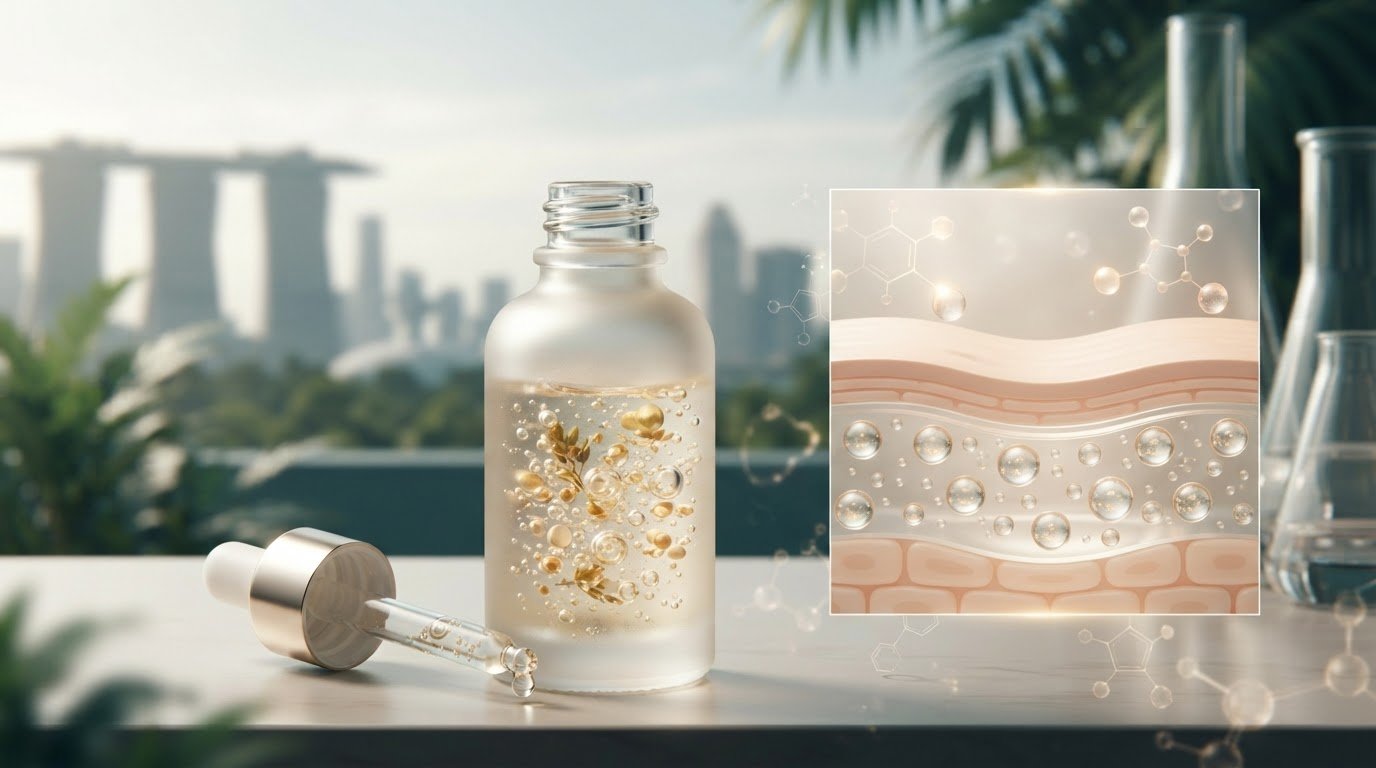
What if an antioxidant serum’s performance depends less on how much active ingredient it contains and more on how well that ingredient is protected and delivered? A nano-emulsified antioxidant serum is designed to disperse ingredients in very small droplets, but the word “nano” alone doesn’t show that a formula is stable, effective, or suitable for your skin.
It’s reasonable to expect an anti-ageing serum to remain reliable from first use to last, support skin without unnecessary irritation, and do more than sit on the surface. This guide explains how antioxidant stability, delivery-system design, and independently verified particle size can help you assess a formula. NanoDoc represents LG Bionano technology and sells anti-ageing skin care formulations that use bionano delivery technology.
You’ll learn what evidence can distinguish a clearly described delivery system from vague marketing, which formulation and packaging details matter, and how to interpret claims about skin penetration without assuming that “deeper” automatically means better. Use these criteria to compare products and choose antioxidant care with greater confidence.
Key Takeaways
- Assess antioxidant stability alongside active-ingredient concentration when comparing formulas.
- Learn how nano-emulsification and liposomal delivery differ, and why verified particle-size data can help you assess delivery claims.
- Use a practical checklist to assess a nano-emulsified antioxidant serum, from evidence of delivery technology to the compatibility of antioxidant combinations.
- Understand what particle-size and quality testing can tell you, and what it cannot establish about results.
- Explore how patented LG Bionano delivery technology is used in NanoDoc’s anti-ageing skin care.
Table of Contents
- The Bioavailability Gap: Why Standard Antioxidant Serums Often Fail
- Understanding Nano-Emulsification: The Science of Deep Dermal Repair
- Selecting High-Performance Serums: Nano-Emulsion vs. Liposomal Delivery
- A Buyer’s Checklist for Nano-Emulsified Formulations
- The NanoDoc Standard: Patented Bionano Technology for Advanced Dermal Repair
The Bioavailability Gap: Why Standard Antioxidant Serums Often Fail
An antioxidant can be well established in skincare and still underperform if it degrades in the bottle or remains largely at the skin surface. That’s the bioavailability gap: the difference between an active ingredient being present in a formula and being available for the skin to use. A nano-emulsified antioxidant serum aims to address parts of this challenge through its delivery system, but the technology doesn’t guarantee results on its own.
The Problem of Surface-Level Skincare
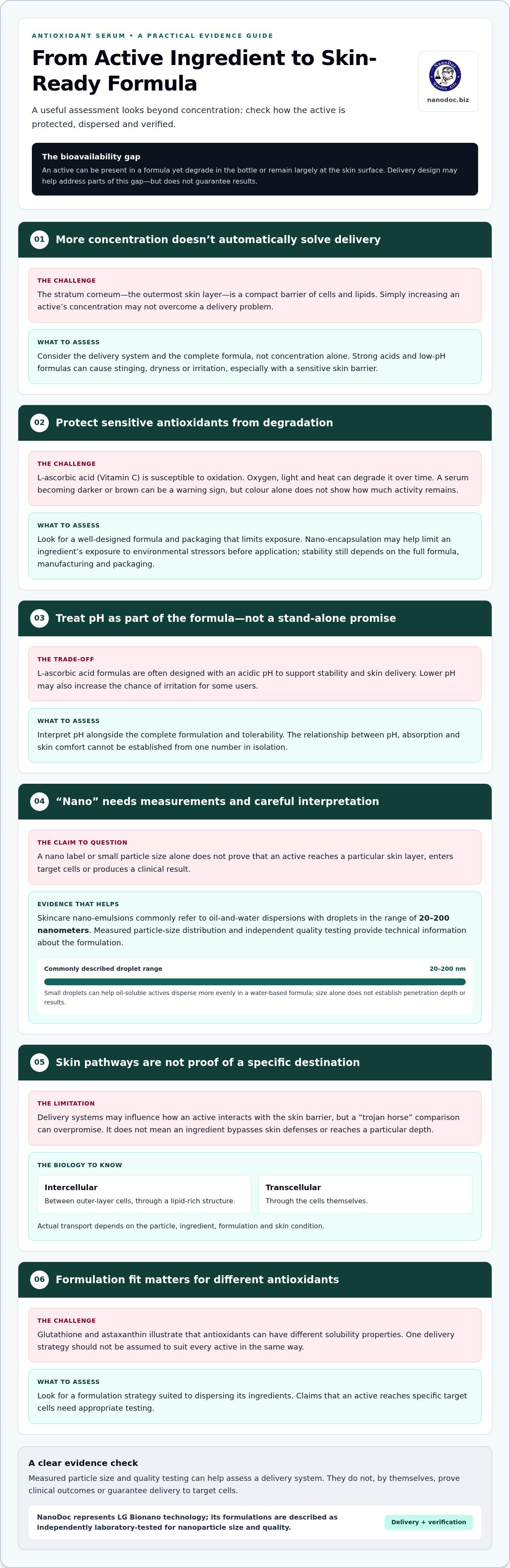
The stratum corneum, the outermost layer of skin, is a protective barrier made of compacted cells and lipids. It limits the movement of substances into the skin, particularly ingredients that don’t readily pass through its structure. There isn’t one reliable percentage that describes how much of every topical ingredient this layer blocks. Penetration depends on the molecule, formula, skin condition, and application.
Simply increasing an active’s concentration may not solve a delivery problem. Strong acids and low-pH formulas can cause stinging, dryness, or irritation, especially when the skin barrier is sensitive. A delivery system is sometimes described as a “trojan horse,” but that image can overpromise: a carrier may help an active disperse or interact with the skin barrier, yet it doesn’t mean the ingredient bypasses the skin’s defenses or reaches a particular depth. The goal of anti-ageing dermal technology is to consider how delivery design affects an active’s stability and interaction with skin.
Antioxidant Instability and Efficacy
L-ascorbic acid, a form of Vitamin C, is susceptible to oxidation. Exposure to oxygen, light, and heat can degrade it over time. A noticeable change in colour, such as a serum becoming darker or brown, can be a warning sign that oxidation has occurred, although colour alone doesn’t establish how much activity remains. Packaging that limits exposure and a well-designed formula can help protect sensitive actives.
pH also matters. L-ascorbic acid formulations are often designed with an acidic pH to support ingredient stability and skin delivery, but lower pH may increase the chance of irritation for some users. The relationship between pH, absorption, and tolerability depends on the complete formulation, not one number in isolation.
Nano-encapsulation can surround or carry ingredients, helping limit their exposure to environmental stressors before application. Nano-emulsions are oil-and-water dispersions; Understanding Nano-Emulsification offers a foundational overview of their structure and properties. Protection in the formula is only one part of performance: particle-size measurement and quality testing provide more useful information than a “nano” label alone.
Understanding Nano-Emulsification: The Science of Deep Dermal Repair
A nano-emulsion is a sub-micron delivery system that disperses ingredients into very small droplets, which can affect how antioxidants disperse and move within a formula. In skincare, nano-emulsification commonly refers to droplets in the range of 20 to 200 nanometers. Their small scale can help oil-soluble actives disperse more evenly in a water-based formula, but particle size alone doesn’t prove that an ingredient reaches a particular skin layer or produces a clinical result.
How Nanoparticles Interact with Skin Biology
Skin penetration can involve two broad routes. The intercellular pathway runs between the cells of the outer skin layer, through its lipid-rich structure. The transcellular pathway passes through the cells themselves. A delivery system may influence how an active interacts with these barriers, but actual transport depends on the particle, ingredient, formulation, and skin condition. Learn more about deep penetration skincare technology and how delivery design relates to skin biology.
Consistency matters. A narrow, measured particle-size distribution can make a formula more predictable than one with widely varying droplet sizes. Independent laboratory testing can verify particle size and quality, providing information about the formulation. It doesn’t, by itself, establish clinical outcomes or guarantee delivery to target cells.
The LG Bionano Proprietary Advantage
NanoDoc represents LG Bionano technology, including patented bionano delivery technology for health products. The value of this approach lies in the delivery system and its verification, not simply the use of “nano” in a product description. NanoDoc’s formulations are independently laboratory-tested to verify nanoparticle size and quality, providing technical information relevant to evaluating the formulation.
Antioxidants such as glutathione and astaxanthin illustrate why delivery design matters: ingredients with different solubility properties may require suitable formulation strategies to disperse them. A carrier can affect how an active interacts with the skin’s outer barrier, but claims that an active reaches specific target cells should be supported by appropriate testing. Likewise, nano-emulsification may contribute to a formula’s physical properties, yet it doesn’t establish that every serum will remain potent longer than standard oils. Stability depends on the complete formula, manufacturing, and packaging.
When assessing a nano-emulsified antioxidant serum, look for measured particle-size information and quality testing rather than relying on a technology label alone. NanoDoc’s LG Bionano delivery technology offers an example of how patented delivery systems and independent laboratory testing can inform advanced anti-ageing skincare.
Selecting High-Performance Serums: Nano-Emulsion vs. Liposomal Delivery
Advanced delivery systems aren’t interchangeable. Nano-emulsions disperse tiny oil droplets through water, while liposomes are microscopic vesicles formed from lipid bilayers. Both can carry skincare actives, but their structure affects which ingredients they suit and how a formula behaves. For a nano-emulsified antioxidant serum, the relevant question isn’t simply whether it uses “nano” technology. It’s whether the delivery system, active ingredients, and supporting evidence fit the intended use.
Nano-Emulsions vs. Liposomes
Nano-emulsions are used to disperse oil-soluble ingredients and may have good physical stability, though performance depends on the full formulation. Liposomes have a bilayer structure with an aqueous interior, allowing them to carry some water-soluble as well as oil-soluble ingredients. Their potential for controlled release may be useful, while nano-emulsions may support faster absorption in some formulations. Neither system is universally superior; the active and formula matter.
Loading capacity also varies with the ingredient’s chemistry and the carrier design. CoQ10 and astaxanthin are oil-soluble antioxidants, so a nano-emulsion may be a practical delivery approach. Glutathione is water-soluble, so its formulation needs different considerations. Particle size can influence surface area and interaction with skin, but absorption also depends on factors such as ingredient concentration, emulsifier system, and skin condition. Oily or mature skin alone doesn’t determine which carrier is best. Texture, supporting ingredients, and individual tolerance are also relevant.
To weigh cost against benefit, focus on evidence rather than a premium label. A formula may be more compelling if its delivery system is clearly described and supported by testing, but technology alone can’t promise visible results. Compare ingredient transparency, stability information, and suitability for your routine.
Verification of “Nano” Claims
Labels can identify ingredients and describe a product’s intended formulation, but they don’t necessarily confirm particle size or delivery performance. Claims such as “nano-powered” without a named delivery approach, measurable particle-size information, or supporting test data are weak evidence. This is sometimes called “nano-washing”: using scientific-sounding language without enough technical detail to substantiate it. The overview of biotech skincare in Southeast Asia provides context for assessing nano-emulsion claims and their relevance to absorption.
Look for independent particle-size verification and, where available, testing that supports claims about ingredient availability. A size report helps establish what was measured; it doesn’t by itself prove clinical effectiveness or guarantee skin penetration. NanoDoc’s formulations are independently tested for nanoparticle size and quality, offering technical information for evaluating advanced anti-ageing skincare.
A Buyer’s Checklist for Nano-Emulsified Formulations
A useful checklist separates measurable formulation details from broad marketing language. Use these five points to assess a nano-emulsified antioxidant serum without assuming that a “nano” claim alone predicts results:
- Verify the delivery technology. Look for a clearly described system, such as patented LG Bionano technology, rather than an unexplained “nano” label.
- Review the antioxidant combination. Vitamin C, Vitamin E, and glutathione may be formulated together, but ingredient compatibility and stability depend on the complete formula.
- Consider packaging. Airless or otherwise protective packaging can reduce exposure to air during use. It supports preservation but can’t prevent every form of degradation.
- Look for independent testing. Particle-size analysis helps verify the characteristics of the delivery system. Quality testing provides additional information about the formulation.
- Assess practical use. Texture and how quickly a serum settles are useful for judging whether it suits your routine. They don’t prove how deeply an active penetrates. See this overview of a nano-emulsified skin care serum for more on formulation and absorption.
Critical Technical Specifications
There is no universal “optimal” particle size that guarantees the best skin penetration. Nano-emulsion droplets are commonly described within a 20 to 200 nanometer range, and performance depends on the active, the full formulation, and the skin. Treat a sub-100-nanometer claim as a specification to evaluate, not proof of superior results. Surfactants help stabilize oil and water mixtures; their suitability and quality affect emulsion stability and the finished formula’s tolerability. Follow the product’s stated storage and expiry guidance, since shelf life varies with ingredients, packaging, and manufacturing.
Ingredient Synergies for Mature Skin
Glutathione is often described as a “master antioxidant,” while astaxanthin is studied for antioxidant properties relevant to oxidative stress, including stress associated with UV exposure. Neither ingredient replaces daily sunscreen. Vitamin C and E may be combined in antioxidant formulas, but a list of actives doesn’t establish synergy or effectiveness. Nano-emulsification can improve dispersion of some ingredients; it doesn’t automatically mean lower concentrations will work better or cause less irritation. Concentration, pH, carrier, and individual skin response all matter.
NanoDoc represents LG Bionano technology, and its formulations are independently tested for nanoparticle size and quality. Explore NanoDoc’s anti-ageing skincare and delivery technology to learn more about its formulation approach.
The NanoDoc Standard: Patented Bionano Technology for Advanced Dermal Repair
Advanced skincare depends on more than the presence of an active ingredient. Formulation, delivery, and verification all influence how reliably an ingredient is protected and dispersed in a topical product. NanoDoc connects LG Bionano’s patented bionano delivery technology with consumer anti-ageing skincare through its range of skin care formulations.
NanoDoc’s formulations are independently tested for nanoparticle size and quality, helping provide measurable information about the delivery system. These tests support transparency, but they shouldn’t be confused with proof that a serum will produce a specific clinical outcome for every user. Technical information builds a stronger basis for evaluation; individual results still depend on the formulation and the person using it.
Our Approach to Anti-Ageing Cosmeceuticals
NanoDoc’s approach emphasizes formulation: protecting sensitive ingredients, refining how they’re dispersed, and verifying particle characteristics through independent testing. A nano-emulsified antioxidant serum is designed to support the dispersion and delivery of antioxidant actives, but claims about reaching deep dermal layers or repairing specific tissue require appropriate evidence. Nano-delivery is a formulation strategy, not a guarantee of depth or visible change.
For consumers, that distinction matters. Well-designed anti-ageing care should be assessed through clear formulation information and evidence, alongside practical considerations such as comfort and consistency of use. The aim is to support skin’s appearance and balance through considered technology, without promising the same radiance or response for everyone.
Next Steps for Your Skincare Regimen
Introduce a new serum thoughtfully. Follow its use directions, and consider applying it after cleansing and before moisturizer if that order is consistent with the product instructions. Moisturizer helps support the skin barrier, while daytime sunscreen remains essential for protection against UV exposure. If you’re using other active ingredients, adding them gradually can make it easier to notice how your skin responds.
Explore NanoDoc’s anti-ageing skin care range to learn about formulations that use patented LG Bionano delivery technology and undergo independent testing for nanoparticle size and quality. Choose products with clear information, realistic expectations, and a place in a routine your skin can tolerate consistently.
Choose Antioxidant Care with Greater Confidence
A high-performance serum is defined by more than its active-ingredient list. Stability, delivery-system design, and evidence behind particle-size claims all matter when comparing options. A nano-emulsified antioxidant serum may support improved dispersion, but “nano” on a label alone doesn’t establish effectiveness. Look for clear technical information and independent testing, while keeping expectations grounded in what the evidence can demonstrate.
NanoDoc represents LG Bionano technology and offers anti-ageing skin care formulations that use patented bionano delivery technology. Its formulations undergo independent laboratory testing for nanoparticle size and quality, offering technical information for evaluating delivery claims. These measures support informed selection without promising the same result for every person.
For anti-ageing skin care informed by patented delivery technology and laboratory testing, Explore NanoDoc’s anti-ageing skincare range. Review the product information and choose the care that fits your skin and routine.
Frequently Asked Questions
Is a nano-emulsified antioxidant serum safe for sensitive skin?
It may be suitable for some people with sensitive skin, but nano-emulsification alone doesn’t determine tolerability. The complete formula, including its active ingredients, concentration, and pH, matters. Review the ingredient list and follow the product’s directions. Before applying a nano-emulsified antioxidant serum to your face, patch-test a small area and monitor for irritation. If you have a persistent skin condition or experience a reaction, stop use and seek appropriate professional advice.
How long does it take to see results from a nano-emulsified serum?
There’s no universal timeframe for visible results. Outcomes depend on the formula, the skin concern, regular use, and individual skin characteristics. A delivery system may influence how ingredients disperse or become available, but it can’t guarantee a particular result or speed. Follow the product directions and assess your skin consistently under similar conditions. If irritation develops, discontinue use rather than increasing the amount or frequency.
Can I use nano-emulsified serums with other active ingredients like Retinol?
Often, but compatibility depends on the serum’s ingredients and your skin’s tolerance. Retinol and antioxidant serums may be used in the same routine, though layering several active formulas can increase dryness or irritation for some people. Introduce products gradually, follow each label’s directions, and consider using them at different times, such as antioxidant care in the morning and retinol at night. Use daytime sun protection as directed.
Why is nanoparticle size so important in antioxidant serums?
Particle size helps describe a delivery system and can affect how ingredients disperse, remain stable, and interact with the skin’s outer barrier. A measured size is more informative than an unsupported “nano” claim, but smaller particles don’t automatically mean better absorption or results. Look for laboratory-verified particle-size information and consider it alongside formulation details. Testing characterizes the product; it doesn’t guarantee a specific clinical outcome.
Does nano-emulsification prevent Vitamin C from turning brown?
No delivery system can be assumed to prevent Vitamin C oxidation completely. Nano-encapsulation or nano-emulsification may help protect sensitive ingredients within a formula, but stability also depends on the Vitamin C form, formulation, packaging, and storage. Darkening can be a sign of oxidation, although colour alone can’t show exactly how much activity remains. Check the product’s appearance and follow its storage and expiry instructions.
What is the difference between nano-emulsion and standard micellar water?
A nano-emulsion is a dispersion of oil and water designed to carry ingredients in small droplets. Micellar water contains surfactant molecules that group into micelles, which can help lift oil, makeup, and debris during cleansing. Their purposes differ: nano-emulsions are formulation and delivery systems, while micellar water is commonly used as a cleanser. Product composition varies, so check the label rather than relying on the product type alone.
Are NanoDoc products tested for nanoparticle safety?
NanoDoc formulations are independently laboratory-tested to verify nanoparticle size and quality. This testing provides information about the formulation’s particle characteristics, but it shouldn’t be described as a complete safety assessment by itself. Safety depends on the complete product, including its ingredients, concentration, and intended use. Follow label directions and discontinue use if irritation occurs. Laboratory verification supports transparency; it doesn’t guarantee that every product will suit every person.
How should I store my nano-emulsified antioxidant serum for maximum potency?
Follow the product’s storage instructions first, since the best conditions vary by formula. In general, keep the container tightly closed and away from direct sunlight, heat, and humid areas. Avoid leaving it open longer than needed, as repeated exposure to air may affect sensitive ingredients. Don’t refrigerate unless the label recommends it. Observe the expiry guidance and any noticeable changes in colour, texture, or smell.
Frequently Asked Questions
- Is a nano-emulsified antioxidant serum safe for sensitive skin?
- It may be suitable for some people with sensitive skin, but nano-emulsification alone doesn’t determine tolerability. The complete formula, including its active ingredients, concentration, and pH, matters. Review the ingredient list and follow the product’s directions. Before applying a nano-emulsified antioxidant serum to your face, patch-test a small area and monitor for irritation. If you have a persistent skin condition or experience a reaction, stop use and seek appropriate professional advice.
- How long does it take to see results from a nano-emulsified serum?
- There’s no universal timeframe for visible results. Outcomes depend on the formula, the skin concern, regular use, and individual skin characteristics. A delivery system may influence how ingredients disperse or become available, but it can’t guarantee a particular result or speed. Follow the product directions and assess your skin consistently under similar conditions. If irritation develops, discontinue use rather than increasing the amount or frequency.
- Can I use nano-emulsified serums with other active ingredients like Retinol?
- Often, but compatibility depends on the serum’s ingredients and your skin’s tolerance. Retinol and antioxidant serums may be used in the same routine, though layering several active formulas can increase dryness or irritation for some people. Introduce products gradually, follow each label’s directions, and consider using them at different times, such as antioxidant care in the morning and retinol at night. Use daytime sun protection as directed.
- Why is nanoparticle size so important in antioxidant serums?
- Particle size helps describe a delivery system and can affect how ingredients disperse, remain stable, and interact with the skin’s outer barrier. A measured size is more informative than an unsupported “nano” claim, but smaller particles don’t automatically mean better absorption or results. Look for laboratory-verified particle-size information and consider it alongside formulation details. Testing characterizes the product; it doesn’t guarantee a specific clinical outcome.
- Does nano-emulsification prevent Vitamin C from turning brown?
- No delivery system can be assumed to prevent Vitamin C oxidation completely. Nano-encapsulation or nano-emulsification may help protect sensitive ingredients within a formula, but stability also depends on the Vitamin C form, formulation, packaging, and storage. Darkening can be a sign of oxidation, although colour alone can’t show exactly how much activity remains. Check the product’s appearance and follow its storage and expiry instructions.
- What is the difference between nano-emulsion and standard micellar water?
- A nano-emulsion is a dispersion of oil and water designed to carry ingredients in small droplets. Micellar water contains surfactant molecules that group into micelles, which can help lift oil, makeup, and debris during cleansing. Their purposes differ: nano-emulsions are formulation and delivery systems, while micellar water is commonly used as a cleanser. Product composition varies, so check the label rather than relying on the product type alone.
- Are NanoDoc products tested for nanoparticle safety?
- NanoDoc formulations are independently laboratory-tested to verify nanoparticle size and quality. This testing provides information about the formulation’s particle characteristics, but it shouldn’t be described as a complete safety assessment by itself. Safety depends on the complete product, including its ingredients, concentration, and intended use. Follow label directions and discontinue use if irritation occurs. Laboratory verification supports transparency; it doesn’t guarantee that every product will suit every person.
- How should I store my nano-emulsified antioxidant serum for maximum potency?
- Follow the product’s storage instructions first, since the best conditions vary by formula. In general, keep the container tightly closed and away from direct sunlight, heat, and humid areas. Avoid leaving it open longer than needed, as repeated exposure to air may affect sensitive ingredients. Don’t refrigerate unless the label recommends it. Observe the expiry guidance and any noticeable changes in colour, texture, or smell.