
Deep Penetration Skincare Technology: Restoring Radiance Through Dermal Repair
5 September 2026
Have you ever wondered why your premium serums fail to deliver the results promised on the label? If you're investing hundreds of dollars in sophisticated routines here in Singapore, it's frustrating to see persistent signs of ageing that refuse to budge. The reality is that the skin's primary function is to act as a barrier; most traditional formulations simply sit on the surface, providing little more than temporary hydration because they lack the mechanism to reach the deeper dermal layers.
This article explores how deep penetration skincare technology utilizes advanced nano-delivery systems to bypass the stratum corneum. By understanding the science of dermal absorption, you can move beyond the confusion of technical claims to identify solutions that offer genuine cellular repair. We'll examine the role of high-performance ingredients backed by delivery tech and how these laboratory-verified systems, such as those from the South East Asia representative for LG Bionano, provide a bridge between advanced biotech and visible rejuvenation for mature skin.
Key Takeaways
- Identify the specific biological hurdles that prevent conventional serums from reaching the dermis and why molecular weight is the decisive factor in product efficacy.
- Learn how deep penetration skincare technology utilizes nano-encapsulation to protect and transport active ingredients safely through the skin's natural defense systems.
- Differentiate between legacy liposomal delivery and modern, high-performance nano-emulsions to ensure you're investing in the most advanced formulation available.
- Follow a clinically-informed application sequence that prioritizes dermal absorption and maintains the structural integrity of high-potency ingredients.
- Recognize the importance of laboratory-verified nanoparticle sizes in ensuring consistent, high-bioavailability results for age-related skin concerns.
Table of Contents
- The Biological Barrier: Why Standard Skincare Often Fails to Penetrate
- The Mechanics of Nano-Encapsulation and Nano-Emulsion Technology
- Nano-Delivery vs. Liposomal and Conventional Formulations
- How to Integrate Deep Penetration Technology into Your Regimen
- LG Bionano Technology: Advancing the Future of Dermal Repair
The Biological Barrier: Why Standard Skincare Often Fails to Penetrate
The human skin is an evolutionary masterpiece designed primarily for protection. Its outermost layer, the stratum corneum, functions as a formidable physical shield that prevents environmental toxins and pathogens from entering the body. While this biological defense is vital for health, it presents a significant challenge for topical treatments. Most conventional serums and creams fail to achieve visible results because they cannot move past this barrier. Instead of reaching the deeper layers where collagen and elastin reside, active ingredients often remain trapped on the surface, where they eventually evaporate or oxidize.
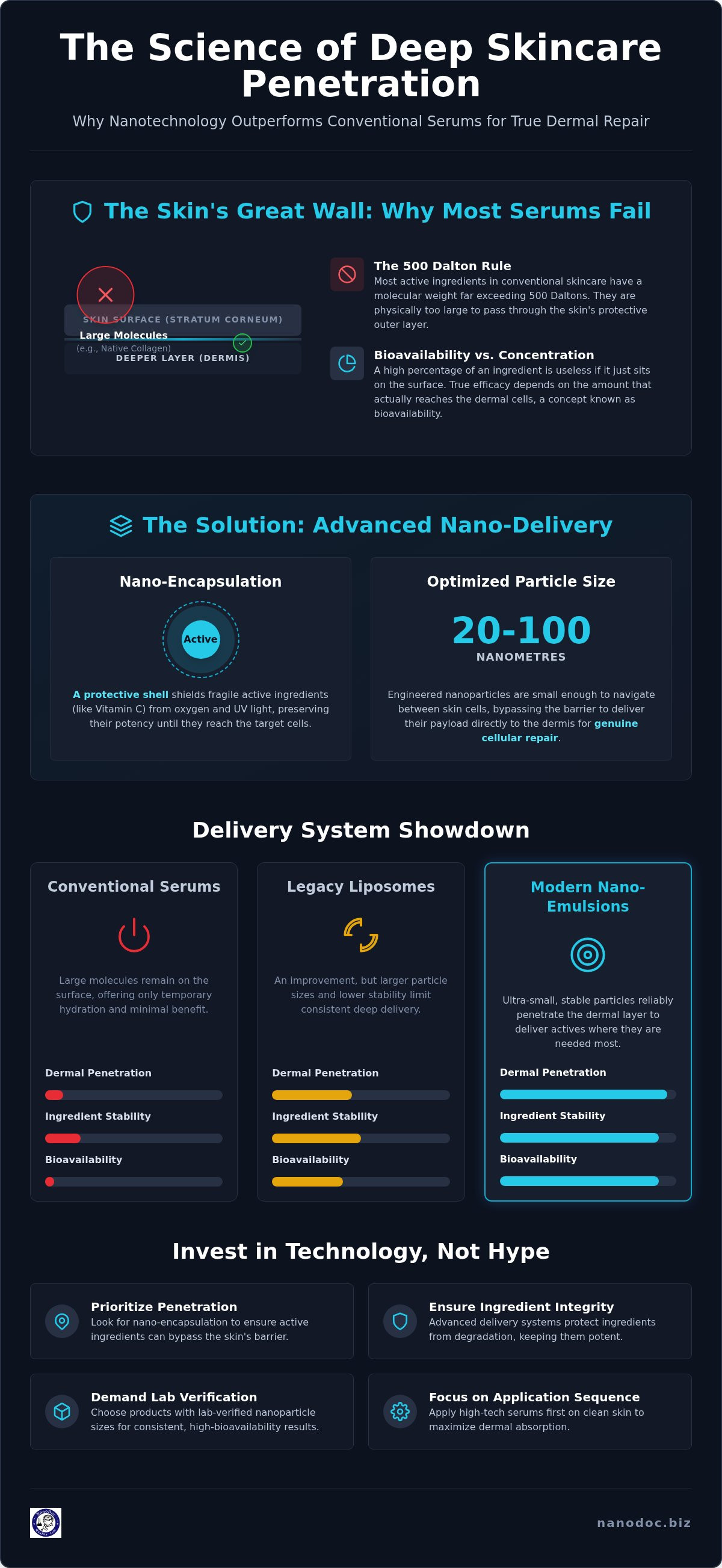
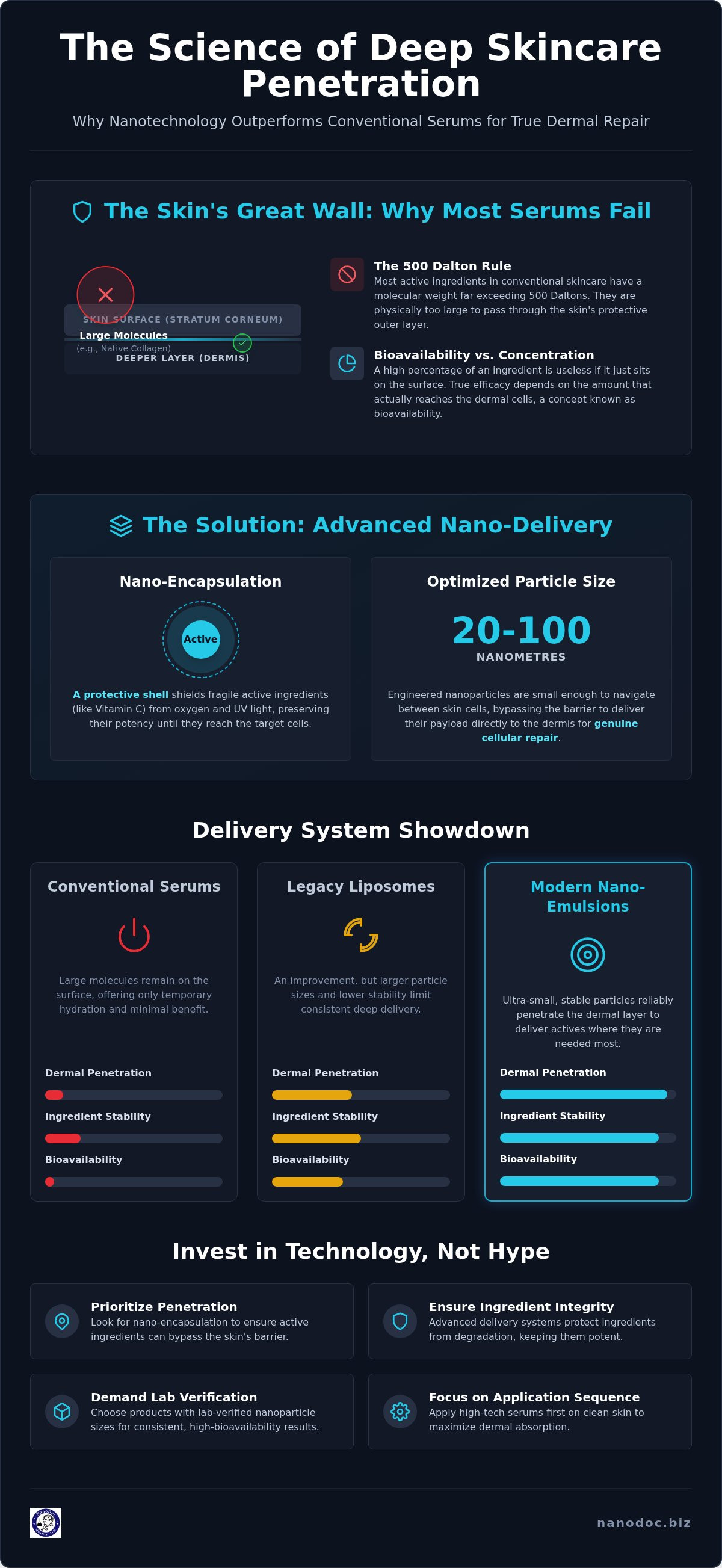
Molecular size is the primary determinant of whether a substance can pass through the skin's pores. Scientific consensus suggests that only molecules smaller than 500 Daltons can effectively permeate the skin barrier. Unfortunately, many popular anti-ageing ingredients, such as native collagen or certain peptides, possess a molecular weight far exceeding this limit. Without the assistance of deep penetration skincare technology, these high-cost ingredients provide nothing more than temporary surface hydration. This explains why many consumers in Singapore spend hundreds of S$ on premium products yet see no structural improvement in mature skin.
The industry's focus on "high concentration" percentages is often a misleading metric. A formulation containing 20% Vitamin C is biologically irrelevant if the delivery system doesn't protect the molecule from oxidation or facilitate its transport. Effective dermal repair requires a shift in focus from ingredient volume to the precision of the delivery mechanism.
The Challenge of the Lipid Bilayer
The skin's barrier is composed of a lipid-rich matrix that naturally repels water-based substances. This hydrophobic nature means that standard aqueous serums are often rejected upon contact. While some oil-based formulations attempt to mimic the skin's natural sebum, they frequently lack the structural refinement to carry active loads into the dermis. The dermal barrier acts as a highly selective filter that restricts entry based on both molecular size and chemical polarity. Modern Nanotechnology in cosmetics addresses this by encapsulating ingredients in biocompatible shells that "trick" the lipid bilayer into allowing passage.
Bioavailability in Topical Applications
Bioavailability refers to the proportion of an active ingredient that actually reaches its intended cellular target to exert a biological effect. There's a stark difference between skin coverage and cellular uptake. Many traditional products utilize heavy fillers and silicones to create a smooth texture, but these synthetic additives can form an occlusive film that actually blocks the absorption of the very nutrients the skin requires. True deep penetration skincare technology ensures that the "payload" is not only delivered but is also released in a stable, bioavailable form that the cells can immediately utilize for repair and regeneration.
The Mechanics of Nano-Encapsulation and Nano-Emulsion Technology
Understanding the transition from surface-level hydration to structural dermal repair requires a look at the precise engineering of delivery vehicles. Nano-encapsulation serves as a sophisticated protective system; it involves wrapping high-performance active ingredients in a biocompatible shell. This process creates a biological "vehicle" that shields the payload from external stressors like UV light and oxygen. By utilizing deep penetration skincare technology, these encapsulated molecules remain stable until they reach their intended destination within the skin's architecture.
The efficacy of this system relies heavily on the physical dimensions of the delivery particles. While standard cosmetic molecules are often too bulky to penetrate the stratum corneum, nanoparticles engineered between 20 and 100 nanometres possess the necessary scale for transdermal passage. This specific size range allows the formulation to navigate the microscopic gaps between skin cells. Complementing this is nano-emulsion technology, which creates a uniform and ultra-fine texture. This ensures that the active ingredients are distributed evenly across the application area, resulting in a high-absorption profile that leaves no occlusive residue.
Precision is further refined through controlled release mechanisms. Instead of a sudden burst on the skin's surface, these advanced systems are designed to trigger the release of their contents only at specific dermal depths. This methodical approach ensures that the cellular environment receives a steady supply of nutrients exactly where they are required for optimal repair. For those seeking these laboratory-verified advancements, exploring the biotech skincare solutions offered by authorized representatives can provide a clear path to measurable results.
Protecting Volatile Actives
Highly effective ingredients like Vitamin C and Retinol are notoriously unstable; they often lose potency long before they can provide any benefit. Encapsulation maintains the integrity of these volatile actives from the moment the bottle is opened until they contact the skin. The release is often triggered by specific enzymes found only in the deeper layers of the epidermis. This mechanism prevents the degradation of the ingredient, ensuring that 100% of the potency is directed toward cellular rejuvenation rather than being wasted on the surface.
Enhancing Dermal Affinity
Advanced nano-carriers are engineered to mimic the skin's natural lipid structure, which significantly enhances dermal affinity. When a delivery system "looks" like the skin's own biological components, the barrier is less likely to trigger an inflammatory response. This targeted delivery reduces the risk of surface irritation, a common problem with high-strength conventional products. Consequently, deep penetration skincare technology has become the preferred standard for individuals in Singapore with sensitive but mature skin who require high-performance results without the typical side effects of aggressive topicals.
Nano-Delivery vs. Liposomal and Conventional Formulations
Conventional skincare formulations typically rely on macro-emulsions where active ingredients are suspended in relatively large droplets. These structures are effective for surface-level hydration and reinforcing the skin's moisture barrier, but they lack the structural capacity for deeper intervention. When consumers in Singapore invest in premium anti-ageing products, the expectation is often dermal repair, yet conventional creams rarely deliver more than 5% to 10% of their active load past the initial layers. Most of the product remains as an occlusive film, providing a temporary aesthetic improvement without addressing the underlying structural decline of mature skin.
Liposomal technology emerged as the first significant advancement in delivery science, utilizing phospholipid spheres to encapsulate actives. While liposomes are more effective than basic emulsions, they often suffer from stability issues when exposed to the high humidity and temperatures characteristic of the Singapore climate. They are also significantly larger than modern nanoparticles, often ranging from 100nm to 300nm. In contrast, deep penetration skincare technology utilizes advanced nano-emulsions that remain stable across diverse environmental conditions. These systems offer superior shelf-life and ensure that a much higher percentage of the active ingredient, often exceeding 60% uptake, actually reaches the target cells.
The Evolution of Delivery Systems
The transition from basic emulsions to biotech-driven delivery marks a shift from passive application to active transport. While liposomes were a groundbreaking predecessor, their fragile nature means they can rupture prematurely in complex formulations. Patented bionano technology, represented by the South East Asia representative for LG Bionano, utilizes more robust delivery vehicles that maintain their integrity throughout the product's lifespan. This reliability is essential for maintaining the clinical potency of age-reversing compounds in the challenging tropical climate of South East Asia.
Performance Indicators for Mature Skin
The speed at which visible results appear is a direct consequence of delivery efficiency. While surface-level products might soften fine lines through simple hydration, they rarely impact deep-set wrinkles caused by dermal degradation. Because deep penetration skincare technology utilizes 20nm particles to navigate the 50nm gaps in the skin barrier, the actives can reach the fibroblasts responsible for collagen synthesis. This precision leads to faster radiance repair and a measurable improvement in the density of mature skin, providing a level of performance that conventional liposomal products cannot match.
How to Integrate Deep Penetration Technology into Your Regimen
The efficacy of any high-performance formulation is contingent upon the precision of its application. Utilizing deep penetration skincare technology requires a specific methodology to ensure that the engineered nanoparticles reach their intended dermal targets without interference. Unlike traditional products that rely on heavy application, biotech-driven solutions function through efficiency rather than volume. This shift in approach ensures that the active ingredients are not wasted on the surface but are instead directed toward cellular repair.
Preparation begins with pH-balanced cleansing. In Singapore's urban environment, the skin accumulates microscopic pollutants and particulate matter that can physically obstruct delivery vehicles. A neutral pH environment is essential; it maintains the integrity of the nano-encapsulation shells while ensuring the stratum corneum is receptive to transport. Once the surface is prepared, the layering logic prioritizes molecular size. Nano-emulsified serums must be applied first, as their ultra-fine structure allows them to navigate the lipid bilayer before heavier, occlusive creams create a barrier that would otherwise block their passage.
Consistency is the final pillar of a successful regimen. Building a dermal reservoir of active ingredients ensures that the skin has a constant supply of nutrients for repair. Because these delivery systems are highly efficient, a smaller dose is often more effective than a thick layer of conventional cream. This "less is more" principle maximizes the value of your investment while preventing surface irritation. To begin your journey with these advanced delivery systems, you can explore our range of anti-ageing skincare solutions.
The Deep Dermal Repair Protocol
Following a structured sequence ensures that the active payload is not lost to evaporation or surface trapping. This protocol is designed to optimize the environment for nanoparticle transport:
- Step 1: Utilize a gentle, pH-balanced cleanser to remove sebum and environmental debris that can clog pores.
- Step 2: Apply nano-active serums to slightly damp skin, as residual moisture can help facilitate the movement of nanoparticles through the initial layers.
- Step 3: Seal the treatment with a biocompatible moisturizer to reinforce the surface barrier while the actives work beneath.
Maximizing Radiance for Mature Skin
Timing is a critical factor in dermal repair. The skin's natural permeability increases during the nocturnal cycle, making the evening application the most vital for structural rejuvenation. This aligns with the body's circadian rhythms, where cellular turnover is at its peak. For a comprehensive approach, many professionals recommend a "gut-to-skin" methodology. Combining topical care with Nano Cellular Essential Nutrition can provide the internal building blocks necessary for the external repair processes to flourish. This dual-action strategy, supported by the South East Asia representative for LG Bionano, addresses ageing from both a structural and a metabolic perspective.
LG Bionano Technology: Advancing the Future of Dermal Repair
LG Bionano stands as a pioneer in the field of nano-cellular science, leveraging decades of rigorous laboratory research to redefine the limits of topical efficacy. While the market is saturated with generic claims of "nano" ingredients, the distinction lies in the structural precision of the delivery vehicle. True deep penetration skincare technology requires a manufacturing process that ensures consistent nanoparticle dimensions, typically within the 20 to 100nm range. LG Bionano's patented systems are engineered to maintain this precision, ensuring that the active compounds remain stable and bioavailable until they reach the dermal target.
NanoDoc International Pte Ltd, as the exclusive South East Asia representative for LG Bionano, maintains a commitment to clinical transparency. Every batch of the Anti-Ageing Skin Care line undergoes independent laboratory testing to verify nanoparticle sizes. This verification process addresses a critical gap in the industry, where many products lack the technical refinement to bypass the skin's defense systems. By providing documented proof of absorption potential, NanoDoc International Pte Ltd establishes a bridge between advanced laboratory science and the practical needs of consumers seeking professional-grade wellness solutions.
The integration of these systems into a daily regimen allows for a level of structural repair previously reserved for clinical environments. The focus remains on the integrity of the manufacturing process, ensuring that each application delivers a potent, protected payload to the mature skin's deeper layers. It's this commitment to technical precision that separates laboratory-verified formulations from mere lifestyle trends.
The NanoDoc International Pte Ltd Standard of Quality
NanoDoc International Pte Ltd operates with a mandate of clinical oversight, ensuring that the technology developed in the laboratory translates effectively to the South East Asian market. This involves more than just distribution; it's a process of continuous verification. Independent testing confirms that the particles are small enough to navigate the skin's lipid matrix, providing a reliable standard for those who have previously found traditional serums ineffective. This methodical approach reinforces the brand's position as a trusted specialist in the biotech landscape.
Beyond Skincare: A Holistic Nano-Tech Approach
True rejuvenation often requires a multi-dimensional strategy that addresses both internal and external biological processes. NanoDoc International Pte Ltd facilitates this through a synergy between topical dermal repair and Nano Cellular Essential Nutrition. By providing systemic support alongside targeted skin care, the body is better equipped to utilize the actives delivered through deep penetration skincare technology. This holistic methodology ensures that the cellular environment is optimized for long-term health and radiance. Explore the Anti-Ageing Skin Care collection powered by LG Bionano to begin your structural skin transformation.
Achieving Structural Skin Integrity through Biotech
The transition from surface hydration to genuine dermal repair requires a shift toward evidence-based delivery systems. We've explored how the biological barrier naturally restricts standard formulations and why precision engineering is the only viable path to cellular rejuvenation. By prioritizing deep penetration skincare technology, you ensure that high-performance ingredients aren't lost to oxidation but are instead delivered directly to the dermal layers where structural repair occurs.
As the exclusive South East Asia representative for LG Bionano, NanoDoc International provides access to patented nano-delivery systems that are independently laboratory-tested for nanoparticle size. This commitment to technical precision offers a reliable bridge between advanced biotech and your daily wellness routine. When you choose formulations backed by clinical verification, you're investing in the long-term integrity of your skin rather than temporary aesthetic trends. Discover the Science of Dermal Repair at NanoDoc and experience the difference that laboratory-verified precision makes for mature skin.
Frequently Asked Questions
What exactly is deep penetration skincare technology?
Deep penetration skincare technology refers to advanced delivery systems, such as nano-encapsulation, designed to transport active ingredients through the skin's lipid barrier. Unlike conventional creams that sit on the surface, this technology uses biocompatible carriers to reach the deeper dermal layers. This ensures that high-performance nutrients are delivered directly to the cells responsible for structural repair, maximizing the biological impact of every application.
Is nanotechnology in skincare safe for sensitive skin?
Nanotechnology is generally safe and often beneficial for sensitive skin because it allows for targeted delivery. By encapsulating active ingredients, the technology prevents them from sitting on the skin's surface where they might cause irritation or inflammatory responses. These delivery vehicles are engineered from biocompatible materials that mimic the skin's natural structure, ensuring the payload is released at a deeper level where it's needed most.
How long does it take to see results from nano-emulsified serums?
Visible improvements in skin radiance often appear within the first few weeks of consistent use as surface hydration and cellular nutrition improve. However, structural dermal repair, such as the reduction of deep-set wrinkles, typically requires 30 to 60 days to align with the skin's natural regenerative cycle. Consistent application is essential to build a reservoir of active ingredients within the dermis, ensuring a steady supply of nutrients for rejuvenation.
Can I use nano-tech products with my current skincare routine?
You can integrate these advanced products into your existing regimen by following a specific layering sequence. Because nano-emulsified serums have an ultra-fine molecular structure, they must be applied immediately after cleansing on slightly damp skin. Applying them before heavier occlusive moisturizers or oils ensures that the nanoparticles can navigate the skin barrier without being blocked by larger synthetic molecules found in many conventional formulations.
What is the difference between nano-encapsulation and liposomes?
The primary differences lie in molecular size and structural stability. Liposomes are legacy delivery vehicles that are typically larger, often ranging between 100nm and 300nm, which can limit their penetration depth. In contrast, deep penetration skincare technology utilizes smaller nanoparticles, often between 20nm and 100nm. These modern nano-emulsions are also more stable in the humid Singapore climate, ensuring the active ingredients don't degrade prematurely.
How do I know if a product actually uses deep penetration technology?
Authenticity is determined by clinical transparency and laboratory verification. Reputable providers, such as the South East Asia representative for LG Bionano, subject their batches to independent testing to confirm the exact nanoparticle size. You should look for technical specifications rather than generic marketing claims. Verified products will often mention specific delivery mechanisms like nano-encapsulation and provide data regarding the bioavailability and absorption rates of their formulations.
Does nanoparticle size really matter for anti-ageing results?
Nanoparticle size is a critical factor because the gaps between skin cells are approximately 50 nanometres wide. If an active ingredient or its delivery vehicle is larger than this threshold, it remains trapped on the stratum corneum. Particles engineered within the 20nm to 40nm range can navigate these microscopic pathways effectively. This precision allows for higher cellular uptake, ensuring that anti-ageing nutrients reach the fibroblasts to stimulate collagen production.
Can deep penetration technology help with deep-set wrinkles?
While no topical product can replicate surgical outcomes, deep penetration technology is highly effective at softening the appearance of deep-set wrinkles. By transporting peptides and growth factors to the dermis, it addresses the root cause of skin sagging and volume loss. This structural intervention helps to densify the dermal matrix from within, providing a level of repair that conventional surface-level treatments cannot achieve due to their limited absorption.
Frequently Asked Questions
- What exactly is deep penetration skincare technology?
- Deep penetration skincare technology refers to advanced delivery systems, such as nano-encapsulation, designed to transport active ingredients through the skin's lipid barrier. Unlike conventional creams that sit on the surface, this technology uses biocompatible carriers to reach the deeper dermal layers. This ensures that high-performance nutrients are delivered directly to the cells responsible for structural repair, maximizing the biological impact of every application.
- Is nanotechnology in skincare safe for sensitive skin?
- Nanotechnology is generally safe and often beneficial for sensitive skin because it allows for targeted delivery. By encapsulating active ingredients, the technology prevents them from sitting on the skin's surface where they might cause irritation or inflammatory responses. These delivery vehicles are engineered from biocompatible materials that mimic the skin's natural structure, ensuring the payload is released at a deeper level where it's needed most.
- How long does it take to see results from nano-emulsified serums?
- Visible improvements in skin radiance often appear within the first few weeks of consistent use as surface hydration and cellular nutrition improve. However, structural dermal repair, such as the reduction of deep-set wrinkles, typically requires 30 to 60 days to align with the skin's natural regenerative cycle. Consistent application is essential to build a reservoir of active ingredients within the dermis, ensuring a steady supply of nutrients for rejuvenation.
- Can I use nano-tech products with my current skincare routine?
- You can integrate these advanced products into your existing regimen by following a specific layering sequence. Because nano-emulsified serums have an ultra-fine molecular structure, they must be applied immediately after cleansing on slightly damp skin. Applying them before heavier occlusive moisturizers or oils ensures that the nanoparticles can navigate the skin barrier without being blocked by larger synthetic molecules found in many conventional formulations.
- What is the difference between nano-encapsulation and liposomes?
- The primary differences lie in molecular size and structural stability. Liposomes are legacy delivery vehicles that are typically larger, often ranging between 100nm and 300nm, which can limit their penetration depth. In contrast, deep penetration skincare technology utilizes smaller nanoparticles, often between 20nm and 100nm. These modern nano-emulsions are also more stable in the humid Singapore climate, ensuring the active ingredients don't degrade prematurely.
- How do I know if a product actually uses deep penetration technology?
- Authenticity is determined by clinical transparency and laboratory verification. Reputable providers, such as the South East Asia representative for LG Bionano, subject their batches to independent testing to confirm the exact nanoparticle size. You should look for technical specifications rather than generic marketing claims. Verified products will often mention specific delivery mechanisms like nano-encapsulation and provide data regarding the bioavailability and absorption rates of their formulations.
- Does nanoparticle size really matter for anti-ageing results?
- Nanoparticle size is a critical factor because the gaps between skin cells are approximately 50 nanometres wide. If an active ingredient or its delivery vehicle is larger than this threshold, it remains trapped on the stratum corneum. Particles engineered within the 20nm to 40nm range can navigate these microscopic pathways effectively. This precision allows for higher cellular uptake, ensuring that anti-ageing nutrients reach the fibroblasts to stimulate collagen production.
- Can deep penetration technology help with deep-set wrinkles?
- While no topical product can replicate surgical outcomes, deep penetration technology is highly effective at softening the appearance of deep-set wrinkles. By transporting peptides and growth factors to the dermis, it addresses the root cause of skin sagging and volume loss. This structural intervention helps to densify the dermal matrix from within, providing a level of repair that conventional surface-level treatments cannot achieve due to their limited absorption.