

The supplement with the most advanced delivery system may not be the one your body absorbs best. Nutrient absorption depends on more than a label: the nutrient’s form, what you take it with, digestion, and individual factors can all influence how much your body uses. That’s why bioavailable nano vitamins may be worth examining, but the word “nano” alone doesn’t prove a meaningful advantage.
If you’re unsure why one supplement seems more effective than another, or find competing claims difficult to compare, you’re not alone. Formulation technology can affect how a nutrient is delivered, but evidence for one ingredient or product can’t automatically be applied to every nano formulation.
This article explains the main factors that influence nutrient absorption, practical ways to support nutrient intake, and how to assess claims about nano vitamins. You’ll also learn what formulation and quality information to look for, including which products testing covers, so you can make a more informed supplement choice.
Key Takeaways
- Learn why nutrient absorption varies with digestion, nutrient form, meals, and individual health factors.
- Explore practical food and routine choices, while checking nutrient-specific directions rather than assuming every supplement should be taken the same way.
- Assess whether bioavailable nano vitamins have relevant evidence for the specific nutrient and formulation. Particle size alone doesn’t establish better absorption or health outcomes.
- Use a supplement checklist to review ingredient amounts, serving directions, warnings, and appropriate upper limits before choosing a product.
- Find out what formulation and laboratory-testing details to verify when considering NanoDoc’s nano-nutrient nutrition category.
Table of Contents
- What nutrient absorption means, and what can interfere with it
- How to improve nutrient absorption with food and routine
- Do bioavailable nano vitamins improve absorption compared with other forms?
- A practical checklist for choosing and using nutrient supplements
- How to explore NanoDoc's nano-nutrient approach responsibly
What nutrient absorption means, and what can interfere with it
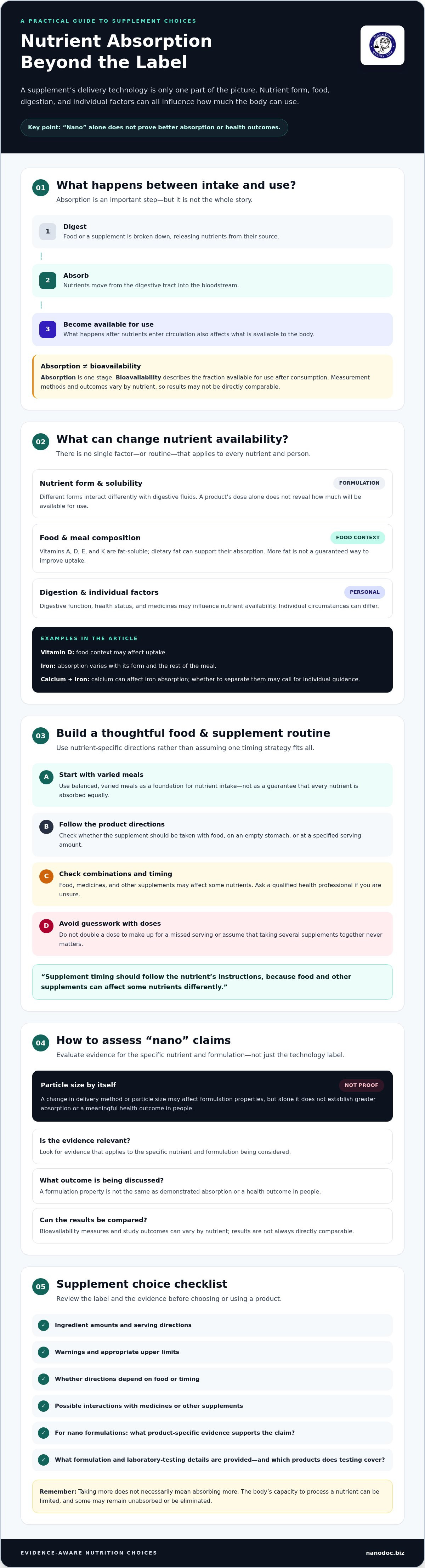
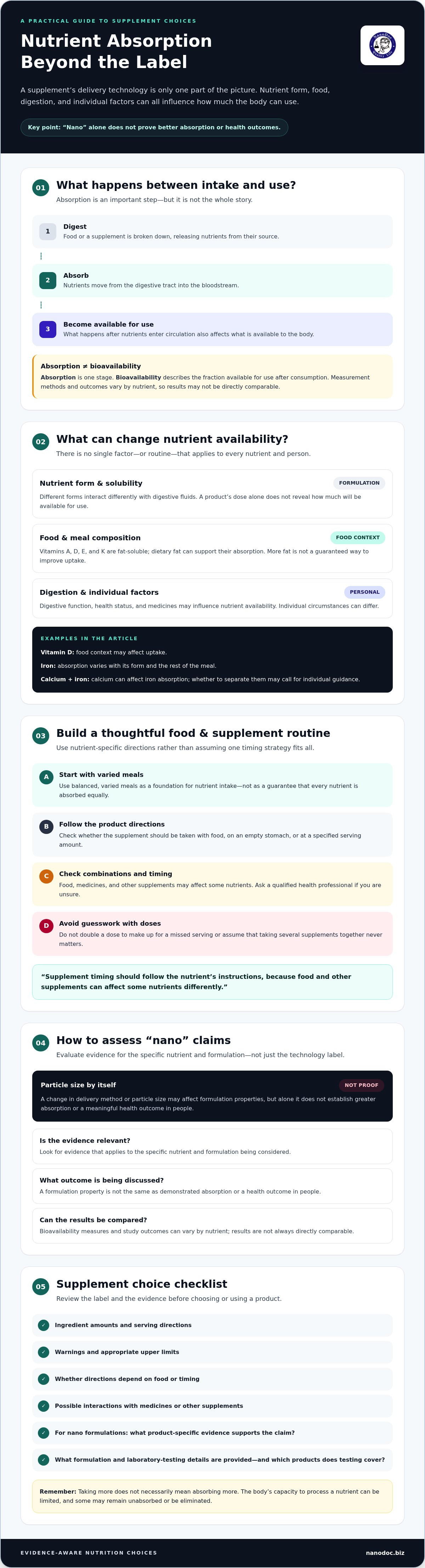
Nutrient absorption is the movement of nutrients from the digestive tract into the bloodstream. It’s an important step in getting nutrients from food or supplements into circulation, but it doesn’t tell the whole story. Digestion must first release nutrients from their source, and what happens after they enter circulation can also affect how much is available for the body to use.
Bioavailability describes the fraction of a nutrient that becomes available for use after it’s consumed. The term is related to absorption, but the two aren’t interchangeable: absorption is one stage in the process, while bioavailability reflects the broader outcome. The Bioavailability overview explains the concept and how it can be assessed. Measurement methods and outcomes vary by nutrient and study, so results aren’t always directly comparable.
Absorption and bioavailability are related, but not interchangeable
Consider a nutrient in a meal and the same nutrient in a supplement. Both may be digested and absorbed, yet differences in nutrient form, the food matrix, and digestion can affect how much becomes available for use. A product’s dose alone doesn’t reveal that amount. Taking more doesn’t necessarily mean absorbing more, since the body’s capacity to process a nutrient can be limited and some may remain unabsorbed or be eliminated.
That distinction matters when interpreting claims about bioavailable nano vitamins. A change in delivery method or particle size may affect a formulation’s properties, but it doesn’t by itself establish greater absorption or a meaningful health outcome in people.
Why absorption differs between nutrients and people
Digestion breaks food and supplements down, while a nutrient’s form and solubility influence how it interacts with digestive fluids. Meal composition can also matter. Vitamin D is fat-soluble, so food context may affect its uptake; iron absorption varies with its form and the rest of the meal. These examples show why directions can be nutrient-specific rather than universal.
Individual factors, including digestive function, health status, and medicines, may influence nutrient availability. This variation doesn’t identify a cause or establish a condition. Follow the product’s directions, and seek advice from a qualified health professional if you have concerns or need guidance for your circumstances. A larger serving isn’t a reliable substitute for understanding the nutrient, its formulation, and its instructions for use.
How to improve nutrient absorption with food and routine
There isn’t one timing strategy that suits every nutrient. A practical routine starts with balanced meals, clear product directions, and advice suited to your health needs. Food choices and digestion can affect nutrient availability, so use reliable, nutrient-specific guidance rather than assuming one habit improves absorption across the board.
Build meals that support nutrient intake
Use varied meals as a foundation for nutrient intake, not as a guarantee that every nutrient will be absorbed equally. Nutrient form, digestion, and meal composition can all play a role. Vitamins A, D, E, and K are fat-soluble, so dietary fat can support their absorption. This doesn’t mean adding more fat will reliably improve uptake; follow relevant food or supplement directions.
Some food combinations also matter for particular nutrients. For example, calcium can affect iron absorption, so people taking both may need individual guidance on whether to separate them. Don’t treat this as a universal rule for every nutrient or supplement. Check the product instructions, and ask a pharmacist or other qualified healthcare professional if you’re unsure about possible interactions with food, medicines, or other supplements.
Use supplement timing and doses thoughtfully
Make the label your starting point. It may specify whether a supplement should be taken with food, on an empty stomach, or at a particular serving amount. Directions can differ because nutrient forms and formulations differ. Avoid doubling a dose to compensate for a missed serving or taking several supplements together on the assumption that timing never matters.
Quotable takeaway: “Supplement timing should follow the nutrient’s instructions, because food and other supplements can affect some nutrients differently.”
- Read the serving directions and warnings before use.
- Check whether food, medicines, or other supplements could affect the nutrient you’re taking.
- Ask a qualified health professional about dose or timing questions, particularly if you use medicines or take multiple supplements.
Persistent digestive symptoms or a suspected deficiency warrant qualified medical advice rather than a trial of higher doses or bioavailable nano vitamins. A health professional can help assess your concern and determine appropriate next steps. If you’re exploring formulations, NanoDoc’s nano-nutrient nutrition category is one option to review alongside product directions and evidence for the specific formulation.
Do bioavailable nano vitamins improve absorption compared with other forms?
Nano-enabled supplements use formulation techniques intended to change how an ingredient is carried, dispersed, or protected during delivery. That approach may be useful for particular nutrients, but “nano” describes a broad category, not a single standardized formulation. Nutrient, carrier system, manufacturing process, and evidence can differ from one product to another.
Smaller particle size alone doesn’t show that a supplement is absorbed better in people, reaches a particular tissue, or produces a meaningful health benefit. These are separate questions. Laboratory measurements can describe formulation properties; absorption research examines what enters circulation; studies of health outcomes assess whether people experience a relevant effect. Evidence at one level doesn’t automatically establish the next.
What nano-encapsulation is intended to do
Encapsulation places an ingredient within or alongside a carrier material. Depending on the design, the carrier may help disperse or protect the ingredient during storage or digestion. It doesn’t mean every nano-formulation crosses biological barriers or behaves the same way in the body. A result for one nutrient and delivery system can’t be assumed to apply to another.
How to assess evidence behind a nano-vitamin claim
Look for human research on the specific nutrient and formulation being considered. Check what the study measured, how the comparison was made, and whether it assessed absorption, a health outcome, or only laboratory properties. If research concerns a different formulation, it may offer context, but it doesn’t directly demonstrate that the product you’re evaluating performs similarly.
For quality claims, ask what was tested and whether the documents identify the method, formulation, and measured characteristics. NanoDoc reports independent laboratory testing for nanoparticle size and quality; confirm the relevant test methods, documentation, and formulations covered rather than assuming they apply to every product.
| Claim | Evidence needed | Questions consumers can ask |
|---|---|---|
| “The particles are nano-sized.” | Product-specific laboratory data and a clear description of the measurement method. | Which formulation was tested, and what does the result measure? |
| “The nutrient is absorbed better.” | Human research measuring absorption for the actual formulation, ideally against a relevant comparator. | Was this exact formulation studied in people, and what was compared? |
| “It provides better results.” | Human evidence measuring a meaningful health outcome, not particle size alone. | What outcome was assessed, and does the evidence apply to this product? |
In short, bioavailable nano vitamins should be evaluated through formulation-specific evidence, not the label alone. Clear answers about testing and human research help distinguish a documented property from an absorption or health claim.
A practical checklist for choosing and using nutrient supplements
Begin with the reason you’re considering a supplement. Review your usual diet and any specific guidance you’ve received, then identify what you want the product to provide. This helps distinguish a targeted nutritional need from general interest in a new formulation. Supplements shouldn’t replace a varied diet, diagnosis, or prescribed care.
Questions to ask before choosing a formulation
Use the label and supporting information to assess the specific ingredient and finished product, rather than relying on broad claims about a nutrient category. For bioavailable nano vitamins, ask whether evidence relates to the actual formulation and intended outcome, or only to a general delivery concept.
- What does the evidence show? Check whether research concerns the same ingredient and formulation, and whether it measured absorption, a health outcome, or only a laboratory characteristic.
- What does testing verify? Identity testing, quality testing, and particle-size analysis address different questions. Ask which tests were performed, which formulation was tested, and whether supporting information is available.
- Are directions and cautions clear? Confirm the serving amount, how and when to take it, relevant warnings, and any storage instructions. Consider whether they fit your circumstances.
- How does it fit with other sources? Account for nutrients in other supplements and fortified foods, rather than assessing one product’s amount in isolation.
For nutrient-specific upper limits, check an authoritative nutrition reference that clearly states the nutrient, age group, and population it covers. If you need guidance relevant to your circumstances in Singapore, ask a local doctor or pharmacist. An upper limit is a safety reference, not a recommended intake target. If product information leaves key questions unanswered, seek clarification before purchasing or using it.
When professional advice is especially important
Ask a qualified healthcare professional or pharmacist about supplements if you take medication, are pregnant, have a chronic condition, or suspect a deficiency. They can help consider potential interactions and whether an assessment is appropriate. Don’t use a supplement to self-diagnose, replace prescribed treatment, or address persistent symptoms without qualified advice.
Before you decide: identify your reason, review the full ingredient and serving information, check warnings and total intake, assess evidence for the specific formulation, and raise personal safety questions with a professional. To review NanoDoc’s nutrition category and its formulation information as part of that process, explore NanoDoc’s nano-nutrient nutrition range.
How to explore NanoDoc's nano-nutrient approach responsibly
Once you’ve considered what evidence to look for, apply the same questions to a specific nutrition category. NanoDoc offers Nano Cellular Essential Nutrition, including nano-nutrient supplements. Treat this as a category to evaluate, not a guaranteed solution: a nano delivery approach alone doesn’t establish superior absorption, clinical efficacy, or a particular result.
What to verify in product information
Review the product’s formulation details, ingredient amounts, serving directions, and warnings. Then check what any testing actually covers. Particle-size analysis can describe a physical feature of a formulation, while identity or quality testing addresses different characteristics. None of these, on its own, demonstrates that people absorb more of the nutrient or experience a health benefit.
NanoDoc states that its formulations are independently laboratory-tested for nanoparticle size and quality. Before drawing conclusions, confirm the available documentation, test methods, measured results, and which formulations the testing applies to. For broader context on nutrient delivery and cellular absorption, read high bioavailability nutrients. Check any research or claim for relevance to the particular ingredient and finished formulation, rather than treating it as proof for every product in the category.
Explore nutrition information without overreading claims
Use a simple evidence check as you review information about bioavailable nano vitamins:
- Identify the claim. Does it refer to particle size, absorption in people, or a health outcome?
- Match the evidence. Was the same ingredient and finished formulation studied, and does the research measure the stated outcome?
- Check product directions. Are ingredient amounts, serving instructions, and warnings clearly provided?
- Consider your circumstances. If you have a health concern, take medication, or are unsure whether a supplement is suitable, discuss it with a qualified healthcare professional.
These checks help separate a documented formulation feature from a claim about what happens in the body. To review NanoDoc’s nutrition and other health and beauty categories, explore NanoDoc's health and beauty products and assess the available product information at your own pace.
Make your next supplement choice with confidence
Nutrient absorption depends on more than dose or delivery label. Food, nutrient form, digestion, and individual factors can influence what becomes available for use, so follow directions specific to the nutrient rather than applying one timing rule to every supplement.
Bioavailable nano vitamins may use delivery systems designed to carry or protect an ingredient, but particle size alone doesn’t establish better absorption or a health benefit. Look for evidence on the specific formulation, clear serving information, and transparent details about what testing verifies. If you take medication, have a health condition, or suspect a deficiency, seek qualified professional guidance before choosing a supplement.
NanoDoc reports independent laboratory testing for nanoparticle size and quality. Verify the scope, methods, and formulations covered before drawing product-specific conclusions. To review NanoDoc’s health and beauty product categories and examine the available information, explore NanoDoc's health and beauty products.
Frequently Asked Questions
How can I improve nutrient absorption naturally?
Start with a varied diet and follow food and supplement directions specific to each nutrient. Meal composition, digestion, and individual health can affect how nutrients become available, so one timing habit won’t suit everyone. Don’t increase a serving to compensate for uncertainty. If you suspect a deficiency, have persistent digestive symptoms, or take medicines that may interact with supplements, ask a qualified healthcare professional for individual guidance.
Do bioavailable nano vitamins absorb better than regular vitamins?
Not automatically. Nano delivery describes a formulation approach, but the label alone doesn’t demonstrate greater absorption or a meaningful health outcome. Look for evidence on the specific nutrient and finished formulation, ideally including relevant human research. Check what the research measured and whether it studied the product itself. Broad claims of superiority deserve caution unless product-specific evidence supports them.
Does taking vitamins with food improve absorption?
It depends on the nutrient and formulation. Some supplements are directed to be taken with food, while others have different instructions. Follow the product label and advice from a qualified healthcare professional rather than assuming one rule applies to every vitamin. If you take medication or have a health condition, check for possible interactions before changing when or how you take a supplement.
Can I take different vitamins together to improve absorption?
There’s no universal combination that improves absorption for everyone. Some nutrient interactions may matter depending on the nutrients and amounts involved, while other combinations may not be relevant in ordinary use. Check product directions and ask a pharmacist or healthcare professional if you take multiple supplements or medicines. Don’t combine products simply because a marketing claim says they work better together without clear supporting evidence.
How do I know whether a supplement’s absorption claims are reliable?
Look for evidence on the specific ingredient and finished formulation, and check what outcome was measured. Particle-size data or laboratory testing may describe product characteristics, but don’t by themselves prove human absorption or clinical benefit. Look for transparent methods, relevant human research, and clear limitations. If the evidence isn’t clear, ask the company for supporting documentation and discuss whether the supplement is suitable for you with a qualified healthcare professional.
Should I take a supplement if I think I have poor nutrient absorption?
Don’t assume a supplement will address the cause. Persistent digestive symptoms or suspected deficiency may need professional assessment, since health conditions and some medicines can affect nutrient status. A qualified healthcare professional can advise whether testing, dietary changes, or supplementation may be appropriate. Follow prescribed care and product directions, and don’t take higher doses to compensate for suspected poor absorption without individual guidance.
Frequently Asked Questions
- How can I improve nutrient absorption naturally?
- Start with a varied diet and follow food and supplement directions specific to each nutrient. Meal composition, digestion, and individual health can affect how nutrients become available, so one timing habit won’t suit everyone. Don’t increase a serving to compensate for uncertainty. If you suspect a deficiency, have persistent digestive symptoms, or take medicines that may interact with supplements, ask a qualified healthcare professional for individual guidance.
- Do bioavailable nano vitamins absorb better than regular vitamins?
- Not automatically. Nano delivery describes a formulation approach, but the label alone doesn’t demonstrate greater absorption or a meaningful health outcome. Look for evidence on the specific nutrient and finished formulation, ideally including relevant human research. Check what the research measured and whether it studied the product itself. Broad claims of superiority deserve caution unless product-specific evidence supports them.
- Does taking vitamins with food improve absorption?
- It depends on the nutrient and formulation. Some supplements are directed to be taken with food, while others have different instructions. Follow the product label and advice from a qualified healthcare professional rather than assuming one rule applies to every vitamin. If you take medication or have a health condition, check for possible interactions before changing when or how you take a supplement.
- Can I take different vitamins together to improve absorption?
- There’s no universal combination that improves absorption for everyone. Some nutrient interactions may matter depending on the nutrients and amounts involved, while other combinations may not be relevant in ordinary use. Check product directions and ask a pharmacist or healthcare professional if you take multiple supplements or medicines. Don’t combine products simply because a marketing claim says they work better together without clear supporting evidence.
- How do I know whether a supplement’s absorption claims are reliable?
- Look for evidence on the specific ingredient and finished formulation, and check what outcome was measured. Particle-size data or laboratory testing may describe product characteristics, but don’t by themselves prove human absorption or clinical benefit. Look for transparent methods, relevant human research, and clear limitations. If the evidence isn’t clear, ask the company for supporting documentation and discuss whether the supplement is suitable for you with a qualified healthcare professional.
- Should I take a supplement if I think I have poor nutrient absorption?
- Don’t assume a supplement will address the cause. Persistent digestive symptoms or suspected deficiency may need professional assessment, since health conditions and some medicines can affect nutrient status. A qualified healthcare professional can advise whether testing, dietary changes, or supplementation may be appropriate. Follow prescribed care and product directions, and don’t take higher doses to compensate for suspected poor absorption without individual guidance.