

What if feeling no different after taking a supplement tells you very little about whether it’s working? If you’ve asked, “are my supplements being absorbed?”, the uncertainty is understandable: absorption happens out of sight, and a lack of noticeable effects doesn’t prove a nutrient isn’t getting into your body.
This guide explains absorption and bioavailability in plain language, and why you can’t reliably judge either by how you feel. You’ll learn how a nutrient’s form, food, digestion and medicines may influence uptake, and how to interpret delivery-system claims carefully.
We’ll also cover practical ways to assess supplement use, including when nutrient-specific blood tests may provide useful information and what to discuss with a healthcare professional. You’ll see what quality checks, such as particle-size testing, can tell you, and what they can’t establish about absorption or health outcomes. The aim is to replace guesswork with better questions.
Key Takeaways
- Ask “are my supplements being absorbed?” by looking beyond how you feel; symptoms alone can’t confirm nutrient uptake.
- Review the intended nutrient, serving directions and any food or timing guidance on the label, then keep a consistent record of use.
- When a nutrient level needs assessment, discuss whether a relevant blood test is appropriate with a healthcare professional.
- Interpret delivery-system claims carefully: particle-size and quality testing is useful quality-control information, but it doesn’t establish clinical absorption or health outcomes.
Table of Contents
- Are My Supplements Being Absorbed? Understand What Absorption Means
- How Supplement Absorption Works, and Why Nutrients Behave Differently
- Can You Tell if Supplements Are Being Absorbed? Signs Versus Evidence
- What to Do If You’re Unsure Your Supplements Are Working
- How Nano-Delivery Fits Into Supplement Absorption Evidence
Are My Supplements Being Absorbed? Understand What Absorption Means
If you’ve wondered, “are my supplements being absorbed?”, the uncertainty is understandable. Absorption is a biological process, not a sensation most people can directly detect. Feeling no immediate change doesn’t show whether a nutrient entered circulation, just as noticing a change doesn’t prove that a supplement caused it.
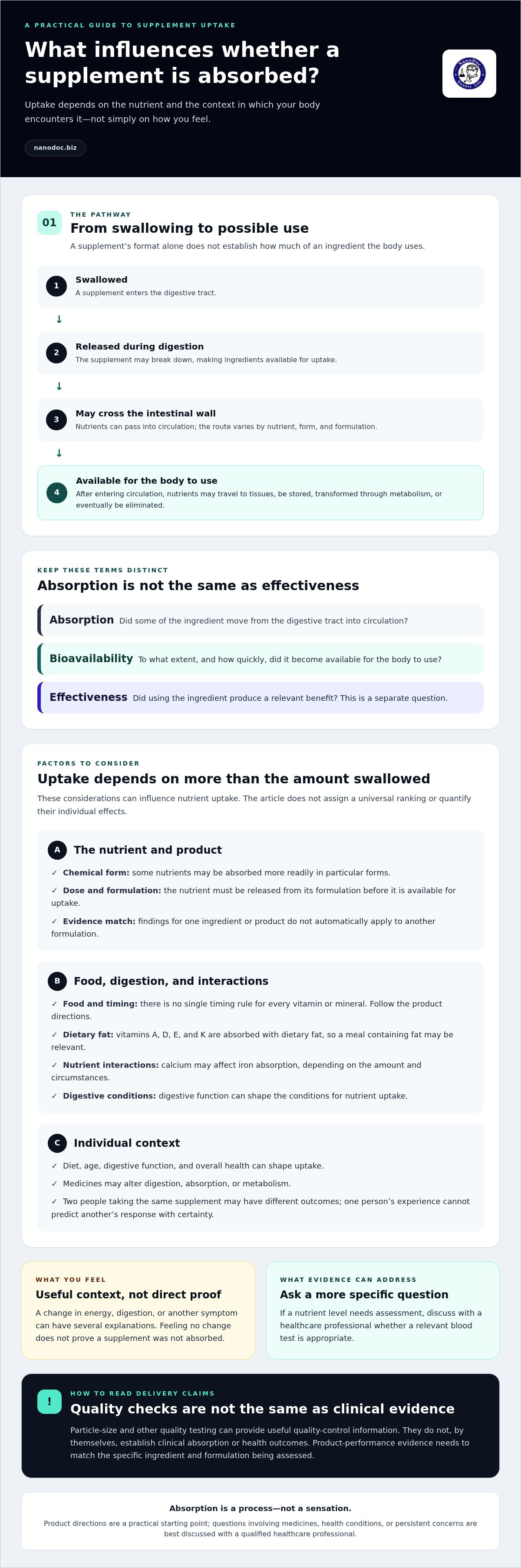
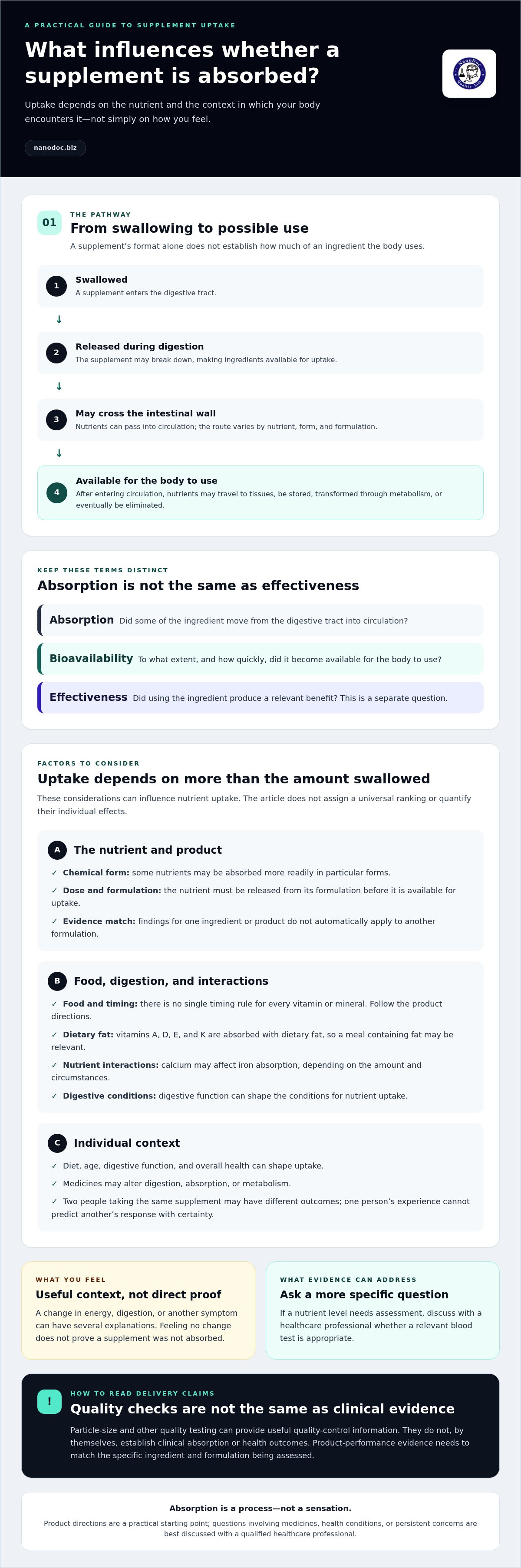
Absorption is the movement of a substance from the digestive tract into the body’s circulation. Bioavailability describes how much, and how quickly, an ingredient becomes available for the body to use. The terms are related but not interchangeable: absorption is one part of the process that can affect bioavailability.
What happens between swallowing a supplement and nutrient uptake?
After you swallow a supplement, it may break down during digestion. Nutrients can then pass through the intestinal wall into circulation. From there, they may travel to tissues, be stored, transformed through metabolism, or eventually be eliminated. The route varies by nutrient, ingredient form and formulation. A capsule, powder or liquid may behave differently, but its format alone doesn’t establish how much of an ingredient the body uses.
Absorption also isn’t the same as an effect. A nutrient entering circulation doesn’t automatically lead to a noticeable sensation or health improvement. The outcome can depend on factors beyond uptake, including whether the nutrient is needed and how the body processes it.
Absorption, bioavailability, and effectiveness: what is the difference?
Think of the terms as describing different stages and questions:
- Absorption: Did some of the ingredient move from the digestive tract into circulation?
- Bioavailability: To what extent, and how quickly, did it become available for the body to use?
- Effectiveness: Did using the ingredient produce a relevant benefit? This is a separate question that requires evidence of an outcome.
The amount taken and the ingredient’s form can influence its availability, but neither guarantees a particular result. For a concise overview of what bioavailability means, note that the concept describes availability to the body, rather than simply the amount printed on a label.
Product performance needs evidence relevant to the ingredient and the specific formulation being assessed. A general claim about a delivery approach may not show how a particular supplement performs. Keeping these distinctions clear helps separate what a product contains, what may be absorbed, and what has been shown to have an effect.
How Supplement Absorption Works, and Why Nutrients Behave Differently
Two people can take the same supplement and experience different outcomes. Uptake depends on more than the amount swallowed: the nutrient’s chemical form, the dose, the meal, digestive conditions and individual physiology can all contribute. Supplement absorption depends on both the nutrient and the context in which the body encounters it.
Which everyday factors can influence nutrient uptake?
The small intestine is a major site of nutrient absorption, but nutrients don’t all cross into circulation in the same way. Some are absorbed more readily in particular forms; others rely on specific transport processes. A supplement must also be released from its formulation before its ingredients are available for uptake.
Food can matter, but there is no single timing rule for every vitamin or mineral. Fat-soluble vitamins, including vitamins A, D, E and K, are absorbed with dietary fat, so taking them alongside a meal containing fat may be relevant. Minerals can also interact: calcium may affect iron absorption, depending on the amount and circumstances. Follow the product’s directions rather than applying a general rule to every supplement.
Digestive conditions and medicines can affect how nutrients are absorbed or used. If you have an ongoing health condition or take medication, ask a doctor or pharmacist whether a supplement’s timing or use could be relevant to your situation. Don’t adjust a prescribed medicine based on supplement advice.
Why the same supplement may not act the same for everyone
Diet, age, digestive function and overall health can shape the conditions for nutrient uptake. Medicines may also alter digestion, absorption or metabolism. These differences don’t mean one person can predict another’s response from personal experience, or that symptoms reveal what is happening internally.
Dose and form matter, too. A nutrient in one chemical form or delivery system may behave differently from the same nutrient in another formulation. But a finding about one ingredient or product cannot automatically be applied to another. Evidence needs to match the nutrient, dose and formulation being assessed.
So if you’re asking, “are my supplements being absorbed?”, population-level research can explain possible patterns, but it can’t predict your individual uptake with certainty. Product directions offer a practical starting point; questions involving medicines, health conditions or persistent concerns are best discussed with a qualified healthcare professional. For an example of how delivery design features in nutrition formulations, explore Nano Cellular Essential Nutrition.
Can You Tell if Supplements Are Being Absorbed? Signs Versus Evidence
Not reliably from how you feel. A change in energy, digestion or another symptom can have several explanations, and feeling no change doesn’t prove that a supplement wasn’t absorbed. These observations may be useful context, but they aren’t direct measures of nutrient uptake.
Are energy, digestion, or other changes proof of absorption?
Short-term sensations are especially difficult to interpret. Energy may shift with sleep, stress, meals or illness; digestive changes may reflect food, a supplement’s other ingredients or unrelated causes. Neither an immediate feeling nor the absence of one confirms what happened to a nutrient after you swallowed it.
Different kinds of information answer different questions:
- Subjective changes: Your observations can help you track what you notice over time, but they can’t establish absorption or prove the supplement caused a change.
- Product-label information: The label can tell you the listed ingredients, amount per serving and directions. It describes the product, not how much your body takes up.
- Clinically appropriate measurements: A healthcare professional may use selected tests to assess nutrient status in context. These offer more objective information than sensations, but they don’t measure every supplement or provide a universal absorption reading.
If you’re tracking a response, record the supplement, serving, consistency of use and relevant context such as meals, sleep or other changes. That record can support a more useful discussion, but it doesn’t replace clinical assessment.
When can testing help answer questions about nutrient status?
A doctor may recommend a nutrient-specific blood test when symptoms, health history or other risk factors make it appropriate. Depending on the question, testing might assess vitamin D, vitamin B12 or iron status. The right test and its interpretation depend on the nutrient and your health context, so one result cannot answer every question about supplement uptake.
A blood concentration measures what is present in the sampled blood at that time. It isn’t necessarily a direct measure of levels in every tissue, nor does it show how much of every ingredient was absorbed from a particular product. Results need to be interpreted alongside the reason for testing and other relevant information.
So, if you’re asking “are my supplements being absorbed?”, testing may help clarify the status of selected nutrients, but it isn’t a universal check. Avoid ordering tests or changing your supplement routine based on a result without qualified clinical guidance. A clinician can decide whether testing is useful and explain what the findings can, and can’t, establish.
What to Do If You’re Unsure Your Supplements Are Working
If you’re asking, “are my supplements being absorbed?”, start with a clear, manageable review rather than changing several things at once. Identify the nutrient and why you’re taking it, then check the product label for serving instructions and any guidance about food or timing. The label gives a practical basis for consistent use; it can’t confirm your individual response.
A practical checklist for reviewing supplement use
Keep a brief record so you can distinguish what you took from what you noticed. Include:
- Product and ingredient: Record the supplement name and the nutrient or active ingredient you intend to use.
- Serving and directions: Note the amount taken and whether you followed the label’s instructions, including any food or timing guidance.
- Start date and consistency: Track when you began and whether use has been regular. Avoid changing the serving to try to produce a faster effect.
- Relevant changes: Note changes in diet, medicines, health or routine that could affect how you feel or how the supplement is used.
- Observations versus findings: Keep personal impressions separate from laboratory results or clinical assessments, which should be interpreted in context.
Set realistic expectations. A supplement may not create an immediate or noticeable sensation, and perceived changes don’t establish that it caused a benefit. Don’t increase the dose or combine products to force a result. Taking more can introduce unnecessary risk, particularly when ingredients overlap or interact with medicines.
When should you speak with a healthcare professional?
Seek individual advice if you have persistent symptoms, a known nutrient deficiency, a chronic health condition, or are pregnant. Bring the supplement label and an up-to-date list of medicines and other supplements. A doctor or pharmacist can review them together and advise whether a potential interaction, test or change in use needs attention.
Get urgent medical care for severe or rapidly worsening symptoms. Don’t spend time troubleshooting a supplement in that situation. For non-urgent questions, your record of use can help a healthcare professional understand what you’ve tried and what you’ve noticed.
If you’re exploring nutrition formulations as part of your supplement research, explore Nano Cellular Essential Nutrition.
How Nano-Delivery Fits Into Supplement Absorption Evidence
Nano-encapsulation is a formulation approach that uses very small carriers to package or deliver an ingredient. It may be designed to protect an ingredient or influence how it behaves in the body, but the term alone doesn’t show that a supplement is better absorbed or produces a health benefit. To assess a claim, look for evidence on the specific ingredient and formulation, not just the delivery technology’s name.
What can nano-encapsulation research establish?
Research findings are meaningful only in the context of what was studied and measured. A laboratory experiment may show how a formulation behaves under controlled conditions, but it doesn’t establish how people absorb or respond to it. Human clinical research can provide more relevant evidence, though its conclusions still depend on the study design and outcome assessed.
For any study, check:
- Ingredient and formulation: Was the exact nutrient and delivery system studied?
- Population and dose: Who took part, and what amount was used?
- Outcome: Did researchers measure nutrient levels, absorption, or a health outcome?
Results for one nutrient, dose or formulation can’t automatically be applied to another. A finding about blood levels, for example, doesn’t by itself establish a broader health benefit. This distinction matters when assessing whether a claim answers the question, “are my supplements being absorbed?”
What does particle-size and quality testing tell you?
Particle-size testing provides information about a specified physical characteristic of a formulation. NanoDoc’s formulations are independently laboratory-tested for nanoparticle size and quality. This is quality-control information, not clinical evidence that a particular nutrient is absorbed by people or produces a specific effect. Particle measurements alone don’t establish human uptake or efficacy.
For a deeper explanation of delivery approaches and bioavailability, read the high bioavailability nutrients guide. NanoDoc’s nano-delivery nutrition range includes Nano Cellular Essential Nutrition. To explore it, visit Explore NanoDoc.
Make Your Next Supplement Decision With Better Evidence
If you’ve asked, “are my supplements being absorbed?”, remember that you can’t reliably answer from a sensation alone. Absorption, bioavailability and effectiveness describe different parts of the process, and feeling no change doesn’t prove a supplement isn’t being taken up. A practical next step is to follow the label consistently, note what you take and discuss persistent concerns or relevant testing with a healthcare professional.
Formulation details can help you understand how a supplement is designed, but weigh them against evidence for the specific ingredient and product. NanoDoc represents LG Bionano and its formulations undergo independent laboratory testing for nanoparticle size and quality. This testing provides quality-control information; it doesn’t, by itself, establish human absorption or a health outcome.
For a closer look at the approach, explore NanoDoc’s nano-delivery nutrition formulations. Keep asking precise questions and use evidence that matches the nutrient and formulation. With a measured approach, you can make more informed choices without relying on guesswork.
Frequently Asked Questions
Is there a way to tell if my supplements are being absorbed?
Usually, you can’t tell from how you feel alone. A perceived change may have several causes, while no noticeable change doesn’t prove a supplement wasn’t absorbed. For selected nutrients, a healthcare professional may recommend testing based on your health context. There’s no single test that confirms absorption for every supplement or ingredient, so a result needs to be interpreted in relation to the nutrient being assessed and your individual circumstances.
Can you feel when vitamins are being absorbed?
No, absorption itself isn’t usually a sensation you can identify. Changes in energy, digestion or general wellbeing don’t reliably show that a nutrient entered circulation or improved your nutrient status. Those experiences can have other explanations. If you’re concerned about a possible deficiency or ongoing symptoms, discuss your situation with a qualified healthcare professional rather than relying on sensations to judge whether a vitamin has been absorbed.
How long does it take for supplements to be absorbed?
There isn’t one timeline for every supplement. The time can vary with the nutrient, formulation, food intake and individual physiology. Absorption also differs from the time it may take to notice a health effect, if one occurs. Follow the product label and don’t change the serving based on an expected timeline. If a specific nutrient or medicine raises questions about timing, ask a healthcare professional or pharmacist for guidance.
What happens if your body does not absorb a supplement properly?
The implications depend on the nutrient, the reason for reduced uptake and your overall health. A supplement not producing a noticeable effect doesn’t, by itself, establish poor absorption. If you have ongoing symptoms, a known deficiency or a condition that may affect digestion, seek clinical advice. A healthcare professional can consider your circumstances and determine whether assessment or testing is appropriate, rather than assuming the supplement isn’t being absorbed.
Do blood tests show whether supplements are being absorbed?
Some blood tests can assess the status of particular nutrients when there’s a clinical reason to do so. They don’t provide a universal measure of absorption for every ingredient, and they may not show what is happening in every tissue. A healthcare professional can select and interpret testing in context, considering factors such as your diet, symptoms, medicines and supplement use. A result should be understood in relation to the specific nutrient being measured.
Does taking supplements with food improve absorption?
It depends on the nutrient and the product. Some ingredients have specific food or timing directions, but a general rule won’t apply to every supplement. Check the label for instructions and follow them unless a healthcare professional advises otherwise. Don’t change how you take prescribed medicines based on general supplement guidance. If you’re uncertain about a particular nutrient or how it fits with your medicines, ask a healthcare professional or pharmacist.
Does nano-encapsulation guarantee better supplement absorption?
No. Nano-encapsulation is a formulation approach, not a guarantee of better absorption or a health benefit for every nutrient or person. Evidence needs to relate to the specific ingredient, formulation and outcome being discussed. Particle-size or quality testing can describe product characteristics, but it doesn’t by itself demonstrate human absorption or effectiveness. Interpret delivery-system claims carefully, and look for evidence that matches the supplement and the claim being made.
Frequently Asked Questions
- What happens between swallowing a supplement and nutrient uptake?
- After you swallow a supplement, it may break down during digestion. Nutrients can then pass through the intestinal wall into circulation. From there, they may travel to tissues, be stored, transformed through metabolism, or eventually be eliminated. The route varies by nutrient, ingredient form and formulation. A capsule, powder or liquid may behave differently, but its format alone doesn’t establish how much of an ingredient the body uses. Absorption also isn’t the same as an effect. A nutrient entering circulation doesn’t automatically lead to a noticeable sensation or health improvement. The outcome can depend on factors beyond uptake, including whether the nutrient is needed and how the body processes it.
- Absorption, bioavailability, and effectiveness: what is the difference?
- Think of the terms as describing different stages and questions: The amount taken and the ingredient’s form can influence its availability, but neither guarantees a particular result. For a concise overview of what bioavailability means, note that the concept describes availability to the body, rather than simply the amount printed on a label. Product performance needs evidence relevant to the ingredient and the specific formulation being assessed. A general claim about a delivery approach may not show how a particular supplement performs. Keeping these distinctions clear helps separate what a product contains, what may be absorbed, and what has been shown to have an effect. Two people can take the same supplement and experience different outcomes. Uptake depends on more than the amount swallowed: the nutrient’s chemical form, the dose, the meal, digestive conditions and individual physiology can all contribute. Supplement absorption depends on both the nutrient and the context in which the body encounters it.
- Which everyday factors can influence nutrient uptake?
- The small intestine is a major site of nutrient absorption, but nutrients don’t all cross into circulation in the same way. Some are absorbed more readily in particular forms; others rely on specific transport processes. A supplement must also be released from its formulation before its ingredients are available for uptake. Food can matter, but there is no single timing rule for every vitamin or mineral. Fat-soluble vitamins, including vitamins A, D, E and K, are absorbed with dietary fat, so taking them alongside a meal containing fat may be relevant. Minerals can also interact: calcium may affect iron absorption, depending on the amount and circumstances. Follow the product’s directions rather than applying a general rule to every supplement. Digestive conditions and medicines can affect how nutrients are absorbed or used. If you have an ongoing health condition or take medication, ask a doctor or pharmacist whether a supplement’s timing or use could be relevant to your situation. Don’t adjust a prescribed medicine based on supplement advice.
- Are energy, digestion, or other changes proof of absorption?
- Short-term sensations are especially difficult to interpret. Energy may shift with sleep, stress, meals or illness; digestive changes may reflect food, a supplement’s other ingredients or unrelated causes. Neither an immediate feeling nor the absence of one confirms what happened to a nutrient after you swallowed it. Different kinds of information answer different questions: If you’re tracking a response, record the supplement, serving, consistency of use and relevant context such as meals, sleep or other changes. That record can support a more useful discussion, but it doesn’t replace clinical assessment.
- When can testing help answer questions about nutrient status?
- A doctor may recommend a nutrient-specific blood test when symptoms, health history or other risk factors make it appropriate. Depending on the question, testing might assess vitamin D, vitamin B12 or iron status. The right test and its interpretation depend on the nutrient and your health context, so one result cannot answer every question about supplement uptake. A blood concentration measures what is present in the sampled blood at that time. It isn’t necessarily a direct measure of levels in every tissue, nor does it show how much of every ingredient was absorbed from a particular product. Results need to be interpreted alongside the reason for testing and other relevant information. So, if you’re asking “are my supplements being absorbed?”, testing may help clarify the status of selected nutrients, but it isn’t a universal check. Avoid ordering tests or changing your supplement routine based on a result without qualified clinical guidance. A clinician can decide whether testing is useful and explain what the findings can, and can’t, establish. If you’re asking, “are my supplements being absorbed?”, start with a clear, manageable review rather than changing several things at once. Identify the nutrient and why you’re taking it, then check the product label for serving instructions and any guidance about food or timing. The label gives a practical basis for consistent use; it can’t confirm your individual response.
- When should you speak with a healthcare professional?
- Seek individual advice if you have persistent symptoms, a known nutrient deficiency, a chronic health condition, or are pregnant. Bring the supplement label and an up-to-date list of medicines and other supplements. A doctor or pharmacist can review them together and advise whether a potential interaction, test or change in use needs attention. Get urgent medical care for severe or rapidly worsening symptoms. Don’t spend time troubleshooting a supplement in that situation. For non-urgent questions, your record of use can help a healthcare professional understand what you’ve tried and what you’ve noticed. If you’re exploring nutrition formulations as part of your supplement research, explore Nano Cellular Essential Nutrition. Nano-encapsulation is a formulation approach that uses very small carriers to package or deliver an ingredient. It may be designed to protect an ingredient or influence how it behaves in the body, but the term alone doesn’t show that a supplement is better absorbed or produces a health benefit. To assess a claim, look for evidence on the specific ingredient and formulation, not just the delivery technology’s name.
- What can nano-encapsulation research establish?
- Research findings are meaningful only in the context of what was studied and measured. A laboratory experiment may show how a formulation behaves under controlled conditions, but it doesn’t establish how people absorb or respond to it. Human clinical research can provide more relevant evidence, though its conclusions still depend on the study design and outcome assessed. For any study, check: Results for one nutrient, dose or formulation can’t automatically be applied to another. A finding about blood levels, for example, doesn’t by itself establish a broader health benefit. This distinction matters when assessing whether a claim answers the question, “are my supplements being absorbed?”
- What does particle-size and quality testing tell you?
- Particle-size testing provides information about a specified physical characteristic of a formulation. NanoDoc’s formulations are independently laboratory-tested for nanoparticle size and quality. This is quality-control information, not clinical evidence that a particular nutrient is absorbed by people or produces a specific effect. Particle measurements alone don’t establish human uptake or efficacy. For a deeper explanation of delivery approaches and bioavailability, read the high bioavailability nutrients guide. NanoDoc’s nano-delivery nutrition range includes Nano Cellular Essential Nutrition. To explore it, visit Explore NanoDoc. If you’ve asked, “are my supplements being absorbed?”, remember that you can’t reliably answer from a sensation alone. Absorption, bioavailability and effectiveness describe different parts of the process, and feeling no change doesn’t prove a supplement isn’t being taken up. A practical next step is to follow the label consistently, note what you take and discuss persistent concerns or relevant testing with a healthcare professional. Formulation details can help you understand how a supplement is designed, but weigh them against evidence for the specific ingredient and product. NanoDoc represents LG Bionano and its formulations undergo independent laboratory testing for nanoparticle size and quality. This testing provides quality-control information; it doesn’t, by itself, establish human absorption or a health outcome. For a closer look at the approach, explore NanoDoc’s nano-delivery nutrition formulations. Keep asking precise questions and use evidence that matches the nutrient and formulation. With a measured approach, you can make more informed choices without relying on guesswork.
- Is there a way to tell if my supplements are being absorbed?
- Usually, you can’t tell from how you feel alone. A perceived change may have several causes, while no noticeable change doesn’t prove a supplement wasn’t absorbed. For selected nutrients, a healthcare professional may recommend testing based on your health context. There’s no single test that confirms absorption for every supplement or ingredient, so a result needs to be interpreted in relation to the nutrient being assessed and your individual circumstances.
- Can you feel when vitamins are being absorbed?
- No, absorption itself isn’t usually a sensation you can identify. Changes in energy, digestion or general wellbeing don’t reliably show that a nutrient entered circulation or improved your nutrient status. Those experiences can have other explanations. If you’re concerned about a possible deficiency or ongoing symptoms, discuss your situation with a qualified healthcare professional rather than relying on sensations to judge whether a vitamin has been absorbed.
- How long does it take for supplements to be absorbed?
- There isn’t one timeline for every supplement. The time can vary with the nutrient, formulation, food intake and individual physiology. Absorption also differs from the time it may take to notice a health effect, if one occurs. Follow the product label and don’t change the serving based on an expected timeline. If a specific nutrient or medicine raises questions about timing, ask a healthcare professional or pharmacist for guidance.
- What happens if your body does not absorb a supplement properly?
- The implications depend on the nutrient, the reason for reduced uptake and your overall health. A supplement not producing a noticeable effect doesn’t, by itself, establish poor absorption. If you have ongoing symptoms, a known deficiency or a condition that may affect digestion, seek clinical advice. A healthcare professional can consider your circumstances and determine whether assessment or testing is appropriate, rather than assuming the supplement isn’t being absorbed.
- Do blood tests show whether supplements are being absorbed?
- Some blood tests can assess the status of particular nutrients when there’s a clinical reason to do so. They don’t provide a universal measure of absorption for every ingredient, and they may not show what is happening in every tissue. A healthcare professional can select and interpret testing in context, considering factors such as your diet, symptoms, medicines and supplement use. A result should be understood in relation to the specific nutrient being measured.
- Does taking supplements with food improve absorption?
- It depends on the nutrient and the product. Some ingredients have specific food or timing directions, but a general rule won’t apply to every supplement. Check the label for instructions and follow them unless a healthcare professional advises otherwise. Don’t change how you take prescribed medicines based on general supplement guidance. If you’re uncertain about a particular nutrient or how it fits with your medicines, ask a healthcare professional or pharmacist.
- Does nano-encapsulation guarantee better supplement absorption?
- No. Nano-encapsulation is a formulation approach, not a guarantee of better absorption or a health benefit for every nutrient or person. Evidence needs to relate to the specific ingredient, formulation and outcome being discussed. Particle-size or quality testing can describe product characteristics, but it doesn’t by itself demonstrate human absorption or effectiveness. Interpret delivery-system claims carefully, and look for evidence that matches the supplement and the claim being made.