

The most sophisticated active ingredients are essentially worthless if they cannot bypass the skin's natural defense barriers. You've likely experienced the frustration of investing in premium formulations only to find they sit on the surface, offering little more than temporary hydration. In the evolving market for biotech skincare South East Asia, the focus is shifting from what's in the bottle to how those nutrients actually reach the cellular level. We understand that clinical efficacy requires more than just high concentrations of bioactives; it demands a delivery system capable of navigating complex biological pathways.
This article serves as a comprehensive technical reference on how nano-emulsion and nano-delivery systems are redefining dermal repair and nutrient absorption. We'll examine the specific mechanisms that allow patented bionano technology to overcome the absorption barrier that often limits traditional products. By the end of this guide, you'll understand the science behind high-performance biotech formulations and how to identify solutions that achieve visible, long-term results through deep dermal repair. We're moving beyond marketing trends to explore the evidence-based reality of modern cellular nutrition.
Key Takeaways
- Understand the biological limitations of the stratum corneum and why traditional large-molecule formulations often fail to penetrate the skin's surface.
- Learn how nano-encapsulation uses microscopic lipid shells to protect active ingredients, ensuring they remain stable until reaching their intended cellular target.
- Distinguish between surface-level hydration and the deep dermal repair offered by bio-engineered ingredients that mimic the body's natural processes.
- Identify specific metrics such as absorption rates and delivery efficacy when evaluating biotech skincare South East Asia to ensure formulations provide more than just a high active load.
- Explore the role of LG Bionano patented delivery systems in bridging the gap between clinical laboratory science and high-performance consumer health solutions.
Table of Contents
- Defining Biotech Skincare in the South East Asian Market
- The Mechanism of Action: Nano-Encapsulation and Dermal Absorption
- Beyond Clean Beauty: Comparing Traditional and Bio-Engineered Formulations
- Evaluating Biotech Efficacy: A Framework for Discerning Consumers
- The Future of Dermal Repair: LG Bionano Patented Delivery Systems
Defining Biotech Skincare in the South East Asian Market
Biotech skincare represents a paradigm shift where biological engineering creates high-performance ingredients that often surpass their traditional counterparts. It's the application of lab-engineered biological processes to develop actives that are structurally precise and highly stable. In the context of biotech skincare South East Asia, we're seeing a decisive transition from "natural-only" products to "bio-identical" and "bio-enhanced" formulations. This shift is driven by a demand for consistent results that traditional raw materials simply can't guarantee. The focus has moved from what a plant might offer to what a lab can perfect.
The region is rapidly becoming a global hub for this innovation. Industry analysts project substantial growth as South East Asian consumers prioritize clinical evidence over marketing jargon. Technologies like precision fermentation and cell cultivation allow for sustainable ingredient sourcing, creating molecules that are identical to those found in nature but without the environmental footprint or variability of agricultural harvesting. This methodology ensures that every application delivers the exact same concentration of nutrients to the skin.
The Evolution from Traditional to Biological Formulations
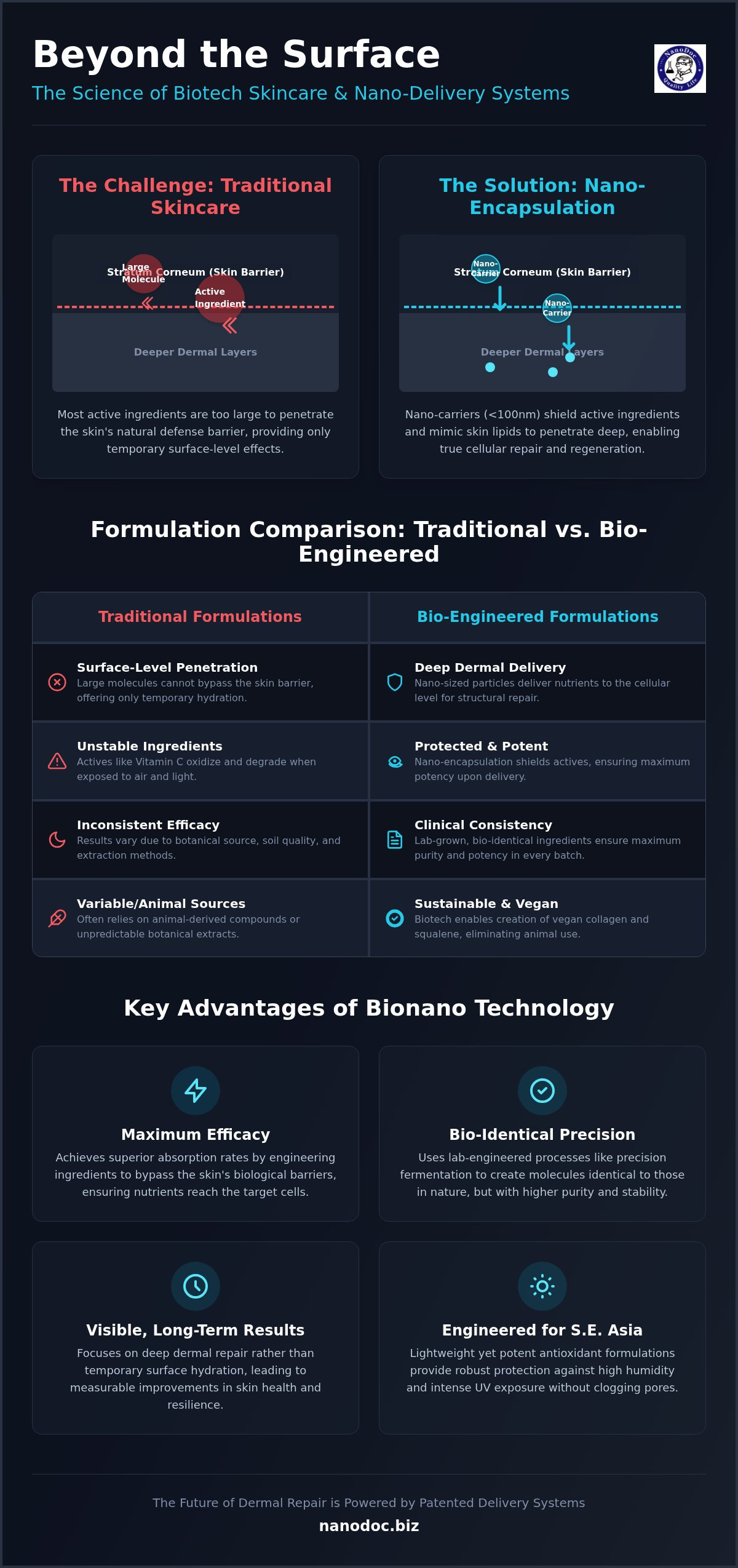
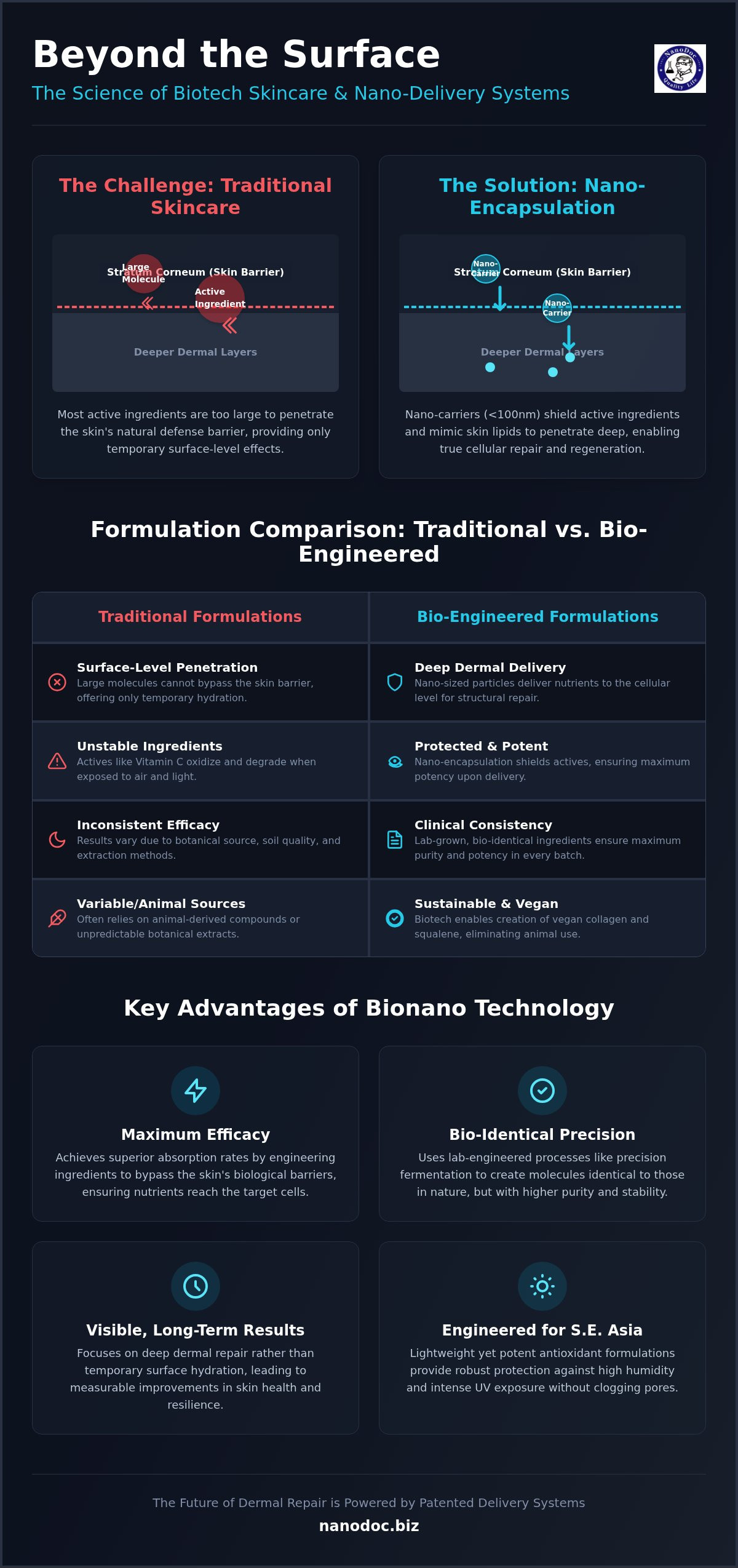
Traditional botanical extracts often fail to deliver consistent results because their chemical profile changes based on soil quality, weather, and extraction methods. Lab-grown ingredients solve this problem by providing a controlled environment that ensures maximum purity and potency in every batch. This scientific approach also addresses significant ethical hurdles. For instance, biotech allows for the production of vegan collagen and squalene, eliminating the need for animal-derived compounds. By using Nano-emulsion technology, these lab-perfected ingredients are then stabilized into delivery systems that maintain their integrity until they reach the target tissue. It's a level of precision that traditional mixing simply cannot match.
South East Asian Environmental Factors and Dermal Needs
The specific climate of South East Asia, characterized by high humidity and intense UV exposure, creates unique dermal challenges. Traditional heavy creams often lead to congestion or discomfort in tropical environments. biotech skincare South East Asia solves this by engineering lightweight yet potent antioxidants that provide robust protection without occluding the pores. We're witnessing the "skinification" of the market, where consumers view dermal repair as a fundamental branch of their overall health strategy. Transparency isn't just a trend here; it's the new standard. Consumers now expect independent verification of a product's active load and its ability to penetrate the skin's surface effectively. This demand for accountability is pushing the industry toward more sophisticated, biotech-driven solutions that offer measurable improvements in skin health and resilience.
The Mechanism of Action: Nano-Encapsulation and Dermal Absorption
The primary obstacle in topical therapy is the stratum corneum, the skin's outermost layer. This biological barrier acts as a "bricks and mortar" structure, designed specifically to prevent the entry of foreign substances, including many high-molecular-weight nutrients found in traditional skincare. While many products boast impressive ingredient lists, most of these actives are too large to penetrate this dense lipid matrix. They remain on the surface, providing only transient hydration rather than structural repair. This is where biotech skincare South East Asia differentiates itself by focusing on the delivery vehicle as much as the active ingredient itself.
Nano-encapsulation is the process of trapping active molecules within 1-100 nanometer carriers to enhance absorption. These microscopic shells, typically composed of biocompatible lipids or polymers, serve as protective shields. They prevent the premature oxidation of sensitive compounds like Vitamin C or CoQ10, ensuring they remain potent until they reach their intended destination. By mimicking the skin's own lipid structure, these carriers can slip through the intercellular spaces of the skin barrier, reaching the deeper dermal layers where true cellular regeneration occurs. Precision is mandatory; particles must be engineered to a specific size range to be effective. This is why independent lab testing for nanoparticle size verification is critical. Without verified data, a "nano" claim is merely a marketing term rather than a functional reality.
Nano-Emulsion vs. Standard Micellar Formulations
Technical differences in particle stability and surface area coverage explain why nano-emulsified skin care serums outperform traditional oil-in-water emulsions. Standard micellar formulations often lack the kinetic stability required to maintain ingredient integrity during storage or application. In contrast, nano-emulsions provide a significantly higher surface-to-volume ratio, allowing for more intimate contact with the skin's surface. Scientific reviews on Nanoemulsion for Transdermal Drug Delivery demonstrate that reducing droplet size to the nanoscale dramatically improves the bioavailability of lipophilic actives. It's a matter of molecular weight and transport efficiency; smaller, stabilized droplets simply move where larger ones cannot.
Bionano Technology: A New Standard for Cosmeceuticals
Patented bionano delivery systems represent the pinnacle of this technology. These systems don't just deliver an ingredient; they manage its release. By engineering the shell's composition, scientists can ensure a sustained release of active compounds over several hours, preventing the "spike and drop" effect common in standard applications. This controlled delivery is essential for anti-ageing dermal repair, where consistent cellular signaling is required for collagen synthesis. For those seeking verified efficacy in their regimen, understanding nano cellular essential nutrition is the first step toward achieving visible, long-term results. The transition from surface-level care to deep dermal repair is entirely dependent on these sophisticated transport mechanisms.
Beyond Clean Beauty: Comparing Traditional and Bio-Engineered Formulations
Traditional skincare has long relied on ingredients that provide immediate sensory feedback but limited biological change. These formulations typically use large-molecule humectants and occlusives that sit atop the epidermis. While these components can alleviate temporary dryness, they don't address the underlying structural degradation of the dermis. Clean beauty emerged as a response to consumer safety concerns, prioritizing "free-from" lists and ingredient transparency. However, a formula's purity doesn't guarantee its performance. Without a sophisticated transport mechanism, even the cleanest botanical extract remains functionally inert once applied. It effectively sits on the surface, unable to penetrate the skin's natural defenses.
In contrast, biotech skincare South East Asia represents a shift toward high-bioavailability systems. This approach treats ingredients like peptides, hyaluronic acid, and vitamins not just as additives, but as biological signals that must reach specific receptors. Bio-engineering allows these compounds to be refined for maximum stability and absorption, bridging the gap between nature and clinical efficacy. The "skinification" of these ingredients means they're no longer just surface treatments; they're designed to integrate with the skin's natural biological processes for long-term health.
The Problem with Large Molecule Ingredients
Molecular size remains a fundamental constraint in topical application. Standard collagen and elastin molecules possess a high molecular weight that prevents them from traversing the stratum corneum. Applying these in their raw form results in surface-level film formation rather than dermal synthesis. Utilizing deep penetration skincare technology solves this dilemma by reducing active compounds into nanoparticle formats or encapsulating them in lipid carriers. This transformation ensures that structural proteins can actually reach the fibroblast cells responsible for skin elasticity. The difference is profound: surface hydration provides a temporary glow, while deep dermal repair addresses the root causes of ageing.
Clinical Authority vs. Marketing Trends
Discerning consumers must distinguish between "biotech-inspired" marketing and true laboratory-engineered products. The former often uses trendy buzzwords without the supporting infrastructure of patented delivery systems. True clinical authority is established through proprietary formulations that have been verified for stability and transport efficiency. As the market for Biotech Beauty in Asia-Pacific expands, professional-grade cosmeceuticals are becoming the preferred standard. These products move beyond the "clean" label to provide evidence-based results. They rely on rigorous development cycles and intellectual property, ensuring that the technology used to deliver the active is as advanced as the active itself. This methodical approach reinforces trust through technical precision rather than lifestyle imagery.
Evaluating Biotech Efficacy: A Framework for Discerning Consumers
Evaluating the efficacy of biotech skincare South East Asia requires a shift in perspective. Most consumers focus on the "Active Load," which is the concentration of ingredients listed on the label. However, high percentages are often misleading. A 20% concentration of an active that remains on the skin's surface is less effective than a 1% concentration delivered via a stabilized nano-carrier. True efficacy is measured by absorption rates and kinetic stability rather than volume. This is why professional formulations prioritize the synergy between topical biotech and anti-ageing dermal technology, ensuring that molecules don't just sit on the skin but interact with it at a cellular level.
Discerning users should look for intellectual property (IP) and patented delivery systems as primary indicators of quality. These are signs that a brand has invested in the technical precision required for deep dermal repair. Verification through independent laboratory testing is the only way to confirm that a formulation actually contains nanoparticles capable of bypassing the skin's natural defenses. In a market crowded with "natural" claims, these scientific benchmarks provide the necessary transparency for consumers seeking measurable results.
Identifying High-Performance Antioxidant Serums
In the South East Asian climate, heat and humidity are constant threats to product stability. Traditional antioxidant serums, particularly those containing Vitamin C or glutathione, often oxidize before they can be fully absorbed. High-performance nano-emulsified formulations solve this by shielding the actives within protective carriers. This stability is a key indicator of quality. When evaluating a serum for skin brightening, the presence of nano-encapsulated glutathione ensures the ingredient remains potent even in tropical conditions. It isn't about the scent or texture; it's about the verified stability of the active compounds within the delivery system.
The Role of Independent Laboratory Verification
Nanoparticle size verification is the gold standard for evaluating biotech skincare South East Asia. If a brand claims nano-delivery but cannot provide laboratory data confirming a particle size between 1 and 100 nanometers, the claim is unsubstantiated. Reading a clinical study summary requires looking for terms like "transdermal flux" or "bioavailability," which describe how much of the ingredient actually reached the target tissue. Professional distribution networks are also vital. They ensure that storage conditions maintain the integrity of these sophisticated cosmeceuticals from the lab to the end user. To explore how these technical standards are applied to high-absorption formulations, you can view our range of nano cellular essential nutrition and skincare solutions.
The Future of Dermal Repair: LG Bionano Patented Delivery Systems
NanoDoc International serves as the exclusive South East Asian representative for LG Bionano, a partnership that brings patented nano-delivery technology to the market for biotech skincare South East Asia. While many brands experiment with prototypes, LG Bionano technology provides a verified solution to the absorption barrier. This patented system ensures that actives aren't just applied but are effectively integrated into the dermal matrix. It represents the pinnacle of current anti-ageing research, moving beyond surface-level aesthetics to address the fundamental biological processes of ageing.
The future of biotech skincare South East Asia lies in the intersection of cosmeceuticals and systemic health. Dermal repair isn't an isolated event; it's intrinsically linked to cellular nutrition. By utilizing the same bionano delivery systems for both topical applications and oral supplements, we can achieve a synergistic effect. This "inside-out" approach ensures that the body has the necessary building blocks for repair at the cellular level, whether those nutrients are delivered through the skin or the digestive tract.
NanoDoc’s Commitment to Scientific Precision
NanoDoc verifies the quality and nanoparticle size of every formulation through independent laboratory testing. This commitment to precision is what establishes NanoDoc as a trusted specialist for advanced wellness solutions in the region. We don't rely on anecdotal evidence. Instead, we provide verified data to ensure that our high-bioavailability formulations for skin and gut health perform as described. This technical transparency is essential for consumers who prioritize evidence over trends and seek the integrity of the manufacturing process.
Integrating Biotech into a Professional Wellness Routine
Integrating these breakthroughs into a professional wellness routine requires a methodical approach. Combining nano-emulsified serums with systemic nano-nutrient supplements creates a comprehensive environment for dermal maintenance. The long-term benefits include enhanced barrier resilience and improved collagen synthesis. To achieve these visible results, it's necessary to move toward a regimen grounded in technical superiority and verified efficacy. You can explore the science of high-absorption care at NanoDoc International to understand how these patented systems are redefining the standards of modern health and beauty.
Advancing the Standards of Dermal and Cellular Repair
The transition from surface-level cosmetics to high-performance biotech skincare South East Asia demands a fundamental shift in how we evaluate efficacy. We've established that the most potent active ingredients remain functionally inert without a delivery system capable of bypassing the skin's natural barriers. By utilizing microscopic lipid carriers and patented bionano technology, it's now possible to achieve deep dermal repair and systemic nutrient absorption that traditional formulations simply cannot match. This scientific approach ensures that nutrients aren't just applied but are effectively integrated into the body's biological pathways.
As the exclusive LG Bionano representative in the region, NanoDoc International provides access to formulations that are independently lab-tested for nanoparticle size verification. This commitment to technical precision ensures that every product delivers on its promise of cellular-level regeneration. It's no longer necessary to rely on marketing trends when scientific innovation offers a verified path to long-term health and resilience. Discover the Science of Nano-Encapsulated Beauty at NanoDoc and begin your journey toward evidence-based wellness. Achieving visible results starts with understanding the science behind the products you choose.
Frequently Asked Questions
What is biotech skincare and how does it differ from natural skincare?
Biotech skincare uses lab-engineered biological processes to create high-purity, bio-identical ingredients, whereas natural skincare relies on raw botanical extracts. While natural products are subject to environmental variability and impurities, biotech ensures consistent potency and safety. This scientific approach allows for the creation of actives like vegan collagen that are structurally identical to human proteins but produced sustainably without animal harvesting. It represents a sophisticated shift toward evidence-based performance and technical precision.
Why is South East Asia a major market for biotechnology in beauty?
South East Asia is a primary hub for biotech skincare South East Asia because regional consumers are increasingly prioritizing clinical efficacy and ingredient transparency. The demand for professional-grade cosmeceuticals is rising as a response to the "skinification" trend, where skincare is viewed as essential health maintenance. Additionally, the region's diverse skin types and environmental challenges require the precision and stability that only advanced biotechnology can provide for effective, long-term dermal repair.
How does nano-encapsulation improve the absorption of anti-ageing serums?
Nano-encapsulation improves absorption by trapping active molecules inside microscopic lipid shells that can penetrate the skin's natural barrier. Most standard anti-ageing serums contain molecules too large to bypass the stratum corneum, causing them to sit on the surface. By reducing particle size to between 1 and 100 nanometers, these systems ensure that nutrients reach the deeper dermal layers. This transport mechanism allows active compounds to support collagen synthesis and cellular repair effectively.
Are biotech skincare ingredients safe for sensitive skin?
Biotech ingredients are often safer for sensitive skin because they are produced in controlled laboratory environments, eliminating the allergens and impurities found in traditional botanical extracts. The precision of lab cultivation ensures that bio-identical actives match the skin's natural chemistry, reducing the risk of adverse reactions. Nano-delivery systems allow for lower concentrations of actives to be more effective, minimizing surface irritation while maximizing deep-tissue repair through targeted nutrient delivery and cellular interaction.
What is the difference between nano-emulsion and liposomal delivery?
Nano-emulsion and liposomal delivery differ primarily in their physical structure and kinetic stability. Liposomes are spherical vesicles composed of one or more lipid bilayers, while nano-emulsions are stable dispersions of oil and water with droplets in the nanometer range. Nano-emulsions typically offer a higher surface-to-volume ratio and better penetration depth for lipophilic actives. This makes them exceptionally efficient for delivering complex nutrients through the skin's lipid-rich matrix compared to traditional micellar systems.
Can biotech skincare help with skin concerns specific to tropical climates?
Biotech skincare is uniquely suited for tropical climates because it addresses stability issues caused by high heat and humidity. Traditional antioxidants often oxidize and lose potency when exposed to these environmental conditions. Patented bionano delivery technology shields sensitive ingredients like Vitamin C within protective carriers, ensuring they remain stable until absorbed. These lightweight, high-absorption formulations provide robust protection without the heavy, occlusive feel of traditional creams in humid South East Asian environments.
How can I verify the claims of a biotech skincare brand?
Consumers can verify biotech claims by looking for patented technology and independent laboratory testing results. A reputable brand should provide data confirming nanoparticle size ranges, typically between 1 and 100 nanometers, to ensure functional absorption. At NanoDoc International, we represent LG Bionano and prioritize technical transparency by verifying the quality and particle size of every formulation. Always check for professional distribution networks and intellectual property that back the brand’s scientific credentials.
Is biotech skincare more sustainable than traditional cosmetics?
Biotech skincare is significantly more sustainable than traditional cosmetics because it reduces the need for large-scale land use and water consumption. Precision fermentation and cell cultivation allow scientists to produce high-performance ingredients in a lab setting, avoiding the environmental impact of industrial agriculture. This methodology ensures a consistent supply of pure actives while protecting biodiversity and reducing the carbon footprint associated with global botanical sourcing. It provides a refined alternative to resource-intensive extraction.
Frequently Asked Questions
- What is biotech skincare and how does it differ from natural skincare?
- Biotech skincare uses lab-engineered biological processes to create high-purity, bio-identical ingredients, whereas natural skincare relies on raw botanical extracts. While natural products are subject to environmental variability and impurities, biotech ensures consistent potency and safety. This scientific approach allows for the creation of actives like vegan collagen that are structurally identical to human proteins but produced sustainably without animal harvesting. It represents a sophisticated shift toward evidence-based performance and technical precision.
- Why is South East Asia a major market for biotechnology in beauty?
- South East Asia is a primary hub for biotech skincare South East Asia because regional consumers are increasingly prioritizing clinical efficacy and ingredient transparency. The demand for professional-grade cosmeceuticals is rising as a response to the "skinification" trend, where skincare is viewed as essential health maintenance. Additionally, the region's diverse skin types and environmental challenges require the precision and stability that only advanced biotechnology can provide for effective, long-term dermal repair.
- How does nano-encapsulation improve the absorption of anti-ageing serums?
- Nano-encapsulation improves absorption by trapping active molecules inside microscopic lipid shells that can penetrate the skin's natural barrier. Most standard anti-ageing serums contain molecules too large to bypass the stratum corneum, causing them to sit on the surface. By reducing particle size to between 1 and 100 nanometers, these systems ensure that nutrients reach the deeper dermal layers. This transport mechanism allows active compounds to support collagen synthesis and cellular repair effectively.
- Are biotech skincare ingredients safe for sensitive skin?
- Biotech ingredients are often safer for sensitive skin because they are produced in controlled laboratory environments, eliminating the allergens and impurities found in traditional botanical extracts. The precision of lab cultivation ensures that bio-identical actives match the skin's natural chemistry, reducing the risk of adverse reactions. Nano-delivery systems allow for lower concentrations of actives to be more effective, minimizing surface irritation while maximizing deep-tissue repair through targeted nutrient delivery and cellular interaction.
- What is the difference between nano-emulsion and liposomal delivery?
- Nano-emulsion and liposomal delivery differ primarily in their physical structure and kinetic stability. Liposomes are spherical vesicles composed of one or more lipid bilayers, while nano-emulsions are stable dispersions of oil and water with droplets in the nanometer range. Nano-emulsions typically offer a higher surface-to-volume ratio and better penetration depth for lipophilic actives. This makes them exceptionally efficient for delivering complex nutrients through the skin's lipid-rich matrix compared to traditional micellar systems.
- Can biotech skincare help with skin concerns specific to tropical climates?
- Biotech skincare is uniquely suited for tropical climates because it addresses stability issues caused by high heat and humidity. Traditional antioxidants often oxidize and lose potency when exposed to these environmental conditions. Patented bionano delivery technology shields sensitive ingredients like Vitamin C within protective carriers, ensuring they remain stable until absorbed. These lightweight, high-absorption formulations provide robust protection without the heavy, occlusive feel of traditional creams in humid South East Asian environments.
- How can I verify the claims of a biotech skincare brand?
- Consumers can verify biotech claims by looking for patented technology and independent laboratory testing results. A reputable brand should provide data confirming nanoparticle size ranges, typically between 1 and 100 nanometers, to ensure functional absorption. At NanoDoc International, we represent LG Bionano and prioritize technical transparency by verifying the quality and particle size of every formulation. Always check for professional distribution networks and intellectual property that back the brand’s scientific credentials.
- Is biotech skincare more sustainable than traditional cosmetics?
- Biotech skincare is significantly more sustainable than traditional cosmetics because it reduces the need for large-scale land use and water consumption. Precision fermentation and cell cultivation allow scientists to produce high-performance ingredients in a lab setting, avoiding the environmental impact of industrial agriculture. This methodology ensures a consistent supply of pure actives while protecting biodiversity and reducing the carbon footprint associated with global botanical sourcing. It provides a refined alternative to resource-intensive extraction.