

What if your skin feels smoother or more hydrated, but its firmness hasn’t changed? That distinction matters when assessing supplements for skin firmness and elasticity: an improvement in one measure doesn’t automatically show a change in another. With collagen and other ingredients promoted for skin support, it helps to separate research findings from product claims.
Look beyond an ingredient name when weighing the evidence. What outcome did a study measure? Was the research conducted in people, and does it apply to the product’s formula and dose? These questions put claims into context and help you judge whether a supplement may be relevant to your goal.
This article explains what firmness and elasticity mean, how to assess the evidence, and why hydration or texture results shouldn’t be mistaken for proven changes in firmness. It also covers practical considerations, including product testing, safety, and the difference between delivery technology and evidence of a skin outcome.
Key Takeaways
- Firmness and elasticity describe different aspects of skin structure, so improvements in hydration or texture don’t automatically show that either has changed.
- Assess supplements for skin firmness and elasticity by checking what human studies measured and whether the ingredient form and daily amount match the product label.
- Collagen peptides are digested components; proposed biological pathways should be distinguished from demonstrated outcomes in people.
- Use a practical checklist to define your goal, review the evidence, compare the formula, and consider whether the product is suitable for you.
- Delivery technology and laboratory testing can describe formulation qualities, but they aren’t by themselves proof of a clinical skin outcome.
Table of Contents
- What supplements for skin firmness and elasticity can, and cannot, do
- How collagen, elastin, and skin structure relate to supplement choices
- What human evidence says about supplements for skin firmness and elasticity
- How to choose skin-firmness supplements with evidence and safety in mind
- How NanoDoc approaches skin-support products and formulation science
What supplements for skin firmness and elasticity can, and cannot, do
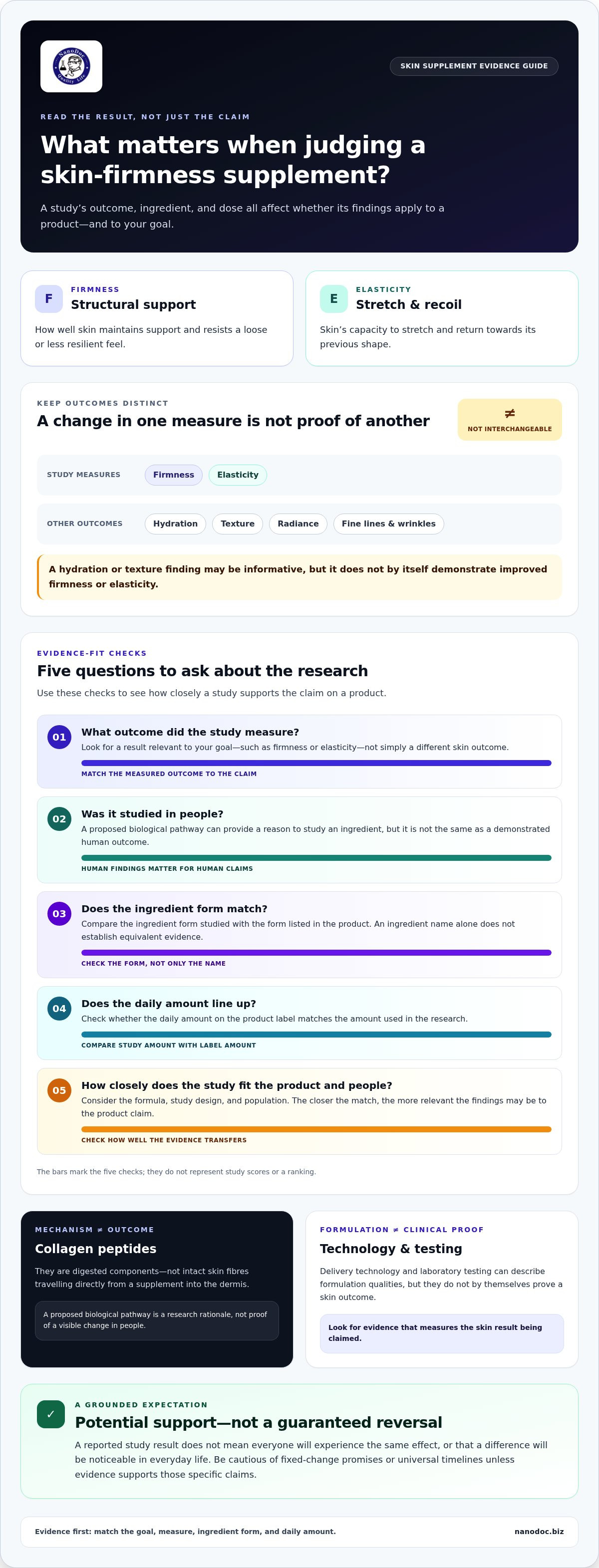
Featured definition: Skin firmness is the structural support that helps skin feel resilient; elasticity is its capacity to stretch and return towards its previous shape.
These qualities are related, but they aren’t interchangeable. Skin may feel temporarily smoother after applying a moisturiser, or look more supple when well hydrated, without a demonstrated change in its underlying support or recoil. Radiance, surface texture, fine lines, and wrinkles are also distinct outcomes. A study measuring one shouldn’t be treated as proof of improvement in another.
What do skin firmness and elasticity mean?
Firmness describes how well skin maintains support and resists a loose or less resilient feel. Elasticity describes how it responds to movement: skin with greater recoil returns more readily after being stretched or compressed. Someone may notice reduced firmness as a softer, less supported appearance, or reduced elasticity as skin that seems slower to recover after movement. These observations can be useful, but they’re subjective and don’t identify a single cause.
Collagen and elastin are different proteins within the skin’s structural network. Collagen provides tensile support, while elastin contributes to stretch and recoil. The Collagen overview introduces its structure and biological roles, but knowing that collagen is part of skin doesn’t establish that an ingested ingredient will produce a visible effect. Oral collagen peptides are digested components, not intact skin fibres travelling directly from a supplement into the dermis.
Skin changes can reflect several influences, including ageing, sun exposure, health, genetics, and environmental conditions. Nutrition may be one part of the wider picture, but visible changes don’t point automatically to a specific deficiency or nutritional solution.
What can a supplement realistically promise?
A proposed biological mechanism can make an ingredient worth studying, but it isn’t the same as demonstrating a meaningful outcome in people. Human research needs to measure a relevant result, such as elasticity, using a suitable method. Findings about hydration or wrinkles may be informative, but they don’t by themselves prove firmer skin. The ingredient, dose, formulation, study design, and population also affect how closely a finding applies to a product or an individual.
For readers considering supplements for skin firmness and elasticity, a reasonable expectation is potential support, not a guaranteed reversal of visible ageing. A result reported in a study doesn’t ensure that everyone will experience the same effect, or that an observed difference will be noticeable in everyday life. Be cautious of promises of a fixed degree of change or a universal timeline unless evidence supports those specific claims.
Keep your desired outcome in view. If your concern is dryness, a hydration result may be relevant; if it is slower recoil or reduced structural support, look for research that assessed elasticity or firmness directly. This distinction makes claims easier to interpret and helps prevent changes in feel, smoothness, or radiance from being mistaken for proof of structural improvement.
How collagen, elastin, and skin structure relate to supplement choices
To assess a supplement claim, it helps to understand the structure it refers to. The dermis, the skin layer beneath the epidermis, contains an extracellular matrix: a network of proteins and other molecules that helps provide support and resilience. Collagen is a major structural protein in this network. Elastin fibres contribute to the skin’s ability to stretch and recoil. These roles are related, but not identical, and neither protein alone determines how skin looks or feels.
How collagen and elastin contribute to skin structure
A simple comparison is a supporting framework with flexible fibres. Collagen helps the framework resist tension, while elastin helps tissue respond to movement. The Collagen reference provides further background on this protein’s structure and biological functions. It explains collagen’s role in the body, but doesn’t establish that a supplement will change skin firmness.
Oral collagen peptides are digested into smaller components. They don’t travel unchanged from a capsule or powder and slot directly into the skin as replacement collagen. Researchers have proposed that digestion products may influence biological processes involved in skin structure, but a proposed pathway is not proof of a visible result. An ingredient list alone therefore can’t show that a product replaces collagen or elastin in the dermis.
How ingredient mechanisms differ from clinical outcomes
Vitamin C illustrates why biological role and product outcome must be considered separately. The body uses vitamin C in normal collagen formation, which makes its role relevant to skin biology. That fact doesn’t show that taking additional vitamin C will increase firmness in someone whose intake is already adequate, or that a particular supplement improves elasticity. The outcome needs to be tested in people using the product or a sufficiently comparable formulation.
Citation-ready distinction: “An ingredient’s known role in a biological process provides a rationale for research, but it does not demonstrate that a supplement improves skin firmness in human studies.”
When reviewing evidence for supplements for skin firmness and elasticity, check whether the study matches the product claim. Ingredient form and daily dose matter because evidence for one form or amount may not apply to another. Formulation can also affect how ingredients are delivered, while the study population and design shape how confidently results can be interpreted. For example, a trial in a specific group may not predict the same response in people with different diets or health characteristics.
Delivery technology is another separate consideration. A feature intended to influence how an ingredient is formulated or delivered does not, by itself, establish improved absorption or a skin outcome. For a broader explanation of how nutrient delivery is discussed, see this high bioavailability nutrients guide.
Keep the chain of evidence clear: a nutrient’s role supports biological plausibility; a relevant human study supports an outcome claim. NanoDoc offers LG Bionano formulations that are independently laboratory-tested for nanoparticle size and quality. Those tests address formulation characteristics, not clinical proof of firmness. Explore NanoDoc’s skin-support offerings with that distinction in mind.
What human evidence says about supplements for skin firmness and elasticity
Human studies can indicate whether an ingredient category may affect a measured skin outcome, but the evidence doesn’t automatically transfer to every product containing that ingredient. A 2026 meta-analysis covering 23 randomised controlled trials and 1,474 participants reported improvements in skin hydration, elasticity, and wrinkles with oral collagen peptides. This is evidence across multiple trials, not proof that every collagen supplement produces those results or that a specific finished product has been tested.
Use the comparison below to distinguish evidence for a skin-related role from evidence for a firmness outcome.
| Ingredient category | Human evidence | Measured outcome | Key limitation |
|---|---|---|---|
| Oral collagen peptides | A 2026 meta-analysis reported positive findings across randomised trials. | Hydration, elasticity, and wrinkles were reported. | Trials may differ in formula, dose, duration, and participants; pooled findings don’t establish the effect of one finished product. |
| Vitamin C | Its role in normal collagen formation is established, but that biological role alone doesn’t demonstrate a supplement-related firmness benefit. | Collagen formation is a biological process, not necessarily a measured change in skin firmness. | Evidence for a nutrient’s role isn’t equivalent to evidence that extra intake improves firmness in a particular person. |
| Zinc, biotin and other skin-related nutrients | Some nutrients have recognised roles in normal skin maintenance, but that doesn’t establish a direct elasticity or firmness effect from supplementation. | Skin maintenance or other nutrient-specific outcomes may be studied. | Check whether human research measured the specific outcome being claimed, rather than a broader skin-health measure. |
How to assess collagen supplement research
Read beyond the ingredient name. Check whether a trial tested collagen alone or combined it with other ingredients, how many participants completed it, how long it ran, and whether the comparator was a placebo or another treatment. Review the exact collagen form and daily amount, and note disclosed funding or other potential conflicts. A systematic review can summarise a body of research, but its conclusions depend on the quality and comparability of the included trials.
One reported meta-analysis estimated an approximately 8% improvement in elasticity with daily collagen peptide doses in the 2.5 to 10 gram range over 8 to 12 weeks. Treat that figure as a pooled research finding, not a promised result. Before interpreting a percentage, establish whether it represents change from baseline, a difference against placebo, or another calculation. These distinctions affect what the number means.
How to compare outcomes and evidence strength
Instrument-based elasticity measurements differ from participant satisfaction or a claim that skin looked firmer. Statistical significance indicates that a result is unlikely to be explained by chance under a study’s assumptions; it doesn’t, by itself, show that the difference is noticeable or practically meaningful. Short, small, or product-specific trials also offer less certainty about broader use.
For supplements for skin firmness and elasticity, match the claim to the tested outcome and formula. A meta-analysis supports an ingredient category; evidence on a finished product requires research on that formulation. NanoDoc’s formulations are independently laboratory-tested for nanoparticle size and quality, which addresses those characteristics rather than proving a clinical skin outcome. The NanoDoc skin-support range includes products formulated with this distinction in mind.
How to choose skin-firmness supplements with evidence and safety in mind
A careful choice starts with a clear goal, then checks whether the research and label support it. This four-step checklist can help you compare supplements for skin firmness and elasticity without treating a compelling ingredient name as proof of a result.
- Define the outcome you want. Decide whether your concern is skin recoil, perceived firmness, dryness, or surface texture. These are different outcomes. A study measuring hydration may not answer whether a supplement affects firmness, so identify the result that matters before comparing claims.
- Inspect the evidence behind the claim. Look for human research that measures the relevant outcome. Check whether it tested the same ingredient form and daily amount shown on the product label, and whether the study used a comparator. Research on an ingredient can inform your judgement, but it doesn’t automatically establish the effect of every finished product containing it.
- Compare the complete formula with the study. Read the ingredient identity, amount per serving, serving directions, and full ingredient list. If a study tested a multi-ingredient formula, its results can’t readily show which ingredient contributed to an outcome. Treat dramatic or guaranteed language cautiously: compare the claim with the measured result and the study’s limitations.
- Assess suitability for your circumstances. Consider allergies, medicines, existing health conditions, and overlapping ingredients in other supplements. If you’re unsure about suitability or possible interactions, discuss the product with a qualified healthcare professional before starting it. Follow the label directions, and don’t assume that taking more will improve an outcome.
Which label and evidence details should readers compare?
Match the research to the label item by item. For example, if a trial examined a specific form at a stated daily amount, a product with a different form or amount isn’t automatically equivalent. Consider whether the study tested the finished formula or only one ingredient, how long it ran, and which outcome it measured. A claim about firmer-looking skin is less informative if the evidence measured only hydration or participant satisfaction.
Also distinguish a percentage change from baseline from a difference compared with a placebo group. They answer different questions. If an advertisement highlights a large percentage, look for what was compared, how the outcome was measured, and whether the study explains the practical meaning of that change.
What safety questions matter before starting?
Supplements are only one part of skin care. Skincare products, sun protection, a balanced diet, and wider health factors each have distinct roles; a supplement shouldn’t replace established skincare practices or medical assessment when needed. If a skin change is concerning or persistent, seek appropriate healthcare advice rather than relying on a supplement claim alone.
NanoDoc offers Anti-Ageing Skin Care and Nano Cellular Essential Nutrition. Review the product information alongside the evidence and suitability considerations above.
How NanoDoc approaches skin-support products and formulation science
Evidence-led product selection involves more than identifying an ingredient associated with skin. It also means understanding what a product’s formulation features establish, and where clinical evidence is needed to support an outcome claim. NanoDoc International is the South East Asia representative of LG Bionano and offers two categories relevant to skin and nutrition: Anti-Ageing Skin Care and Nano Cellular Essential Nutrition.
These categories serve different roles. Topical skincare is applied to the skin, while nutrition products are taken as supplements. Evidence about a topical technology shouldn’t be treated as evidence about an oral supplement, or vice versa. For readers exploring topical approaches, the anti-ageing dermal technology guide provides separate context. This article’s focus remains on how to assess research for supplements for skin firmness and elasticity.
What NanoDoc’s formulation testing establishes
NanoDoc’s formulations are independently laboratory-tested to verify nanoparticle size and quality. These checks address formulation characteristics. They don’t establish how much of an ingredient the body absorbs, whether it reaches a particular skin layer, or whether a person will experience a change in firmness or elasticity.
Those are different questions requiring different evidence. A quality test can help describe the material being tested; a clinical study assesses outcomes in people under defined conditions. To substantiate a skin-firmness claim, evidence would need to relate to the relevant finished formulation and measure that outcome. Testing nanoparticle size and quality alone doesn’t provide that clinical evidence.
How to continue exploring skin and nutrition science
When considering Nano Cellular Essential Nutrition, assess the product information and any available evidence using the same careful approach applied to other supplements: identify what is being tested, what outcome is claimed, and whether the evidence matches the formulation. A delivery-technology feature may be relevant to how a formulation is characterised, but it shouldn’t be read as proof of absorption or a skin benefit. This keeps product features separate from demonstrated clinical outcomes.
Anti-Ageing Skin Care is a distinct category for topical products, so its formulation context differs from oral nutrition. The topical guide can help readers understand that separate area without implying that topical research proves an oral supplement’s effect. Keeping these evidence streams distinct makes it easier to evaluate claims according to product type and outcome.
NanoDoc offers a science-led product range, including Anti-Ageing Skin Care and Nano Cellular Essential Nutrition. Assess any skin outcome claim against evidence on the relevant finished product, rather than assuming that a formulation feature guarantees a particular result.
Make your next choice with evidence in view
Turn your skin concern into a specific question: which outcome matters to you, and what evidence would help you judge whether a product is relevant? Keep that question beside the label and any research you review. It can help you distinguish a product feature from an outcome supported by human evidence, without expecting a supplement to deliver the same result for everyone.
NanoDoc offers LG Bionano formulations that undergo independent laboratory testing for nanoparticle size and quality. These are formulation-quality checks, not proof of a particular clinical result. For supplements for skin firmness and elasticity, weigh product claims against evidence on the relevant finished formulation.
Explore NanoDoc’s product information and view the science-led product range to compare Anti-Ageing Skin Care and Nano Cellular Essential Nutrition with your priorities and suitability in mind.
Frequently Asked Questions
Can supplements reverse sagging skin?
No supplement can be assumed to reverse sagging skin. Research into a skin-related ingredient may show changes in a particular measured outcome, but that doesn’t establish that a supplement can restore loose skin or reverse visible ageing. If you’re considering a product, look for evidence on the specific outcome it claims to affect, rather than relying on broad phrases such as “skin renewal.” Persistent or sudden skin changes are better discussed with a qualified healthcare professional.
Is collagen the best supplement for skin firmness and elasticity?
There isn’t enough basis to call collagen the best option for everyone. Human research has examined collagen peptides and reported skin outcomes, but studies can differ in formulation, dose, design, and what they measure. A pooled finding doesn’t prove that every collagen product works, or that it is more suitable than another option for your needs. Compare evidence on the relevant outcome and finished product, then consider suitability and personal health context.
Do skin-firmness supplements work differently for mature skin?
Research findings don’t necessarily predict how a supplement will affect every age group. To judge relevance for mature skin, check who participated in a study and whether results were reported separately by age. If a trial included a broad age range but didn’t analyse age-specific outcomes, it may not answer whether the effect differs with age. Skin concerns can also have different causes, so age alone isn’t enough to identify a suitable supplement.
Can vitamin C supplements improve skin elasticity on their own?
Vitamin C has a role in normal collagen formation, but that biological function doesn’t prove that taking vitamin C alone improves skin elasticity. The relevance may depend on factors such as a person’s existing intake and the dose studied. Look for human trials that measured elasticity directly and tested vitamin C in a comparable form and amount. A general claim about collagen formation isn’t the same as evidence of a visible or measurable firmness benefit.
How can I tell whether a supplement study applies to the product I am considering?
Compare the study and product label side by side. Check the ingredient’s exact form, amount per serving, serving directions, and whether the trial tested that ingredient alone or in a combination. For example, evidence from a multi-ingredient product may not show which component contributed to the result. Also note the study’s participants, comparator, and measured outcome. If key details differ, treat the research as background rather than direct proof for that product.
Are supplements for skin firmness safe to take with medication?
Not necessarily. Whether a supplement is suitable alongside medication depends on its full ingredient list, your medicines, and your health circumstances. Before starting, show the label to a qualified healthcare professional, particularly if you take prescription medicines, manage a health condition, have an allergy, or use several supplements. They can help assess possible interactions and overlapping ingredients. Don’t stop, replace, or change prescribed medication based on a supplement claim.
What is the difference between skin hydration and skin elasticity?
Hydration concerns the skin’s water content and can affect how comfortable or smooth its surface feels. Elasticity describes how skin responds to stretching and returns towards its previous shape. These outcomes may be assessed differently, so an improvement in hydration doesn’t establish that elasticity has changed. For instance, skin may feel less dry after a moisturising routine while its recoil remains unmeasured. Check which outcome a product study actually assessed before interpreting its results.
Frequently Asked Questions
- What do skin firmness and elasticity mean?
- Firmness describes how well skin maintains support and resists a loose or less resilient feel. Elasticity describes how it responds to movement: skin with greater recoil returns more readily after being stretched or compressed. Someone may notice reduced firmness as a softer, less supported appearance, or reduced elasticity as skin that seems slower to recover after movement. These observations can be useful, but they’re subjective and don’t identify a single cause. Collagen and elastin are different proteins within the skin’s structural network. Collagen provides tensile support, while elastin contributes to stretch and recoil. The Collagen overview introduces its structure and biological roles, but knowing that collagen is part of skin doesn’t establish that an ingested ingredient will produce a visible effect. Oral collagen peptides are digested components, not intact skin fibres travelling directly from a supplement into the dermis. Skin changes can reflect several influences, including ageing, sun exposure, health, genetics, and environmental conditions. Nutrition may be one part of the wider picture, but visible changes don’t point automatically to a specific deficiency or nutritional solution.
- What can a supplement realistically promise?
- A proposed biological mechanism can make an ingredient worth studying, but it isn’t the same as demonstrating a meaningful outcome in people. Human research needs to measure a relevant result, such as elasticity, using a suitable method. Findings about hydration or wrinkles may be informative, but they don’t by themselves prove firmer skin. The ingredient, dose, formulation, study design, and population also affect how closely a finding applies to a product or an individual. For readers considering supplements for skin firmness and elasticity, a reasonable expectation is potential support, not a guaranteed reversal of visible ageing. A result reported in a study doesn’t ensure that everyone will experience the same effect, or that an observed difference will be noticeable in everyday life. Be cautious of promises of a fixed degree of change or a universal timeline unless evidence supports those specific claims. Keep your desired outcome in view. If your concern is dryness, a hydration result may be relevant; if it is slower recoil or reduced structural support, look for research that assessed elasticity or firmness directly. This distinction makes claims easier to interpret and helps prevent changes in feel, smoothness, or radiance from being mistaken for proof of structural improvement. To assess a supplement claim, it helps to understand the structure it refers to. The dermis, the skin layer beneath the epidermis, contains an extracellular matrix: a network of proteins and other molecules that helps provide support and resilience. Collagen is a major structural protein in this network. Elastin fibres contribute to the skin’s ability to stretch and recoil. These roles are related, but not identical, and neither protein alone determines how skin looks or feels.
- Which label and evidence details should readers compare?
- Match the research to the label item by item. For example, if a trial examined a specific form at a stated daily amount, a product with a different form or amount isn’t automatically equivalent. Consider whether the study tested the finished formula or only one ingredient, how long it ran, and which outcome it measured. A claim about firmer-looking skin is less informative if the evidence measured only hydration or participant satisfaction. Also distinguish a percentage change from baseline from a difference compared with a placebo group. They answer different questions. If an advertisement highlights a large percentage, look for what was compared, how the outcome was measured, and whether the study explains the practical meaning of that change.
- What safety questions matter before starting?
- Supplements are only one part of skin care. Skincare products, sun protection, a balanced diet, and wider health factors each have distinct roles; a supplement shouldn’t replace established skincare practices or medical assessment when needed. If a skin change is concerning or persistent, seek appropriate healthcare advice rather than relying on a supplement claim alone. NanoDoc offers Anti-Ageing Skin Care and Nano Cellular Essential Nutrition. Review the product information alongside the evidence and suitability considerations above. Evidence-led product selection involves more than identifying an ingredient associated with skin. It also means understanding what a product’s formulation features establish, and where clinical evidence is needed to support an outcome claim. NanoDoc International is the South East Asia representative of LG Bionano and offers two categories relevant to skin and nutrition: Anti-Ageing Skin Care and Nano Cellular Essential Nutrition. These categories serve different roles. Topical skincare is applied to the skin, while nutrition products are taken as supplements. Evidence about a topical technology shouldn’t be treated as evidence about an oral supplement, or vice versa. For readers exploring topical approaches, the anti-ageing dermal technology guide provides separate context. This article’s focus remains on how to assess research for supplements for skin firmness and elasticity.
- Can supplements reverse sagging skin?
- No supplement can be assumed to reverse sagging skin. Research into a skin-related ingredient may show changes in a particular measured outcome, but that doesn’t establish that a supplement can restore loose skin or reverse visible ageing. If you’re considering a product, look for evidence on the specific outcome it claims to affect, rather than relying on broad phrases such as “skin renewal.” Persistent or sudden skin changes are better discussed with a qualified healthcare professional.
- Is collagen the best supplement for skin firmness and elasticity?
- There isn’t enough basis to call collagen the best option for everyone. Human research has examined collagen peptides and reported skin outcomes, but studies can differ in formulation, dose, design, and what they measure. A pooled finding doesn’t prove that every collagen product works, or that it is more suitable than another option for your needs. Compare evidence on the relevant outcome and finished product, then consider suitability and personal health context.
- Do skin-firmness supplements work differently for mature skin?
- Research findings don’t necessarily predict how a supplement will affect every age group. To judge relevance for mature skin, check who participated in a study and whether results were reported separately by age. If a trial included a broad age range but didn’t analyse age-specific outcomes, it may not answer whether the effect differs with age. Skin concerns can also have different causes, so age alone isn’t enough to identify a suitable supplement.
- Can vitamin C supplements improve skin elasticity on their own?
- Vitamin C has a role in normal collagen formation, but that biological function doesn’t prove that taking vitamin C alone improves skin elasticity. The relevance may depend on factors such as a person’s existing intake and the dose studied. Look for human trials that measured elasticity directly and tested vitamin C in a comparable form and amount. A general claim about collagen formation isn’t the same as evidence of a visible or measurable firmness benefit.
- How can I tell whether a supplement study applies to the product I am considering?
- Compare the study and product label side by side. Check the ingredient’s exact form, amount per serving, serving directions, and whether the trial tested that ingredient alone or in a combination. For example, evidence from a multi-ingredient product may not show which component contributed to the result. Also note the study’s participants, comparator, and measured outcome. If key details differ, treat the research as background rather than direct proof for that product.
- Are supplements for skin firmness safe to take with medication?
- Not necessarily. Whether a supplement is suitable alongside medication depends on its full ingredient list, your medicines, and your health circumstances. Before starting, show the label to a qualified healthcare professional, particularly if you take prescription medicines, manage a health condition, have an allergy, or use several supplements. They can help assess possible interactions and overlapping ingredients. Don’t stop, replace, or change prescribed medication based on a supplement claim.
- What is the difference between skin hydration and skin elasticity?
- Hydration concerns the skin’s water content and can affect how comfortable or smooth its surface feels. Elasticity describes how skin responds to stretching and returns towards its previous shape. These outcomes may be assessed differently, so an improvement in hydration doesn’t establish that elasticity has changed. For instance, skin may feel less dry after a moisturising routine while its recoil remains unmeasured. Check which outcome a product study actually assessed before interpreting its results.