

A smaller particle isn’t automatically a better supplement. If you’re comparing standard vs nano supplements, it’s reasonable to ask whether a nano formulation improves absorption or whether the label is doing more work than the evidence. The answer depends on the nutrient, delivery system and research behind the specific product, not the word “nano” alone.
This guide explains how standard and nano formulations differ without treating either as universally superior. You’ll learn what absorption studies can show, why results for one nutrient don’t automatically apply to another, and how to distinguish laboratory verification of particle size and quality from evidence of a health benefit. We’ll also cover the product details and study findings worth checking, so technical claims are easier to assess. The aim is to help you make an informed decision based on the formulation, available evidence and your own needs.
Key Takeaways
- Understand how conventional formulations differ from nano-delivery systems, without assuming every nano supplement uses the same technology.
- Assess absorption in context: nutrient form, solubility, stability, digestion and individual factors can all influence bioavailability.
- When comparing standard vs nano supplements, look for evidence on the specific nutrient and formulation, not just a nano label.
- Check what the product contains, how its delivery system is described, and whether testing verifies product characteristics or demonstrates health outcomes.
- Compare your nutrient needs, the formulation evidence and product quality, while considering your health circumstances and medications.
Table of Contents
- Standard vs. Nano Supplements: What Is the Formulation Difference?
- How Formulation Can Affect Supplement Absorption and Bioavailability
- Standard vs. Nano Supplements: A Practical Comparison of Benefits and Limits
- How to Evaluate Nano Supplement Claims Before You Choose
- Choosing Between Standard and Nano Supplements for Your Needs
Standard vs. Nano Supplements: What Is the Formulation Difference?
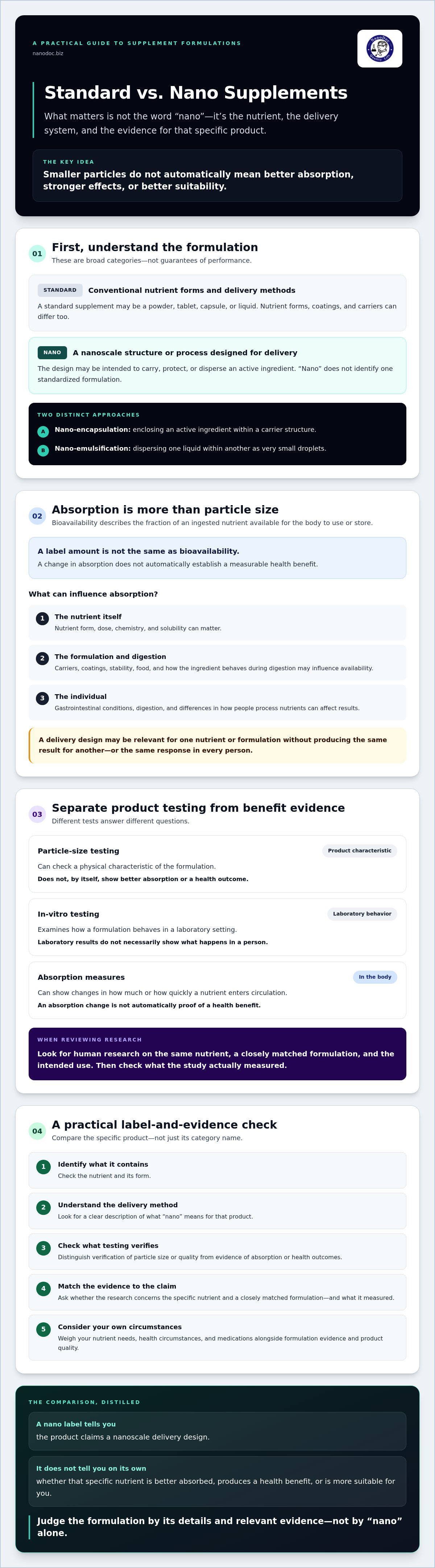
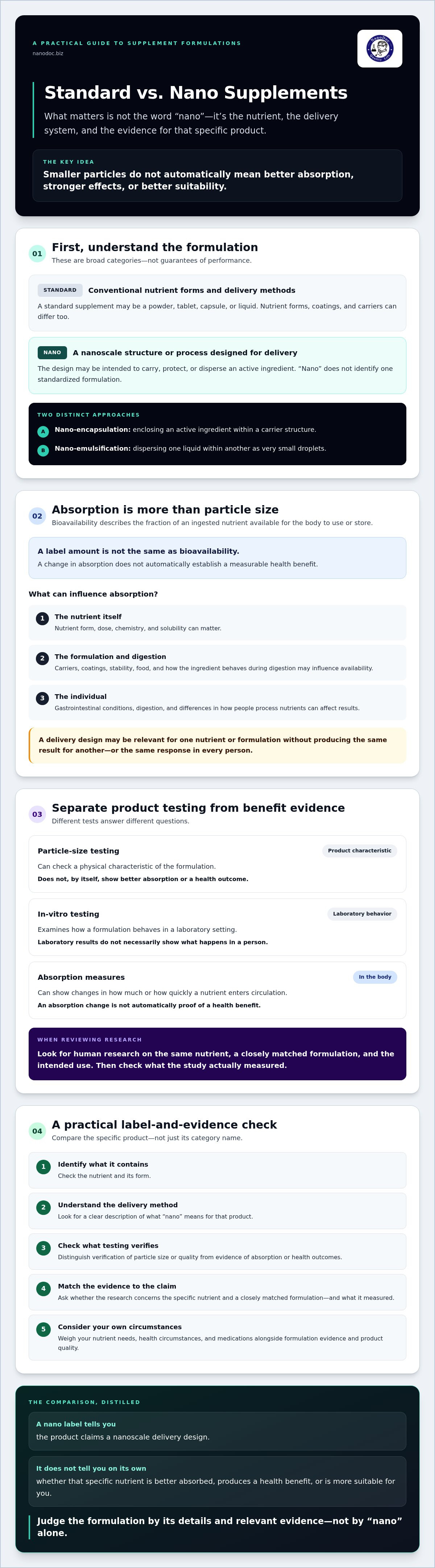
Standard supplements use conventional nutrient forms and delivery methods, while nano supplements use nanoscale structures or processes intended to deliver an active ingredient. These terms describe broad formulation categories, not guaranteed levels of absorption or effectiveness. In the standard vs nano supplements comparison, focus on how the nutrient is carried and released, rather than whether it comes as a capsule, tablet or liquid.
What does “nano” mean on a supplement label?
“Nano” refers to the scale or design of a delivery system, but it doesn’t identify one standardized formulation. Products may use different materials and methods, so check whether the label explains what the term means for that particular supplement.
For example, nano-encapsulation generally means enclosing an active ingredient within a carrier structure. Nano-emulsification involves dispersing one liquid within another as very small droplets. These are distinct formulation approaches, not interchangeable names for the same process. The broader science of nanoparticle drug delivery systems helps explain how carriers can transport active compounds, but a general description of delivery technology doesn’t establish a benefit for a specific supplement.
Look for details about the delivery method and any testing used to verify the formulation. A particle-size or quality test can help confirm product characteristics. By itself, it doesn’t show that the nutrient is better absorbed or produces a particular health outcome.
How does a nano formulation differ from a standard supplement?
The comparison is about the delivery system, not simply the dosage form or a marketing label. A standard supplement might provide a nutrient as a powder, tablet, capsule or liquid. Conventional products can also use different nutrient forms, coatings and carriers, which may affect how an ingredient behaves during storage and digestion.
A nano formulation adds a delivery design intended to alter how the active ingredient is carried, protected or dispersed. That design may be relevant for a particular nutrient, but its effect needs to be assessed for the specific formulation. Smaller particle size alone doesn’t establish greater absorption, stronger effects or better suitability for an individual.
Neither category is inherently safer, stronger or more effective. For a fair comparison, check the nutrient form, stated delivery method, evidence for that exact formulation and what product testing actually verifies. These details matter more than the category name.
How Formulation Can Affect Supplement Absorption and Bioavailability
Bioavailability is the fraction of an ingested nutrient that becomes available for the body to use or store. It’s not the same as the amount listed on a supplement label, and a change in absorption doesn’t automatically mean a measurable health benefit.
A delivery system may matter differently depending on the nutrient, its chemistry and solubility, the stability of its ingredient, how it behaves during digestion, and whether the formulation addresses a specific limitation. A carrier designed for one compound may not produce the same result with another. In the standard vs nano supplements comparison, particle size is one formulation detail, not a complete measure of performance.
Which factors influence absorption beyond particle size?
Nutrient form and dose can affect how much is available for absorption. So can other ingredients in the formulation, including carriers or coatings, and whether the supplement is taken with food. Some nutrients may interact with components of a meal, while others may be affected by how well they dissolve or remain stable as they pass through the digestive tract.
Individual factors matter, too. Gastrointestinal conditions, digestion and differences in how people process nutrients can influence results. A delivery structure may change how an ingredient is presented to the body, but it doesn’t bypass every digestive process or guarantee the same response in every person.
What evidence shows whether a formulation makes a difference?
Look for human research on the same nutrient, a closely matched formulation and the intended use. Then check what the study measured. Each level of evidence answers a different question:
- Particle-size testing checks a physical characteristic of the formulation.
- In-vitro testing examines behaviour in a laboratory setting, not necessarily in a person.
- Absorption measures can show changes in how much or how quickly a nutrient enters circulation.
- Clinical outcomes assess whether the formulation leads to a meaningful health effect in people.
Evidence at one level doesn’t automatically establish the next. Verifying particle size isn’t proof of improved absorption, and an absorption measure alone doesn’t demonstrate a health outcome. A balanced discussion in Today's Dietitian also underscores the need to weigh proposed benefits against questions about safety and evidence. Review the nano-nutrient range with these distinctions in mind. For a broader look at nutrient forms and absorption, consult a high bioavailability nutrients guide.
Standard vs. Nano Supplements: A Practical Comparison of Benefits and Limits
A useful comparison looks beyond the “nano” label. Match products by nutrient, nutrient form, daily amount and serving format, then ask whether the evidence supports the stated benefit for that specific formulation. A capsule and a liquid can differ in format without using a nano-delivery system. The delivery design is the relevant distinction.
| Comparison point | Standard supplement | Nano supplement |
|---|---|---|
| Formulation | Uses a conventional nutrient form and delivery method. Ingredients, coatings and carriers can vary. | Uses a nanoscale structure or process, which may differ between products. |
| Evidence to seek | Research on the nutrient form, dose and intended use. | Human research on the specific nutrient and formulation, including relevant absorption measures and outcomes. |
| Potential advantage | May be suitable when the nutrient form and evidence fit the intended use. | May offer a delivery advantage if evidence supports it for that nutrient and formulation. |
| Limit to consider | A familiar format doesn’t establish suitability, quality or effectiveness on its own. | A nano label or particle-size result alone doesn’t establish improved absorption or health outcomes. |
Possible advantages depend on the nutrient and delivery system, not the nano label alone. Where possible, compare equivalent daily amounts and serving formats. Check whether claims rely on laboratory testing, absorption measures or human clinical outcomes, since these types of evidence answer different questions.
When might a nano supplement be worth considering?
A nano formulation may merit consideration when suitable evidence supports a relevant advantage for that specific nutrient and delivery design. Ask whether the claimed benefit addresses your actual need and whether it has been observed in people using a comparable product. A general claim about nano technology isn’t enough to establish an improved outcome or a reason to supplement for a medical condition.
When might a standard supplement be sufficient?
A conventional option may remain reasonable when its nutrient form is appropriate, its label clearly states the contents and serving amount, and the available evidence suits your intended use. A familiar formulation doesn’t automatically mean poor absorption or quality. Suitability still depends on personal circumstances, including health needs and other products or medicines you take. Read more about the nano-delivery and liposomal comparison when assessing these distinct delivery approaches.
How to Evaluate Nano Supplement Claims Before You Choose
A careful review helps you assess standard vs nano supplements using the same criteria, rather than relying on a technology label. Work through this checklist to decide whether a product’s formulation and claims are relevant to you.
What should you check on the label and product information?
- 1. Identify the nutrient. Check the active ingredient and its form. Confirm the amount per serving and the recommended serving directions.
- 2. Understand the delivery system. If the product says “nano,” look for a clear explanation of what that means for this formulation. A specific description is more informative than a general technology claim.
- 3. Review the full ingredient list. Note carriers, coatings, flavourings and other ingredients. Check whether the directions explain how to take the product, including any stated instructions about food.
- 4. Match the evidence to the claim. Look for research on the same nutrient and a comparable formulation. Find out whether it measured particle characteristics, absorption in people or a health outcome. These are different types of evidence.
- 5. Examine the testing information. Check what was tested, which characteristic the test assessed and whether the information applies to the product you’re considering. Also consider whether the dose and directions suit your circumstances.
Broad wording such as “maximum absorption” should prompt a closer look. Ask what comparison supports the claim, which formulation was studied and what outcome was measured. Evidence that a delivery system has a particular physical property doesn’t, on its own, show that people absorb more of the nutrient or experience a health benefit.
What can laboratory testing confirm, and what can it not prove?
Depending on the test and its scope, laboratory testing can verify defined product characteristics, such as particle size or aspects of formulation quality. It can’t establish human absorption or clinical outcomes by itself. When reviewing nanoparticle size in supplements, look for information about the method and the specific sample tested, rather than treating the word “tested” as a complete account of the evidence.
NanoDoc states that its formulations are independently laboratory-tested for nanoparticle size and quality. This is information about product-characteristic verification, not proof of clinical outcomes. To assess such a statement, check what documentation is available and what the testing covers.
For a concrete example, review NanoDoc’s nano-nutrient formulation information and compare its stated delivery approach and testing details with the evidence you’re seeking. A transparent description can inform your decision, but it doesn’t mean a nano formulation is necessary for everyone.
Choosing Between Standard and Nano Supplements for Your Needs
There isn’t one formulation that suits everyone. Start with the nutrient you’re considering, then compare the available forms, evidence and product information. The aim of comparing standard vs nano supplements isn’t to select the more advanced-sounding label. It’s to determine whether a specific formulation is relevant to your needs and supported by appropriate evidence.
Which questions should guide your final comparison?
- Does the research match the product? Check whether studies concern the same nutrient, delivery formulation, dose and intended use. Findings from a different ingredient or formulation may not apply.
- What does the testing establish? Ask what was tested, how the testing relates to the product and what the results can confirm. Product-quality checks and evidence of efficacy answer different questions.
- Is the product information complete? Review the active ingredients, serving amount, directions and relevant cautions. Clear information helps you compare products and assess whether the formulation fits your circumstances.
- Does it suit your health context? Existing health conditions, individual needs and medications can affect whether a supplement is appropriate. If you’re unsure about potential interactions or suitability, seek advice from a qualified healthcare professional.
Use those answers to weigh evidence and quality together. A well-described delivery system can help you understand how a product is formulated, while relevant human research is needed to support claims about absorption or health outcomes. Neither an advanced formulation nor a laboratory test alone determines what’s right for you.
How does NanoDoc’s nano-nutrient range fit the comparison?
NanoDoc International is the representative of LG Bionano and offers nano-nutrient supplements. The company states that its formulations are independently laboratory-tested for nanoparticle size and quality. Review any available testing documentation and its scope. Such testing can address product characteristics, but it doesn’t by itself establish improved absorption or clinical benefit.
For a broader perspective on nutrient forms and absorption, consult a clinical guide to high bioavailability nutrients. You can also explore NanoDoc’s nano-nutrient information as one option to assess against the same criteria, not as a universal recommendation. Compare its formulation details and supporting evidence with your specific nutrient needs before making a choice.
Make Your Supplement Choice With Evidence in View
The key to comparing standard vs nano supplements is to focus on the specific nutrient and formulation, not assume a nano label guarantees better results. Consider whether the evidence matches the product and intended use, and distinguish tests of formulation characteristics from research showing absorption or health outcomes.
Your health circumstances and medications also matter. A formulation that appears promising in research may not be suitable for every person, so review product directions and relevant cautions before choosing.
NanoDoc International represents LG Bionano and offers nano-nutrient supplements. The company states that its formulations are independently laboratory-tested for nanoparticle size and quality. That testing relates to product characteristics, not proof of clinical outcomes. For a closer look at the formulation information, explore NanoDoc’s nano-nutrient supplements.
With clear questions and careful attention to evidence, you can make a considered choice that fits your needs without treating any one delivery approach as universally superior.
Frequently Asked Questions
Is a nano supplement absorbed better than a standard supplement?
It depends on the nutrient, formulation, dose and available evidence. When comparing standard vs nano supplements, nanoscale design alone doesn’t prove superior absorption or better health outcomes. Look for relevant human studies comparing equivalent nutrient forms and doses. Check what researchers measured: an increase in a nutrient’s absorption is not the same as evidence that taking the supplement improves a health outcome.
What is the difference between standard and nano supplements?
The main difference is the delivery formulation, not necessarily the nutrient itself. Standard supplements may use varied nutrient forms, coatings and carriers, while nano supplements use a nanoscale delivery design. The term “nano” can refer to different technologies, so it doesn’t identify one uniform formulation. Check the product’s specific delivery method, ingredient list and supporting evidence rather than inferring performance from the label.
Are nano supplements safe to take every day?
Daily suitability depends on the ingredients, dose, directions, product quality and your individual health circumstances. A nano formulation shouldn’t be assumed safe or unsafe based on its label alone. Follow the product directions and review its ingredients and cautions. If you’re pregnant, managing a health condition or taking medication, consult a qualified healthcare professional before starting a supplement, particularly if you’re unsure about potential interactions.
Do nano supplements work faster than standard supplements?
Not necessarily. Particle size or delivery terminology alone can’t show that a supplement will act faster. The answer depends on the nutrient, formulation, intended outcome and research measuring that effect. Absorption data may show how a nutrient enters circulation, but it doesn’t establish how quickly a person will notice a health outcome. Look for evidence on the specific formulation and avoid assuming one format works faster for everyone.
What evidence should I look for when comparing nano supplements?
Look for evidence on the same nutrient, formulation, dose and intended use. Relevant human studies can help assess absorption or health outcomes, while laboratory particle-size testing addresses a physical product characteristic. Check whether the claim is specific, the methods are explained and limitations are acknowledged. A product test or patent may provide information about formulation or intellectual property, but neither alone proves clinical effectiveness.
Can nano supplements replace standard supplements?
Nano supplements offer an alternative delivery approach, not a universally necessary replacement. Whether one is appropriate depends on the nutrient, supporting evidence, product details and your individual needs. A standard supplement may remain suitable if its nutrient form and quality fit its intended purpose. Don’t switch based only on marketing claims. If you have health concerns or take medication, discuss supplement choices with a qualified healthcare professional.
Does nanoparticle size alone determine supplement quality?
No. Particle size is one formulation characteristic, not a complete measure of quality, absorption or efficacy. Consider the ingredient identity, dose, stability, manufacturing controls and evidence for the intended use as well. Testing may verify a stated particle-size range, but its meaning depends on what was tested and how. That result alone doesn’t establish how a supplement behaves in people or prove a health benefit.
To compare NanoDoc’s nano-nutrient products with other options, review the product and formulation information, then assess it against your needs and the evidence available.
Frequently Asked Questions
- What does “nano” mean on a supplement label?
- “Nano” refers to the scale or design of a delivery system, but it doesn’t identify one standardized formulation. Products may use different materials and methods, so check whether the label explains what the term means for that particular supplement. For example, nano-encapsulation generally means enclosing an active ingredient within a carrier structure. Nano-emulsification involves dispersing one liquid within another as very small droplets. These are distinct formulation approaches, not interchangeable names for the same process. The broader science of nanoparticle drug delivery systems helps explain how carriers can transport active compounds, but a general description of delivery technology doesn’t establish a benefit for a specific supplement. Look for details about the delivery method and any testing used to verify the formulation. A particle-size or quality test can help confirm product characteristics. By itself, it doesn’t show that the nutrient is better absorbed or produces a particular health outcome.
- How does a nano formulation differ from a standard supplement?
- The comparison is about the delivery system, not simply the dosage form or a marketing label. A standard supplement might provide a nutrient as a powder, tablet, capsule or liquid. Conventional products can also use different nutrient forms, coatings and carriers, which may affect how an ingredient behaves during storage and digestion. A nano formulation adds a delivery design intended to alter how the active ingredient is carried, protected or dispersed. That design may be relevant for a particular nutrient, but its effect needs to be assessed for the specific formulation. Smaller particle size alone doesn’t establish greater absorption, stronger effects or better suitability for an individual. Neither category is inherently safer, stronger or more effective. For a fair comparison, check the nutrient form, stated delivery method, evidence for that exact formulation and what product testing actually verifies. These details matter more than the category name. Bioavailability is the fraction of an ingested nutrient that becomes available for the body to use or store. It’s not the same as the amount listed on a supplement label, and a change in absorption doesn’t automatically mean a measurable health benefit. A delivery system may matter differently depending on the nutrient, its chemistry and solubility, the stability of its ingredient, how it behaves during digestion, and whether the formulation addresses a specific limitation. A carrier designed for one compound may not produce the same result with another. In the standard vs nano supplements comparison, particle size is one formulation detail, not a complete measure of performance.
- Which factors influence absorption beyond particle size?
- Nutrient form and dose can affect how much is available for absorption. So can other ingredients in the formulation, including carriers or coatings, and whether the supplement is taken with food. Some nutrients may interact with components of a meal, while others may be affected by how well they dissolve or remain stable as they pass through the digestive tract. Individual factors matter, too. Gastrointestinal conditions, digestion and differences in how people process nutrients can influence results. A delivery structure may change how an ingredient is presented to the body, but it doesn’t bypass every digestive process or guarantee the same response in every person.
- What evidence shows whether a formulation makes a difference?
- Look for human research on the same nutrient, a closely matched formulation and the intended use. Then check what the study measured. Each level of evidence answers a different question: Evidence at one level doesn’t automatically establish the next. Verifying particle size isn’t proof of improved absorption, and an absorption measure alone doesn’t demonstrate a health outcome. A balanced discussion in Today's Dietitian also underscores the need to weigh proposed benefits against questions about safety and evidence. Review the nano-nutrient range with these distinctions in mind. For a broader look at nutrient forms and absorption, consult a high bioavailability nutrients guide. A useful comparison looks beyond the “nano” label. Match products by nutrient, nutrient form, daily amount and serving format, then ask whether the evidence supports the stated benefit for that specific formulation. A capsule and a liquid can differ in format without using a nano-delivery system. The delivery design is the relevant distinction. Possible advantages depend on the nutrient and delivery system, not the nano label alone. Where possible, compare equivalent daily amounts and serving formats. Check whether claims rely on laboratory testing, absorption measures or human clinical outcomes, since these types of evidence answer different questions.
- When might a nano supplement be worth considering?
- A nano formulation may merit consideration when suitable evidence supports a relevant advantage for that specific nutrient and delivery design. Ask whether the claimed benefit addresses your actual need and whether it has been observed in people using a comparable product. A general claim about nano technology isn’t enough to establish an improved outcome or a reason to supplement for a medical condition.
- When might a standard supplement be sufficient?
- A conventional option may remain reasonable when its nutrient form is appropriate, its label clearly states the contents and serving amount, and the available evidence suits your intended use. A familiar formulation doesn’t automatically mean poor absorption or quality. Suitability still depends on personal circumstances, including health needs and other products or medicines you take. Read more about the nano-delivery and liposomal comparison when assessing these distinct delivery approaches. A careful review helps you assess standard vs nano supplements using the same criteria, rather than relying on a technology label. Work through this checklist to decide whether a product’s formulation and claims are relevant to you.
- What should you check on the label and product information?
- Broad wording such as “maximum absorption” should prompt a closer look. Ask what comparison supports the claim, which formulation was studied and what outcome was measured. Evidence that a delivery system has a particular physical property doesn’t, on its own, show that people absorb more of the nutrient or experience a health benefit.
- What can laboratory testing confirm, and what can it not prove?
- Depending on the test and its scope, laboratory testing can verify defined product characteristics, such as particle size or aspects of formulation quality. It can’t establish human absorption or clinical outcomes by itself. When reviewing nanoparticle size in supplements, look for information about the method and the specific sample tested, rather than treating the word “tested” as a complete account of the evidence. NanoDoc states that its formulations are independently laboratory-tested for nanoparticle size and quality. This is information about product-characteristic verification, not proof of clinical outcomes. To assess such a statement, check what documentation is available and what the testing covers. For a concrete example, review NanoDoc’s nano-nutrient formulation information and compare its stated delivery approach and testing details with the evidence you’re seeking. A transparent description can inform your decision, but it doesn’t mean a nano formulation is necessary for everyone. There isn’t one formulation that suits everyone. Start with the nutrient you’re considering, then compare the available forms, evidence and product information. The aim of comparing standard vs nano supplements isn’t to select the more advanced-sounding label. It’s to determine whether a specific formulation is relevant to your needs and supported by appropriate evidence.
- Which questions should guide your final comparison?
- Use those answers to weigh evidence and quality together. A well-described delivery system can help you understand how a product is formulated, while relevant human research is needed to support claims about absorption or health outcomes. Neither an advanced formulation nor a laboratory test alone determines what’s right for you.
- How does NanoDoc’s nano-nutrient range fit the comparison?
- NanoDoc International is the representative of LG Bionano and offers nano-nutrient supplements. The company states that its formulations are independently laboratory-tested for nanoparticle size and quality. Review any available testing documentation and its scope. Such testing can address product characteristics, but it doesn’t by itself establish improved absorption or clinical benefit. For a broader perspective on nutrient forms and absorption, consult a clinical guide to high bioavailability nutrients. You can also explore NanoDoc’s nano-nutrient information as one option to assess against the same criteria, not as a universal recommendation. Compare its formulation details and supporting evidence with your specific nutrient needs before making a choice. The key to comparing standard vs nano supplements is to focus on the specific nutrient and formulation, not assume a nano label guarantees better results. Consider whether the evidence matches the product and intended use, and distinguish tests of formulation characteristics from research showing absorption or health outcomes. Your health circumstances and medications also matter. A formulation that appears promising in research may not be suitable for every person, so review product directions and relevant cautions before choosing. NanoDoc International represents LG Bionano and offers nano-nutrient supplements. The company states that its formulations are independently laboratory-tested for nanoparticle size and quality. That testing relates to product characteristics, not proof of clinical outcomes. For a closer look at the formulation information, explore NanoDoc’s nano-nutrient supplements. With clear questions and careful attention to evidence, you can make a considered choice that fits your needs without treating any one delivery approach as universally superior.
- Is a nano supplement absorbed better than a standard supplement?
- It depends on the nutrient, formulation, dose and available evidence. When comparing standard vs nano supplements, nanoscale design alone doesn’t prove superior absorption or better health outcomes. Look for relevant human studies comparing equivalent nutrient forms and doses. Check what researchers measured: an increase in a nutrient’s absorption is not the same as evidence that taking the supplement improves a health outcome.
- What is the difference between standard and nano supplements?
- The main difference is the delivery formulation, not necessarily the nutrient itself. Standard supplements may use varied nutrient forms, coatings and carriers, while nano supplements use a nanoscale delivery design. The term “nano” can refer to different technologies, so it doesn’t identify one uniform formulation. Check the product’s specific delivery method, ingredient list and supporting evidence rather than inferring performance from the label.
- Are nano supplements safe to take every day?
- Daily suitability depends on the ingredients, dose, directions, product quality and your individual health circumstances. A nano formulation shouldn’t be assumed safe or unsafe based on its label alone. Follow the product directions and review its ingredients and cautions. If you’re pregnant, managing a health condition or taking medication, consult a qualified healthcare professional before starting a supplement, particularly if you’re unsure about potential interactions.
- Do nano supplements work faster than standard supplements?
- Not necessarily. Particle size or delivery terminology alone can’t show that a supplement will act faster. The answer depends on the nutrient, formulation, intended outcome and research measuring that effect. Absorption data may show how a nutrient enters circulation, but it doesn’t establish how quickly a person will notice a health outcome. Look for evidence on the specific formulation and avoid assuming one format works faster for everyone.
- What evidence should I look for when comparing nano supplements?
- Look for evidence on the same nutrient, formulation, dose and intended use. Relevant human studies can help assess absorption or health outcomes, while laboratory particle-size testing addresses a physical product characteristic. Check whether the claim is specific, the methods are explained and limitations are acknowledged. A product test or patent may provide information about formulation or intellectual property, but neither alone proves clinical effectiveness.
- Can nano supplements replace standard supplements?
- Nano supplements offer an alternative delivery approach, not a universally necessary replacement. Whether one is appropriate depends on the nutrient, supporting evidence, product details and your individual needs. A standard supplement may remain suitable if its nutrient form and quality fit its intended purpose. Don’t switch based only on marketing claims. If you have health concerns or take medication, discuss supplement choices with a qualified healthcare professional.
- Does nanoparticle size alone determine supplement quality?
- No. Particle size is one formulation characteristic, not a complete measure of quality, absorption or efficacy. Consider the ingredient identity, dose, stability, manufacturing controls and evidence for the intended use as well. Testing may verify a stated particle-size range, but its meaning depends on what was tested and how. That result alone doesn’t establish how a supplement behaves in people or prove a health benefit. To compare NanoDoc’s nano-nutrient products with other options, review the product and formulation information, then assess it against your needs and the evidence available.