

How long morning stiffness lasts can matter as much as where you feel it. Stiff joints can make those first steps uncomfortable, and advice about natural remedies for stiff joints in the morning can be difficult to judge. Duration may offer a useful clue about a symptom’s pattern, but it can’t identify the cause on its own.
It’s reasonable to look for simple ways to move more comfortably while also wondering whether persistent symptoms need attention. This guide covers low-risk morning strategies, what the evidence can and can’t tell us, and how to approach supplements with care.
You’ll find practical options such as gentle movement and comfortable warmth, along with common supplement considerations. We’ll also look at why duration and other symptoms matter, and when ongoing or concerning stiffness warrants assessment by a healthcare professional. The aim is a considered plan, not a promise of a quick fix.
Key Takeaways
- Use a brief symptom log to note how long stiffness lasts, which joints are affected, and whether other symptoms occur. Patterns can help guide a clinical discussion but can’t diagnose the cause.
- Try gentle range-of-motion movement and gradual activity as practical natural remedies for stiff joints in the morning. Adjust or stop if movement increases discomfort.
- Compare approaches by purpose and evidence: warmth may feel soothing, while supplement benefits and safety vary. Review potential risks before use.
- Build a flexible routine of noticing symptoms, moving gently, using comfortable warmth, and reassessing. Seek clinical assessment for persistent or concerning symptoms.
- Topical pain-relief care may be an adjunct, not a substitute for assessment or treatment. Independent testing of nanoparticle size and quality is a formulation-quality measure, not proof of clinical effectiveness.
Table of Contents
- Why are joints stiff in the morning, and what patterns matter?
- Which natural morning strategies may ease stiff joints?
- How do natural remedies compare, and what are their limits?
- How can you build a safe morning routine and know when to seek help?
- Where can topical pain-relief care fit into a longer-term plan?
Why are joints stiff in the morning, and what patterns matter?
Morning joint stiffness is difficulty moving a joint normally after waking. It may feel like tightness, reduced flexibility or discomfort when you first bend or put weight on a joint. Stiffness is a symptom, not a diagnosis: the sensation alone can’t identify its cause or show whether a joint is damaged.
Causes vary. A short-lived episode may follow a period of rest, while arthritis and other health conditions can also be associated with stiffness. The overview of joint stiffness describes its association with conditions such as osteoarthritis and rheumatoid arthritis. Duration can provide context, but it isn’t a reliable way to diagnose yourself. Recurrence, affected joints and accompanying symptoms matter too.
A comfort measure may ease how stiff a joint feels, but it doesn’t establish or treat the underlying cause.
What can contribute to stiffness after waking?
During sleep, joints move less than they do during ordinary daytime activity. After a period of relative inactivity, a joint may feel stiff as you begin moving again. This experience varies between people and mornings; inactivity is one possible contributor, not a complete explanation for every case. Arthritis and other conditions may also cause symptoms, so a familiar morning pattern shouldn’t be taken as proof of a particular diagnosis.
The same distinction matters when considering natural remedies for stiff joints in the morning. A measure that makes it more comfortable to get moving may help with daily function, but symptom relief doesn’t explain why stiffness is happening. Notice whether the feeling settles, persists or returns later, rather than judging the pattern from one morning alone.
Which symptom patterns are useful to track?
A brief record can make changes easier to describe and help you share a clearer history during a healthcare appointment. Keep it simple and factual. Tracking provides context, not a self-diagnosis, and it shouldn’t delay advice if symptoms are persistent or concerning.
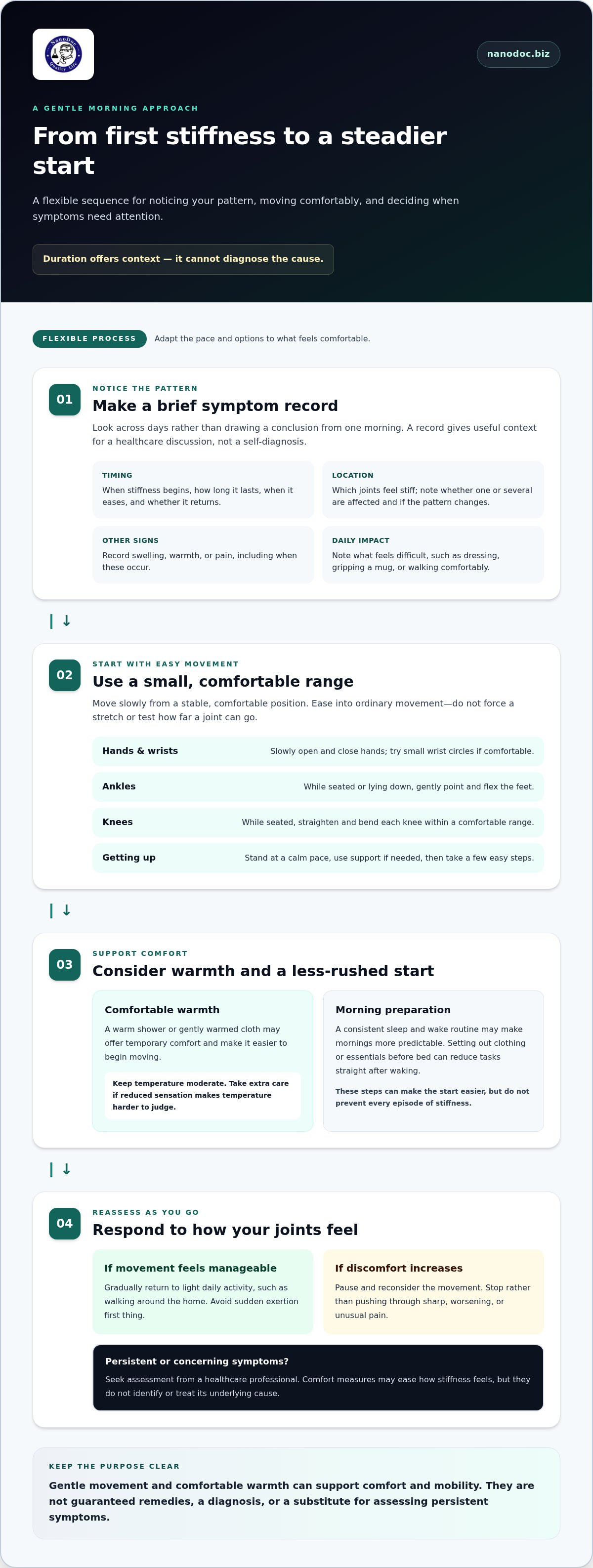
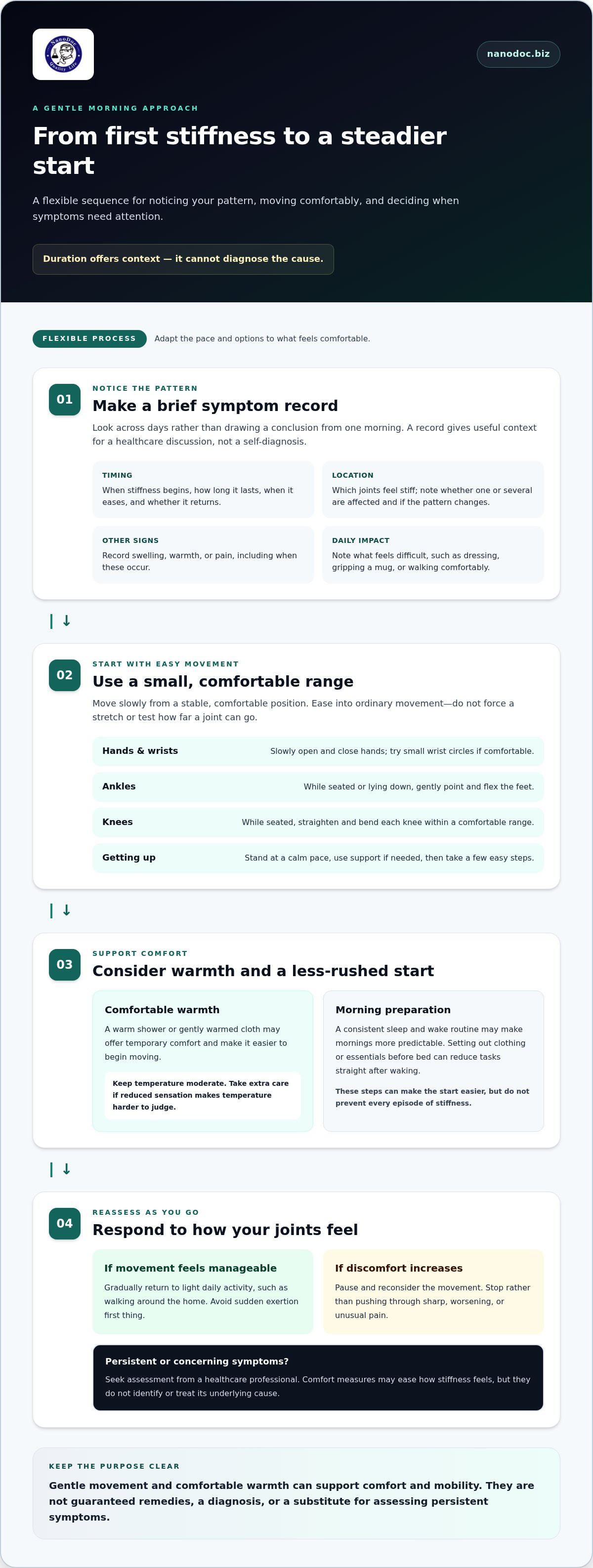
- Timing: Note when stiffness begins, how long it lasts, when it eases and whether it returns later in the day.
- Location: Record which joints feel stiff and whether one or several are affected. Note if the pattern changes between mornings.
- Other signs: Describe any swelling, warmth or pain, including whether these appear alongside stiffness or at another time.
- Daily impact: Write down what feels difficult, such as getting dressed, gripping a mug or walking comfortably after waking.
Look for patterns across days rather than treating a single entry as a conclusion. For example, recurring stiffness in several joints with swelling provides different context from occasional tightness in one joint that eases quickly. Neither pattern gives a diagnosis on its own, but both are more informative than a general impression that your joints “feel stiff.”
Which natural morning strategies may ease stiff joints?
A measured start can make movement feel more manageable, although no routine works the same way for everyone. Gentle range-of-motion movements, gradual activity and comfortable warmth are low-intensity options to try. Treat them as ways to support comfort and mobility, not guaranteed remedies or substitutes for assessing persistent symptoms.
Start gently, use only comfortable warmth, and stop if movement causes sharp or worsening pain.
How can gentle movement fit into the first minutes?
Begin in a stable, comfortable position and move the affected area slowly through a range that feels manageable. The goal is to ease into ordinary movement, not force a stretch or test how far a joint can go. If a movement causes sharp, worsening or unusual pain, stop rather than pushing through it.
- Hands and wrists: Slowly open and close your hands, or make small wrist circles if comfortable.
- Ankles: While seated or lying down, point and flex your feet gently.
- Knees: While seated, straighten and bend each knee within a comfortable range.
- Getting up: Move from sitting to standing at a calm pace, using support if needed, then take a few easy steps.
Choose movements that match the joints involved, and keep the range small at first. As movement feels more comfortable, you can gradually return to light daily activity, such as walking around the home. Avoid sudden exertion or forceful stretching first thing. If discomfort increases rather than settling, pause and reconsider the movement.
When might warmth and better sleep habits help?
Some people find that comfortable warmth makes it easier to begin moving. A warm shower or gently warmed cloth over a stiff area may offer temporary comfort, but it won’t identify or treat the cause. The Arthritis Foundation’s Heat Therapy for Stiff Joints discusses heat as a comfort approach. Keep the temperature moderate, avoid extreme heat, and take extra care if reduced sensation makes it harder to judge temperature.
Preparation can make a rushed morning less demanding. A consistent sleep and wake routine may make mornings more predictable, while setting out clothing or other essentials before bed can reduce tasks straight after waking. These steps don’t prevent every episode of stiffness, but they can give you more room to move at a comfortable pace.
A simple sequence is to notice how your joints feel, try a few slow movements, add comfortable warmth if it suits you, then reassess before increasing activity. The best natural remedies for stiff joints in the morning are practical, tolerable options, not a reason to ignore a changing symptom pattern. Topical pain-relief care can also be considered as an adjunct to these habits. NanoDoc offers pain-relief care, which is distinct from diagnosis or treatment of an underlying condition.
How do natural remedies compare, and what are their limits?
Natural approaches differ in what they may offer. Movement supports mobility, warmth may provide temporary comfort, and topical products or supplements vary by formulation and evidence. The comparison below describes possible roles, not guaranteed benefits. Evidence labels refer to the specific use described, not treatment of every cause of morning stiffness.
| Approach | Possible purpose | Evidence and cautions |
|---|---|---|
| Gentle movement | Ease into ordinary movement and support joint function. | Established as part of arthritis management through regular exercise; a particular morning sequence isn’t guaranteed to relieve stiffness. Adapt activity to comfort. |
| Comfortable warmth | Help some people feel more comfortable and mobile before activity. | Uncertain for treating the cause of morning stiffness. Avoid extreme heat and take care if sensation is reduced. |
| Topical products | Offer a possible local comfort measure. | Uncertain for morning stiffness as a general symptom. Effects depend on the specific formulation and evidence; follow product labelling. |
| Supplements | May be considered for a specific health context or symptom. | Limited and ingredient-specific evidence; benefits and risks vary. Supplements can interact with medicines and may not suit everyone. |
These categories aren’t interchangeable. A movement routine may support function without explaining why a joint feels stiff. Feeling more comfortable after warmth or a topical product doesn’t establish that an underlying condition has improved. Product testing is also different from clinical research: testing nanoparticle size and quality can verify aspects of formulation quality, but it doesn’t demonstrate clinical effectiveness.
What should readers know about supplements and diet?
Evidence depends on the specific supplement, dose and person’s health context. Research findings for one ingredient or condition can’t be applied to all supplements or to morning stiffness generally. Turmeric, vitamins and restrictive diets shouldn’t be presented as proven treatments for stiff joints. Before starting a supplement, speak with a clinician or pharmacist, especially if you take medicines or manage an ongoing health condition.
What can topical products reasonably offer?
A topical product may be one possible comfort option, but its effects depend on its ingredients, formulation, intended use and supporting clinical evidence. Read and follow the label, including directions and warnings, and don’t apply it to skin the label identifies as unsuitable. Delivery technology or a laboratory measurement alone can’t show that a product will ease symptoms or treat their cause.
Use this comparison to set realistic expectations while considering natural remedies for stiff joints in the morning. Choose options that are comfortable and appropriate for you, and don’t let a temporary change in how a joint feels replace attention to persistent or worsening symptoms.
How can you build a safe morning routine and know when to seek help?
A useful routine should be flexible, not a test of how much discomfort you can tolerate. Start with a few low-intensity steps, notice how your joints respond, and adjust rather than pushing through worsening symptoms. If stiffness repeatedly interferes with ordinary tasks, self-care shouldn’t be the only plan: a healthcare professional can assess possible causes and advise on next steps.
What is a simple routine to try after waking?
Allow a little time before moving into a busy morning. Follow this sequence, adapting or skipping any step that feels uncomfortable:
- Notice: Check which joints feel stiff and whether you have pain, swelling or warmth. Note anything unusual before starting.
- Move gently: While still in bed or seated, try a few slow movements within a comfortable range. Avoid forceful stretching.
- Stand gradually: Take time to sit up and stand, using support if needed. Begin with easy steps instead of rushing straight into demanding activity.
- Add comfortable warmth if useful: A comfortably warm shower or other gentle warmth may help you feel ready to move. Avoid extreme heat, especially if you have reduced sensation.
- Reassess: Notice whether movement feels easier, unchanged or more uncomfortable. Stop or modify steps that worsen symptoms, and record what you tried.
The sequence isn’t a treatment plan for every cause of stiffness. It’s a way to approach natural remedies for stiff joints in the morning cautiously and learn which comfort measures fit your day. A short note on what helped, what aggravated symptoms and how stiffness affected daily activities may also make a future appointment more informative.
When should morning stiffness be assessed?
Arrange a clinical assessment if stiffness persists, worsens over time, keeps returning or repeatedly limits activities such as dressing, walking or using your hands. Include changes in the number of joints affected and any accompanying symptoms in your notes. Seek prompt medical advice for a hot, swollen joint, fever, severe sudden pain or sudden inability to move the joint. Don’t wait to see whether a morning routine helps when symptoms are severe or concerning.
Self-care and clinical assessment serve different purposes. A comfort measure may help you manage a morning, but it can’t determine whether an underlying condition needs treatment. NanoDoc’s Pain Relief Care is an adjunct to consider alongside clinical advice, not a substitute for diagnosis or prescribed care.
Where can topical pain-relief care fit into a longer-term plan?
Topical pain-relief care may be considered as one possible adjunct when planning how to manage discomfort, but it shouldn’t replace assessment or treatment of a suspected underlying condition. A product applied to the skin may support comfort for some people; it can’t establish why a joint feels stiff or determine whether further care is needed. Its usefulness also depends on the particular formulation and the evidence available for its intended use.
This distinction matters when weighing natural remedies for stiff joints in the morning. A change in comfort after using a topical product isn’t proof that the cause of stiffness has been treated. Keep track of symptoms separately, and follow clinical advice if stiffness persists, worsens or affects daily activities.
How should a topical product be considered?
Before using any topical product, read its ingredient list, directions and warnings. Check whether it’s suitable for your circumstances and use it only as directed. Don’t apply it to skin the label identifies as unsuitable, and stop if you experience an unexpected reaction. Products with similar descriptions may have different ingredients, instructions or evidence.
- Review the label: Check ingredients, intended use, application instructions and precautions.
- Consider your health context: Ask a clinician or pharmacist for advice if you’re pregnant, take medicines or manage an ongoing condition.
- Keep expectations measured: A topical product may be a comfort measure, but it can’t diagnose or treat every possible cause of stiffness.
These checks help you consider a product as part of a broader plan rather than as a stand-alone answer. If stiffness is concerning, product use shouldn’t delay clinical assessment.
What does NanoDoc’s quality testing establish?
NanoDoc’s formulations use LG Bionano nano-delivery technology and are independently laboratory-tested to verify nanoparticle size and quality. These checks relate to formulation characteristics. They don’t, on their own, establish that a product is clinically effective, demonstrate that it treats morning stiffness or show that it is suitable for every person. Clinical effectiveness requires relevant evidence about the product’s use and outcomes, which is distinct from testing particle size and quality.
That distinction supports a careful evaluation: consider formulation information alongside the product’s instructions, your personal health context and appropriate clinical guidance. Pain-relief care is a category of supportive products, not a replacement for diagnosis or prescribed treatment.
NanoDoc’s Pain Relief Care uses nano-delivery technology, with product-quality testing distinct from evidence of clinical benefit.
Make your next morning a measured step forward
You don’t need to change everything at once. Choose one manageable adjustment, such as allowing more time to get moving, and notice how it fits your routine. A gradual approach can help you make informed choices without treating temporary comfort as proof that an underlying problem has been resolved. If symptoms persist or concern you, make clinical assessment part of your next step.
For those considering topical care, NanoDoc’s Pain Relief Care is one option to consider as a possible adjunct, not a substitute for diagnosis or treatment. The company’s formulations are independently laboratory-tested for nanoparticle size and quality. This describes formulation testing, not proof of clinical effectiveness for morning stiffness.
Explore NanoDoc’s Pain Relief Care as you consider which natural remedies for stiff joints in the morning may fit alongside appropriate clinical guidance. A thoughtful, consistent plan can help you move into the day with greater confidence.
Frequently Asked Questions
Is morning joint stiffness normal?
Brief stiffness can occur, but there isn’t one duration that’s normal for everyone. Pay attention to how often it happens, how long it lasts, how severe it feels and whether other symptoms appear. For example, stiffness that repeatedly makes it hard to grip a toothbrush or climb stairs deserves attention. Arrange an assessment if it persists, recurs, worsens or affects daily function. Only a qualified clinician can evaluate its cause.
Can gentle exercise help stiff joints in the morning?
Slow, comfortable movement may help some people ease into activity, but it isn’t a cure and every intensity may not suit every joint. You might begin seated with small ankle or wrist movements before standing. Stop if pain becomes sharp or worsens rather than forcing a stretch. These natural remedies for stiff joints in the morning are not a substitute for care. Seek clinical advice for ongoing symptoms or new movement limitations.
How long does morning joint stiffness usually last?
Its duration varies by person and possible cause, so there’s no single timeframe that can diagnose a condition. Instead of relying on a general rule, note when stiffness starts, when it eases and whether it returns later. A simple phone note can capture these details across different mornings. Arrange an assessment if stiffness is prolonged, worsening, recurrent or disruptive, particularly if you’re changing activities to avoid discomfort.
What happens if morning stiffness comes with swelling or warmth?
Swelling or warmth can occur with several conditions, so these signs shouldn’t be self-diagnosed. Note which joint is affected and whether the change appeared suddenly, but don’t use a home remedy to rule out an underlying cause. Seek medical advice, especially if the joint becomes suddenly hot and swollen, symptoms are severe, or you also have a fever. Prompt assessment is more appropriate than waiting to see whether the signs settle.
Are natural supplements safe for joint stiffness?
Not necessarily. A supplement’s natural origin doesn’t guarantee safety, and some may interact with medicines or be unsuitable for particular health conditions. Evidence also differs by ingredient and intended use, so a claim about one product shouldn’t be assumed to apply to another. Before starting a specific supplement, discuss it with a clinician or pharmacist, especially if you take regular medicine. Follow the label and don’t exceed its stated directions.
Can heat help stiff joints in the morning?
Comfortably warm applications may provide temporary comfort for some people, but responses vary and warmth doesn’t treat every cause of stiffness. Keep the temperature moderate and avoid applying intense heat, particularly if reduced sensation makes it harder to judge how hot something is. Stop if your skin becomes uncomfortable or irritated. If stiffness continues to concern you or interferes with ordinary tasks, seek advice rather than relying on warmth alone.
Can a topical pain-relief product replace medical care?
No. A topical product may be considered as an adjunct when appropriate, but it can’t identify why stiffness occurs or replace clinical assessment and treatment. Follow the product’s directions and warnings, and don’t apply it in ways the label advises against. Seek professional advice if symptoms persist, worsen or limit daily activities. Severe or concerning signs, such as sudden intense pain or a hot, swollen joint with fever, warrant prompt medical attention.
Frequently Asked Questions
- What can contribute to stiffness after waking?
- During sleep, joints move less than they do during ordinary daytime activity. After a period of relative inactivity, a joint may feel stiff as you begin moving again. This experience varies between people and mornings; inactivity is one possible contributor, not a complete explanation for every case. Arthritis and other conditions may also cause symptoms, so a familiar morning pattern shouldn’t be taken as proof of a particular diagnosis. The same distinction matters when considering natural remedies for stiff joints in the morning. A measure that makes it more comfortable to get moving may help with daily function, but symptom relief doesn’t explain why stiffness is happening. Notice whether the feeling settles, persists or returns later, rather than judging the pattern from one morning alone.
- Which symptom patterns are useful to track?
- A brief record can make changes easier to describe and help you share a clearer history during a healthcare appointment. Keep it simple and factual. Tracking provides context, not a self-diagnosis, and it shouldn’t delay advice if symptoms are persistent or concerning. Look for patterns across days rather than treating a single entry as a conclusion. For example, recurring stiffness in several joints with swelling provides different context from occasional tightness in one joint that eases quickly. Neither pattern gives a diagnosis on its own, but both are more informative than a general impression that your joints “feel stiff.” A measured start can make movement feel more manageable, although no routine works the same way for everyone. Gentle range-of-motion movements, gradual activity and comfortable warmth are low-intensity options to try. Treat them as ways to support comfort and mobility, not guaranteed remedies or substitutes for assessing persistent symptoms. Start gently, use only comfortable warmth, and stop if movement causes sharp or worsening pain.
- How can gentle movement fit into the first minutes?
- Begin in a stable, comfortable position and move the affected area slowly through a range that feels manageable. The goal is to ease into ordinary movement, not force a stretch or test how far a joint can go. If a movement causes sharp, worsening or unusual pain, stop rather than pushing through it. Choose movements that match the joints involved, and keep the range small at first. As movement feels more comfortable, you can gradually return to light daily activity, such as walking around the home. Avoid sudden exertion or forceful stretching first thing. If discomfort increases rather than settling, pause and reconsider the movement.
- When might warmth and better sleep habits help?
- Some people find that comfortable warmth makes it easier to begin moving. A warm shower or gently warmed cloth over a stiff area may offer temporary comfort, but it won’t identify or treat the cause. The Arthritis Foundation’s Heat Therapy for Stiff Joints discusses heat as a comfort approach. Keep the temperature moderate, avoid extreme heat, and take extra care if reduced sensation makes it harder to judge temperature. Preparation can make a rushed morning less demanding. A consistent sleep and wake routine may make mornings more predictable, while setting out clothing or other essentials before bed can reduce tasks straight after waking. These steps don’t prevent every episode of stiffness, but they can give you more room to move at a comfortable pace. A simple sequence is to notice how your joints feel, try a few slow movements, add comfortable warmth if it suits you, then reassess before increasing activity. The best natural remedies for stiff joints in the morning are practical, tolerable options, not a reason to ignore a changing symptom pattern. Topical pain-relief care can also be considered as an adjunct to these habits. NanoDoc offers pain-relief care, which is distinct from diagnosis or treatment of an underlying condition. Natural approaches differ in what they may offer. Movement supports mobility, warmth may provide temporary comfort, and topical products or supplements vary by formulation and evidence. The comparison below describes possible roles, not guaranteed benefits. Evidence labels refer to the specific use described, not treatment of every cause of morning stiffness. These categories aren’t interchangeable. A movement routine may support function without explaining why a joint feels stiff. Feeling more comfortable after warmth or a topical product doesn’t establish that an underlying condition has improved. Product testing is also different from clinical research: testing nanoparticle size and quality can verify aspects of formulation quality, but it doesn’t demonstrate clinical effectiveness.
- What should readers know about supplements and diet?
- Evidence depends on the specific supplement, dose and person’s health context. Research findings for one ingredient or condition can’t be applied to all supplements or to morning stiffness generally. Turmeric, vitamins and restrictive diets shouldn’t be presented as proven treatments for stiff joints. Before starting a supplement, speak with a clinician or pharmacist, especially if you take medicines or manage an ongoing health condition.
- What can topical products reasonably offer?
- A topical product may be one possible comfort option, but its effects depend on its ingredients, formulation, intended use and supporting clinical evidence. Read and follow the label, including directions and warnings, and don’t apply it to skin the label identifies as unsuitable. Delivery technology or a laboratory measurement alone can’t show that a product will ease symptoms or treat their cause. Use this comparison to set realistic expectations while considering natural remedies for stiff joints in the morning. Choose options that are comfortable and appropriate for you, and don’t let a temporary change in how a joint feels replace attention to persistent or worsening symptoms. A useful routine should be flexible, not a test of how much discomfort you can tolerate. Start with a few low-intensity steps, notice how your joints respond, and adjust rather than pushing through worsening symptoms. If stiffness repeatedly interferes with ordinary tasks, self-care shouldn’t be the only plan: a healthcare professional can assess possible causes and advise on next steps.
- What is a simple routine to try after waking?
- Allow a little time before moving into a busy morning. Follow this sequence, adapting or skipping any step that feels uncomfortable: The sequence isn’t a treatment plan for every cause of stiffness. It’s a way to approach natural remedies for stiff joints in the morning cautiously and learn which comfort measures fit your day. A short note on what helped, what aggravated symptoms and how stiffness affected daily activities may also make a future appointment more informative.
- When should morning stiffness be assessed?
- Arrange a clinical assessment if stiffness persists, worsens over time, keeps returning or repeatedly limits activities such as dressing, walking or using your hands. Include changes in the number of joints affected and any accompanying symptoms in your notes. Seek prompt medical advice for a hot, swollen joint, fever, severe sudden pain or sudden inability to move the joint. Don’t wait to see whether a morning routine helps when symptoms are severe or concerning. Self-care and clinical assessment serve different purposes. A comfort measure may help you manage a morning, but it can’t determine whether an underlying condition needs treatment. NanoDoc’s Pain Relief Care is an adjunct to consider alongside clinical advice, not a substitute for diagnosis or prescribed care. Topical pain-relief care may be considered as one possible adjunct when planning how to manage discomfort, but it shouldn’t replace assessment or treatment of a suspected underlying condition. A product applied to the skin may support comfort for some people; it can’t establish why a joint feels stiff or determine whether further care is needed. Its usefulness also depends on the particular formulation and the evidence available for its intended use. This distinction matters when weighing natural remedies for stiff joints in the morning. A change in comfort after using a topical product isn’t proof that the cause of stiffness has been treated. Keep track of symptoms separately, and follow clinical advice if stiffness persists, worsens or affects daily activities.
- How should a topical product be considered?
- Before using any topical product, read its ingredient list, directions and warnings. Check whether it’s suitable for your circumstances and use it only as directed. Don’t apply it to skin the label identifies as unsuitable, and stop if you experience an unexpected reaction. Products with similar descriptions may have different ingredients, instructions or evidence. These checks help you consider a product as part of a broader plan rather than as a stand-alone answer. If stiffness is concerning, product use shouldn’t delay clinical assessment.
- What does NanoDoc’s quality testing establish?
- NanoDoc’s formulations use LG Bionano nano-delivery technology and are independently laboratory-tested to verify nanoparticle size and quality. These checks relate to formulation characteristics. They don’t, on their own, establish that a product is clinically effective, demonstrate that it treats morning stiffness or show that it is suitable for every person. Clinical effectiveness requires relevant evidence about the product’s use and outcomes, which is distinct from testing particle size and quality. That distinction supports a careful evaluation: consider formulation information alongside the product’s instructions, your personal health context and appropriate clinical guidance. Pain-relief care is a category of supportive products, not a replacement for diagnosis or prescribed treatment. NanoDoc’s Pain Relief Care uses nano-delivery technology, with product-quality testing distinct from evidence of clinical benefit. You don’t need to change everything at once. Choose one manageable adjustment, such as allowing more time to get moving, and notice how it fits your routine. A gradual approach can help you make informed choices without treating temporary comfort as proof that an underlying problem has been resolved. If symptoms persist or concern you, make clinical assessment part of your next step. For those considering topical care, NanoDoc’s Pain Relief Care is one option to consider as a possible adjunct, not a substitute for diagnosis or treatment. The company’s formulations are independently laboratory-tested for nanoparticle size and quality. This describes formulation testing, not proof of clinical effectiveness for morning stiffness. Explore NanoDoc’s Pain Relief Care as you consider which natural remedies for stiff joints in the morning may fit alongside appropriate clinical guidance. A thoughtful, consistent plan can help you move into the day with greater confidence.
- Is morning joint stiffness normal?
- Brief stiffness can occur, but there isn’t one duration that’s normal for everyone. Pay attention to how often it happens, how long it lasts, how severe it feels and whether other symptoms appear. For example, stiffness that repeatedly makes it hard to grip a toothbrush or climb stairs deserves attention. Arrange an assessment if it persists, recurs, worsens or affects daily function. Only a qualified clinician can evaluate its cause.
- Can gentle exercise help stiff joints in the morning?
- Slow, comfortable movement may help some people ease into activity, but it isn’t a cure and every intensity may not suit every joint. You might begin seated with small ankle or wrist movements before standing. Stop if pain becomes sharp or worsens rather than forcing a stretch. These natural remedies for stiff joints in the morning are not a substitute for care. Seek clinical advice for ongoing symptoms or new movement limitations.
- How long does morning joint stiffness usually last?
- Its duration varies by person and possible cause, so there’s no single timeframe that can diagnose a condition. Instead of relying on a general rule, note when stiffness starts, when it eases and whether it returns later. A simple phone note can capture these details across different mornings. Arrange an assessment if stiffness is prolonged, worsening, recurrent or disruptive, particularly if you’re changing activities to avoid discomfort.
- What happens if morning stiffness comes with swelling or warmth?
- Swelling or warmth can occur with several conditions, so these signs shouldn’t be self-diagnosed. Note which joint is affected and whether the change appeared suddenly, but don’t use a home remedy to rule out an underlying cause. Seek medical advice, especially if the joint becomes suddenly hot and swollen, symptoms are severe, or you also have a fever. Prompt assessment is more appropriate than waiting to see whether the signs settle.
- Are natural supplements safe for joint stiffness?
- Not necessarily. A supplement’s natural origin doesn’t guarantee safety, and some may interact with medicines or be unsuitable for particular health conditions. Evidence also differs by ingredient and intended use, so a claim about one product shouldn’t be assumed to apply to another. Before starting a specific supplement, discuss it with a clinician or pharmacist, especially if you take regular medicine. Follow the label and don’t exceed its stated directions.
- Can heat help stiff joints in the morning?
- Comfortably warm applications may provide temporary comfort for some people, but responses vary and warmth doesn’t treat every cause of stiffness. Keep the temperature moderate and avoid applying intense heat, particularly if reduced sensation makes it harder to judge how hot something is. Stop if your skin becomes uncomfortable or irritated. If stiffness continues to concern you or interferes with ordinary tasks, seek advice rather than relying on warmth alone.
- Can a topical pain-relief product replace medical care?
- No. A topical product may be considered as an adjunct when appropriate, but it can’t identify why stiffness occurs or replace clinical assessment and treatment. Follow the product’s directions and warnings, and don’t apply it in ways the label advises against. Seek professional advice if symptoms persist, worsen or limit daily activities. Severe or concerning signs, such as sudden intense pain or a hot, swollen joint with fever, warrant prompt medical attention.