
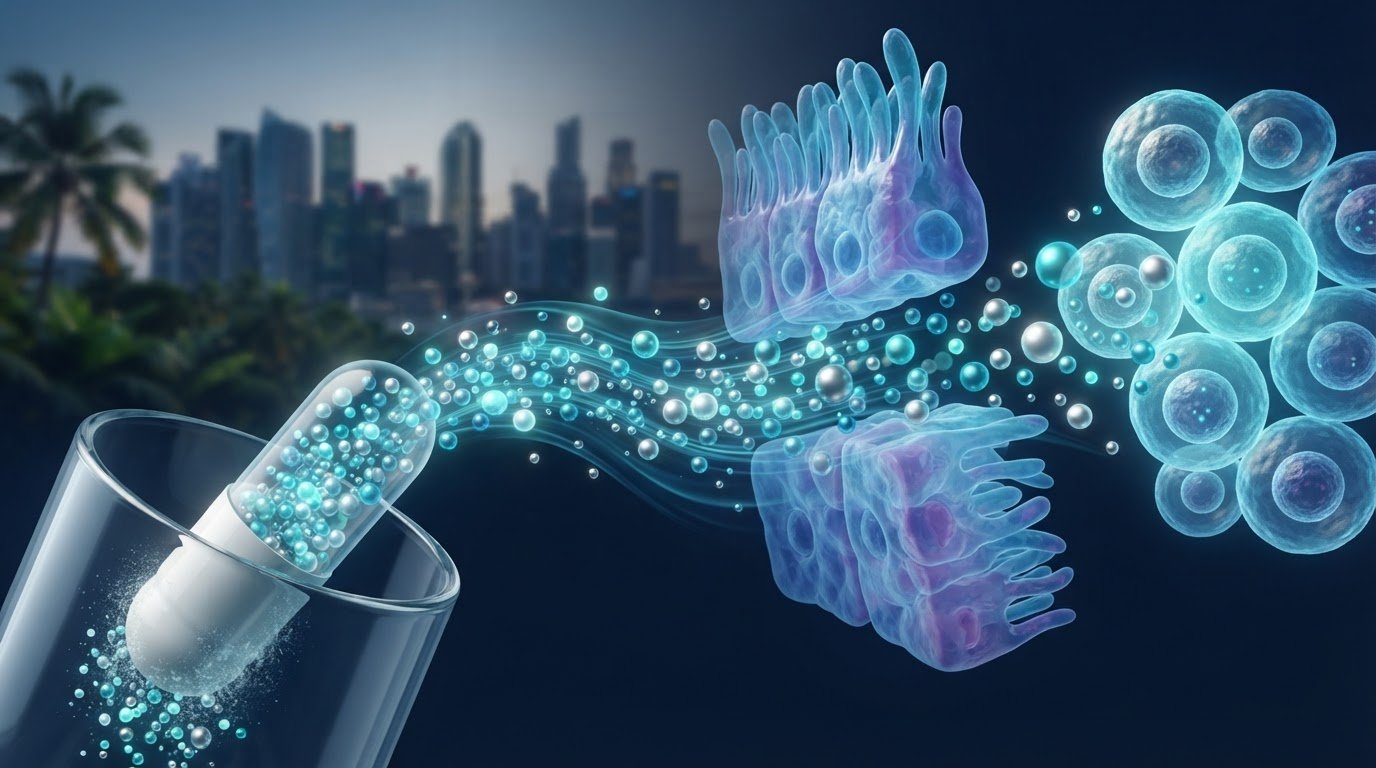
What does “nano” on a supplement label actually tell you? Nanoparticle size in supplements can influence how an ingredient disperses and behaves in the digestive system, but smaller particles do not automatically reach cells or guarantee better absorption. If you have spent money on products that did not deliver, it helps to distinguish a measured delivery technology from a marketing claim.
Particle size can affect bioavailability, but it is only one part of the picture. The ingredient, its formulation, and how the body processes it also shape what becomes available for use. This article explains how particle dimensions relate to nutrient delivery, what “nano” and “liposomal” can mean, and which details to look for when assessing the evidence behind a product.
You will also learn why independent particle-size testing can help you assess “nano” claims. NanoDoc’s Nano Cellular Essential Nutrition formulations are independently laboratory-tested for particle size and quality before reaching consumers. Understanding what that testing does, and does not, establish can help you evaluate supplement claims with greater clarity.
Key Takeaways
- Learn what nanoparticle size in supplements can indicate about nutrient delivery, and why particle size alone does not guarantee absorption.
- Understand how digestion and the gut-blood barrier influence whether nutrients become available to the body.
- Compare nano-encapsulation with standard formulations, including how encapsulation may help protect sensitive ingredients.
- Discover how particle-size distribution reports and independent laboratory testing can help you assess “nano” claims.
- Explore how NanoDoc’s independently tested formulations and LG Bionano’s patented delivery technology inform a more evidence-based supplement choice.
Table of Contents
- What Is Nanoparticle Size in Modern Nutraceuticals?
- The Biological Gateway: Why Particle Scale Matters for Absorption
- Nano-Encapsulation vs. Standard Supplements: A Comparative Analysis
- Verification Standards: How to Identify Genuine Nano-Technology
- LG Bionano Technology: Precision Engineering for Cellular Health
What Is Nanoparticle Size in Supplements and Modern Nutraceuticals?
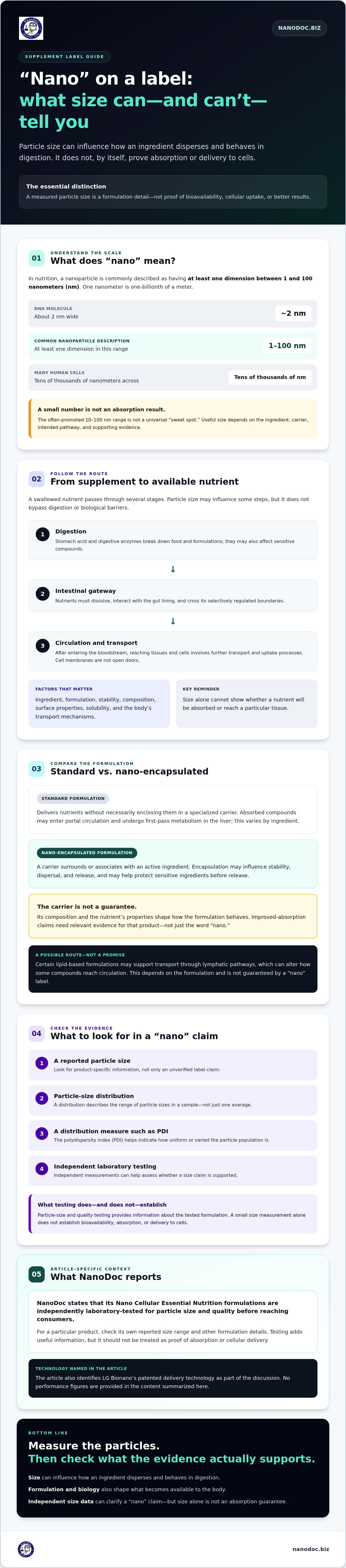
In nutrition, a nanoparticle is a very small particle, commonly described as having at least one dimension between 1 and 100 nanometers (nm). A nanometer is one-billionth of a meter. For scale, many human cells are tens of thousands of nanometers across, while a DNA molecule is about 2 nm wide. A particle between 10 and 100 nm is therefore much smaller than a cell, but its size alone does not show whether a nutrient will be absorbed or reach a particular tissue.
Particle size in supplements matters because it can affect how an ingredient disperses, interacts with its carrier, and behaves in the digestive tract. There is no universal “smaller is better” rule. Absorption also depends on the nutrient, formulation, stability, and biological barriers. Research on nanoparticle drug delivery systems offers background on how particle design can support protection and controlled release, although supplement outcomes require evidence specific to the formulation.
The Difference Between Nano-Encapsulation and Standard Particles
Standard formulations deliver nutrients without necessarily enclosing them in a specialized carrier. After digestion and absorption, some compounds enter the portal circulation and may undergo first-pass metabolism in the liver. This process varies by ingredient, and it does not mean all standard particles are simply “processed by the liver.” In nano-encapsulated formulations, a carrier surrounds or associates with an active ingredient, potentially influencing its stability, dispersal, and release.
Nano-encapsulation can act as a protective layer around an active nutrient, helping limit exposure to conditions that may degrade it before release.
The carrier is part of the formulation, not a guarantee of cellular delivery. Its composition and the nutrient’s properties help determine how the encapsulated material behaves. Claims about improved absorption should therefore be supported by relevant product evidence, rather than inferred from the word “nano.”
Common Measurement Units: Understanding Nanometers (nm)
A nanometer is far below what a standard ruler or the naked eye can resolve, so particle size must be measured using suitable laboratory methods. The often-promoted range of 10 to 100 nm is not a universal “sweet spot” for biological absorption. A useful size depends on the ingredient, carrier, intended delivery pathway, and supporting evidence. A small measurement by itself cannot establish bioavailability.
Particle-size distribution describes the range of sizes present in a sample, rather than just one average. A distribution measure such as the polydispersity index (PDI) helps indicate how uniform or varied that population is. For consumers, a reported size and distribution backed by independent testing are more informative than an unverified “nano” label. NanoDoc states that its formulations are independently laboratory-tested for particle size and quality before reaching consumers. Check product-specific information for the exact size range and other details of a formulation.
The Biological Gateway: Why Particle Scale Matters for Absorption
A swallowed nutrient has to pass through several stages before it can become available to the body. Stomach acid and digestive enzymes help break down food and supplement formulations, but they may also affect sensitive compounds. The intestine then acts as a selective gateway: nutrients must dissolve, interact with the gut lining, and cross into circulation. Particle size can influence these steps, but it does not let particles skip digestion or pass freely through biological barriers.
The gut lining is made of cells joined by tightly regulated boundaries. Once nutrients enter the bloodstream, reaching tissues and cells involves further transport and uptake processes. Cell membranes are lipid bilayers, not open doors, so a particle’s size alone does not determine whether it can cross. Composition, surface properties, solubility, and the body’s transport mechanisms all matter.
Bypassing First-Pass Metabolism
Some absorbed nutrients travel from the intestine through the portal vein to the liver, where they may be metabolized before reaching the wider circulation. This first-pass process varies by nutrient and formulation. It is not simply a filter that removes larger molecules. Certain lipid-based formulations may support transport through lymphatic pathways, which can alter how some compounds reach circulation. That route depends on the formulation and is not guaranteed by a “nano” label.
When assessing a nutrient marketed for high bioavailability, ask whether the delivery system has relevant evidence for that specific ingredient. Improved availability may support nutrient delivery, but it does not by itself establish a particular health result or cellular effect.
Surface Area and Solubility: The Physics of Nano
Reducing a particle’s diameter increases the total surface area exposed when the same amount of material is divided into smaller particles. This relationship can help a compound dissolve or disperse more readily, depending on its properties and the surrounding formulation. Greater surface area may support faster dissolution, but it does not guarantee faster absorption or a higher amount reaching the bloodstream.
Nano-emulsions disperse tiny droplets of oil through a water-based mixture. This approach can be relevant for fat-soluble nutrients such as vitamins D3 and K2, which need to be incorporated into a suitable lipid environment for digestion and absorption. The specific result depends on the formulation and should be supported by testing, rather than assumed from particle scale alone.
For that reason, consider nanoparticle size in supplements alongside the formulation and evidence of performance. NanoDoc states that its formulations are independently laboratory-tested for particle size and quality before reaching consumers. To learn more about its approach to nano-delivery, visit NanoDoc’s nutrition information.
Nano-Encapsulation vs. Standard Supplements: A Comparative Analysis
Supplement forms differ in how they protect and disperse an active ingredient, but no delivery format guarantees a particular absorption result. A standard tablet may rely on digestion to release its ingredients. An encapsulated formulation adds a carrier that can help protect or disperse a nutrient, depending on the carrier’s composition and the ingredient being delivered.
Protection matters for compounds that can be affected by oxygen, light, moisture, or digestive conditions. Encapsulation may reduce exposure to some of these factors, but the effect depends on the formulation and packaging. When comparing products, look for evidence about stability under relevant storage conditions, not just a claim that a nutrient is “protected.”
Absorption speed and bioavailability are also distinct measures. Time-to-bloodstream results require testing for the specific nutrient and formulation; there is no single timeline that applies to all nano-supplements. Bioavailability describes the fraction of an ingested nutrient that becomes available for use, while delivery to a particular target site is a further claim requiring specific evidence. Most nutrients distribute systemically, so “precision delivery” should not be assumed from particle size alone.
Nano-Delivery vs. Liposomal: How to Compare Them
Nano-delivery and liposomal are not always separate categories. Liposomes are one type of carrier used in delivery systems, and their properties vary with composition and manufacturing. Nano-encapsulation is a broader approach. It is not accurate to say that every nano-encapsulated system is more structurally stable than every liposome. Compare formulation-specific evidence, including stability testing and performance over the stated shelf life. NanoDoc represents LG Bionano’s patented nano-delivery technology and states that its formulations are independently tested for particle size and quality before reaching consumers.
Assessing Value Beyond Claims About Inefficiency
The phrase “expensive urine” oversimplifies nutrient metabolism. Some nutrients are excreted, but that alone does not prove a supplement was poorly absorbed or wasted. The body’s needs, dose, and nutrient type all influence what happens after intake. Likewise, a higher dose does not necessarily produce a better outcome, and a nano formulation does not automatically justify a lower dose.
For a practical comparison, assess the declared amount of active nutrient, relevant absorption or stability evidence, and testing that supports delivery claims. Particle size in supplements is one part of that assessment, not a standalone measure of value. Review NanoDoc’s nutrition information to learn about its nano-delivery approach.
Verification Standards: How to Identify Genuine Nano-Technology
A “nano” label is not evidence of a measured particle size. To assess nanoparticle size in supplements, look for product-specific laboratory results that identify the measurement method, sample tested, reported size, and particle-size distribution. Independent testing can provide useful verification, but a result applies only to the tested sample and conditions. It does not by itself prove absorption, safety, or clinical benefit.
Be cautious of claims that provide no measurement details, rely only on “nano” in a product name, or promise cellular delivery without explaining how that outcome was tested. A useful report should make it possible to understand what was measured and how consistent the particle population is, rather than presenting a single number without context.
What to Look for on a Laboratory Report
For measurements made by dynamic light scattering (DLS), the Z-average is a method-specific average particle diameter that reflects hydrodynamic size in the sample. The polydispersity index (PDI) indicates the breadth of the measured size distribution. A lower value generally suggests a more uniform sample, but interpretation depends on the method and material. Check whether the report names the technique, gives the Z-average and PDI, and identifies the sample.
A 50 nm average is useful only when read alongside the range and distribution. For example, a reported range of 40 to 60 nm would provide context that the average alone cannot. This example is illustrative, not a verified specification for any product. A narrow distribution can support manufacturing consistency, but it does not independently establish safety or efficacy.
ISO 19749:2021 covers particle-size and shape distribution measurement using scanning electron microscopy. It is one standard for characterizing nanomaterials, not a universal certification for supplement quality or biological performance. Measurement methods capture different characteristics, so a report should identify the method used rather than treating results from different techniques as interchangeable.
The Importance of Intellectual Property and Patents
A patent describes protected intellectual property, not independent proof that a formulation is safer or more effective. A defined, patented process may help a manufacturer specify how a delivery system is produced, while repeatable controls and testing are needed to verify that batches meet those specifications. Manufacturing precision matters because meaningful variation can affect product characteristics, but particle-size data alone cannot establish biological safety.
There is no single global “nano-safe” mark that guarantees a supplement’s performance. Distinguish patents, laboratory measurements, and regulatory or quality assessments: each answers a different question. NanoDoc represents LG Bionano’s patented nano-delivery technology and states that its formulations are independently tested for particle size and quality before reaching consumers.
To review NanoDoc’s nano-delivery approach and available verification information, visit NanoDoc’s nano-nutrition information.
LG Bionano Technology: Precision Engineering for Cellular Health
Precision delivery starts with a defined formulation and evidence about its properties. NanoDoc International is the representative of LG Bionano’s patented nano-delivery technology. The company develops and markets nutraceutical formulations that use nano-encapsulation to support nutrient absorption. This approach informs NanoDoc’s Nano Cellular Essential Nutrition offering, where particle-size verification provides a measurable specification rather than relying on the word “nano” alone.
That distinction matters. Particle size can influence how a formulation behaves, but it does not prove that a nutrient reaches a particular cell or produces a specific health outcome. Exact size ranges vary by formulation and should be confirmed through product-specific information, not assumed across an entire range.
A Laboratory-Tested Approach
Testing provides a way to check a formulation’s measurable characteristics, including particle size and quality. It should not be confused with evidence of clinical benefit or a guarantee that every batch is identical. When reviewing information, look for results tied to the relevant formulation and details about the measurement. NanoDoc also offers anti-ageing skin care and oral and immunity care, but those categories should not automatically be assumed to use the same nano-delivery technology. For background on topical approaches, explore anti-ageing dermal technology.
More broadly, patented technology can describe a protected delivery process, while independent testing helps verify measurable product characteristics. Neither alone establishes a health outcome. A careful assessment considers the technology, formulation-specific testing, ingredient information, and evidence relevant to the intended use.
Choosing and Using a Supplement Thoughtfully
Use supplements according to their product directions and consider how they fit with your existing routine. There is no universal timeline for noticing benefits from a high-bioavailability formulation: outcomes depend on the nutrient, individual needs, and other factors. Improved delivery is not an immediate or guaranteed effect, so avoid relying on promised timeframes unsupported by product-specific evidence.
Understanding nanoparticle size in supplements helps clarify what a delivery claim can tell you and what still needs verification. For details on NanoDoc’s offerings and nano-delivery approach, explore NanoDoc’s nutrition range.
Choose Supplement Delivery With Greater Clarity
Particle size can influence how a nutrient is formulated and delivered, but it cannot guarantee absorption or cellular reach on its own. A useful assessment considers the full formulation, relevant evidence, and independent verification rather than relying on “nano” as a label. Particle-size results are most informative when they are specific to the product and interpreted in the context of how they were measured.
NanoDoc represents LG Bionano’s patented nano-delivery technology, and its formulations are independently laboratory-tested for particle size and quality before reaching consumers. These details offer a more concrete basis for evaluating delivery claims, while remaining distinct from proof of a particular health outcome. Understanding nanoparticle size in supplements can help you ask better questions and make more informed choices about nutrient delivery.
Frequently Asked Questions
What is the ideal nanoparticle size for supplement absorption?
There is no single ideal size for every supplement. The effect of nanoparticle size in supplements depends on the nutrient, carrier, formulation, and how the body processes them. A size measurement can help describe a formulation, but it does not prove absorption or cellular delivery. Look for product-specific laboratory results that report both the measured size and its distribution, alongside evidence relevant to the ingredient and claimed benefit.
Are nanoparticles in supplements safe to consume daily?
Daily safety cannot be determined from particle size alone. It depends on the ingredient, carrier materials, amount consumed, product quality, and available safety evidence for that formulation. Independent testing of particle size is useful, but it does not establish overall safety or suitability for every person. Follow the product directions, and ask a qualified healthcare professional about regular use if you have a health condition, take medication, or are unsure whether the ingredients are appropriate for you.
How do I know if a supplement actually uses nano-technology?
Look for product-specific laboratory information, not just “nano” on the label or in marketing copy. Useful details include the measurement method, reported particle size, size distribution, and sample tested. Independent testing can verify those measured characteristics, though it does not by itself prove improved absorption or clinical results. If a brand provides no supporting details, treat the nano claim as unverified and seek clearer documentation before relying on it.
Can nano-encapsulation prevent stomach upset from vitamins?
Nano-encapsulation may protect some ingredients from environmental or digestive conditions, but it cannot be assumed to prevent stomach upset. Discomfort may depend on the nutrient, amount, other ingredients, and individual response. A delivery system that changes how an ingredient disperses or releases does not guarantee better tolerance. Check the product directions and ingredient list, and stop use and seek appropriate medical advice if symptoms are persistent or concerning.
Is there a difference between nano-emulsion and nano-encapsulation?
Yes. A nano-emulsion disperses very small droplets of one liquid within another, often oil in water. Nano-encapsulation is a broader approach in which a carrier encloses or associates with an active ingredient to influence its protection, dispersion, or release. The terms are not interchangeable, although a formulation may use encapsulation and an emulsion structure together. To understand a product’s delivery system, look for an explanation of its formulation rather than relying on terminology alone.
Why are nano-supplements more expensive than standard ones?
Some nano-formulations may involve additional formulation, manufacturing, or testing steps, which can contribute to product costs. However, the term “nano” alone does not explain a price or establish better value. Compare the active ingredient and amount, delivery-system details, product-specific testing, and evidence supporting the stated claims. Do not assume that a higher price, smaller particle size, or higher absorption claim means a supplement will provide a better result.
Do nano-nutrients bypass the liver entirely?
No. Nano-nutrients do not automatically bypass the liver. After intestinal absorption, some nutrients travel to the liver through the portal circulation and may undergo first-pass metabolism. Certain lipid-based formulations may support lymphatic transport for some compounds, but this depends on the specific formulation and nutrient. Particle size alone cannot establish the route of absorption or show that a nutrient avoids liver processing altogether.
Can nano-technology be used for topical skincare as well as supplements?
Yes. Nano-based delivery approaches can be developed for topical formulations as well as orally consumed products, but the formulation and intended delivery pathway differ. Evidence for a supplement should not be treated as proof of skincare performance, or vice versa. NanoDoc offers anti-ageing skin care and represents LG Bionano’s patented nano-delivery technology. Check product-specific information to understand which technology and evidence apply to each offering.
Explore NanoDoc’s nutrition range and learn about its nano-delivery approach.
Frequently Asked Questions
- What is the ideal nanoparticle size for supplement absorption?
- There is no single ideal size for every supplement. The effect of nanoparticle size in supplements depends on the nutrient, carrier, formulation, and how the body processes them. A size measurement can help describe a formulation, but it does not prove absorption or cellular delivery. Look for product-specific laboratory results that report both the measured size and its distribution, alongside evidence relevant to the ingredient and claimed benefit.
- Are nanoparticles in supplements safe to consume daily?
- Daily safety cannot be determined from particle size alone. It depends on the ingredient, carrier materials, amount consumed, product quality, and available safety evidence for that formulation. Independent testing of particle size is useful, but it does not establish overall safety or suitability for every person. Follow the product directions, and ask a qualified healthcare professional about regular use if you have a health condition, take medication, or are unsure whether the ingredients are appropriate for you.
- How do I know if a supplement actually uses nano-technology?
- Look for product-specific laboratory information, not just “nano” on the label or in marketing copy. Useful details include the measurement method, reported particle size, size distribution, and sample tested. Independent testing can verify those measured characteristics, though it does not by itself prove improved absorption or clinical results. If a brand provides no supporting details, treat the nano claim as unverified and seek clearer documentation before relying on it.
- Can nano-encapsulation prevent stomach upset from vitamins?
- Nano-encapsulation may protect some ingredients from environmental or digestive conditions, but it cannot be assumed to prevent stomach upset. Discomfort may depend on the nutrient, amount, other ingredients, and individual response. A delivery system that changes how an ingredient disperses or releases does not guarantee better tolerance. Check the product directions and ingredient list, and stop use and seek appropriate medical advice if symptoms are persistent or concerning.
- Is there a difference between nano-emulsion and nano-encapsulation?
- Yes. A nano-emulsion disperses very small droplets of one liquid within another, often oil in water. Nano-encapsulation is a broader approach in which a carrier encloses or associates with an active ingredient to influence its protection, dispersion, or release. The terms are not interchangeable, although a formulation may use encapsulation and an emulsion structure together. To understand a product’s delivery system, look for an explanation of its formulation rather than relying on terminology alone.
- Why are nano-supplements more expensive than standard ones?
- Some nano-formulations may involve additional formulation, manufacturing, or testing steps, which can contribute to product costs. However, the term “nano” alone does not explain a price or establish better value. Compare the active ingredient and amount, delivery-system details, product-specific testing, and evidence supporting the stated claims. Do not assume that a higher price, smaller particle size, or higher absorption claim means a supplement will provide a better result.
- Do nano-nutrients bypass the liver entirely?
- No. Nano-nutrients do not automatically bypass the liver. After intestinal absorption, some nutrients travel to the liver through the portal circulation and may undergo first-pass metabolism. Certain lipid-based formulations may support lymphatic transport for some compounds, but this depends on the specific formulation and nutrient. Particle size alone cannot establish the route of absorption or show that a nutrient avoids liver processing altogether.
- Can nano-technology be used for topical skincare as well as supplements?
- Yes. Nano-based delivery approaches can be developed for topical formulations as well as orally consumed products, but the formulation and intended delivery pathway differ. Evidence for a supplement should not be treated as proof of skincare performance, or vice versa. NanoDoc offers anti-ageing skin care and represents LG Bionano’s patented nano-delivery technology. Check product-specific information to understand which technology and evidence apply to each offering. Explore NanoDoc’s nutrition range and learn about its nano-delivery approach.