
Nano-Encapsulated Iron vs. Traditional Iron Supplements: What the Delivery Technology Changes
3 September 2026
Why Traditional Iron Supplements Fall Short
Iron deficiency is one of the most common nutritional gaps worldwide, yet the standard fix — an oral iron tablet — has a reputation problem. Conventional supplements typically use inorganic iron salts such as ferrous sulfate or ferrous fumarate. These forms are cheap to produce, but the body absorbs only a small fraction of what's swallowed.
Most of the unabsorbed iron passes through the gut, where it commonly causes:
- Constipation and bloating
- Nausea and stomach cramps
- A metallic aftertaste
- Tooth or gum staining, especially with liquid formulations
These side effects are a major reason people stop taking iron supplements before their levels actually recover.
What Nano-Encapsulation Actually Does
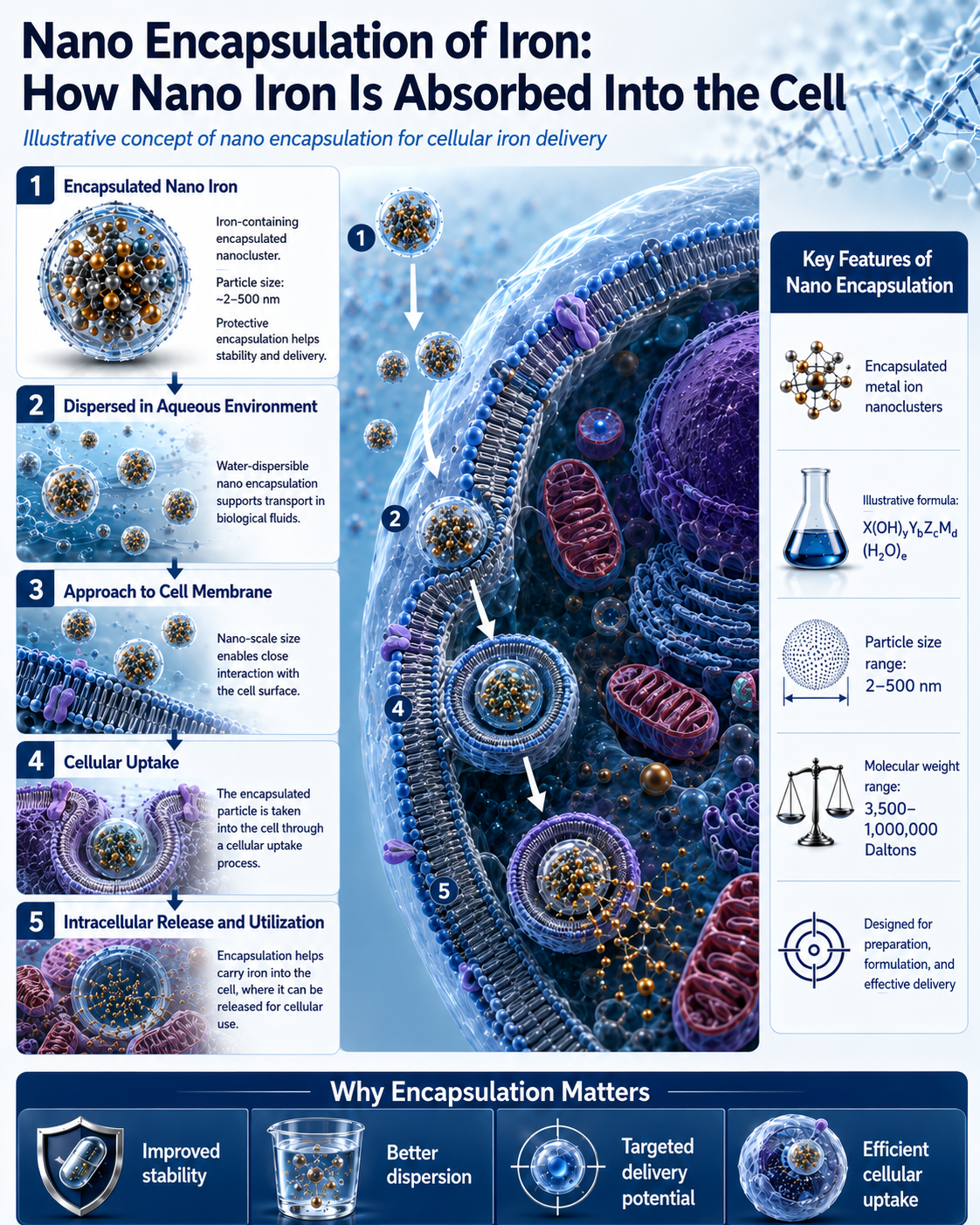
Nano-encapsulation wraps the active iron compound inside a nanoscale carrier — typically a lipid or biopolymer shell just tens to a few hundred nanometres across. Instead of releasing free iron ions into the stomach immediately, the carrier:
- Shields the payload from stomach acid and digestive enzymes that would otherwise degrade or destabilise it
- Improves solubility, since many iron compounds are poorly soluble in their raw form
- Controls release so iron reaches the small intestine — where absorption actually happens — in a more usable form
- Reduces exposure of free iron to the stomach lining and taste receptors, which is why nano-encapsulated liquids are noticeably easier to tolerate
This is the same principle behind nano-delivery systems used across the supplement and pharmaceutical industry: the goal isn't to change what the active ingredient is, but to change how — and where — the body gets to use it.
Nano Iron vs. Traditional Iron, Side by Side
| Traditional Iron Salts | Nano-Encapsulated Iron | |
|---|---|---|
| Absorption | Low — much of the dose is unabsorbed | Enhanced via protected, controlled release |
| Digestive comfort | Common: constipation, nausea, cramping | Reduced free-iron irritation |
| Taste | Strong metallic taste | Largely masked by the carrier |
| Format | Usually tablets or capsules | Well suited to oral liquids |
How NanoDoc Applies This: Rich Iron Vitamin Liquid Candy
NanoDoc's Rich Iron Vitamin Liquid Candy is an internationally patented, nano-encapsulated iron essence oral liquid, built on the same delivery principle described above. Rather than relying on a raw iron salt, the iron essence is nano-encapsulated to help the body's blood transport oxygen to cells more efficiently, support energy metabolism, and contribute to immune function — while being formulated as an easy-to-take liquid rather than a hard-to-swallow tablet.
For anyone who has tried — and given up on — a standard iron tablet because of stomach discomfort, the delivery mechanism is often the real barrier, not the iron itself.
The Takeaway
Nano-encapsulation doesn't change what iron is — it changes whether your body actually gets to use it, and how comfortable that process is along the way. If you're evaluating an iron supplement, the delivery technology behind it matters just as much as the dose on the label.
This article is for general educational purposes and does not constitute medical advice. Individual results vary — consult a healthcare professional before starting any new supplement, particularly if you are pregnant, nursing, have a medical condition, or take other medication.
Frequently Asked Questions
- Is nano-encapsulated iron the same iron as in regular supplements?
- Yes — nano-encapsulation doesn't change the underlying iron compound. It changes how that iron is protected and released in the body, which is what affects absorption and tolerability.
- Why do traditional iron tablets cause stomach upset?
- Standard iron salts release free iron ions directly in the stomach and gut, which commonly leads to constipation, nausea and cramping in a large share of users.
- Is nano-encapsulated iron suitable for everyone?
- As with any iron supplement, suitability depends on individual health status. Consult a healthcare professional before starting, especially if pregnant, nursing, or managing an existing condition.