

Most of the high-performance active ingredients in your current regimen are likely resting on the surface of your skin, physically unable to bypass the stratum corneum. This structural limitation is why nano-delivery technology in skincare has shifted from a niche laboratory concept to the primary benchmark for dermal efficacy in 2026. It's understandable if you feel skeptical. You've likely invested in expensive serums that yielded minimal results or felt concerned by contradictory safety reports regarding nanoparticles. Distinguishing between genuine biotech and "nano-washing" marketing has become increasingly difficult for even the most informed consumers.
We're here to provide the clinical clarity you need to navigate this complex field with confidence. You'll learn the technical reality behind how nano-emulsions function and how to identify high-quality formulations through independent laboratory verification. We'll dismantle the five most persistent myths currently circulating in the industry, moving past the hype to focus on the structural evolution of dermal repair. By understanding the mechanism of absorption, you can ensure your skin health is supported by verified science rather than mere lifestyle trends.
Key Takeaways
- Understand why most topical ingredients fail to penetrate the stratum corneum and how nano-delivery technology in skincare provides a structural solution for deeper absorption.
- Distinguish between insoluble industrial particles and the biodegradable, organic nano-carriers used in professional cosmeceuticals to ensure safety and biological compatibility.
- Learn to identify authentic biotech by prioritizing independent laboratory verification of particle size over unverified marketing "nano-washing."
- Discover the 2026 regulatory landscape and why patented delivery systems are required to maintain active ingredient integrity and prevent surface evaporation.
- Recognize the synergy between topical dermal repair and internal nano-cellular nutrition for a comprehensive, science-backed approach to anti-ageing.
Table of Contents
Myth 1: 'Nano-Delivery' is Just a Skincare Marketing Buzzword
The beauty industry frequently adopts technical terminology to justify premium pricing, which has led to a justified skepticism among modern consumers. It's easy to assume that nano-delivery technology in skincare is simply the latest iteration of "nano-washing" marketing. However, this technology isn't a mere label or a standalone active ingredient like Vitamin C. It represents a fundamental shift in the architecture of topical formulations. Think of it as the difference between a person walking through a storm versus being transported in a sealed, high-speed vehicle. One is exposed and inefficient; the other is protected and targeted.
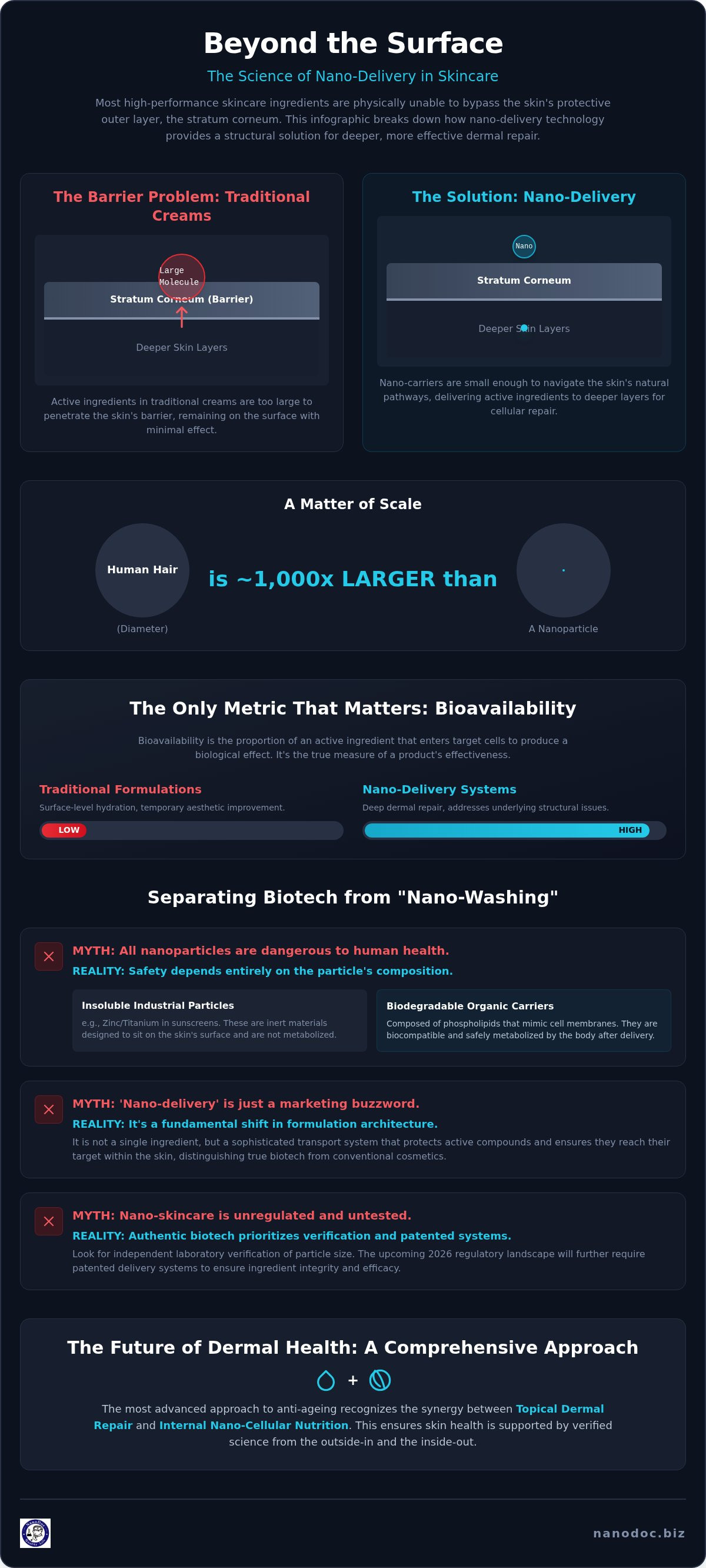
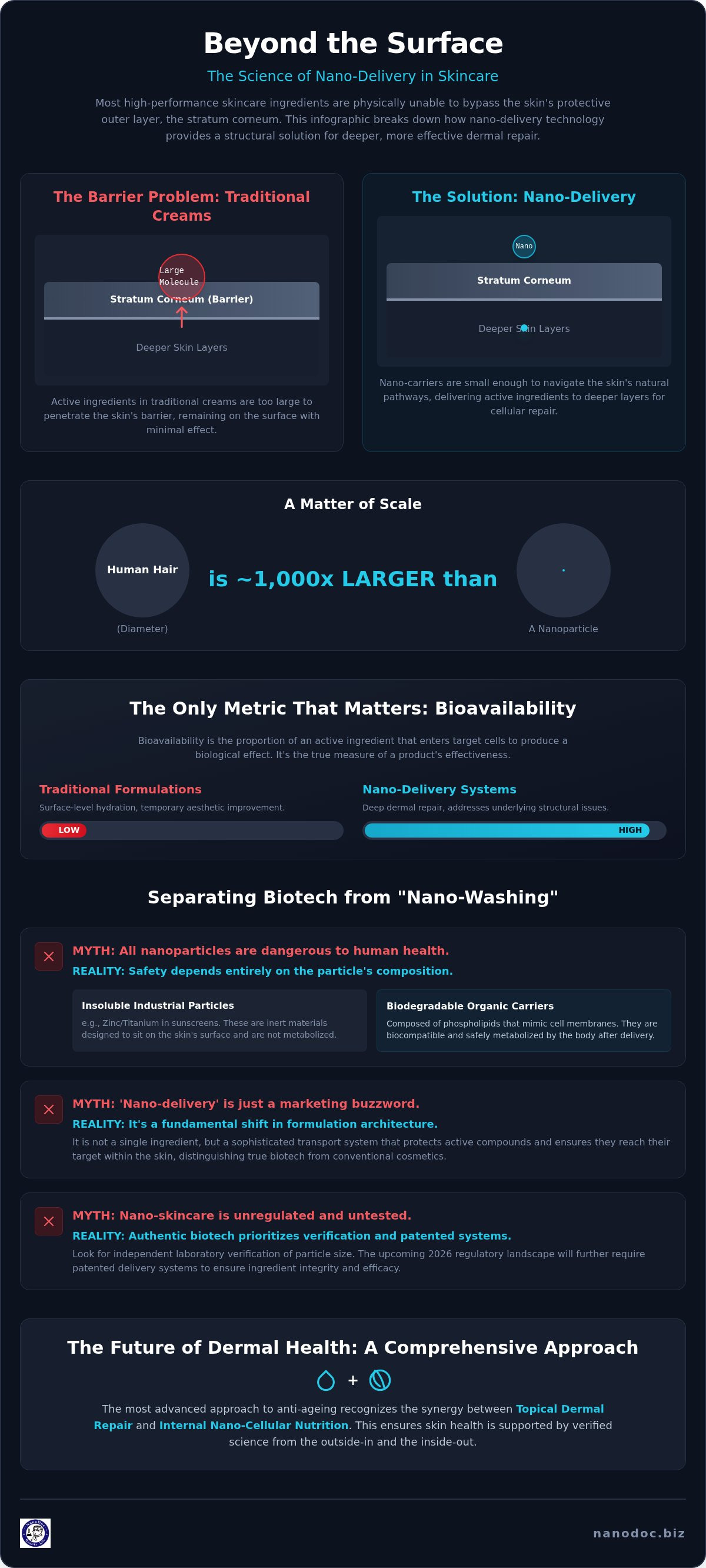
The primary obstacle for any topical treatment is the stratum corneum, the skin's outermost layer. This "brick and mortar" structure is designed specifically to keep external substances out. Most traditional skincare formulations consist of large molecular structures that simply cannot fit through the narrow intercellular gaps of the epidermis. To put the physical scale into perspective, a typical nanoparticle is approximately 1,000 times smaller than the diameter of a human hair. This minute size allows the encapsulated active ingredients to navigate the skin's natural defenses without disrupting the barrier's integrity. Nano-encapsulation serves as a protective vehicle, ensuring that fragile compounds don't degrade before they reach their intended destination.
The Reality of Dermal Penetration
In traditional formulations, research suggests that a significant portion of active compounds remain trapped on the surface, where they eventually evaporate or are wiped away. This inefficiency occurs because the gaps between skin cells are significantly smaller than the molecules found in standard creams. Nano-delivery technology in skincare acts as a precision-engineered transport system for bioactive compounds. By utilizing nano-emulsions, we wrap nutrients in a protective lipid layer that mimics the skin's own composition, allowing for seamless entry through the lipid-rich pathways of the stratum corneum.
Why Bioavailability is the Only Metric That Matters
In clinical terms, the effectiveness of a product isn't measured by the concentration of ingredients in the bottle, but by its bioavailability. This is the proportion of the substance that enters the target cells to produce a biological effect. Most luxury creams provide surface-level hydration, which offers a temporary aesthetic improvement but fails to address underlying structural issues. LG Bionano technology, represented by NanoDoc International, prioritizes deep dermal repair by ensuring that anti-ageing nutrients reach the deeper layers where collagen synthesis occurs. This transition from "sitting on the skin" to "cellular integration" is what distinguishes true bio-tech from conventional cosmetic products.
Myth 2: All Nanoparticles are Dangerous to Human Health
Public apprehension regarding nanotechnology often centers on the fear of systemic absorption. Many consumers worry that nano-delivery technology in skincare might allow foreign, potentially toxic substances to bypass natural filters and enter the bloodstream. This concern is understandable but frequently fails to account for the fundamental differences between industrial materials and the organic, biodegradable carriers used in modern cosmeceuticals. Safety in nanotechnology isn't a binary state; it depends entirely on the chemical composition and the intended metabolic pathway of the particle.
The "bloodstream myth" assumes that all nanoparticles behave like persistent pollutants. In reality, the lipid-based nano-emulsions utilized in advanced dermal repair are designed to be biocompatible. These carriers are often composed of phospholipids, which are the same building blocks found in your own cell membranes. Because they mimic the skin's natural sebum, the body recognizes and processes them through established biological channels rather than treating them as invasive threats. Once the encapsulated active ingredient is delivered to the target cell, the organic shell is safely metabolized.
Soluble vs. Insoluble Nanoparticles
To understand safety, you must distinguish between insoluble mineral particles and soluble bio-nutrient systems. Mineral sunscreens often use insoluble zinc or titanium nanoparticles to provide UV protection without the traditional white cast. These are designed to remain inert. In contrast, the patented bionano systems represented by NanoDoc International utilize soluble, organic carriers. These systems are specifically engineered for high bioavailability, ensuring that anti-ageing nutrients are integrated into the dermal structure without lingering in the body as foreign debris. This metabolic transparency is a key reason why these formulations maintain such high safety profiles in the 2026 regulatory environment.
The Importance of Particle Size Verification
Precision is the primary safeguard against adverse reactions. When particle sizes are inconsistent, the product's behavior becomes unpredictable, which is why independent laboratory testing is non-negotiable. At NanoDoc, we verify the integrity and dimensions of every nanoparticle to ensure they fall within the optimal range for dermal integration. If a particle is too small, it may behave erratically; if it's too large, it remains on the surface, wasting the active ingredients. You can learn more about how these precise dimensions facilitate cellular restoration in our detailed look at anti-ageing dermal technology.
By prioritizing rigorous verification and using biodegradable materials, we bridge the gap between high-performance results and clinical safety. If you are interested in experiencing the benefits of verified biotech, you can explore our anti-ageing skin care range, which is built on the global standards of LG Bionano research.
Myth 3: Traditional Creams are Just as Effective as Nano-Emulsions
Many consumers operate under the assumption that a premium price point or a high concentration of active ingredients automatically correlates with superior results. However, a luxury price tag can't compensate for a formula's inherent inability to penetrate the skin's protective layers. Traditional water-based serums and creams often suffer from the "evaporation factor." In these standard formulations, a significant percentage of the active compounds dries on the surface or evaporates into the air before any meaningful absorption can occur. Nano-delivery technology in skincare solves this inefficiency by anchoring the ingredients within a structure that resists evaporation and prioritizes cellular entry.
The technical superiority of nano-emulsions lies in their ability to facilitate a sustained, slow-release delivery. While traditional creams might provide a single, overwhelming surge of ingredients that can lead to surface irritation, nano-carriers release their payload gradually. This methodical approach ensures that the skin receives a consistent supply of nutrients over several hours, which is essential for long-term dermal health and repair. It's the difference between a flash flood and a controlled irrigation system.
Nano-Emulsified Serums vs. Traditional Formulations
Standard skincare products often rely on harsh surfactants to force penetration, which can inadvertently damage the skin's natural barrier and cause chronic sensitivity. Nano-biotech utilizes lipid-based carriers that are biologically compatible with the epidermis, allowing for deep dermal repair without the need for irritating chemicals. While a traditional cream might offer temporary surface hydration, it rarely reaches the deeper layers where collagen synthesis occurs. For a detailed look at how these mechanisms compare in clinical settings, you can refer to this scientific comparison of nano-delivery for topical efficacy data.
Stability and Oxidation Control
Volatility is a persistent challenge for high-performance cosmeceuticals like Vitamin C, Retinol, and various antioxidants. When these compounds are exposed to light and oxygen in an open-formula traditional cream, they begin to oxidize almost immediately, often losing their potency before they're even applied. Nano-encapsulation acts as a protective shield, sealing these sensitive molecules within a stable environment that prevents premature degradation. Nano-emulsions prevent the premature degradation of active cosmeceuticals, ensuring that the product remains effective throughout its entire shelf life. This structural protection ensures you aren't just paying for expensive ingredients that have already lost their biological activity.
Myth 4: Nano-Skincare is Unregulated and Untested
The assumption that nanotechnology operates in an unregulated "Wild West" is a persistent misconception that ignores the rigorous standards of 2026. The global regulatory landscape for cosmeceutical nanotechnology has become highly sophisticated, with stringent verification protocols that distinguish between genuine biotech and surface-level claims. These standards require extensive documentation regarding particle stability, size distribution, and toxicological profiles before a product can be categorized as a nano-biotech solution. Because of these high entry barriers, many brands don't have the technical infrastructure or the intellectual property rights to utilize authentic nano-delivery technology in skincare.
The "Patented Technology" barrier serves as a primary filter for quality in the current market. Authentic nanotechnology requires significant investment in research and development, which is why the most effective systems are protected by international patents. As the exclusive representative for LG Bionano in South East Asia, NanoDoc International maintains these international standards by ensuring that every formulation undergoes independent laboratory verification. This process confirms that the nanoparticles remain within the specified therapeutic range, providing a level of transparency that unverified brands simply can't match.
The LG Bionano Standard of Excellence
Representing a global biotech leader like LG Bionano involves adhering to strict clinical testing protocols that go far beyond standard cosmetic requirements. Every formulation is subjected to rigorous analysis to ensure the integrity of the delivery system remains intact from production to application. We prioritize independent laboratory verification of particle size as a non-negotiable step in our quality control process. This methodical approach guarantees that our anti-ageing skin care solutions meet the highest benchmarks for safety and performance, bridging the gap between advanced laboratory science and consumer health.
Identifying 'Nano-Washing' in the Market
The rise of "nano-washing" is a significant concern for consumers who want to invest in real biotech. This occurs when brands use the term "nano" in their marketing without providing the technical documentation or patent numbers to support their claims. To protect yourself from marketing hype, look for these specific indicators of quality:
- Verified Particle Size: Does the brand provide independent lab reports confirming the size and uniformity of their nano-emulsions?
- Intellectual Property: Can the brand cite specific, verifiable patents for their delivery technology?
- Biocompatibility: Does the formulation use biodegradable organic carriers rather than insoluble industrial minerals?
Before purchasing any nano-tech product, you should ask the brand for their verification data. If they can't provide it, the product is likely a standard formulation disguised with biotech terminology. You can find verified, high-performance solutions by exploring our anti-ageing skin care collections, which are backed by the global authority of LG Bionano research.
The Future of Dermal Health: Beyond the Surface
The year 2026 marks a definitive shift in how we approach skin health. We've moved past the era of "one-size-fits-all" traditional creams that offer little more than surface-level occlusion. The industry is now centered on the transition from purely cosmetic products to high-performance cosmeceuticals. This evolution is driven by nano-delivery technology in skincare, which allows for the precise targeting of dermal structures that were previously inaccessible. It's no longer enough to simply apply a product; the modern standard requires that the product's active compounds actually integrate with the skin's biological processes.
This transition represents a move toward structural integrity rather than temporary aesthetic improvement. By utilizing nano-emulsions, we can ensure that anti-ageing nutrients bypass the surface barrier to stimulate repair at the cellular level. This methodical approach to dermal health ensures that every application contributes to the long-term resilience of the skin, rather than providing a fleeting glow that disappears after the next wash. It's the end of an era where consumers accept products that don't actually reach their intended destination.
A Holistic Approach to Bioavailability
True dermal health doesn't exist in isolation from the rest of the body's biological systems. At NanoDoc, we integrate the LG Bionano methodology to bridge the gap between topical repair and internal cellular nutrition. This synergy is crucial because the skin's ability to repair itself is often limited by the availability of essential nutrients in the deeper tissues. When you combine high-bioavailability internal supplements with targeted topical applications, you create a comprehensive environment for restoration. You can see this principle of rapid absorption in action by exploring how specialized formulations like muscle relief gel utilize nano-carriers to deliver active compounds directly through the skin barrier for immediate functional benefits.
Transitioning to a Biotech-Driven Routine
Upgrading your regimen to include nano-delivery technology in skincare doesn't require a complete overhaul of your current habits. You can introduce nano-emulsified serums as the primary "active" step in your routine, applying them directly to cleansed skin before heavier traditional moisturizers. Because these particles are designed for deep penetration, they don't sit on the surface. This allows for better layering without the risk of product pilling or surface residue.
While traditional creams might show surface hydration within minutes, biotech-driven solutions focus on structural changes. You should expect to see visible improvements in skin density and texture over a four to six-week period, which aligns with the natural dermal turnover cycle. This commitment to evidence-based results ensures that your investment in skincare yields a measurable biological return. To begin your transition into the next generation of dermal health, explore the LG Bionano range at NanoDoc and discover the difference that verified laboratory science makes.
Advancing Your Dermal Strategy for 2026
Transitioning from traditional topical applications to a biotech-driven regimen represents a fundamental shift toward structural skin health. We've established that nano-delivery technology in skincare isn't a mere marketing trend but a precision-engineered solution to the skin's natural barrier. By prioritizing high bioavailability and organic, biodegradable carriers, you can achieve deep dermal repair that standard water-based serums simply can't provide. Authentic progress in this field depends on clinical verification rather than industry hype.
As the exclusive representative for LG Bionano in South East Asia, NanoDoc International ensures that every formulation undergoes independent laboratory testing to confirm nanoparticle size and quality. This commitment to technical precision allows you to invest in your skin health with absolute confidence. It's time to move beyond surface-level hydration and embrace the verified science of cellular restoration. You can upgrade your skincare with LG Bionano technology at NanoDoc to experience the clinical reality of deep dermal repair. Secure your skin's future by choosing solutions rooted in laboratory excellence and global biotech leadership.
Frequently Asked Questions
Is nano-delivery technology in skincare safe for sensitive skin?
Yes, it's often safer than traditional formulas. Nano-delivery systems use biocompatible lipids that mimic natural skin sebum. This reduces the requirement for harsh chemical surfactants that typically cause irritation in sensitive skin types. Because the ingredients are encapsulated, they bypass the surface where inflammation usually occurs, delivering actives directly to the target cells. This precision-engineered approach minimizes surface-level reactions while maintaining high efficacy.
Can nanoparticles in skincare enter my bloodstream?
Professional cosmeceutical nano-carriers are designed to be biodegradable and soluble. Unlike industrial insoluble minerals, these organic lipids are metabolized by the body's natural biological processes. While they penetrate deep into the dermal layers for repair, they don't linger in the system as foreign bodies. Patented LG Bionano systems prioritize biocompatibility, ensuring that the carriers break down safely once their payload of anti-ageing nutrients is delivered.
What is the difference between liposomes and nano-emulsions?
The primary difference lies in structural stability and particle size. Liposomes are double-layered lipid vesicles that can be fragile and prone to breaking down on the skin's surface. Nano-emulsions are more stable, translucent dispersions with significantly smaller particle sizes, typically below 100 nanometers. This smaller scale allows nano-delivery technology in skincare to provide more consistent penetration and a higher degree of bioavailability compared to traditional liposomal formulations.
How do I know if a skincare product actually uses nano-technology?
You should look for independent laboratory verification and specific patent numbers. Genuine biotech brands, such as those represented by NanoDoc International, provide documentation confirming their nanoparticle size and uniformity. Avoid products that use "nano" as a vague marketing term without citing intellectual property or clinical data. Authentic formulations will often feature a translucent appearance, which is a physical characteristic of stable, high-quality nano-emulsions.
Are the results of nano-skincare permanent or temporary?
Nano-skincare provides long-term structural benefits rather than temporary aesthetic fixes. Because the technology facilitates deep dermal repair and collagen synthesis, it addresses the underlying causes of ageing. While surface hydration from traditional creams fades quickly, the cellular integration achieved through nano-delivery supports the skin's natural regeneration cycle. Consistent use leads to cumulative improvements in skin density and texture that persist as long as the cellular environment is supported.
Does nano-delivery technology make ingredients like Retinol more irritating?
It actually reduces irritation through controlled release. Traditional Retinol can cause surface redness because the entire dose hits the skin at once. Nano-encapsulation protects the Retinol and releases it slowly as it penetrates the deeper layers. This slow-release mechanism prevents the concentrated active from overwhelming the skin's surface. It's a more sophisticated way to achieve high-performance results without the typical inflammatory side effects associated with volatile compounds.
Why is nano-skincare more expensive than traditional products?
The cost reflects the complex manufacturing process and the requirement for patented technology. Developing stable, independently verified nano-emulsions requires advanced laboratory equipment and rigorous clinical testing protocols. Unlike standard creams that use inexpensive fillers and water-based bases, nano-delivery technology in skincare involves proprietary systems designed for maximum bioavailability. You're investing in a precision-engineered transport system that ensures your active ingredients aren't wasted through surface evaporation.
Can I use nano-delivery products alongside my standard moisturiser?
Yes, you can integrate them seamlessly into your existing routine. Apply your nano-emulsified serum first on cleansed skin to ensure the nanoparticles have direct access to the stratum corneum. Once the serum has absorbed, you can layer your traditional moisturiser or sunscreen over it. The nano-carriers penetrate so efficiently that they won't interfere with your other products. Maintaining a healthy surface barrier with a standard moisturiser can actually support the overall efficacy of your biotech routine.
Frequently Asked Questions
- Is nano-delivery technology in skincare safe for sensitive skin?
- Yes, it's often safer than traditional formulas. Nano-delivery systems use biocompatible lipids that mimic natural skin sebum. This reduces the requirement for harsh chemical surfactants that typically cause irritation in sensitive skin types. Because the ingredients are encapsulated, they bypass the surface where inflammation usually occurs, delivering actives directly to the target cells. This precision-engineered approach minimizes surface-level reactions while maintaining high efficacy.
- Can nanoparticles in skincare enter my bloodstream?
- Professional cosmeceutical nano-carriers are designed to be biodegradable and soluble. Unlike industrial insoluble minerals, these organic lipids are metabolized by the body's natural biological processes. While they penetrate deep into the dermal layers for repair, they don't linger in the system as foreign bodies. Patented LG Bionano systems prioritize biocompatibility, ensuring that the carriers break down safely once their payload of anti-ageing nutrients is delivered.
- What is the difference between liposomes and nano-emulsions?
- The primary difference lies in structural stability and particle size. Liposomes are double-layered lipid vesicles that can be fragile and prone to breaking down on the skin's surface. Nano-emulsions are more stable, translucent dispersions with significantly smaller particle sizes, typically below 100 nanometers. This smaller scale allows nano-delivery technology in skincare to provide more consistent penetration and a higher degree of bioavailability compared to traditional liposomal formulations.
- How do I know if a skincare product actually uses nano-technology?
- You should look for independent laboratory verification and specific patent numbers. Genuine biotech brands, such as those represented by NanoDoc International, provide documentation confirming their nanoparticle size and uniformity. Avoid products that use "nano" as a vague marketing term without citing intellectual property or clinical data. Authentic formulations will often feature a translucent appearance, which is a physical characteristic of stable, high-quality nano-emulsions.
- Are the results of nano-skincare permanent or temporary?
- Nano-skincare provides long-term structural benefits rather than temporary aesthetic fixes. Because the technology facilitates deep dermal repair and collagen synthesis, it addresses the underlying causes of ageing. While surface hydration from traditional creams fades quickly, the cellular integration achieved through nano-delivery supports the skin's natural regeneration cycle. Consistent use leads to cumulative improvements in skin density and texture that persist as long as the cellular environment is supported.
- Does nano-delivery technology make ingredients like Retinol more irritating?
- It actually reduces irritation through controlled release. Traditional Retinol can cause surface redness because the entire dose hits the skin at once. Nano-encapsulation protects the Retinol and releases it slowly as it penetrates the deeper layers. This slow-release mechanism prevents the concentrated active from overwhelming the skin's surface. It's a more sophisticated way to achieve high-performance results without the typical inflammatory side effects associated with volatile compounds.
- Why is nano-skincare more expensive than traditional products?
- The cost reflects the complex manufacturing process and the requirement for patented technology. Developing stable, independently verified nano-emulsions requires advanced laboratory equipment and rigorous clinical testing protocols. Unlike standard creams that use inexpensive fillers and water-based bases, nano-delivery technology in skincare involves proprietary systems designed for maximum bioavailability. You're investing in a precision-engineered transport system that ensures your active ingredients aren't wasted through surface evaporation.
- Can I use nano-delivery products alongside my standard moisturiser?
- Yes, you can integrate them seamlessly into your existing routine. Apply your nano-emulsified serum first on cleansed skin to ensure the nanoparticles have direct access to the stratum corneum. Once the serum has absorbed, you can layer your traditional moisturiser or sunscreen over it. The nano-carriers penetrate so efficiently that they won't interfere with your other products. Maintaining a healthy surface barrier with a standard moisturiser can actually support the overall efficacy of your biotech routine.