
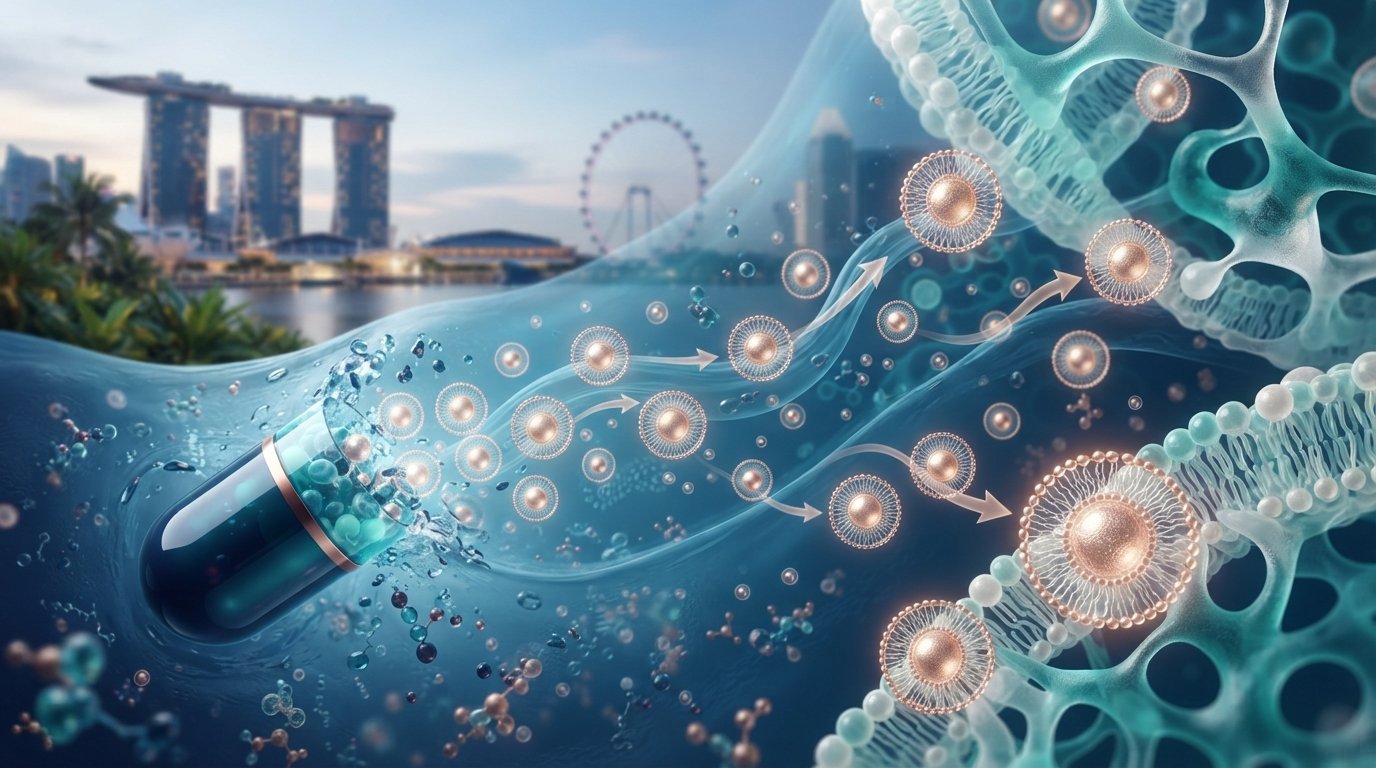
A higher supplement dose doesn’t guarantee that more of a nutrient will be absorbed. That’s why nano cellular nutrition focuses on delivery as well as dosage: some nutrients may degrade or be poorly absorbed before the body can use them. Nano-encapsulation is designed to protect selected compounds and may support their bioavailability, but it doesn’t guarantee that nutrients reach every cell.
If you’ve spent money on supplements without noticing a difference, or still feel fatigued despite taking vitamins, it’s reasonable to ask what happens after you swallow them. The terminology can be confusing, too. “Nano” isn’t proof of effectiveness on its own. The delivery method, formulation quality, and evidence all matter.
This article explains how nano-encapsulation and liposomal delivery work, how they differ from standard supplementation, and what to check when assessing a product’s claims. You’ll also learn why independent testing matters. NanoDoc International represents LG Bionano, whose patented bionano delivery technology is used in health products. NanoDoc’s Nano Cellular Essential Nutrition formulations are independently laboratory-tested for nanoparticle size and quality. The aim is to offer a clearer, evidence-minded way to consider nutrient absorption and daily vitality.
Key Takeaways
- Understand how nano-encapsulation may protect nutrient compounds during digestion and support bioavailability, without assuming it guarantees cellular uptake.
- Learn why the amount you swallow may differ from the amount your body absorbs and uses.
- Explore how nano-delivery may affect nutrient transport, while recognizing that specific health outcomes depend on the formulation and evidence.
- Use clear criteria to assess nano cellular nutrition products, including transparent delivery claims and independent testing.
- See how NanoDoc International’s Nano Cellular Essential Nutrition connects patented delivery technology with formulations tested for nanoparticle size and quality.
Table of Contents
- Defining Nano Cellular Nutrition: The Evolution of Bioavailability
- The Bioavailability Challenge: Why Standard Supplements Fail
- Nano-Encapsulation Technology: The Mechanism of Enhanced Delivery
- The Practical Benefits of Nano Cellular Nutrition for Vitality
- Implementing Nano-Technology into Your Health Regimen
Defining Nano Cellular Nutrition: The Evolution of Bioavailability
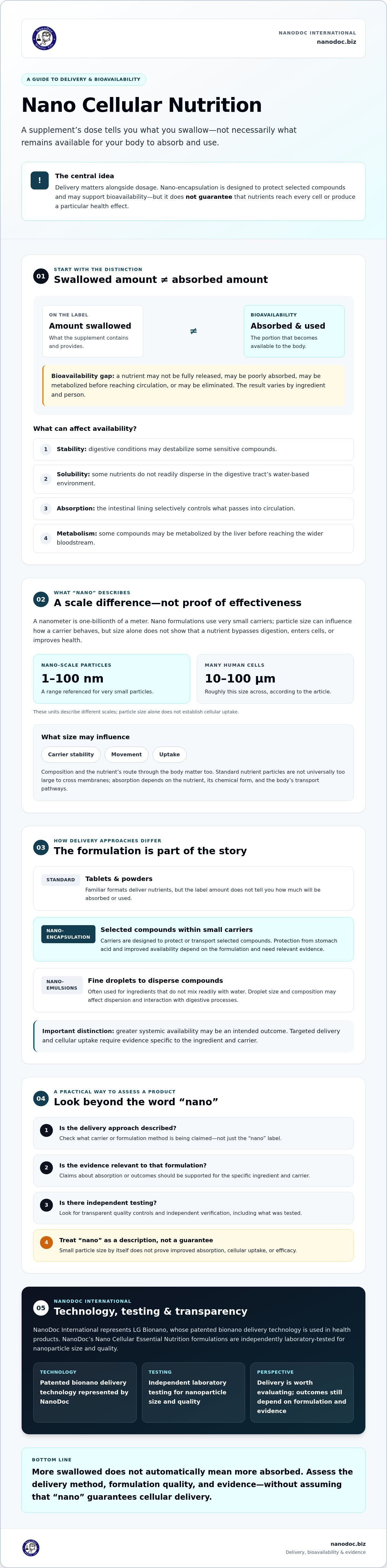
Nutrition labels tend to emphasize what a supplement contains and how much it provides. Nano cellular nutrition shifts attention to delivery: whether a nutrient remains stable through digestion and becomes available for absorption. The term is common in consumer health, but it isn’t a precise scientific category. A nanoscale formulation doesn’t automatically enter cells or produce a particular health effect.
To assess a formulation, look beyond its dosage to the delivery system, supporting evidence, and quality controls. Bionano technology uses nanoscale carriers in nutraceuticals, with the aim of protecting or transporting selected compounds. NanoDoc International represents LG Bionano, and its formulations are independently laboratory-tested for nanoparticle size and quality.
The Science of Small: What Does “Nano” Actually Mean?
A nanometer is one-billionth of a meter. For scale, many human cells measure roughly 10 to 100 micrometers across, making a 1-to-100-nanometer particle far smaller than a typical cell. That difference in scale can influence how a formulation behaves. It doesn’t mean standard nutrient particles are universally too large to cross membranes: absorption depends on the nutrient, its chemical form, and the body’s transport pathways.
Nanoparticle size can influence a carrier’s stability, movement, and uptake, but size alone doesn’t bypass digestion or the liver’s first-pass metabolism. Particle composition and the route a nutrient takes through the body matter, too.
Nutraceuticals vs. Nanonutraceuticals
Traditional tablets and powders deliver nutrients in familiar formats. Nano-encapsulated liquids disperse selected compounds within very small carriers. Some carriers are designed to shield sensitive ingredients from environmental or digestive conditions, but protection from stomach acid depends on the formulation and should be supported by relevant testing. The word “nano” alone isn’t evidence of improved absorption.
Nano-emulsions use fine droplets to disperse compounds, often ingredients that don’t mix readily with water. The droplets’ size and composition may affect how they stay dispersed and interact with digestive processes. Greater systemic availability may be an intended outcome, but targeted delivery requires evidence specific to the ingredient and carrier.
This is where nanotechnology connects laboratory design with consumer nutrition. Nanoparticle drug delivery systems illustrate how carriers can be designed to transport payloads, though mechanisms developed for medicines shouldn’t be assumed to apply in the same way to supplements. When assessing a product, check whether it identifies its delivery approach and provides independent verification. A small particle size by itself doesn’t prove cellular uptake or efficacy.
The Bioavailability Challenge: Why Standard Supplements Fail
A supplement label shows the amount swallowed, not the amount absorbed or used by tissues. This difference is the bioavailability gap. Nutrients may not be fully released, may be poorly absorbed, may be metabolized before reaching circulation, or may be eliminated. The result varies by ingredient and person, so a high dose alone can’t confirm that cells receive more of a nutrient.
The liver’s first-pass effect is one factor, not a universal explanation for why a supplement may not have the expected effect. After intestinal absorption, some compounds travel through the portal circulation and are metabolized by the liver before reaching the wider bloodstream. Curcumin, for example, is known for limited solubility and low oral bioavailability. Glutathione’s oral availability can also depend on formulation. A review of nanotechnology for nutrient absorption discusses how nano-encapsulation may address challenges involving nutrient stability, solubility, and bioavailability.
Biological Barriers to Nutrient Absorption
Digestion involves a sequence of chemical and physical barriers. Gastric acid can destabilize some sensitive compounds, while the intestinal lining selectively controls what passes into circulation. Fat-soluble nutrients face a different challenge: they don’t readily disperse in the water-based environment of the digestive tract. Absorption depends on the nutrient’s properties, the food or formulation it’s delivered in, and individual digestive physiology.
Age and digestive health can also influence absorption, but the effects aren’t identical for every nutrient or person. Changes in digestion, intestinal function, or medication use may matter. Persistent fatigue or other symptoms shouldn’t be assumed to result from poor supplement absorption alone.
The Cost of Poor Bioavailability
“Expensive urine” is a common shorthand for the idea that excess nutrients are simply excreted. The reality is more specific: the body processes each nutrient differently. Some excess may be eliminated, while other nutrients can accumulate or cause harm. Taking a larger dose doesn’t reliably compensate for low absorption, and it may not be appropriate for every ingredient.
If a nutrient is poorly absorbed, supplementation may not correct an inadequate status as expected. However, symptoms alone can’t confirm a deficiency, and persistent concerns call for appropriate assessment rather than simply increasing a dose. The same delivery principle applies to topical care: the skin’s outer barrier affects how ingredients reach the intended layers. Explore advanced skincare for aging skin as an example of addressing a distinct dermal barrier. For readers comparing delivery approaches, NanoDoc’s nano cellular nutrition offers a point of reference. Look for transparent claims and independent testing rather than relying on dosage or “nano” wording alone.
Nano-Encapsulation Technology: The Mechanism of Enhanced Delivery
A nano-carrier is a tiny delivery structure that can surround or disperse a nutrient payload. Depending on its composition, it may help protect sensitive compounds during digestion and influence how they interact with the gut. That is the proposed mechanism behind some nano cellular nutrition formulations, not proof that every nutrient bypasses digestion or enters cells directly. The carrier, ingredient, and formulation all matter.
How Nano-Encapsulation Interacts With the Gut Barrier
After oral consumption, a formulation encounters stomach acid, digestive enzymes, bile, and the intestinal lining. Some nanoscale carriers are designed to protect ingredients or improve their dispersion, but they don’t necessarily pass unchanged through the digestive tract. Cells can take up certain particles through processes such as endocytosis, in which a cell membrane encloses material. Whether this occurs, and what happens next, depends on the particle’s properties and the biological setting.
Smaller particles have a greater surface area relative to their volume, which can affect dissolution and interaction with surrounding fluids. This relationship may support absorption for some formulations, but it doesn’t establish faster uptake or a clinical benefit on its own.
Nano-emulsification disperses oil-based ingredients into very small droplets within a water-based mixture, helping them remain distributed rather than making them instantly absorbable. The body still has to digest, transport, and process the ingredient.
What Testing Can Tell You
Particle-size verification helps establish whether a formulation has the physical characteristics its manufacturer describes. On its own, it doesn’t prove absorption, safety, or health outcomes. For a fuller assessment, look for clear information about the delivery system, ingredient quality, and what the testing actually measures.
NanoDoc International represents LG Bionano, whose patented bionano delivery technology is used in nutraceutical and cosmeceutical formulations designed for gut and skin absorption. NanoDoc reports that its formulations are independently laboratory-tested for nanoparticle size and quality. This provides product-specific verification, while clinical effects still require evidence suited to the ingredient and intended use.
The LG Bionano Technology in Context
Claims such as “more stable than standard liposomal products” or “uniform size for predictable clinical results” require supporting data. Particle-size testing alone doesn’t establish either a comparison or a clinical result. The practical distinction is that delivery technology describes how a formulation is engineered. It shouldn’t be treated as a guarantee of performance.
Nano Cellular Essential Nutrition is among NanoDoc’s offerings. NanoDoc also offers Pain Relief Care, but the available information doesn’t establish that it uses the same patented bionano delivery system. Keeping these claims distinct helps readers assess each formulation on its own evidence.
The Practical Benefits of Nano Cellular Nutrition for Vitality
Nano-delivery is intended to influence how selected ingredients disperse, remain stable, and become available for absorption. It doesn’t create energy by itself or guarantee that a nutrient reaches a particular cell. This distinction matters when considering potential benefits for vitality, immune function, recovery, and healthy aging. Those outcomes depend on the nutrient, formulation, a person’s needs, and supporting evidence.
Energy, Antioxidants, and Recovery
B vitamins and minerals support normal energy metabolism, including processes that take place in mitochondria, the structures that help cells produce ATP. They aren’t stimulants, and taking more won’t necessarily increase energy if a person already gets enough. A delivery system may affect absorption for some ingredients, but claims that nano-formulated B vitamins provide faster energy or improve cognition need evidence specific to the formulation.
Antioxidants also have roles in the body’s defenses against oxidative processes. Their effects depend on the compound and dose, and a product’s “high-bioavailability” description isn’t proof of reduced oxidative stress or faster recovery. Active people and older adults can assess a supplement by checking the ingredient, evidence for its intended use, and independent quality testing, rather than assuming a nano format delivers a particular outcome.
Liquid formulations may be easier for some people to take, but liquid form alone doesn’t establish a faster onset of action than capsules. Absorption and effects vary by ingredient and formulation.
Immune Support and Oral Health
The oral microbiome is part of the body’s broader microbial environment, and oral health is relevant to overall health. That doesn’t mean an oral supplement can replace routine oral care or that a nano-formulated ingredient provides targeted protection at the mouth or another point of entry. Look for evidence that matches the specific product claim.
For a considered wellness routine, focus on transparent ingredient information, appropriate use, and product-quality verification. NanoDoc International’s formulations are independently laboratory-tested for nanoparticle size and quality. This testing helps verify a measured product characteristic, but doesn’t by itself demonstrate immune benefits or clinical effectiveness.
Internal and External Delivery
NanoDoc’s offerings include Nano Cellular Essential Nutrition, Oral & Immunity Care, and anti-ageing skin care. Delivery design matters for ingredients taken by mouth and those applied to skin, although each route faces different biological barriers and needs its own evidence. Read more about anti-ageing dermal technology to understand how topical delivery is approached. To explore NanoDoc’s Nano Cellular Essential Nutrition, review the formulation and testing information alongside your own health goals.
Implementing Nano-Technology into Your Health Regimen
Moving from conventional vitamins to nano-encapsulated formulations is best approached as a product comparison, not an automatic upgrade. Delivery technology may affect how an ingredient is formulated, but it doesn’t guarantee better results for every nutrient or person. Before making a change, compare the active ingredients and amounts in both products, follow label directions, and avoid unintentionally doubling up on the same nutrients.
Consider your goal, too. Nano Cellular Essential Nutrition is one option within NanoDoc International’s offerings; Pain Relief Care and Oral & Immunity Care are separate categories. Don’t assume these products share the same ingredients or delivery system, or that combining them is appropriate. Compare labels carefully, and ask a qualified health professional about potential interactions if you take medication or have a health condition.
Verification and Quality: Avoiding “Nano-Washing”
“Nano” on a label isn’t enough to establish formulation quality, absorption, or effectiveness. Look for specific information about the delivery approach and independent testing, then check what the testing verifies. For example, a particle-size analysis supports claims about measured size; it doesn’t by itself demonstrate clinical benefits, safety, or shelf life.
Proprietary bionano technology may describe a particular delivery platform, but claims of improved stability or efficacy should be supported by relevant product data. NanoDoc International represents LG Bionano. NanoDoc reports that its formulations are independently laboratory-tested for nanoparticle size and quality. These details help consumers assess the technology without treating a patent or test result as proof of every health claim.
A Methodical Path to Choosing
A practical selection process is straightforward: identify the ingredient and intended purpose, assess whether its standard format meets your needs, then compare delivery and verification information. Nano-technology may offer a way to address formulation challenges, but “cellular precision” should be treated as an aim, not an assured outcome. Give changes time to be assessed appropriately, and don’t use a perceived lack of effect as a reason to increase a dose beyond label directions.
For a closer look at the LG Bionano range and NanoDoc’s nano cellular nutrition offering, explore the LG Bionano range at NanoDoc.
Make Your Next Nutrition Choice More Informed
The value of nano cellular nutrition lies in examining how a nutrient is delivered, not simply how much a supplement contains. Nano-encapsulation may help address stability and absorption challenges, but particle size or a “nano” label alone doesn’t prove cellular uptake or a health outcome. Compare formulations by their ingredients, evidence, and independent testing.
NanoDoc International represents LG Bionano and offers access to its patented bionano delivery technology. NanoDoc’s formulations are independently laboratory-tested for nanoparticle size and quality, giving consumers specific information to consider without treating testing as a guarantee of clinical results.
To explore delivery-focused nutrition, explore NanoDoc’s LG Bionano formulations and review the available product information. A methodical, evidence-minded approach can help you choose products that better fit your health goals.
Frequently Asked Questions
Is nano cellular nutrition safe for long-term daily use?
There isn’t one safety answer for every nano-formulated supplement. Long-term suitability depends on the specific ingredients, dose, carrier materials, product quality, and individual health factors. A “nano” label alone doesn’t establish safety or effectiveness. Review the full ingredient list and directions, and seek advice from a qualified health professional before regular use if you take medication, have a health condition, or are considering combining several supplements.
How do nano-encapsulated supplements differ from liposomal vitamins?
Nano-encapsulation is a broad approach that places or disperses an ingredient within a small carrier. Liposomal delivery uses liposomes, structures made from lipid layers, as the carrier. The terms can overlap, but not every nano-encapsulated formulation is liposomal, and products vary in composition and performance. Compare the stated delivery method and supporting product data rather than assuming one format is automatically more effective.
Why is nanoparticle size so important for nutrient absorption?
Particle size can affect a formulation’s stability, surface area, and interaction with fluids and biological barriers. That makes it useful information when assessing a nano-product. Size alone, however, can’t predict how much nutrient will be absorbed or used. Carrier composition, the ingredient itself, and the body’s digestive and transport processes also matter. Independent size testing verifies a physical characteristic, not a clinical outcome.
Can nano-nutrients really bypass the “first-pass” liver metabolism?
Not necessarily. After many orally consumed substances are absorbed from the intestine, they travel through the portal circulation to the liver, where metabolism may occur before they reach the wider bloodstream. A nano-carrier may influence an ingredient’s stability or absorption, but it doesn’t automatically avoid this first-pass process. Claims of bypass or reduced metabolism should be supported by evidence for the specific ingredient and formulation.
What are the first signs that nano-cellular nutrition is working?
There’s no universal first sign, and feeling different isn’t proof that a supplement has improved nutrient status or health. Effects depend on the ingredient, the reason for taking it, and individual factors. Follow the product directions and track relevant changes over time, but don’t use symptoms alone to diagnose a deficiency or judge absorption. If a health concern persists, seek guidance from a qualified health professional.
Are NanoDoc products independently laboratory-tested for quality?
Yes. NanoDoc’s formulations are independently laboratory-tested for nanoparticle size and quality. This verification can help confirm measured product characteristics, but it doesn’t by itself prove a supplement’s effectiveness, safety for every person, or long-term benefits. When reviewing any product, check what the testing covers and consider it alongside ingredient information, directions, and evidence related to the intended use.
Can I use nano-nutrition alongside traditional cosmeceuticals?
Oral supplements and topical skincare are different product types and routes of use, so one doesn’t automatically replace the other. Whether they’re suitable together depends on their ingredients, directions, and your individual circumstances. Follow the labels, introduce products thoughtfully, and stop use if you experience an unexpected reaction. NanoDoc offers both nano-nutrient supplements and anti-ageing skincare, but specific combinations should be assessed based on their individual formulations.
How does LG Bionano technology improve the bioavailability of Glutathione?
LG Bionano’s patented bionano delivery technology is designed to support delivery and absorption, but the available information doesn’t establish a specific bioavailability result for Glutathione. Effects depend on the ingredient’s formulation and supporting evidence. NanoDoc’s independent testing verifies nanoparticle size and quality; that testing alone doesn’t demonstrate a particular absorption rate or clinical benefit. Review product-specific information before drawing conclusions about Glutathione.
Frequently Asked Questions
- The Science of Small: What Does “Nano” Actually Mean?
- A nanometer is one-billionth of a meter. For scale, many human cells measure roughly 10 to 100 micrometers across, making a 1-to-100-nanometer particle far smaller than a typical cell. That difference in scale can influence how a formulation behaves. It doesn’t mean standard nutrient particles are universally too large to cross membranes: absorption depends on the nutrient, its chemical form, and the body’s transport pathways. Nanoparticle size can influence a carrier’s stability, movement, and uptake, but size alone doesn’t bypass digestion or the liver’s first-pass metabolism. Particle composition and the route a nutrient takes through the body matter, too.
- Is nano cellular nutrition safe for long-term daily use?
- There isn’t one safety answer for every nano-formulated supplement. Long-term suitability depends on the specific ingredients, dose, carrier materials, product quality, and individual health factors. A “nano” label alone doesn’t establish safety or effectiveness. Review the full ingredient list and directions, and seek advice from a qualified health professional before regular use if you take medication, have a health condition, or are considering combining several supplements.
- How do nano-encapsulated supplements differ from liposomal vitamins?
- Nano-encapsulation is a broad approach that places or disperses an ingredient within a small carrier. Liposomal delivery uses liposomes, structures made from lipid layers, as the carrier. The terms can overlap, but not every nano-encapsulated formulation is liposomal, and products vary in composition and performance. Compare the stated delivery method and supporting product data rather than assuming one format is automatically more effective.
- Why is nanoparticle size so important for nutrient absorption?
- Particle size can affect a formulation’s stability, surface area, and interaction with fluids and biological barriers. That makes it useful information when assessing a nano-product. Size alone, however, can’t predict how much nutrient will be absorbed or used. Carrier composition, the ingredient itself, and the body’s digestive and transport processes also matter. Independent size testing verifies a physical characteristic, not a clinical outcome.
- Can nano-nutrients really bypass the “first-pass” liver metabolism?
- Not necessarily. After many orally consumed substances are absorbed from the intestine, they travel through the portal circulation to the liver, where metabolism may occur before they reach the wider bloodstream. A nano-carrier may influence an ingredient’s stability or absorption, but it doesn’t automatically avoid this first-pass process. Claims of bypass or reduced metabolism should be supported by evidence for the specific ingredient and formulation.
- What are the first signs that nano-cellular nutrition is working?
- There’s no universal first sign, and feeling different isn’t proof that a supplement has improved nutrient status or health. Effects depend on the ingredient, the reason for taking it, and individual factors. Follow the product directions and track relevant changes over time, but don’t use symptoms alone to diagnose a deficiency or judge absorption. If a health concern persists, seek guidance from a qualified health professional.
- Are NanoDoc products independently laboratory-tested for quality?
- Yes. NanoDoc’s formulations are independently laboratory-tested for nanoparticle size and quality. This verification can help confirm measured product characteristics, but it doesn’t by itself prove a supplement’s effectiveness, safety for every person, or long-term benefits. When reviewing any product, check what the testing covers and consider it alongside ingredient information, directions, and evidence related to the intended use.
- Can I use nano-nutrition alongside traditional cosmeceuticals?
- Oral supplements and topical skincare are different product types and routes of use, so one doesn’t automatically replace the other. Whether they’re suitable together depends on their ingredients, directions, and your individual circumstances. Follow the labels, introduce products thoughtfully, and stop use if you experience an unexpected reaction. NanoDoc offers both nano-nutrient supplements and anti-ageing skincare, but specific combinations should be assessed based on their individual formulations.
- How does LG Bionano technology improve the bioavailability of Glutathione?
- LG Bionano’s patented bionano delivery technology is designed to support delivery and absorption, but the available information doesn’t establish a specific bioavailability result for Glutathione. Effects depend on the ingredient’s formulation and supporting evidence. NanoDoc’s independent testing verifies nanoparticle size and quality; that testing alone doesn’t demonstrate a particular absorption rate or clinical benefit. Review product-specific information before drawing conclusions about Glutathione.