

The gel with the most advanced-sounding technology isn’t automatically the right option for your joint pain. When comparing joint pain relief gel Singapore products, start with the active ingredients, intended use, directions and precautions. These details are more useful than a product name or technology claim on its own.
If labels filled with terms such as NSAID, capsaicin or nano-delivery have left you unsure what to choose, you’re not alone. Formulations aren’t interchangeable, and a marketing claim doesn’t establish whether a gel suits your needs. This guide explains how common topical ingredients differ, how to assess claims and which label details to review before use, including application warnings and potential interactions.
You’ll also find practical criteria for comparing products and guidance on when persistent or severe symptoms warrant clinical assessment. The aim isn’t to name one gel for everyone, but to help you make an informed decision based on your symptoms, health considerations and the product information.
Key Takeaways
- Compare joint pain relief gel Singapore options by active ingredient and intended use, not popularity or marketing language.
- Distinguish topical NSAIDs, counterirritants and other formulations, then compare their directions and the evidence for their stated benefits.
- Use a label-first safety check: review warnings, consider your health conditions and medicines, and apply only as directed.
- Track how symptoms respond. Seek clinical assessment if joint pain is severe or persists instead of relying on a gel alone.
- Nano-delivery is a formulation approach. Laboratory checks of nanoparticle size and quality describe product testing, not proof of clinical effectiveness.
Table of Contents
- Joint Pain Relief Gel: Topical Product Pros and Cons
- How Joint Gel Ingredients and Nano-Delivery Claims Differ
- Compare Joint Pain Relief Gels in Singapore Using These Criteria
- Using a Joint Pain Relief Gel Safely: A Singapore Consumer Checklist
- NanoDoc Pain-Relief Care: Formulation Technology and Quality Checks
Joint Pain Relief Gel: Topical Product Pros and Cons
A topical joint-pain gel is applied to the skin over or near an area of discomfort. Its ingredients and formulation determine its intended use, so products sold as gels aren’t necessarily interchangeable. Some are designed to provide temporary symptom relief. That doesn’t mean they treat the condition causing the pain or change the joint itself.
Definition: A topical gel is applied to the skin to manage symptoms in a targeted area, not to treat an underlying joint disease. A change in how the area feels doesn’t explain why the pain began or establish whether the cause needs medical attention.
The location and pattern of discomfort can help you decide whether a product’s directions are relevant, but they can’t identify the cause on their own. Occasional soreness after activity is different from pain that repeatedly returns, steadily worsens or affects movement. The broad category of topical analgesics includes products with different mechanisms, so read the label rather than relying on the word “gel.”
What kinds of joint discomfort do topical gels target?
Some products are intended for temporary, local discomfort; others have directions tied to a particular ingredient or use. Check the package for the active ingredient, the area it’s intended for, how often to apply it and any limits on use. Don’t assume a product suitable for one type of soreness is appropriate for every joint or symptom.
Consider the pattern: Is the discomfort occasional or persistent? Does it follow a particular activity, recur without a clear trigger or interfere with ordinary movement? These observations can help you describe the problem to a healthcare professional, but they aren’t a diagnosis. Assess a joint pain relief gel Singapore option against its stated use and your circumstances, not as a guaranteed response to pain.
When is a gel not a substitute for assessment?
Don’t rely on self-treatment alone for sudden, severe pain, significant swelling, pain following an injury, fever alongside joint symptoms or restricted movement. These signs warrant prompt medical assessment. Seek urgent care if symptoms are severe or rapidly worsening. A topical product may change how symptoms feel without clarifying their cause.
Persistent, recurrent or worsening symptoms also deserve clinical evaluation rather than indefinite use of a gel. Before seeking assessment, note when the discomfort began, which joint is affected, what changes it and which products you’ve applied. This information can help a clinician assess the situation. If symptoms persist despite following the product directions, reassess rather than increasing the amount or frequency beyond the label.
How Joint Gel Ingredients and Nano-Delivery Claims Differ
Ingredient categories indicate what a gel is intended to do, but they don’t establish that it will suit every person or joint. Compare the active ingredient, full formulation and directions, along with the evidence for any specific benefit. When comparing a joint pain relief gel Singapore option, don’t let an unfamiliar technology term outweigh clear information about intended use and precautions.
How do common topical ingredient categories differ?
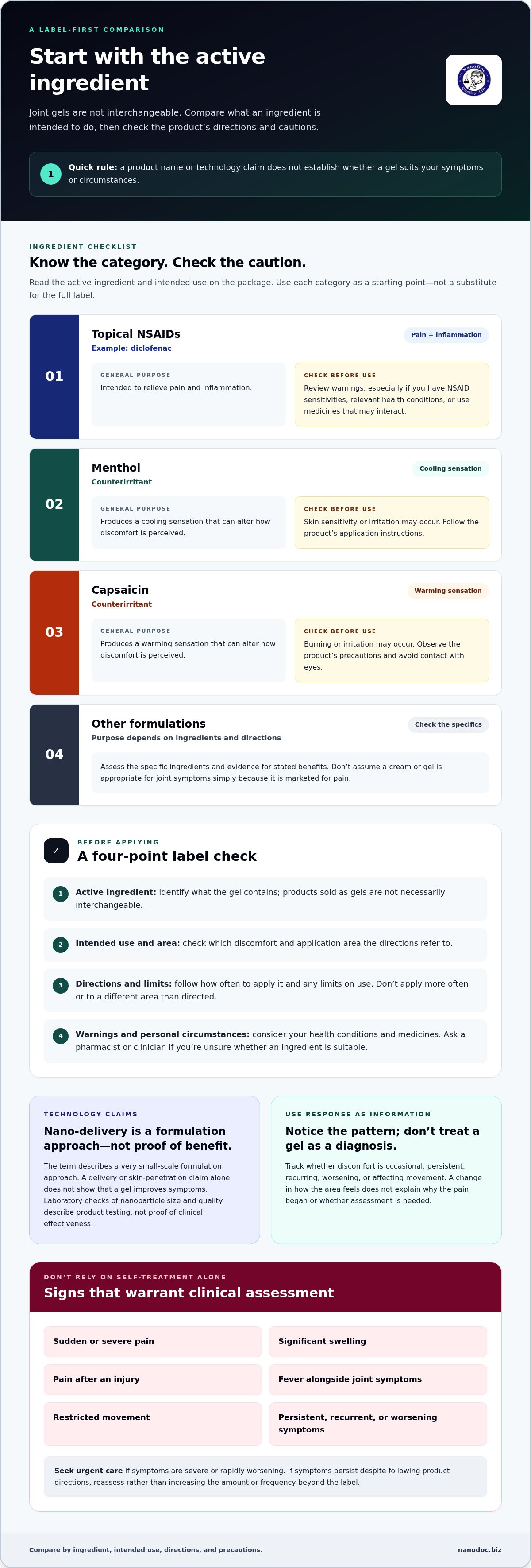
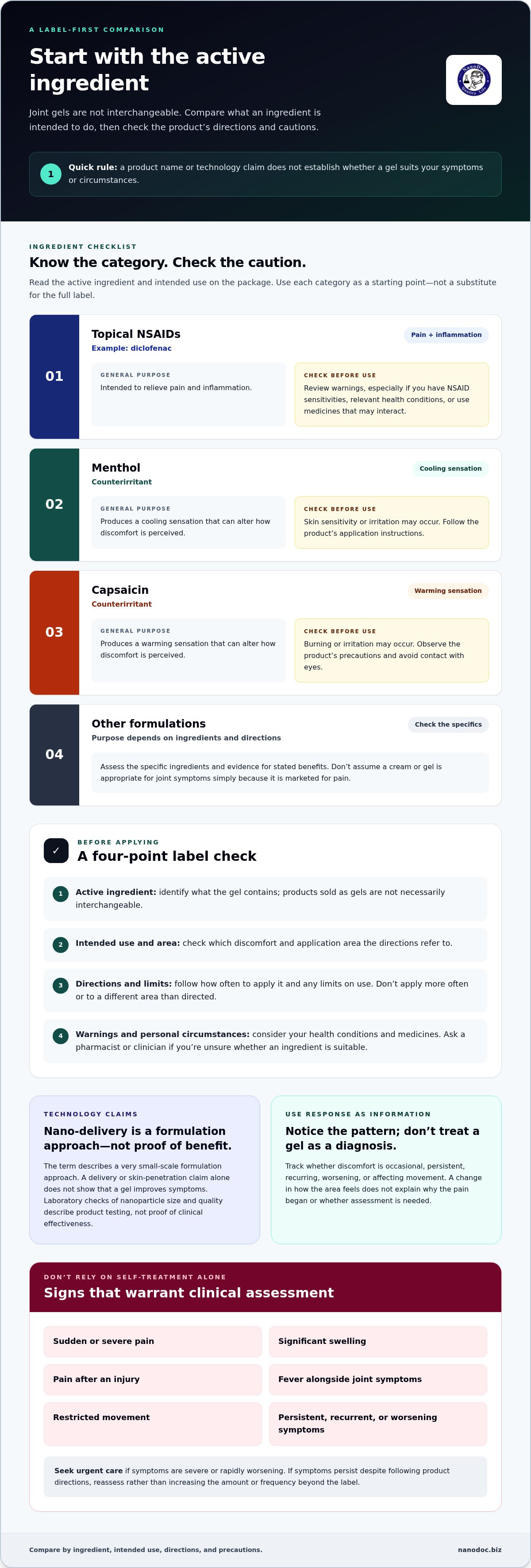
Topical non-steroidal anti-inflammatory drugs (NSAIDs), such as diclofenac, are different from counterirritants such as menthol and capsaicin. NSAIDs are used for pain and inflammation. Counterirritants produce sensations such as cooling or warmth that can alter how discomfort is perceived. These categories aren’t interchangeable, and products containing them may have different cautions.
Other formulations may use different ingredients or combine them. Don’t assume a cream or gel is appropriate for joint symptoms simply because it’s marketed for pain. Check the active ingredients, intended application area, directions and warnings, including circumstances in which use should be avoided. If you’re unsure whether an ingredient is suitable alongside your medicines or health conditions, seek advice from a pharmacist or clinician.
| Ingredient category | General purpose | Key caution |
|---|---|---|
| Topical NSAIDs, such as diclofenac | Intended to relieve pain and inflammation. | Review warnings, especially if you have NSAID sensitivities, relevant health conditions or use other medicines that may interact. |
| Menthol | A counterirritant that produces a cooling sensation. | Skin sensitivity or irritation may occur; follow the product’s application instructions. |
| Capsaicin | A counterirritant that produces a warming sensation. | It may cause a burning sensation or irritation; observe the product’s precautions and avoid contact with eyes. |
| Other formulations | Purpose varies with the ingredients and product directions. | Assess the specific ingredients and evidence rather than relying on broad pain-relief claims. |
Use this table as a starting point, not a substitute for the product label. Formulation, application instructions and individual suitability all matter. Don’t apply a product more often or to a different area than its directions permit.
What does nano-delivery mean in a topical gel?
Nano-delivery describes a formulation approach involving materials at a very small scale, designed to influence how ingredients are formulated or delivered. The term alone doesn’t tell you whether a gel improves symptoms. A claim about delivery or skin penetration isn’t the same as clinical evidence of a meaningful benefit for people with joint discomfort.
Delivery technology alone doesn’t establish clinical efficacy. Laboratory testing of nanoparticle size or formulation quality can help characterise a product, but it doesn’t prove that the product relieves pain or improves joint function. Look for evidence tied to the actual formulation and the outcome being claimed, not just a technology label.
NanoDoc’s pain-relief care includes formulations using LG Bionano nano-delivery technology. Its formulations are independently laboratory-tested for nanoparticle size and quality. These checks describe product characteristics, not clinical outcomes. Explore NanoDoc’s pain-relief care to learn about this formulation approach.
Compare Joint Pain Relief Gels in Singapore Using These Criteria
Start a comparison with the full label, not the headline claim on the front of the pack. For a joint pain relief gel Singapore shoppers are considering, note its intended use, active ingredients, application directions and warnings. Then look for evidence that supports its stated benefits. This makes it easier to identify meaningful differences and set aside persuasive wording that offers little practical information.
Comparison checklist: Match the intended use, active ingredient, formulation, directions, warnings and supporting evidence to your symptoms and circumstances.
Which label details should you compare?
Read the product information as a whole. First compare the stated indication and intended application area. Then check the active ingredients and any maximum-use instructions. Look for allergy warnings, age guidance, interaction information and restrictions related to health conditions, pregnancy or other specific circumstances. If a detail is unclear, don’t guess; seek guidance from a pharmacist or clinician before use.
- Intended use: Does the label describe the type of discomfort or area you want to address?
- Ingredients and formulation: Are the active ingredients clearly identified, and are you comparing similar categories?
- Directions: What application method, frequency and duration does the label specify?
- Warnings: Are there precautions relevant to your age, allergies, health conditions or medicines?
- Claims and evidence: Is there information supporting the specific benefit being claimed?
Consider the joint and symptom pattern, too. A gel’s stated use for a particular area may make it more relevant than a general pain-relief claim, but it can’t establish the cause of discomfort. Note whether symptoms are occasional, recurring or worsening, and whether movement is affected. These details help you compare products; they don’t diagnose the problem.
How should you weigh product claims and evidence?
Different forms of evidence answer different questions. A laboratory test may describe a formulation or a measured product characteristic, but it doesn’t by itself show that users experience pain relief. An explanation of how an ingredient or delivery system is intended to work describes a proposed mechanism, not proof of a clinical outcome.
For claims about symptom improvement, look for clinical research relevant to the actual formulation and the outcome being advertised. Check whether the evidence concerns the same ingredient or product, the same intended use and a result that matters to you. Evidence for one ingredient or formulation shouldn’t automatically be treated as proof for another.
Testimonials, retailer rankings and popularity may reflect individual experiences or purchasing patterns, but they don’t establish effectiveness. Compare products on intended symptom, active ingredient category, formulation, directions and evidence source. If a technology term is unfamiliar, look for a precise explanation and supporting evidence rather than treating the term itself as a verdict on quality or effectiveness.
Using a Joint Pain Relief Gel Safely: A Singapore Consumer Checklist
Safe use starts with the specific product label, not general advice for a different gel. Ingredients and formulations vary, so instructions for one product may not apply to another. Use this checklist before and after application:
- Read the complete label. Identify the active ingredients, intended use, application directions, maximum-use instructions and expiry information. Don’t rely on front-of-pack claims alone.
- Check whether it’s suitable for you. Review warnings about age, allergies, pregnancy or breastfeeding, health conditions and medicines you use. If a warning is unclear, consult a pharmacist or clinician before applying the product.
- Apply only as directed. Use it on the stated area and follow the specified amount and frequency. Don’t apply it to broken or irritated skin unless the product label explicitly permits this.
- Observe precautions after use. Avoid contact with the eyes, mouth and other sensitive areas. Wash your hands afterwards if the label directs you to do so, and follow any other product-specific instructions.
- Monitor and reassess. Notice any skin reaction or unexpected effect, and consider whether symptoms are improving, unchanged or worsening. Don’t exceed the directions or continue self-treatment indefinitely.
What precautions matter before and after application?
Warnings vary by ingredient and product. Check the label for allergy information and restrictions related to age, pregnancy, health circumstances or other medicines, even if you’ve used a different topical product before. If you develop irritation or an unexpected reaction, stop using the gel and seek advice from a healthcare professional. Don’t apply more to counter a reaction or try to obtain faster relief.
For Singapore consumers, the Health Sciences Authority (HSA) is the official source for current guidance on health products and their classification. Regulatory requirements can depend on how a product is classified and the claims made, so don’t assume one general rule applies to every topical gel. Follow the specific product information and refer to current HSA guidance where relevant.
When should symptoms prompt medical attention?
Seek prompt medical assessment for sudden or severe pain, symptoms after an injury or pain that is rapidly worsening. Don’t use a topical product to postpone care when symptoms are concerning. A gel may provide temporary symptom management, but it doesn’t determine what caused the pain or whether further assessment is needed.
Arrange clinical evaluation if pain persists, swelling recurs or joint function becomes reduced. Difficulty moving the joint or managing usual activities is a reason to reassess rather than simply applying more product. If symptoms feel urgent or severe, seek appropriate urgent medical care.
Careful label-reading helps you assess a joint pain relief gel Singapore consumers may consider for their circumstances. To explore formulations in this category, view NanoDoc’s pain-relief care range.
NanoDoc Pain-Relief Care: Formulation Technology and Quality Checks
Once you’ve compared ingredient categories, evidence and safe-use information, consider how formulation technology and quality processes fit into your assessment. NanoDoc’s pain-relief care includes gels using LG Bionano nano-delivery technology. Formulation design is one part of the decision. You should still check what the product contains, how to use it and what evidence supports its stated use.
What does NanoDoc’s formulation approach contribute?
NanoDoc represents LG Bionano. Its focus on nano-delivery concerns how a formulation is designed; it doesn’t establish that the product will produce a particular health outcome. A delivery approach may be technically distinctive, but that description alone doesn’t show whether a gel provides meaningful symptom relief for a particular person or joint.
Formulation technology describes how a product is designed; it doesn’t guarantee clinical benefit. A delivery-system claim should be considered separately from clinical evidence about the finished formulation and its intended outcome. Technology is one aspect to understand, not a replacement for ingredient information, product directions or evidence relevant to the stated use.
This distinction is useful when comparing a joint pain relief gel Singapore consumers may encounter with products based on different ingredient categories or delivery approaches. Don’t assume a technical term makes two gels equivalent or that a product using a particular technology is automatically more suitable. The complete product information puts the formulation in context.
How should readers evaluate quality and next steps?
NanoDoc’s formulations are independently laboratory-tested for nanoparticle size and quality. This quality-process information describes testing of formulation characteristics. It isn’t proof that a gel relieves pain, improves movement, treats a joint condition or is suitable for every user. Those are separate questions that require evidence relevant to clinical outcomes and intended use.
Before deciding whether a topical gel fits your needs, review its product directions and precautions. Confirm the active ingredients and intended application, read warnings that may apply to your health circumstances or medicines, and use the product only as directed. If you have questions about suitability, a pharmacist or healthcare professional can help interpret the label. Persistent or concerning joint symptoms still warrant clinical assessment rather than reliance on formulation claims.
Technical design and clear quality information can contribute to an informed comparison when their limits are understood. Explore NanoDoc’s pain-relief care to learn more about its formulation approach and product range.
Make Your Next Gel Choice with Confidence
Turn your research into a practical shortlist. Note the type of discomfort you want a topical product to address, any ingredients or precautions that may be relevant to you, and questions to resolve before use. This keeps the decision grounded in your circumstances rather than whichever claim sounds most advanced. If joint symptoms continue to affect daily activities, make clinical assessment your next step instead of relying on repeated self-treatment.
Choosing a joint pain relief gel Singapore option doesn’t require understanding every technical term. It does require reading the product information carefully and knowing what it can and cannot establish. A measured decision is a practical first step toward managing discomfort responsibly.
Explore NanoDoc’s pain-relief care to learn more about its formulations and approach.
Frequently Asked Questions
Does joint pain relief gel work for osteoarthritis?
Some topical gels may help manage osteoarthritis symptoms, depending on their active ingredient and the evidence for that formulation. For example, topical NSAIDs such as diclofenac are used for pain associated with osteoarthritis, but a gel doesn’t reverse joint changes or cure the condition. Suitability can depend on the affected joint, other health conditions and medicines. Check the product’s stated use and ask a healthcare professional if you’re uncertain.
Can I use joint pain gel with oral pain medicine?
Possibly, but it depends on the gel’s ingredients and the oral medicine. Combining a topical NSAID with an oral NSAID, for example, may increase risks for some people. Don’t assume topical application eliminates interaction concerns. Check both labels and ask a pharmacist or clinician before combining products, especially if you take regular medicines or have a history of stomach, kidney, heart or bleeding problems.
Is it safe to apply joint gel to broken skin?
Generally, don’t apply a joint gel to cuts, abrasions or inflamed skin unless that specific product’s label explicitly permits it. Damaged skin may react differently, and the product may not be intended for that use. If the skin over the joint is broken, don’t apply the gel there; ask a pharmacist or clinician how to proceed. Keep the product away from wounds and sensitive areas.
How long should I use a joint pain relief gel?
Use the gel only for the duration stated on its label; there isn’t one time limit that applies to every formulation. If symptoms haven’t improved within the product’s stated period, keep returning or worsen, don’t extend use indefinitely or increase application frequency. Arrange clinical assessment to understand why the discomfort persists. For a joint pain relief gel Singapore consumers are considering, follow the product-specific directions for duration.
Can joint pain gel help pain in the hip?
It depends on the product’s stated application area and the source of the pain. The hip joint lies beneath substantial tissue, so a gel applied to the skin may not be suitable for every type of hip discomfort. Check whether the label specifically includes the area and follow its directions. New, persistent or movement-limiting hip pain deserves clinical assessment rather than repeated trials of different topical products.
What should I do if a joint gel causes a skin reaction?
Stop applying the gel if you develop a rash, marked burning, swelling or another unexpected skin reaction. Gently wash the area if product remains, unless the label advises otherwise, and seek advice from a pharmacist or clinician before using it again. For severe swelling, breathing difficulty or signs of a serious allergic reaction, seek emergency medical care immediately. Keep the packaging available so the ingredients can be identified.
Are nano-delivery joint gels proven to work better?
Nano-delivery technology alone doesn’t prove that a joint gel works better than another formulation. Laboratory checks can describe characteristics such as nanoparticle size, while clinical research is needed to assess health outcomes. When evaluating a claim of superior relief, look for evidence on the specific finished product and relevant symptoms instead of inferring effectiveness from a technology description or laboratory quality test.
Frequently Asked Questions
- What kinds of joint discomfort do topical gels target?
- Some products are intended for temporary, local discomfort; others have directions tied to a particular ingredient or use. Check the package for the active ingredient, the area it’s intended for, how often to apply it and any limits on use. Don’t assume a product suitable for one type of soreness is appropriate for every joint or symptom. Consider the pattern: Is the discomfort occasional or persistent? Does it follow a particular activity, recur without a clear trigger or interfere with ordinary movement? These observations can help you describe the problem to a healthcare professional, but they aren’t a diagnosis. Assess a joint pain relief gel Singapore option against its stated use and your circumstances, not as a guaranteed response to pain.
- When is a gel not a substitute for assessment?
- Don’t rely on self-treatment alone for sudden, severe pain, significant swelling, pain following an injury, fever alongside joint symptoms or restricted movement. These signs warrant prompt medical assessment. Seek urgent care if symptoms are severe or rapidly worsening. A topical product may change how symptoms feel without clarifying their cause. Persistent, recurrent or worsening symptoms also deserve clinical evaluation rather than indefinite use of a gel. Before seeking assessment, note when the discomfort began, which joint is affected, what changes it and which products you’ve applied. This information can help a clinician assess the situation. If symptoms persist despite following the product directions, reassess rather than increasing the amount or frequency beyond the label. Ingredient categories indicate what a gel is intended to do, but they don’t establish that it will suit every person or joint. Compare the active ingredient, full formulation and directions, along with the evidence for any specific benefit. When comparing a joint pain relief gel Singapore option, don’t let an unfamiliar technology term outweigh clear information about intended use and precautions.
- How do common topical ingredient categories differ?
- Topical non-steroidal anti-inflammatory drugs (NSAIDs), such as diclofenac, are different from counterirritants such as menthol and capsaicin. NSAIDs are used for pain and inflammation. Counterirritants produce sensations such as cooling or warmth that can alter how discomfort is perceived. These categories aren’t interchangeable, and products containing them may have different cautions. Other formulations may use different ingredients or combine them. Don’t assume a cream or gel is appropriate for joint symptoms simply because it’s marketed for pain. Check the active ingredients, intended application area, directions and warnings, including circumstances in which use should be avoided. If you’re unsure whether an ingredient is suitable alongside your medicines or health conditions, seek advice from a pharmacist or clinician. Use this table as a starting point, not a substitute for the product label. Formulation, application instructions and individual suitability all matter. Don’t apply a product more often or to a different area than its directions permit.
- What does nano-delivery mean in a topical gel?
- Nano-delivery describes a formulation approach involving materials at a very small scale, designed to influence how ingredients are formulated or delivered. The term alone doesn’t tell you whether a gel improves symptoms. A claim about delivery or skin penetration isn’t the same as clinical evidence of a meaningful benefit for people with joint discomfort. Delivery technology alone doesn’t establish clinical efficacy. Laboratory testing of nanoparticle size or formulation quality can help characterise a product, but it doesn’t prove that the product relieves pain or improves joint function. Look for evidence tied to the actual formulation and the outcome being claimed, not just a technology label. NanoDoc’s pain-relief care includes formulations using LG Bionano nano-delivery technology. Its formulations are independently laboratory-tested for nanoparticle size and quality. These checks describe product characteristics, not clinical outcomes. Explore NanoDoc’s pain-relief care to learn about this formulation approach. Start a comparison with the full label, not the headline claim on the front of the pack. For a joint pain relief gel Singapore shoppers are considering, note its intended use, active ingredients, application directions and warnings. Then look for evidence that supports its stated benefits. This makes it easier to identify meaningful differences and set aside persuasive wording that offers little practical information. Comparison checklist: Match the intended use, active ingredient, formulation, directions, warnings and supporting evidence to your symptoms and circumstances.
- Which label details should you compare?
- Read the product information as a whole. First compare the stated indication and intended application area. Then check the active ingredients and any maximum-use instructions. Look for allergy warnings, age guidance, interaction information and restrictions related to health conditions, pregnancy or other specific circumstances. If a detail is unclear, don’t guess; seek guidance from a pharmacist or clinician before use. Consider the joint and symptom pattern, too. A gel’s stated use for a particular area may make it more relevant than a general pain-relief claim, but it can’t establish the cause of discomfort. Note whether symptoms are occasional, recurring or worsening, and whether movement is affected. These details help you compare products; they don’t diagnose the problem.
- How should you weigh product claims and evidence?
- Different forms of evidence answer different questions. A laboratory test may describe a formulation or a measured product characteristic, but it doesn’t by itself show that users experience pain relief. An explanation of how an ingredient or delivery system is intended to work describes a proposed mechanism, not proof of a clinical outcome. For claims about symptom improvement, look for clinical research relevant to the actual formulation and the outcome being advertised. Check whether the evidence concerns the same ingredient or product, the same intended use and a result that matters to you. Evidence for one ingredient or formulation shouldn’t automatically be treated as proof for another. Testimonials, retailer rankings and popularity may reflect individual experiences or purchasing patterns, but they don’t establish effectiveness. Compare products on intended symptom, active ingredient category, formulation, directions and evidence source. If a technology term is unfamiliar, look for a precise explanation and supporting evidence rather than treating the term itself as a verdict on quality or effectiveness. Safe use starts with the specific product label, not general advice for a different gel. Ingredients and formulations vary, so instructions for one product may not apply to another. Use this checklist before and after application:
- What precautions matter before and after application?
- Warnings vary by ingredient and product. Check the label for allergy information and restrictions related to age, pregnancy, health circumstances or other medicines, even if you’ve used a different topical product before. If you develop irritation or an unexpected reaction, stop using the gel and seek advice from a healthcare professional. Don’t apply more to counter a reaction or try to obtain faster relief. For Singapore consumers, the Health Sciences Authority (HSA) is the official source for current guidance on health products and their classification. Regulatory requirements can depend on how a product is classified and the claims made, so don’t assume one general rule applies to every topical gel. Follow the specific product information and refer to current HSA guidance where relevant.
- When should symptoms prompt medical attention?
- Seek prompt medical assessment for sudden or severe pain, symptoms after an injury or pain that is rapidly worsening. Don’t use a topical product to postpone care when symptoms are concerning. A gel may provide temporary symptom management, but it doesn’t determine what caused the pain or whether further assessment is needed. Arrange clinical evaluation if pain persists, swelling recurs or joint function becomes reduced. Difficulty moving the joint or managing usual activities is a reason to reassess rather than simply applying more product. If symptoms feel urgent or severe, seek appropriate urgent medical care. Careful label-reading helps you assess a joint pain relief gel Singapore consumers may consider for their circumstances. To explore formulations in this category, view NanoDoc’s pain-relief care range. Once you’ve compared ingredient categories, evidence and safe-use information, consider how formulation technology and quality processes fit into your assessment. NanoDoc’s pain-relief care includes gels using LG Bionano nano-delivery technology. Formulation design is one part of the decision. You should still check what the product contains, how to use it and what evidence supports its stated use.
- What does NanoDoc’s formulation approach contribute?
- NanoDoc represents LG Bionano. Its focus on nano-delivery concerns how a formulation is designed; it doesn’t establish that the product will produce a particular health outcome. A delivery approach may be technically distinctive, but that description alone doesn’t show whether a gel provides meaningful symptom relief for a particular person or joint. Formulation technology describes how a product is designed; it doesn’t guarantee clinical benefit. A delivery-system claim should be considered separately from clinical evidence about the finished formulation and its intended outcome. Technology is one aspect to understand, not a replacement for ingredient information, product directions or evidence relevant to the stated use. This distinction is useful when comparing a joint pain relief gel Singapore consumers may encounter with products based on different ingredient categories or delivery approaches. Don’t assume a technical term makes two gels equivalent or that a product using a particular technology is automatically more suitable. The complete product information puts the formulation in context.
- How should readers evaluate quality and next steps?
- NanoDoc’s formulations are independently laboratory-tested for nanoparticle size and quality. This quality-process information describes testing of formulation characteristics. It isn’t proof that a gel relieves pain, improves movement, treats a joint condition or is suitable for every user. Those are separate questions that require evidence relevant to clinical outcomes and intended use. Before deciding whether a topical gel fits your needs, review its product directions and precautions. Confirm the active ingredients and intended application, read warnings that may apply to your health circumstances or medicines, and use the product only as directed. If you have questions about suitability, a pharmacist or healthcare professional can help interpret the label. Persistent or concerning joint symptoms still warrant clinical assessment rather than reliance on formulation claims. Technical design and clear quality information can contribute to an informed comparison when their limits are understood. Explore NanoDoc’s pain-relief care to learn more about its formulation approach and product range. Turn your research into a practical shortlist. Note the type of discomfort you want a topical product to address, any ingredients or precautions that may be relevant to you, and questions to resolve before use. This keeps the decision grounded in your circumstances rather than whichever claim sounds most advanced. If joint symptoms continue to affect daily activities, make clinical assessment your next step instead of relying on repeated self-treatment. Choosing a joint pain relief gel Singapore option doesn’t require understanding every technical term. It does require reading the product information carefully and knowing what it can and cannot establish. A measured decision is a practical first step toward managing discomfort responsibly. Explore NanoDoc’s pain-relief care to learn more about its formulations and approach.
- Does joint pain relief gel work for osteoarthritis?
- Some topical gels may help manage osteoarthritis symptoms, depending on their active ingredient and the evidence for that formulation. For example, topical NSAIDs such as diclofenac are used for pain associated with osteoarthritis, but a gel doesn’t reverse joint changes or cure the condition. Suitability can depend on the affected joint, other health conditions and medicines. Check the product’s stated use and ask a healthcare professional if you’re uncertain.
- Can I use joint pain gel with oral pain medicine?
- Possibly, but it depends on the gel’s ingredients and the oral medicine. Combining a topical NSAID with an oral NSAID, for example, may increase risks for some people. Don’t assume topical application eliminates interaction concerns. Check both labels and ask a pharmacist or clinician before combining products, especially if you take regular medicines or have a history of stomach, kidney, heart or bleeding problems.
- Is it safe to apply joint gel to broken skin?
- Generally, don’t apply a joint gel to cuts, abrasions or inflamed skin unless that specific product’s label explicitly permits it. Damaged skin may react differently, and the product may not be intended for that use. If the skin over the joint is broken, don’t apply the gel there; ask a pharmacist or clinician how to proceed. Keep the product away from wounds and sensitive areas.
- How long should I use a joint pain relief gel?
- Use the gel only for the duration stated on its label; there isn’t one time limit that applies to every formulation. If symptoms haven’t improved within the product’s stated period, keep returning or worsen, don’t extend use indefinitely or increase application frequency. Arrange clinical assessment to understand why the discomfort persists. For a joint pain relief gel Singapore consumers are considering, follow the product-specific directions for duration.
- Can joint pain gel help pain in the hip?
- It depends on the product’s stated application area and the source of the pain. The hip joint lies beneath substantial tissue, so a gel applied to the skin may not be suitable for every type of hip discomfort. Check whether the label specifically includes the area and follow its directions. New, persistent or movement-limiting hip pain deserves clinical assessment rather than repeated trials of different topical products.
- What should I do if a joint gel causes a skin reaction?
- Stop applying the gel if you develop a rash, marked burning, swelling or another unexpected skin reaction. Gently wash the area if product remains, unless the label advises otherwise, and seek advice from a pharmacist or clinician before using it again. For severe swelling, breathing difficulty or signs of a serious allergic reaction, seek emergency medical care immediately. Keep the packaging available so the ingredients can be identified.
- Are nano-delivery joint gels proven to work better?
- Nano-delivery technology alone doesn’t prove that a joint gel works better than another formulation. Laboratory checks can describe characteristics such as nanoparticle size, while clinical research is needed to assess health outcomes. When evaluating a claim of superior relief, look for evidence on the specific finished product and relevant symptoms instead of inferring effectiveness from a technology description or laboratory quality test.