

A topical gel can be one part of a hand arthritis plan, but it may not address every cause of pain or stiffness. If gripping, opening containers or managing everyday tasks has become difficult, finding pain relief for arthritis in hands Singapore starts with understanding what may be causing the symptoms. Osteoarthritis is one possibility, but inflammatory arthritis and other hand conditions can also cause discomfort. The right approach depends on the cause.
This guide covers common types and symptoms of hand arthritis and compares options such as topical products, medicines, splints and practical changes to daily activities. It also explains the limits of each approach, safer use of supportive care and what to discuss with a healthcare professional, including when an assessment may be important. NanoDoc’s Pain Relief Care gels are a topical comfort-support option. Independent testing for nanoparticle size and quality does not, by itself, establish effectiveness for arthritis. The aim is to help you build a considered plan for everyday comfort, rather than rely on a single product.
Key Takeaways
- Hand pain, stiffness, swelling and reduced movement can have different causes. Symptoms alone can’t confirm the type of arthritis.
- Effective pain relief for arthritis in hands Singapore may involve clinician-guided care, activity adjustments, supportive devices and topical comfort options.
- Track which joints hurt, when symptoms occur, possible triggers and how pain affects daily tasks. This information can make a clinical assessment more useful.
- Use topical products according to their directions. Discuss your health history and other medicines with a healthcare professional when considering relief options.
- NanoDoc Pain Relief Care is a topical comfort-support option. Independent testing of nanoparticle size and quality does not establish arthritis-specific effectiveness.
Table of Contents
- Hand arthritis pain in Singapore: symptoms that can disrupt daily life
- What causes arthritis pain in the hands, and how is it identified?
- Comparing Hand Arthritis Relief: Care & Topical Options
- A safer everyday plan for hand arthritis pain in Singapore
- NanoDoc Pain Relief Care: A Topical Option for Hand Pain
Hand arthritis pain in Singapore: symptoms that can disrupt daily life
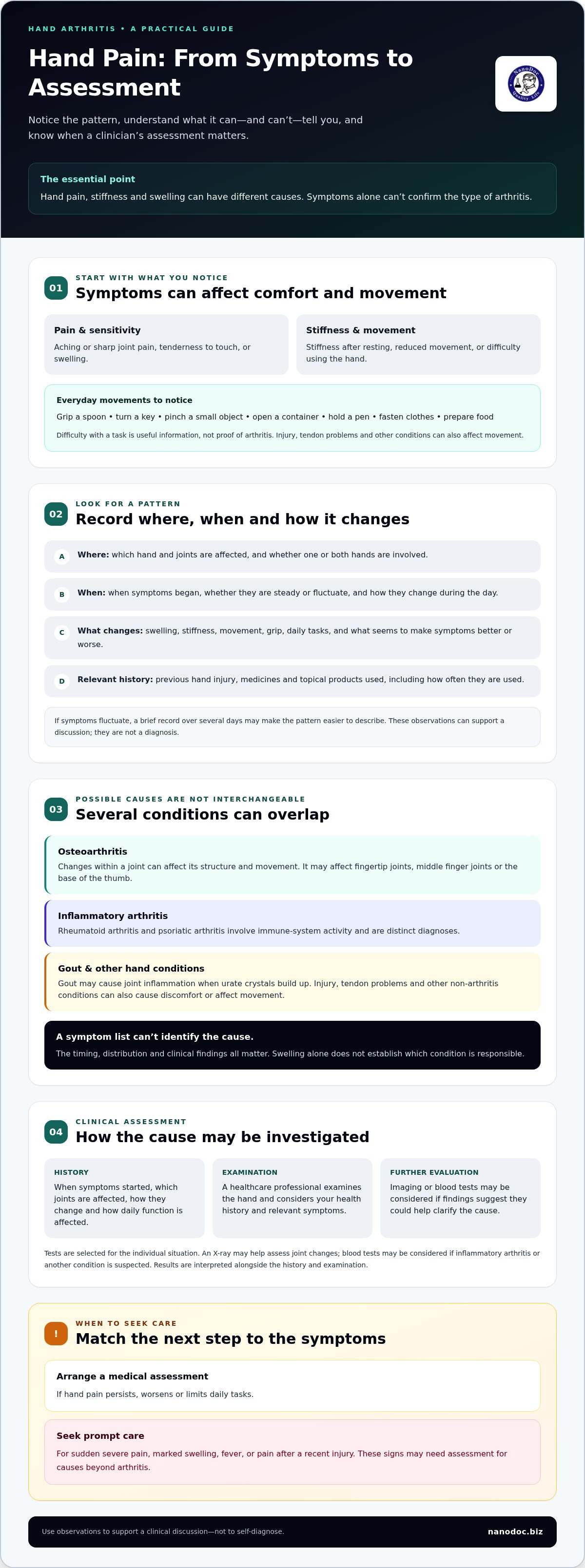
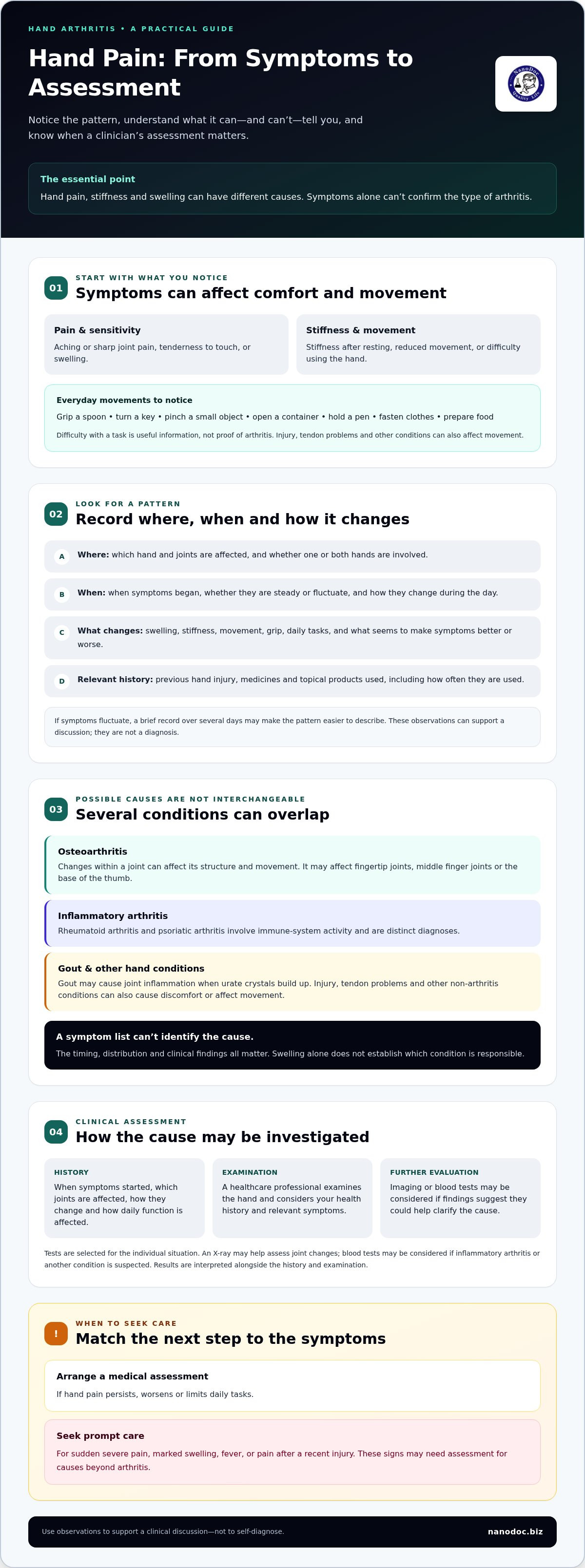
Persistent hand pain can make ordinary tasks harder, from gripping a spoon or fastening clothes to preparing food or writing. Hand arthritis refers to a group of joint conditions that can cause pain and affect movement and everyday function. Symptoms may include aching or sharp joint pain, stiffness, swelling, tenderness to touch and reduced movement. The pattern varies depending on the joints affected, the underlying cause and the person.
For example, osteoarthritis may affect joints at the fingertips, in the middle of the fingers or at the base of the thumb. The Osteoarthritis of the hand overview provides background on how osteoarthritis affects joints, but a symptom list can’t establish the cause of your pain. Inflammatory arthritis and non-arthritis conditions can produce overlapping symptoms.
Pay attention to how symptoms change rather than relying on one sign. You might notice stiffness after resting, tenderness around one joint or swelling that makes a ring feel tight. Record which hand and joints are affected, whether symptoms change during the day and which activities have become difficult. These observations can help you describe the problem during an assessment, but they aren’t a diagnosis.
Which hand movements may become painful?
Symptoms may become noticeable during movements that require grip strength, thumb pressure or finger coordination. You might find it harder to turn a key, pinch a small object, open a container or hold a pen. Note the task and the joints involved, such as the base of the thumb or a finger joint. Difficulty with an activity is useful information, not proof of arthritis. Injury, tendon problems and other conditions can also affect movement.
When should hand pain be assessed?
Arrange a medical assessment if pain persists, worsens or limits daily tasks. Seek prompt care for sudden severe pain, marked swelling, fever or pain after a recent injury. These signs may need assessment for causes beyond arthritis. A healthcare professional can review your symptoms and health history, examine the affected hand and decide whether further evaluation is appropriate. The cause matters because it guides which relief options are suitable.
Before an appointment, make a concise symptom record. Include when the pain began, which joints are affected, whether one or both hands are involved, and what makes symptoms better or worse. Note changes in swelling, stiffness and movement, as well as tasks you’ve had to adapt or avoid. If symptoms fluctuate, a brief record over several days may make the pattern easier to describe. This helps focus a discussion about pain relief for arthritis in hands Singapore on assessment rather than self-diagnosis.
What causes arthritis pain in the hands, and how is it identified?
Hand arthritis describes different joint conditions, not one diagnosis with a single cause. Osteoarthritis involves changes within a joint that can affect its structure and movement. Inflammatory forms, including rheumatoid arthritis and psoriatic arthritis, involve immune-system activity and may cause joint inflammation. Gout can also affect hand joints. Because these conditions can share symptoms, a checklist can’t reliably identify which one is responsible.
Hand pain has multiple possible causes and requires clinical assessment for diagnosis. A healthcare professional considers the overall pattern rather than relying on one symptom or a self-assessment. HealthHub’s overview, contributed by the National University Hospital (NUH), provides Singapore-specific context on arthritis and its assessment.
How do common types of hand arthritis differ?
In osteoarthritis, changes to cartilage and other joint structures can contribute to pain and restricted movement. Rheumatoid and psoriatic arthritis are inflammatory conditions, but they’re distinct diagnoses and don’t affect everyone in the same way. Gout may cause joint inflammation when urate crystals build up. Swelling alone doesn’t identify the cause. The timing, distribution and clinical findings all matter.
What might a clinical assessment include?
An assessment may begin with questions about when symptoms started, which joints are affected, how symptoms change over time and how they affect daily function. The healthcare professional may also ask about your medical history, previous injuries and other relevant symptoms. They’ll examine the hand and may consider imaging or blood tests if the findings suggest these could help clarify the cause.
Tests are selected for the individual situation. An X-ray may help assess joint changes, while blood tests may be considered if inflammatory arthritis or another condition is suspected. No single test necessarily answers every question. Results are interpreted alongside your history and examination, so neither a test result nor a symptom pattern should be used alone to label hand pain.
To make the appointment more productive, bring a concise record of:
- When symptoms began and whether they are steady or fluctuate.
- Which joints are affected and whether symptoms involve one or both hands.
- Changes in movement, grip or everyday activities, and any previous hand injury.
- Medicines or topical products you use, including how often you use them.
A clearer understanding of the cause can guide decisions about pain relief for arthritis in hands Singapore, including whether topical comfort support is suitable alongside clinician-directed care. NanoDoc’s Pain Relief Care options are a topical category to consider as part of a broader plan, not a substitute for diagnosis or arthritis treatment.
Comparing Hand Arthritis Relief: Care & Topical Options
There isn’t one approach that suits every painful hand. The right plan depends on the type of arthritis, symptoms, health history and clinical assessment. Some options focus on identifying and treating the underlying condition; others may help reduce strain or provide comfort during daily activities. They can work together as parts of a broader plan.
| Option | Potential role | What to consider |
|---|---|---|
| Clinician-guided care | Assessment can clarify the cause and inform treatment, including medicines or other care suited to the diagnosis. | Choices depend on the condition, symptoms, medical history and possible medicine risks. A product for temporary comfort isn’t a substitute for diagnosis or clinician-directed care. |
| Activity adjustments | Pacing demanding tasks, taking breaks and changing how you hold or carry objects may reduce repeated strain. | Adjustments can make tasks more manageable, but they don’t identify or treat the underlying cause. Avoid pushing through worsening pain. |
| Splints or supports | A suitable device may support a joint during particular activities or periods of discomfort. | Fit and use depend on the affected joint and symptoms. Discuss options with a healthcare professional rather than assuming one support suits every hand. |
| Topical comfort products | A gel may be considered for local comfort as one element of a wider approach. | Follow the product label and relevant professional advice. Topical products shouldn’t be described as reversing joint changes or as a stand-alone arthritis treatment. |
For topical comfort support as part of a wider plan, NanoDoc Pain Relief Care is one option.
What can non-product approaches contribute?
Small adjustments can reduce the demands a task places on sore joints. Break a longer activity into shorter steps, alternate heavier tasks with lighter ones and use a comfortable grip where possible. Maintaining comfortable hand movement may support function, but the right movements depend on the diagnosis and symptoms. Ask a healthcare professional whether specific exercises or a splint are appropriate for you.
Where might a topical pain-relief gel fit?
A topical gel may provide comfort support, but it can’t diagnose arthritis, replace clinician-directed care or reverse structural joint changes. Follow the product’s label, including its directions and warnings, and seek professional advice if you’re unsure how it fits with other medicines or care. NanoDoc’s formulations use nano-delivery technology and are independently tested for nanoparticle size and quality. Those quality tests don’t establish arthritis-specific clinical outcomes.
When considering pain relief for arthritis in hands Singapore, compare options by the role each can play and its limits. A layered plan can combine appropriate clinical care with practical adjustments and suitable comfort support, guided by the cause of symptoms and your individual needs.
A safer everyday plan for hand arthritis pain in Singapore
A manageable routine can help you notice patterns, reduce unnecessary strain and use comfort products thoughtfully. It won’t identify the cause of hand pain, but a clear record can help you explain what’s changing and support a more useful discussion with a healthcare professional. HealthHub’s hand and wrist arthritis overview offers additional local educational context.
- Observe and record. Note which joints are affected, when symptoms occur, what seems to trigger or ease them, and how they affect tasks such as dressing, cooking or writing. Include changes in stiffness, swelling or movement.
- Adapt demanding tasks. Break prolonged or forceful activities into shorter periods and alternate them with lighter tasks. Use a larger grip or both hands where comfortable and practical, rather than repeatedly placing pressure on a sore joint.
- Use products as directed. Follow the label for any medicine or topical product. Don’t assume that using more or applying it more often will improve comfort. Keep a note of what you use so you can discuss it with a healthcare professional.
- Arrange assessment when needed. Seek professional advice if symptoms persist, worsen or interfere with daily function, or if you’re uncertain about the cause or appropriate relief options.
Self-management can support comfort, but it can’t replace professional diagnosis or treatment. Activity changes may make specific tasks easier, but they don’t suit everyone or guarantee that arthritis will not progress. If an adjustment increases pain or makes movement harder, stop and seek advice about a more suitable approach.
How can daily tasks be adjusted?
Consider where a task places the most demand on your hand. For example, carrying a bag by narrow handles may require a tight grip. A broader handle, splitting the load or carrying it with both hands may feel more manageable. Prepare ingredients in stages instead of doing every hand-intensive task at once. Keep movement within your comfort and ability, and ask a professional before starting a specific exercise or using a support.
What information should you prepare for an appointment?
Along with your symptom log, write down when symptoms began, which joints are involved and what makes them better or worse. Include any swelling, stiffness, previous hand injury, medicines and relevant health conditions. Bringing product packaging or a list of topical products can help clarify what you’re using.
Useful questions include: What causes should we consider? Are any tests appropriate? Which relief options suit my health history? Could a topical product interact with my medicines or other treatments? These questions connect symptom observations to a safer, individual plan for pain relief for arthritis in hands Singapore. If topical comfort support is part of that plan, NanoDoc Pain Relief Care is available to explore.
NanoDoc Pain Relief Care: A Topical Option for Hand Pain
NanoDoc’s Pain Relief Care category includes pain-relief gels that may be considered as topical comfort support within a broader plan. A topical product can be one part of managing discomfort, but it doesn’t diagnose the cause of hand pain or replace assessment and care directed by a healthcare professional. Suitability depends on the individual and the product’s specific instructions.
NanoDoc’s formulations use nano-delivery technology, and nanoparticle size and quality are independently laboratory-tested. These details describe the formulation approach and quality testing. They should be considered separately from evidence that a product improves symptoms in a particular condition.
What nano-delivery and laboratory testing can, and cannot, tell you
Nano-delivery refers to a formulation approach involving nanoparticles. The term alone doesn’t demonstrate that a topical product will provide greater relief, reach a specific joint or change the course of arthritis. Independent testing of nanoparticle size and quality provides information about those tested characteristics, but it doesn’t establish clinical effectiveness for hand arthritis. Keep this distinction in mind when comparing product information with evidence about health outcomes.
For readers considering pain relief for arthritis in hands Singapore, this distinction helps set realistic expectations. A quality-testing statement isn’t the same as research showing a product benefits people with arthritis in the hands. A formulation description also doesn’t establish that the product can reverse cartilage or other joint changes. Treat topical care as a potential comfort measure, not a cure or substitute for diagnosis.
How to consider a topical product responsibly
Start with the specific product label. Read its directions and warnings, and use it only as instructed. Don’t assume that directions for one gel apply to another, or increase use because discomfort continues. If symptoms persist or worsen, seek professional assessment rather than relying on a topical product alone.
Discuss topical product use with a healthcare professional if you take medicines, have other health conditions or aren’t sure whether a product is appropriate for you. Share the product label or ingredient information where available, and mention any other treatments you’re using. This can help the professional consider your overall health context and advise on safe use.
NanoDoc’s Pain Relief Care is topical comfort support to consider within an informed, individual plan. Formulation technology and nanoparticle quality testing provide product information, while decisions about arthritis diagnosis and treatment belong in a clinical assessment. Explore NanoDoc Pain Relief Care.
Make your next step a considered one
Hand comfort is best approached as an ongoing decision, not a search for one perfect remedy. Focus on a practical goal that matters to you, such as completing a daily task with less difficulty. Discuss that goal with a healthcare professional so care choices reflect your diagnosis, health history and response over time.
For pain relief for arthritis in hands Singapore, topical comfort support may be one option within that broader plan. NanoDoc International Pte Ltd is the South-East Asia representative for LG Bionano, and its Pain Relief Care category offers topical products for people exploring this type of support. A product should complement, not replace, appropriate clinical care.
To learn more about this topical option, explore NanoDoc Pain Relief Care. Take the next step at a manageable pace, with safer, more informed everyday comfort in mind.
Frequently Asked Questions
Is hand arthritis reversible?
Most structural changes from osteoarthritis aren’t reversible, but symptoms and function can often be managed. Inflammatory arthritis may respond to treatment that controls disease activity. The outlook depends on the specific diagnosis and how it affects you. Relief doesn’t necessarily mean joint changes have disappeared. A healthcare professional can explain what improvement is realistic for your condition and whether treatment aims to reduce symptoms, limit further damage or both.
Can hand arthritis affect both hands?
Yes. Hand arthritis can affect both hands, though it may not affect them equally. One hand or particular joints may be more painful or stiff than others, depending on the condition and individual factors. Compare the hands and note differences in swelling, movement or strength. If symptoms appear in several joints or change quickly, share that pattern during an assessment rather than assuming both hands have the same cause.
How much pain relief can a topical gel provide for hand arthritis?
The amount of relief varies with the product, the cause of pain and the person using it. There isn’t one reliable figure for every gel. Some topical medicines have evidence for particular types of arthritis, while other gels may be intended for comfort without established arthritis-specific benefit. Check the product’s active ingredients and label, and ask a healthcare professional what evidence applies to your situation before relying on it.
Is it safe to use a pain-relief gel with arthritis medication?
It depends on the gel’s ingredients and the medicines you take, so don’t assume every topical product can be combined safely. Some gels contain active medicines that may have precautions or contribute to side effects, even when applied to the skin. Check the label and ask a doctor or pharmacist about your specific combination, especially if you use oral painkillers, take several medicines or have other health conditions.
What happens if hand arthritis is left untreated?
The effects vary by arthritis type. Some people experience ongoing pain or reduced movement, while certain inflammatory conditions can damage joints if disease activity isn’t controlled. This doesn’t mean every case inevitably worsens at the same rate. Delaying assessment may also leave another cause of hand pain unidentified. Seek professional advice if symptoms persist, progress or interfere with tasks so the cause and appropriate care can be considered.
Can hand exercises make arthritis pain worse?
They can aggravate symptoms if the movement is too forceful, repetitive or unsuitable for the affected joint. Gentle movement may be appropriate for some people, but exercise should be adjusted to your symptoms and diagnosis. Stop a movement that causes sharp pain or a clear increase in discomfort, and ask a healthcare professional about suitable options. Don’t use pain during exercise as a sign that the activity is working.
Does cold or damp weather worsen arthritis pain in the hands?
Some people notice more stiffness or discomfort during colder or damp conditions, but responses differ, and weather doesn’t establish the cause of joint pain. A change in symptoms doesn’t necessarily mean arthritis is progressing. If cold seems to affect your comfort, note when it happens and whether warmth or changes to your routine help. Seek assessment for persistent or worsening symptoms rather than attributing them to the weather alone.
For topical comfort support, explore NanoDoc Pain Relief Care as one part of a broader, clinically informed plan.
Frequently Asked Questions
- Which hand movements may become painful?
- Symptoms may become noticeable during movements that require grip strength, thumb pressure or finger coordination. You might find it harder to turn a key, pinch a small object, open a container or hold a pen. Note the task and the joints involved, such as the base of the thumb or a finger joint. Difficulty with an activity is useful information, not proof of arthritis. Injury, tendon problems and other conditions can also affect movement.
- When should hand pain be assessed?
- Arrange a medical assessment if pain persists, worsens or limits daily tasks. Seek prompt care for sudden severe pain, marked swelling, fever or pain after a recent injury. These signs may need assessment for causes beyond arthritis. A healthcare professional can review your symptoms and health history, examine the affected hand and decide whether further evaluation is appropriate. The cause matters because it guides which relief options are suitable. Before an appointment, make a concise symptom record. Include when the pain began, which joints are affected, whether one or both hands are involved, and what makes symptoms better or worse. Note changes in swelling, stiffness and movement, as well as tasks you’ve had to adapt or avoid. If symptoms fluctuate, a brief record over several days may make the pattern easier to describe. This helps focus a discussion about pain relief for arthritis in hands Singapore on assessment rather than self-diagnosis. Hand arthritis describes different joint conditions, not one diagnosis with a single cause. Osteoarthritis involves changes within a joint that can affect its structure and movement. Inflammatory forms, including rheumatoid arthritis and psoriatic arthritis, involve immune-system activity and may cause joint inflammation. Gout can also affect hand joints. Because these conditions can share symptoms, a checklist can’t reliably identify which one is responsible. Hand pain has multiple possible causes and requires clinical assessment for diagnosis. A healthcare professional considers the overall pattern rather than relying on one symptom or a self-assessment. HealthHub’s overview, contributed by the National University Hospital (NUH), provides Singapore-specific context on arthritis and its assessment.
- How do common types of hand arthritis differ?
- In osteoarthritis, changes to cartilage and other joint structures can contribute to pain and restricted movement. Rheumatoid and psoriatic arthritis are inflammatory conditions, but they’re distinct diagnoses and don’t affect everyone in the same way. Gout may cause joint inflammation when urate crystals build up. Swelling alone doesn’t identify the cause. The timing, distribution and clinical findings all matter.
- What might a clinical assessment include?
- An assessment may begin with questions about when symptoms started, which joints are affected, how symptoms change over time and how they affect daily function. The healthcare professional may also ask about your medical history, previous injuries and other relevant symptoms. They’ll examine the hand and may consider imaging or blood tests if the findings suggest these could help clarify the cause. Tests are selected for the individual situation. An X-ray may help assess joint changes, while blood tests may be considered if inflammatory arthritis or another condition is suspected. No single test necessarily answers every question. Results are interpreted alongside your history and examination, so neither a test result nor a symptom pattern should be used alone to label hand pain. To make the appointment more productive, bring a concise record of: A clearer understanding of the cause can guide decisions about pain relief for arthritis in hands Singapore, including whether topical comfort support is suitable alongside clinician-directed care. NanoDoc’s Pain Relief Care options are a topical category to consider as part of a broader plan, not a substitute for diagnosis or arthritis treatment. There isn’t one approach that suits every painful hand. The right plan depends on the type of arthritis, symptoms, health history and clinical assessment. Some options focus on identifying and treating the underlying condition; others may help reduce strain or provide comfort during daily activities. They can work together as parts of a broader plan. For topical comfort support as part of a wider plan, NanoDoc Pain Relief Care is one option.
- What can non-product approaches contribute?
- Small adjustments can reduce the demands a task places on sore joints. Break a longer activity into shorter steps, alternate heavier tasks with lighter ones and use a comfortable grip where possible. Maintaining comfortable hand movement may support function, but the right movements depend on the diagnosis and symptoms. Ask a healthcare professional whether specific exercises or a splint are appropriate for you.
- Where might a topical pain-relief gel fit?
- A topical gel may provide comfort support, but it can’t diagnose arthritis, replace clinician-directed care or reverse structural joint changes. Follow the product’s label, including its directions and warnings, and seek professional advice if you’re unsure how it fits with other medicines or care. NanoDoc’s formulations use nano-delivery technology and are independently tested for nanoparticle size and quality. Those quality tests don’t establish arthritis-specific clinical outcomes. When considering pain relief for arthritis in hands Singapore, compare options by the role each can play and its limits. A layered plan can combine appropriate clinical care with practical adjustments and suitable comfort support, guided by the cause of symptoms and your individual needs. A manageable routine can help you notice patterns, reduce unnecessary strain and use comfort products thoughtfully. It won’t identify the cause of hand pain, but a clear record can help you explain what’s changing and support a more useful discussion with a healthcare professional. HealthHub’s hand and wrist arthritis overview offers additional local educational context. Self-management can support comfort, but it can’t replace professional diagnosis or treatment. Activity changes may make specific tasks easier, but they don’t suit everyone or guarantee that arthritis will not progress. If an adjustment increases pain or makes movement harder, stop and seek advice about a more suitable approach.
- How can daily tasks be adjusted?
- Consider where a task places the most demand on your hand. For example, carrying a bag by narrow handles may require a tight grip. A broader handle, splitting the load or carrying it with both hands may feel more manageable. Prepare ingredients in stages instead of doing every hand-intensive task at once. Keep movement within your comfort and ability, and ask a professional before starting a specific exercise or using a support.
- What information should you prepare for an appointment?
- Along with your symptom log, write down when symptoms began, which joints are involved and what makes them better or worse. Include any swelling, stiffness, previous hand injury, medicines and relevant health conditions. Bringing product packaging or a list of topical products can help clarify what you’re using. Useful questions include: What causes should we consider? Are any tests appropriate? Which relief options suit my health history? Could a topical product interact with my medicines or other treatments? These questions connect symptom observations to a safer, individual plan for pain relief for arthritis in hands Singapore. If topical comfort support is part of that plan, NanoDoc Pain Relief Care is available to explore. NanoDoc’s Pain Relief Care category includes pain-relief gels that may be considered as topical comfort support within a broader plan. A topical product can be one part of managing discomfort, but it doesn’t diagnose the cause of hand pain or replace assessment and care directed by a healthcare professional. Suitability depends on the individual and the product’s specific instructions. NanoDoc’s formulations use nano-delivery technology, and nanoparticle size and quality are independently laboratory-tested. These details describe the formulation approach and quality testing. They should be considered separately from evidence that a product improves symptoms in a particular condition.
- Is hand arthritis reversible?
- Most structural changes from osteoarthritis aren’t reversible, but symptoms and function can often be managed. Inflammatory arthritis may respond to treatment that controls disease activity. The outlook depends on the specific diagnosis and how it affects you. Relief doesn’t necessarily mean joint changes have disappeared. A healthcare professional can explain what improvement is realistic for your condition and whether treatment aims to reduce symptoms, limit further damage or both.
- Can hand arthritis affect both hands?
- Yes. Hand arthritis can affect both hands, though it may not affect them equally. One hand or particular joints may be more painful or stiff than others, depending on the condition and individual factors. Compare the hands and note differences in swelling, movement or strength. If symptoms appear in several joints or change quickly, share that pattern during an assessment rather than assuming both hands have the same cause.
- How much pain relief can a topical gel provide for hand arthritis?
- The amount of relief varies with the product, the cause of pain and the person using it. There isn’t one reliable figure for every gel. Some topical medicines have evidence for particular types of arthritis, while other gels may be intended for comfort without established arthritis-specific benefit. Check the product’s active ingredients and label, and ask a healthcare professional what evidence applies to your situation before relying on it.
- Is it safe to use a pain-relief gel with arthritis medication?
- It depends on the gel’s ingredients and the medicines you take, so don’t assume every topical product can be combined safely. Some gels contain active medicines that may have precautions or contribute to side effects, even when applied to the skin. Check the label and ask a doctor or pharmacist about your specific combination, especially if you use oral painkillers, take several medicines or have other health conditions.
- What happens if hand arthritis is left untreated?
- The effects vary by arthritis type. Some people experience ongoing pain or reduced movement, while certain inflammatory conditions can damage joints if disease activity isn’t controlled. This doesn’t mean every case inevitably worsens at the same rate. Delaying assessment may also leave another cause of hand pain unidentified. Seek professional advice if symptoms persist, progress or interfere with tasks so the cause and appropriate care can be considered.
- Can hand exercises make arthritis pain worse?
- They can aggravate symptoms if the movement is too forceful, repetitive or unsuitable for the affected joint. Gentle movement may be appropriate for some people, but exercise should be adjusted to your symptoms and diagnosis. Stop a movement that causes sharp pain or a clear increase in discomfort, and ask a healthcare professional about suitable options. Don’t use pain during exercise as a sign that the activity is working.
- Does cold or damp weather worsen arthritis pain in the hands?
- Some people notice more stiffness or discomfort during colder or damp conditions, but responses differ, and weather doesn’t establish the cause of joint pain. A change in symptoms doesn’t necessarily mean arthritis is progressing. If cold seems to affect your comfort, note when it happens and whether warmth or changes to your routine help. Seek assessment for persistent or worsening symptoms rather than attributing them to the weather alone. For topical comfort support, explore NanoDoc Pain Relief Care as one part of a broader, clinically informed plan.