

What if the word “cosmeceutical” tells you less than the ingredient list and evidence behind the product? If you’re comparing cosmeceutical skin care products, you’ve likely seen the term used in different ways, alongside technical claims that can be difficult to assess. The label alone doesn’t establish how a formula was developed or whether its promises are supported.
A more useful comparison starts with what the product contains, how the formulation is designed, and whether the available evidence relates to the claims being made. Delivery technologies are formulation features to evaluate, not guarantees of visible or clinical results. Clear information about testing matters too: check what was tested and what the results can verify.
This guide will help you assess products against your skin needs, examine ingredient and delivery-system claims, and look for meaningful evidence and quality information. You’ll also learn what the cosmeceutical category does and doesn’t tell you, so you can identify sensible next steps without relying on exaggerated promises.
Key Takeaways
- Choose one realistic skin priority to narrow your options, then check each product’s ingredients, directions, and suitability information.
- Compare cosmeceutical skin care products by intended use, formulation details, relevant evidence, and fit with your existing routine.
- Understand how the stratum corneum, the skin’s outer barrier, provides context for evaluating topical delivery claims.
- Assess nano-delivery and conventional formulations using the same criteria rather than assuming a delivery system means better results.
- Interpret NanoDoc’s stated testing for nanoparticle size and quality without treating it as proof of clinical outcomes.
Table of Contents
- What Are Cosmeceutical Skin Care Products, and What Does the Term Tell You?
- How to Compare Cosmeceutical Formulations, Ingredients, and Evidence
- Nano-Delivery and Conventional Skincare: What Should You Compare?
- How to Choose Cosmeceutical Skin Care Products for Your Needs
- How NanoDoc Approaches Cosmeceutical Skin Care Products
What Are Cosmeceutical Skin Care Products, and What Does the Term Tell You?
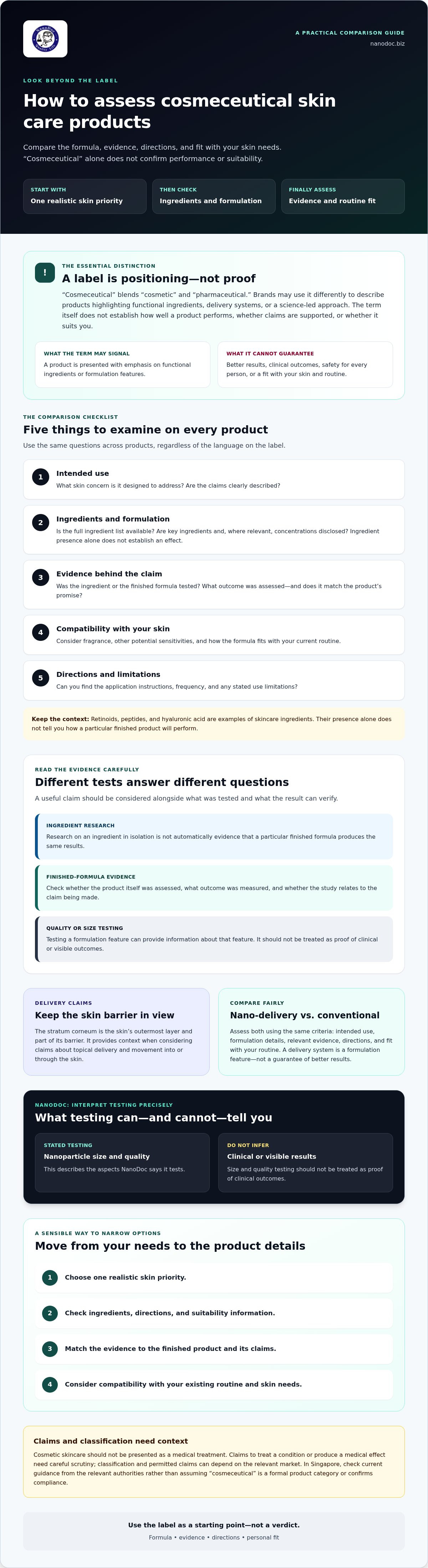
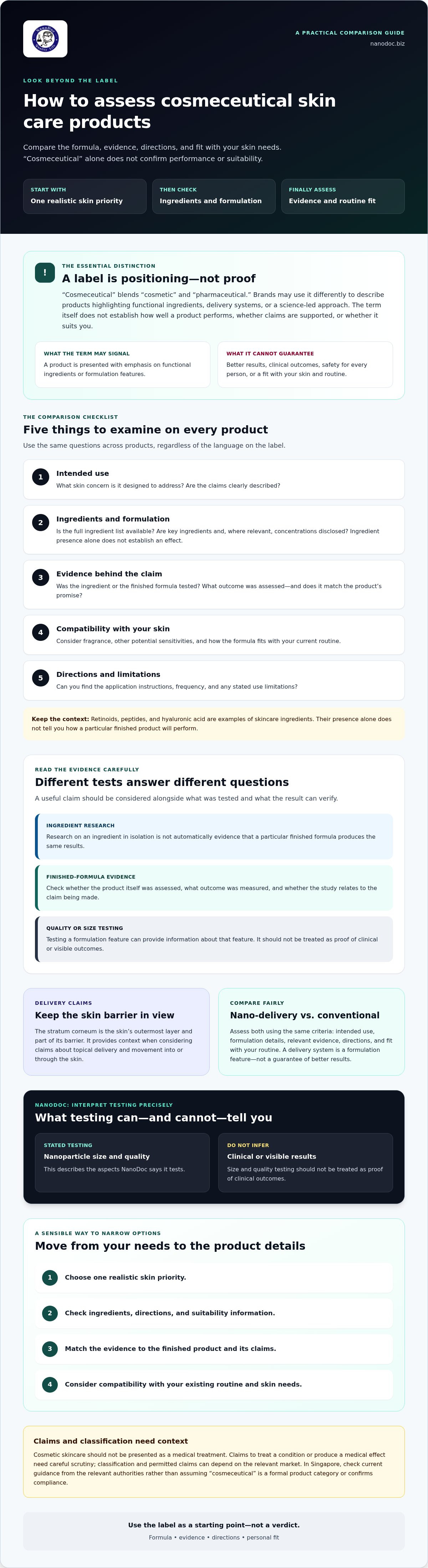
A cosmeceutical is a cosmetic product positioned around functional ingredients or formulation features associated with skin benefits. The term describes how a brand presents a product, but it doesn’t establish how well the product performs, whether its claims are supported, or whether it suits a particular person. For mature skin, a technical-sounding label is no substitute for checking the formula and the evidence.
The term blends “cosmetic” and “pharmaceutical” and is used in product descriptions for skincare that highlights active ingredients, delivery systems, or a science-led approach. The Cosmeceutical overview provides background on the term and how it has been used. Brands may apply it differently, so treat it as positioning language and assess the product itself.
How Are Cosmeceuticals Different from Ordinary Skincare?
Cosmeceuticals are often presented with a stronger focus on functional ingredients or formulation technology than products described simply as everyday skincare. That’s a difference in emphasis, not a strict dividing line between two consistent product classes. Products can vary in ingredients, concentrations, combinations, and directions, even when their marketing language sounds similar.
Look beyond the category name. An ingredient’s presence alone doesn’t show how much is in the formula, how it is used, or what evidence supports the finished product’s claims. Cosmetic skincare should not be presented as a medical treatment. Claims to treat a condition or produce a medical effect need careful scrutiny, and classification depends on the rules that apply in the relevant market.
Does the Cosmeceutical Label Guarantee Better Results?
No. The label itself doesn’t guarantee performance or individual suitability. A product may contain an ingredient that has been studied, but research on an ingredient in isolation isn’t automatically evidence that a particular finished formula produces the same results. The formula, concentration, application instructions, and study design all affect how relevant that evidence is.
Assess each claim in context. Ask whether the evidence concerns the finished formula or only one ingredient, and whether it measures an outcome that matches the product’s promise. Then consider your skin needs and tolerance. A formulation can be well described yet still be unsuitable for you.
Classification and permitted claims can depend on market-specific requirements. In Singapore, check current guidance from the relevant authorities rather than assuming that “cosmeceutical” is a formal product category or that the term alone confirms compliance. Use the label as a starting point, not a verdict on safety, efficacy, or fit.
How to Compare Cosmeceutical Formulations, Ingredients, and Evidence
A useful comparison goes beyond the headline ingredient. Check what the product is intended for, what the manufacturer discloses, what evidence supports its claims, and whether its directions suit your skin and routine. Use the table as a practical starting point.
| What to compare | Questions to ask |
|---|---|
| Intended use | What skin concern is the product designed to address, and are its claims clearly described? |
| Ingredients | Is the ingredient list available? Are key ingredients identified, and are concentrations disclosed where relevant? |
| Evidence | Was the ingredient or the finished formulation tested? What outcome was assessed? |
| Compatibility | Do fragrance or other ingredients raise concerns based on your sensitivities or current routine? |
| Directions | Are application instructions, frequency, and use limitations easy to find? |
Which Formulation Details Should Buyers Check?
Start with the full ingredient list, directions, intended skin concern, and any stated limitations. Retinoids, peptides, and hyaluronic acid are examples of ingredients used in skincare, but their presence alone doesn’t establish a product’s effect. Formulas differ in composition and concentration. Check fragrance and other potential sensitivities against your own needs, and consider how the product fits with the rest of your routine.
The skin barrier, including the outermost layer known as the stratum corneum, helps limit the movement of substances into and through the skin. This is useful context for topical claims: an ingredient’s properties or a delivery system’s design don’t, by themselves, show how a finished product behaves on skin.
What Evidence Supports a Skincare Claim?
Look for specifics: what was tested, how it was tested, and whether the tested formulation matches the product being sold. Research on an ingredient may provide background, but it doesn’t automatically demonstrate the same outcome for every product containing that ingredient. The formula, its use, and the measure of success all matter.
A delivery-system claim needs product-specific context because the technology’s description alone doesn’t establish what the finished formula does on skin. Quality testing and clinical efficacy evidence answer different questions. NanoDoc states that its formulations are independently laboratory-tested for nanoparticle size and quality. That describes testing of formulation characteristics, not proof of a clinical skin outcome. NanoDoc’s anti-ageing skincare is one example of a product category where delivery-technology claims and quality testing should be assessed separately.
Nano-Delivery and Conventional Skincare: What Should You Compare?
Nano-delivery describes a formulation approach, not a result. Compare it with a conventional formulation using the same practical factors: disclosed composition, intended use, supporting data, directions, and compatibility with your routine. Technical language may explain how a formula is designed, but it doesn’t establish that it will work better for your skin.
What Can Nano-Delivery Technology Tell You?
A delivery system is one part of a finished formulation. To assess a nano-delivery claim, look for a clear description of the technology and information about the testing behind it. NanoDoc states that its formulations are independently tested for nanoparticle size and quality. Check what reports are available and exactly what those tests verify before drawing conclusions.
Particle-size data can describe a technical characteristic. On its own, it doesn’t show how a product behaves on skin or prove a consumer benefit. Claims about enhanced absorption, deeper penetration, or better outcomes need relevant evidence for the specific formulation and intended use. Don’t infer those results from the word “nano” alone.
When Might a Conventional Formulation Be the Better Fit?
A conventional formulation may be a sensible choice if its ingredients are well disclosed, its directions are straightforward, and it fits your existing routine. If a technology adds complexity without clear evidence relevant to your concern, it may not help you make a better-informed choice. Novelty is not a substitute for suitability.
Use this balanced check for any of the cosmeceutical skin care products you’re considering:
- Potential value of nano-delivery: It identifies a formulation feature worth evaluating when its design and supporting data are clearly explained.
- Limit to verify: Claims of improved absorption or results aren’t established by particle-size testing alone. Look for evidence tied to the finished product and the specific claim.
- Potential value of a conventional formula: A straightforward composition and clear directions can make routine compatibility easier to assess.
- Limit to verify: “Conventional” doesn’t automatically mean more suitable or better supported. Review its ingredients and evidence using the same criteria.
In either case, prioritise tolerance and practical fit. Compare what each product discloses, what its supporting information demonstrates, and whether its instructions work for you. Treat performance claims that go beyond the available product-specific evidence as questions to verify, not established advantages.
How to Choose Cosmeceutical Skin Care Products for Your Needs
A product is easier to assess when you know what you want it to do in your routine. Mature skin needs and ingredient tolerance vary, so start with your own priority rather than choosing several products based on broad age-related claims. If symptoms are persistent, severe, or medically concerning, seek advice from a qualified healthcare professional.
Use this checklist: define one skin priority, review the ingredients and directions, assess relevant evidence and suitability, then introduce the product cautiously.
A Practical Selection Process
- Choose one realistic priority. Identify the main concern you want your skincare routine to address rather than trying to change several things at once. This gives you a clearer basis for comparing options.
- Review the ingredient list. Check the full list for ingredients you know you may not tolerate, including fragrance if it’s a concern for you. A highlighted ingredient doesn’t tell you everything about the formula.
- Read the directions and precautions. Note how the product is intended to be applied, how often it should be used, and any stated limitations. Directions are part of the product’s practical fit, not an afterthought.
- Assess the evidence and suitability information. Look for information relevant to the finished product and its stated use. Consider whether the product’s intended skin concern aligns with your priority and whether its guidance addresses your needs.
- Add it cautiously. Follow the product’s stated directions and avoid changing several parts of your routine at once. A measured approach makes it easier to notice how the new product fits your routine.
Check Compatibility, Directions, and Routine Fit
Before adding a product, consider what you already use and whether the combined routine remains manageable. Introducing several new products at once can make it difficult to identify which one may be associated with a reaction or discomfort. Where practical, add one new product at a time and follow its label rather than increasing use on your own.
A simple record can help you keep track without making diagnostic conclusions. Note the product, when you started using it, how you followed the directions, and any changes you notice. If an unexpected reaction occurs, follow the product’s safety guidance and seek qualified advice if symptoms are concerning.
Use these steps to compare cosmeceutical skin care products against your own priorities, not just their technical language. To explore NanoDoc’s anti-ageing skincare category, view anti-ageing skincare options and assess the available product information using the same criteria.
How NanoDoc Approaches Cosmeceutical Skin Care Products
After comparing products by intended use, ingredients, evidence, and routine fit, apply the same criteria to NanoDoc’s anti-ageing skincare category. NanoDoc International is the South East Asia representative of LG Bionano and offers formulations using its patented bionano nano-delivery technology. This describes a formulation feature, not a promise of visible change or clinical results.
What NanoDoc’s Technology and Testing Information Covers
NanoDoc states that its formulations are independently laboratory-tested for nanoparticle size and quality. These tests can characterise specified formulation properties, but they don’t by themselves show how a product performs on skin or establish clinical efficacy. To understand what the testing supports, look for documentation that identifies the formulations tested, the methods used, and the results covered. The scope matters as much as the word “independent.”
NanoDoc describes the LG Bionano technology as patented. Patent information and laboratory testing address different questions, and neither alone demonstrates that a product will suit every user or deliver a particular skincare outcome.
For a careful assessment, separate the information into three parts:
- Formulation feature: What does the product information say about its nano-delivery approach?
- Quality testing: What do the available reports verify about particle size and quality?
- Product outcomes: Is there evidence for the finished formulation and the specific benefit being claimed?
This distinction helps keep technical specifications in perspective. Particle-size information can describe a measurable characteristic, but it should not be translated into claims about skin penetration, absorption, or results unless relevant evidence supports those claims.
How to Take the Next Step with Confidence
Review the information for each formulation against the priorities established earlier in this guide. Check its ingredient information, intended use, directions, precautions, and suitability details. If a claim is unclear, look for supporting documentation that explains what was tested and what the findings can reasonably establish.
Nano-delivery may be relevant to your comparison, but it need not determine your choice. The product still needs to fit your skin needs and routine, and its available evidence should match the claims that matter to you. Apply the same measured standard you would use for any skincare formulation.
To review NanoDoc’s available skincare information and product details, explore NanoDoc’s skincare range.
Choose Your Next Skincare Step with Confidence
Choose cosmeceutical skin care products by how well their disclosed formulation, evidence, directions, and suitability information align with your skin needs, not by the label or technical language alone. Ingredient research and delivery-system details can inform a comparison, but they don’t automatically prove that a finished product will deliver a particular result or suit every user.
NanoDoc states that its formulations undergo independent testing for nanoparticle size and quality. Review any available supporting documentation to confirm what was tested and what the results establish. NanoDoc is the South East Asia representative of LG Bionano. Keep the scope of any testing and patent information in perspective: neither alone demonstrates a skincare benefit.
Ready to compare the available product information with your priorities and routine? Explore NanoDoc’s skincare range and make a considered choice that fits your needs.
Frequently Asked Questions
What are cosmeceutical skin care products?
Cosmeceutical skin care products are cosmetic formulations positioned around functional ingredients or formulation features associated with skin benefits. The term combines “cosmetic” and “pharmaceutical,” but it doesn’t establish a product’s performance, safety, or suitability. Treat it as category language, then examine the ingredient list, intended use, directions, and evidence for the finished formulation.
Are cosmeceutical products better than regular skincare?
No category label can establish that a product is better than another skincare product. Formulas differ in ingredients, concentrations, directions, and supporting evidence, regardless of how they’re described. Compare products based on the concern you want to address, ingredient transparency, relevant evidence, tolerance, and routine compatibility. A technical formulation feature may be worth investigating, but it isn’t proof of superior results.
Can cosmeceutical skincare help with mature skin?
Some skincare formulations may be designed to support concerns associated with mature skin, but results depend on the particular product, its evidence, and individual suitability. Age alone doesn’t determine what your skin needs or tolerates. Check whether evidence relates to the finished formula and its intended use, and follow the directions. For persistent, severe, or medically concerning symptoms, seek advice from a qualified healthcare professional.
How do I choose cosmeceutical products for my skin type?
Start with one realistic skin priority, then review the product’s full ingredient list, directions, precautions, and suitability information. Consider your known sensitivities and current routine rather than relying on a broad skin-type label alone. Introduce one new product at a time where practical, and follow its stated directions. If you’re unsure whether a persistent or concerning skin issue needs care, consult a qualified professional.
What should I look for in cosmeceutical ingredients?
Look for a complete, readable ingredient list and clear information about the product’s intended use and directions. Consider whether ingredients such as retinoids, peptides, or hyaluronic acid are relevant to your priority, but don’t assume their presence guarantees a result. Check for fragrance or other ingredients that may not suit your sensitivities. Also distinguish general research on an ingredient from evidence on the finished product.
Does nano-delivery mean skincare absorbs more effectively?
No. Nano-delivery describes a formulation approach, but the term alone doesn’t demonstrate increased absorption, deeper penetration, or better outcomes. Ask what the delivery system is designed to do and what evidence supports claims for the specific finished formulation. Particle-size or quality testing can describe formulation characteristics, but it doesn’t establish clinical effectiveness or predict how an individual’s skin will respond.
Are cosmeceutical products regulated in Singapore?
Products sold in Singapore are subject to applicable requirements based on their nature, intended use, and claims. “Cosmeceutical” alone doesn’t confirm a product’s regulatory classification or compliance. For current details, check official Health Sciences Authority guidance and the product’s labelling and claims. Be cautious of claims that present a cosmetic product as treating or preventing a medical condition, and seek qualified advice for medical concerns.
Frequently Asked Questions
- How Are Cosmeceuticals Different from Ordinary Skincare?
- Cosmeceuticals are often presented with a stronger focus on functional ingredients or formulation technology than products described simply as everyday skincare. That’s a difference in emphasis, not a strict dividing line between two consistent product classes. Products can vary in ingredients, concentrations, combinations, and directions, even when their marketing language sounds similar. Look beyond the category name. An ingredient’s presence alone doesn’t show how much is in the formula, how it is used, or what evidence supports the finished product’s claims. Cosmetic skincare should not be presented as a medical treatment. Claims to treat a condition or produce a medical effect need careful scrutiny, and classification depends on the rules that apply in the relevant market.
- Does the Cosmeceutical Label Guarantee Better Results?
- No. The label itself doesn’t guarantee performance or individual suitability. A product may contain an ingredient that has been studied, but research on an ingredient in isolation isn’t automatically evidence that a particular finished formula produces the same results. The formula, concentration, application instructions, and study design all affect how relevant that evidence is. Assess each claim in context. Ask whether the evidence concerns the finished formula or only one ingredient, and whether it measures an outcome that matches the product’s promise. Then consider your skin needs and tolerance. A formulation can be well described yet still be unsuitable for you. Classification and permitted claims can depend on market-specific requirements. In Singapore, check current guidance from the relevant authorities rather than assuming that “cosmeceutical” is a formal product category or that the term alone confirms compliance. Use the label as a starting point, not a verdict on safety, efficacy, or fit. A useful comparison goes beyond the headline ingredient. Check what the product is intended for, what the manufacturer discloses, what evidence supports its claims, and whether its directions suit your skin and routine. Use the table as a practical starting point.
- Which Formulation Details Should Buyers Check?
- Start with the full ingredient list, directions, intended skin concern, and any stated limitations. Retinoids, peptides, and hyaluronic acid are examples of ingredients used in skincare, but their presence alone doesn’t establish a product’s effect. Formulas differ in composition and concentration. Check fragrance and other potential sensitivities against your own needs, and consider how the product fits with the rest of your routine. The skin barrier, including the outermost layer known as the stratum corneum, helps limit the movement of substances into and through the skin. This is useful context for topical claims: an ingredient’s properties or a delivery system’s design don’t, by themselves, show how a finished product behaves on skin.
- What Evidence Supports a Skincare Claim?
- Look for specifics: what was tested, how it was tested, and whether the tested formulation matches the product being sold. Research on an ingredient may provide background, but it doesn’t automatically demonstrate the same outcome for every product containing that ingredient. The formula, its use, and the measure of success all matter. A delivery-system claim needs product-specific context because the technology’s description alone doesn’t establish what the finished formula does on skin. Quality testing and clinical efficacy evidence answer different questions. NanoDoc states that its formulations are independently laboratory-tested for nanoparticle size and quality. That describes testing of formulation characteristics, not proof of a clinical skin outcome. NanoDoc’s anti-ageing skincare is one example of a product category where delivery-technology claims and quality testing should be assessed separately. Nano-delivery describes a formulation approach, not a result. Compare it with a conventional formulation using the same practical factors: disclosed composition, intended use, supporting data, directions, and compatibility with your routine. Technical language may explain how a formula is designed, but it doesn’t establish that it will work better for your skin.
- What Can Nano-Delivery Technology Tell You?
- A delivery system is one part of a finished formulation. To assess a nano-delivery claim, look for a clear description of the technology and information about the testing behind it. NanoDoc states that its formulations are independently tested for nanoparticle size and quality. Check what reports are available and exactly what those tests verify before drawing conclusions. Particle-size data can describe a technical characteristic. On its own, it doesn’t show how a product behaves on skin or prove a consumer benefit. Claims about enhanced absorption, deeper penetration, or better outcomes need relevant evidence for the specific formulation and intended use. Don’t infer those results from the word “nano” alone.
- When Might a Conventional Formulation Be the Better Fit?
- A conventional formulation may be a sensible choice if its ingredients are well disclosed, its directions are straightforward, and it fits your existing routine. If a technology adds complexity without clear evidence relevant to your concern, it may not help you make a better-informed choice. Novelty is not a substitute for suitability. Use this balanced check for any of the cosmeceutical skin care products you’re considering: In either case, prioritise tolerance and practical fit. Compare what each product discloses, what its supporting information demonstrates, and whether its instructions work for you. Treat performance claims that go beyond the available product-specific evidence as questions to verify, not established advantages. A product is easier to assess when you know what you want it to do in your routine. Mature skin needs and ingredient tolerance vary, so start with your own priority rather than choosing several products based on broad age-related claims. If symptoms are persistent, severe, or medically concerning, seek advice from a qualified healthcare professional. Use this checklist: define one skin priority, review the ingredients and directions, assess relevant evidence and suitability, then introduce the product cautiously.
- What are cosmeceutical skin care products?
- Cosmeceutical skin care products are cosmetic formulations positioned around functional ingredients or formulation features associated with skin benefits. The term combines “cosmetic” and “pharmaceutical,” but it doesn’t establish a product’s performance, safety, or suitability. Treat it as category language, then examine the ingredient list, intended use, directions, and evidence for the finished formulation.
- Are cosmeceutical products better than regular skincare?
- No category label can establish that a product is better than another skincare product. Formulas differ in ingredients, concentrations, directions, and supporting evidence, regardless of how they’re described. Compare products based on the concern you want to address, ingredient transparency, relevant evidence, tolerance, and routine compatibility. A technical formulation feature may be worth investigating, but it isn’t proof of superior results.
- Can cosmeceutical skincare help with mature skin?
- Some skincare formulations may be designed to support concerns associated with mature skin, but results depend on the particular product, its evidence, and individual suitability. Age alone doesn’t determine what your skin needs or tolerates. Check whether evidence relates to the finished formula and its intended use, and follow the directions. For persistent, severe, or medically concerning symptoms, seek advice from a qualified healthcare professional.
- How do I choose cosmeceutical products for my skin type?
- Start with one realistic skin priority, then review the product’s full ingredient list, directions, precautions, and suitability information. Consider your known sensitivities and current routine rather than relying on a broad skin-type label alone. Introduce one new product at a time where practical, and follow its stated directions. If you’re unsure whether a persistent or concerning skin issue needs care, consult a qualified professional.
- What should I look for in cosmeceutical ingredients?
- Look for a complete, readable ingredient list and clear information about the product’s intended use and directions. Consider whether ingredients such as retinoids, peptides, or hyaluronic acid are relevant to your priority, but don’t assume their presence guarantees a result. Check for fragrance or other ingredients that may not suit your sensitivities. Also distinguish general research on an ingredient from evidence on the finished product.
- Does nano-delivery mean skincare absorbs more effectively?
- No. Nano-delivery describes a formulation approach, but the term alone doesn’t demonstrate increased absorption, deeper penetration, or better outcomes. Ask what the delivery system is designed to do and what evidence supports claims for the specific finished formulation. Particle-size or quality testing can describe formulation characteristics, but it doesn’t establish clinical effectiveness or predict how an individual’s skin will respond.
- Are cosmeceutical products regulated in Singapore?
- Products sold in Singapore are subject to applicable requirements based on their nature, intended use, and claims. “Cosmeceutical” alone doesn’t confirm a product’s regulatory classification or compliance. For current details, check official Health Sciences Authority guidance and the product’s labelling and claims. Be cautious of claims that present a cosmetic product as treating or preventing a medical condition, and seek qualified advice for medical concerns.