
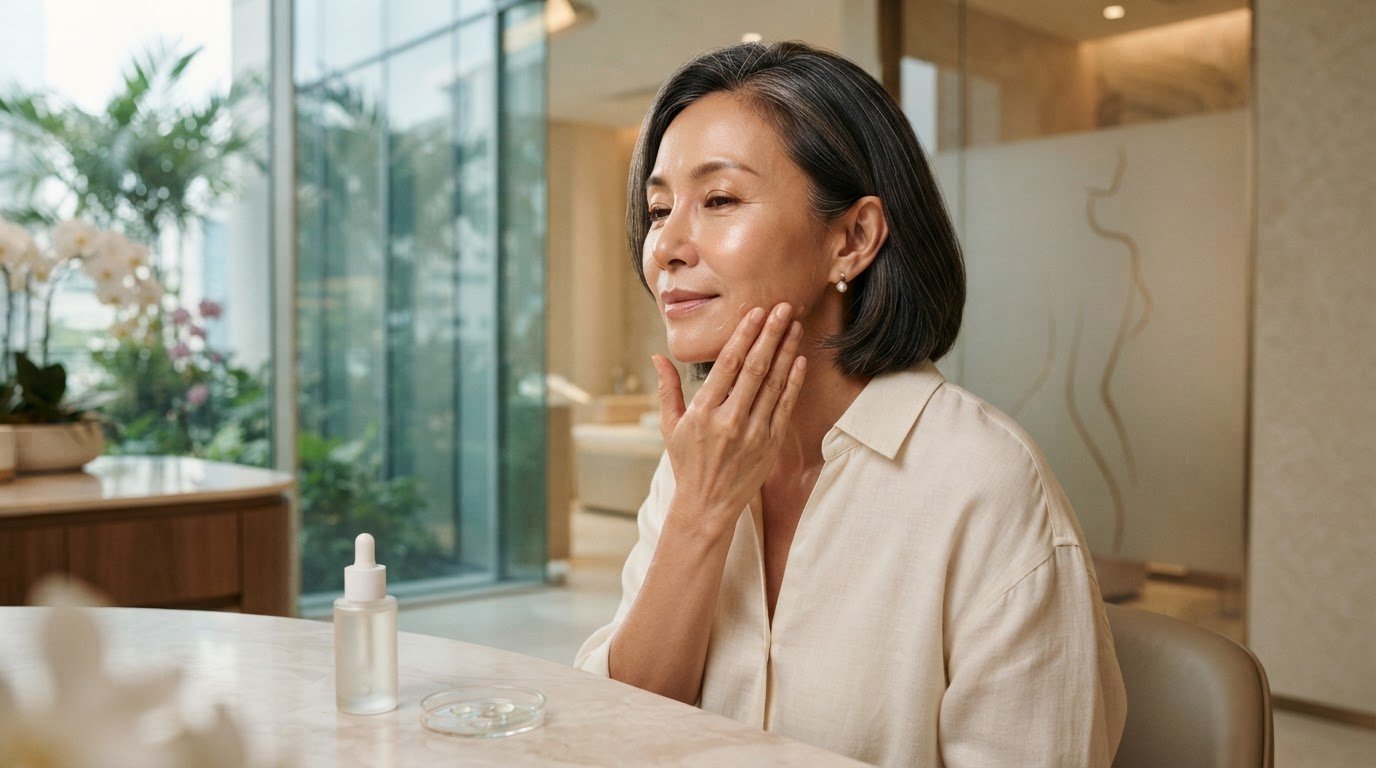
The best serum for sagging jowls may improve how your skin looks and feels, but it won’t lift the area or restore a sharper jawline. Serums can support hydration and soften the appearance of uneven texture or fine lines. They can’t reposition skin or reliably change facial contour when laxity is more pronounced. If firming claims and promises of fast results have left you unsure what to believe, start by separating surface benefits from structural change.
This guide explains what topical skincare may realistically change and how to assess a product before adding it to your routine. Match the product’s stated benefit to your concern, then consider the formulation, directions, evidence for the claim, and how your skin tolerates it. We’ll also compare skincare with dermatologist-led options and explain how delivery technology and product testing fit into the decision. The goal is a practical next step with expectations grounded in what skincare can and can’t do.
Key Takeaways
- Assess the best serum for sagging jowls by matching its stated purpose to the concern you want to address, not by relying on a firming claim alone.
- Compare ingredients by their intended role, such as hydration, antioxidant support, or improving the appearance of skin texture.
- Review product claims, directions, and skin tolerance before adding a serum to your routine.
- Understand how skincare and dermatologist-led options differ, so you can judge when professional advice may be more appropriate.
- Nano-delivery technology and nanoparticle quality testing describe aspects of formulation and product quality. They are not, by themselves, evidence of a jowl-lifting effect.
Table of Contents
- What Can the Best Serum for Sagging Jowls Realistically Do?
- How Serum Ingredients Relate to Firmness, Hydration, and Skin Appearance
- Serum, Professional Treatment, or Both: Comparing Options for Jowls
- How to Choose and Use a Serum for Sagging Jowls
- NanoDoc Anti-Ageing Skincare: Technology, Testing, and Next Steps
What Can the Best Serum for Sagging Jowls Realistically Do?
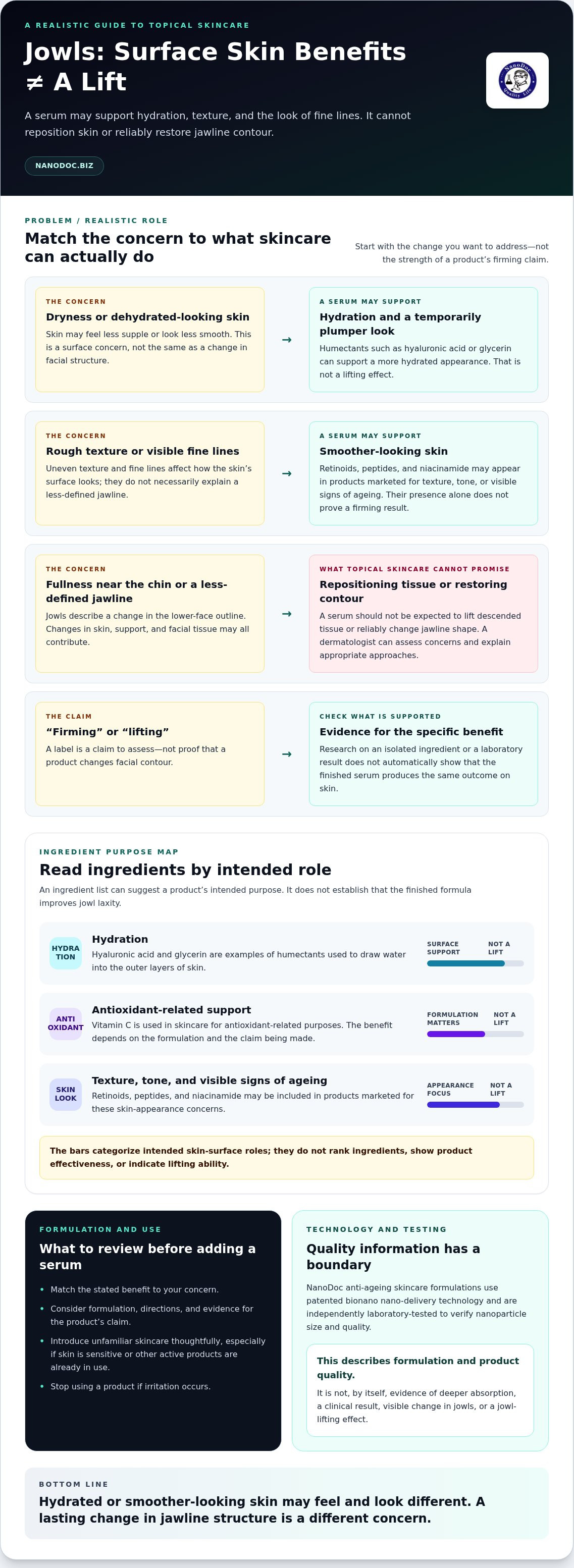
A topical serum can support the appearance and feel of skin, but it shouldn’t be framed as a facelift. The best serum for sagging jowls may help with surface concerns such as dryness, rough texture, or the look of fine lines. It shouldn’t be expected to lift descended tissue or restore a previous jawline contour.
Jowls describe a change in the lower-face outline, where tissue along the jawline appears less defined or fuller near the chin. That differs from dehydration, roughness, or fine lines, which affect the skin’s surface. Moisturised skin, for example, may look smoother and feel more supple while the underlying lower-face contour remains unchanged. Set your goal accordingly before comparing products.
Facial ageing involves more than one process. Changes in skin, underlying support, and the distribution of facial tissue may all contribute to a changing contour, and these factors vary between individuals. A serum’s topical action is distinct from deeper structural changes. Cosmetic skin-quality benefits may improve how the surface looks and feels, but they don’t guarantee a lifting effect. Hydration can temporarily make skin appear plumper; that isn’t the same as a lasting change in facial structure.
Why do jowls become more noticeable?
There isn’t one universal cause. Ageing, inherited features, cumulative environmental exposure, and changes in skin and supporting tissues may influence how the lower face looks over time. The overview of Skin aging describes several processes involved in these changes. Jowls are a visible contour concern, not necessarily a sign of a medical problem, and their appearance alone doesn’t identify the cause.
Can a serum visibly firm the lower face?
A serum may leave skin feeling smoother, more hydrated, or temporarily firmer at the surface. Those effects aren’t equivalent to a lasting change in jawline shape. Results vary with the product, your skin, and the concern being addressed. Treat a “firming” label as a claim to assess, not proof of lifting. If you’re unsure what’s contributing to a contour change or want to discuss options beyond skincare, a dermatologist can assess your concerns and explain appropriate approaches.
How Serum Ingredients Relate to Firmness, Hydration, and Skin Appearance
An ingredient list can indicate a serum’s intended role, but an ingredient’s presence alone doesn’t show that the finished product improves jowl laxity. Concentration, formulation, stability, directions, and evidence for the product’s claims all matter. A claim about hydration or smoother-looking skin is also different from evidence that a serum changes facial contour.
Assess ingredient claims by their intended purpose rather than treating them as a ranking of “best” actives:
- Hydration: Humectants such as hyaluronic acid or glycerin are commonly used to draw water into the outer layers of skin. This can support a more hydrated appearance, but it doesn’t demonstrate a lifting effect.
- Antioxidant support: Ingredients such as vitamin C are used in skincare products for antioxidant-related purposes. The specific benefit depends on the formulation and the claim being made.
- Skin texture and appearance: Retinoids, peptides, and niacinamide may appear in products marketed for texture, tone, or visible signs of ageing. Their presence doesn’t prove that a particular serum will firm the lower face.
These are general examples, not a description of a specific formula. When evaluating an ingredient-specific statement, consider the type of evidence and the outcome studied.
Which ingredient claims deserve careful interpretation?
Read claims closely. “Hydrating” describes a different purpose from “firmer-looking,” while “lifting” suggests a change in facial contour. Research on an isolated ingredient, or a result observed in laboratory conditions, doesn’t automatically show that a finished consumer serum produces the same outcome on skin. Evidence should relate to the product, how it’s used, and the specific benefit claimed.
A cosmetic benefit may improve the skin’s appearance, but it doesn’t automatically mean the face is being lifted. When evaluating the best serum for sagging jowls, look for support for the stated skin-quality benefit rather than assuming that support extends to a structural result.
Why formulation and consistent use matter
Formulation affects how a serum spreads, feels, and fits into a routine. It also shapes how ingredients are presented in the product, but a delivery technology by itself doesn’t guarantee deeper absorption, a clinical result, or visible change in jowls. NanoDoc’s anti-ageing skincare formulations use patented bionano nano-delivery technology. The formulations are independently laboratory-tested to verify nanoparticle size and quality. This testing supports information about product quality; it isn’t proof of a jowl-lifting outcome.
Follow the product directions and introduce unfamiliar skincare thoughtfully, especially if your skin is sensitive or you already use other active products. Stop using a product if irritation occurs. Consistency can help you assess how your skin responds, but it can’t turn an unsupported claim into evidence. To explore this formulation approach, visit NanoDoc anti-ageing skincare and consider the intended benefit separately from the delivery technology.
Serum, Professional Treatment, or Both: Comparing Options for Jowls
Skincare and professional treatments serve different purposes. A topical routine can support everyday skin appearance and comfort, while dermatologist-led options involve clinical assessment and a higher level of intervention. They aren’t interchangeable, and a serum isn’t an at-home equivalent to a procedure. The American Academy of Dermatology’s guidance on skin-firming approaches can provide a starting point. Discuss procedure details and indications with a qualified clinician.
| Approach | Intended concern | Level of intervention | Expectation to discuss |
|---|---|---|---|
| Topical skincare, including serums and moisturisers | Surface hydration, comfort, texture, or other appearance concerns supported by the product’s evidence | At-home routine | What specific cosmetic benefit the product supports, and whether it addresses your main concern |
| Energy-based options, such as radiofrequency or ultrasound treatments | Concerns a clinician may assess in relation to skin firmness or facial contour | Professional assessment and treatment | Current evidence, suitability, potential risks, and the outcome that is realistic for your goals |
| Other clinician-led options, which may include injectables or surgery | Different concerns involving facial contour or tissue position | Clinical consultation and procedure | How the option works, its limitations, and whether its risks and expected results fit your preferences |
What topical skincare may contribute
A considered routine may help maintain hydration and support a smoother, more comfortable-looking skin surface, depending on the products used and the evidence for their claims. The guide to anti-ageing dermal technology offers related context on skincare formulation. Even a well-chosen product remains skincare. It shouldn’t be described as equivalent to a procedure or as a guaranteed way to change jawline shape.
When a dermatologist’s assessment may help
If your main concern is a persistent change in lower-face contour, or you’re considering options beyond topical care, a dermatologist can assess your skin and discuss approaches in light of your goals. Depending on the concern, a discussion might cover energy-based treatments, injectables, or surgery. These are distinct options, not interchangeable solutions. Suitability and results vary, so an option’s name alone can’t predict an individual outcome.
Before weighing choices, clarify what you want to improve: dryness or texture, overall appearance, or facial contour. Then consider what outcome each approach is intended to address, what evidence supports it, and what limitations or risks apply. This can help you decide whether the best serum for sagging jowls is a reasonable skincare step for your priorities, or whether professional advice would better answer your questions.
How to Choose and Use a Serum for Sagging Jowls
Start with the specific concern you want a serum to address. Dryness, uneven texture, and a changing jawline aren’t the same issue, so match the product’s stated benefit to your goal. Use this checklist to assess whether a serum suits your routine without expecting a single product to reshape facial contour.
A practical checklist for evaluating serum claims
- Define your concern. Decide whether you want to improve hydration, texture, or another visible skin-quality concern. If your main goal is a more defined jawline, remember that this differs from a surface skincare benefit.
- Read the full claims. Look for specific cosmetic language rather than vague promises of a dramatic lift. Check what the product is intended to improve and whether that benefit matches your goal.
- Look at the evidence. Evidence about an individual ingredient doesn’t automatically establish that the finished formulation produces the same effect. Give more weight to information that addresses the actual product and the cosmetic outcome claimed.
- Review directions and tolerance. Read the label, including application instructions and cautions. Consider your skin’s sensitivity and whether the product fits alongside the skincare you already use.
This process helps you judge the best serum for sagging jowls by its evidence and intended use, rather than the strength of its marketing. It also keeps the decision grounded: a serum may support a skincare goal, but one product shouldn’t be expected to change your whole facial contour.
How to set a reasonable routine and timeline
Follow the product label; don’t assume different serums should be used in the same way. If a product is new to your routine, introduce it cautiously and avoid changing several products at once. That makes it easier to identify what your skin tolerates. Stop use if irritation occurs, and seek appropriate professional advice if a reaction concerns you.
Keep the rest of your routine in view. A serum is one part of skincare, so consider how it fits with your usual cleansing and moisturising steps and any other products you use. Aim for consistent, appropriate use rather than increasing the amount or frequency beyond the label. There’s no guaranteed timeline for visible results. Judge any change against the benefit the product claims to support, not an expectation of facial lifting.
For broader context on formulation and delivery approaches, see the deep dermal repair guide. If you’re ready to explore skincare options within this evidence-aware framework, explore NanoDoc anti-ageing skincare.
NanoDoc Anti-Ageing Skincare: Technology, Testing, and Next Steps
NanoDoc’s anti-ageing skincare formulations use patented bionano nano-delivery technology. This describes a formulation approach, not a guaranteed cosmetic result. When comparing products, ask what each is intended to improve and what evidence supports that specific claim, rather than judging by technology alone.
What NanoDoc’s nano-delivery approach means
In accessible terms, nano-delivery refers to a method of formulating skincare around very small particles. The term describes a technical feature of the formulation. On its own, it doesn’t establish how a finished product will perform on an individual’s skin, prove that ingredients reach a particular depth, or demonstrate a visible change in lower-face contour.
NanoDoc’s formulations are independently laboratory-tested to verify nanoparticle size and quality. This provides information about product characteristics. It answers a quality-related question, not whether a serum has been shown to lift jowls or produce a particular clinical outcome. Those are different kinds of evidence and should be considered separately.
Keep these distinctions clear when comparing products:
- Formulation approach: What technology is used, and what does that description establish?
- Product quality: What characteristics are tested, and what can those tests tell you?
- Cosmetic benefit: What visible skin concern is the product intended to address, and what evidence supports that claim?
This framework helps prevent technical language from being mistaken for proof of a specific result. It also gives you a more useful basis for comparing skincare than a delivery-system claim alone.
A considered next step for your skincare decision
Choose skincare according to the concern you want to address, the evidence for the product’s stated benefit, its directions, and how your skin tolerates it. If you’re considering the best serum for sagging jowls, keep your expectations grounded in the product’s cosmetic benefits rather than expecting a technology label to promise a change in facial contour.
If your concern is primarily a change in facial shape, or you want advice about options beyond cosmetic skincare, a dermatologist can assess your concerns and discuss appropriate approaches. That assessment is distinct from choosing a skincare product and can help clarify which expectations are realistic for your goals.
Use technical information alongside product directions and evidence for the stated benefit. Explore NanoDoc anti-ageing skincare and review the available product information in light of your personal skincare goals.
Choose Your Next Skincare Step with Confidence
Match your skincare choice to the change you want to address. If your goal is improved skin appearance, consider a serum’s stated cosmetic benefits, supporting evidence, directions, and fit with your routine. If your concern is facial contour, a dermatologist can help you understand whether skincare aligns with your goals. The best serum for sagging jowls isn’t simply the one with the boldest firming language. It’s one whose claims and intended use make sense for your concern.
NanoDoc’s formulations are independently laboratory-tested to verify nanoparticle size and quality. This offers context about product characteristics, while expectations should remain grounded in the specific cosmetic benefits a product claims to support.
Take a considered next step: explore NanoDoc anti-ageing skincare and review the information with your personal skincare goals in mind. A clear, realistic choice is a strong place to begin.
Frequently Asked Questions
Can a serum get rid of sagging jowls?
No. A serum can’t reliably remove jowls or restore a previous jawline shape. It may still be useful if your concern includes a separate surface issue, such as dry or rough skin. Before purchasing, identify the result you expect: smoother-feeling skin is a different goal from changing facial contour. If contour change is your main concern, a dermatologist can help clarify what skincare can realistically address.
What ingredients should I look for in a serum for sagging jowls?
Choose ingredients according to the skin concern you want to address, not the word “firming” on the label. For example, hyaluronic acid is commonly used in hydrating products, while vitamin C may appear in formulas aimed at antioxidant support. These examples don’t establish that a serum will lift jowls. Check the full ingredient list, directions, and evidence for the finished formulation. The best serum for sagging jowls isn’t defined by one ingredient alone.
How long does it take for a firming serum to work?
There’s no reliable universal timeline, and a serum can’t be expected to produce a guaranteed change in jowl contour. Some products may make skin feel more comfortable soon after application, but that doesn’t establish a lasting firming result. Follow the label and assess only the benefit the product claims to support. If you track changes, use consistent lighting and viewing conditions rather than relying on day-to-day impressions.
Are serums better than creams for sagging skin?
Not inherently. Serums and creams can differ in texture, how they layer, and the role they play in a routine. Neither format is automatically more effective for sagging skin. Consider the full formulation, intended cosmetic benefit, and whether you can use the product comfortably as directed. For example, a lighter serum may layer more easily under another product, while a cream may suit someone who prefers a richer feel.
Can skincare improve skin firmness without a procedure?
Skincare may support a smoother, more hydrated appearance without a procedure, depending on the product and the benefit it can substantiate. A consistent routine can also include sun protection, which helps limit exposure to a factor associated with visible skin ageing. These steps don’t guarantee a firmer jawline or replace a clinical option when the goal is a structural contour change.
When should I see a dermatologist about sagging jowls?
Consider seeing a dermatologist if you want an assessment of what may be contributing to a change in your lower-face appearance, or if you’re weighing options beyond over-the-counter skincare. Bring the products you use and describe your main goal, such as improving texture or discussing contour. This context can make the conversation more specific. A dermatologist can explain relevant approaches, limitations, and potential risks without assuming one option suits everyone.
Frequently Asked Questions
- Why do jowls become more noticeable?
- There isn’t one universal cause. Ageing, inherited features, cumulative environmental exposure, and changes in skin and supporting tissues may influence how the lower face looks over time. The overview of Skin aging describes several processes involved in these changes. Jowls are a visible contour concern, not necessarily a sign of a medical problem, and their appearance alone doesn’t identify the cause.
- Can a serum visibly firm the lower face?
- A serum may leave skin feeling smoother, more hydrated, or temporarily firmer at the surface. Those effects aren’t equivalent to a lasting change in jawline shape. Results vary with the product, your skin, and the concern being addressed. Treat a “firming” label as a claim to assess, not proof of lifting. If you’re unsure what’s contributing to a contour change or want to discuss options beyond skincare, a dermatologist can assess your concerns and explain appropriate approaches. An ingredient list can indicate a serum’s intended role, but an ingredient’s presence alone doesn’t show that the finished product improves jowl laxity. Concentration, formulation, stability, directions, and evidence for the product’s claims all matter. A claim about hydration or smoother-looking skin is also different from evidence that a serum changes facial contour. Assess ingredient claims by their intended purpose rather than treating them as a ranking of “best” actives: These are general examples, not a description of a specific formula. When evaluating an ingredient-specific statement, consider the type of evidence and the outcome studied.
- Which ingredient claims deserve careful interpretation?
- Read claims closely. “Hydrating” describes a different purpose from “firmer-looking,” while “lifting” suggests a change in facial contour. Research on an isolated ingredient, or a result observed in laboratory conditions, doesn’t automatically show that a finished consumer serum produces the same outcome on skin. Evidence should relate to the product, how it’s used, and the specific benefit claimed. A cosmetic benefit may improve the skin’s appearance, but it doesn’t automatically mean the face is being lifted. When evaluating the best serum for sagging jowls, look for support for the stated skin-quality benefit rather than assuming that support extends to a structural result.
- Can a serum get rid of sagging jowls?
- No. A serum can’t reliably remove jowls or restore a previous jawline shape. It may still be useful if your concern includes a separate surface issue, such as dry or rough skin. Before purchasing, identify the result you expect: smoother-feeling skin is a different goal from changing facial contour. If contour change is your main concern, a dermatologist can help clarify what skincare can realistically address.
- What ingredients should I look for in a serum for sagging jowls?
- Choose ingredients according to the skin concern you want to address, not the word “firming” on the label. For example, hyaluronic acid is commonly used in hydrating products, while vitamin C may appear in formulas aimed at antioxidant support. These examples don’t establish that a serum will lift jowls. Check the full ingredient list, directions, and evidence for the finished formulation. The best serum for sagging jowls isn’t defined by one ingredient alone.
- How long does it take for a firming serum to work?
- There’s no reliable universal timeline, and a serum can’t be expected to produce a guaranteed change in jowl contour. Some products may make skin feel more comfortable soon after application, but that doesn’t establish a lasting firming result. Follow the label and assess only the benefit the product claims to support. If you track changes, use consistent lighting and viewing conditions rather than relying on day-to-day impressions.
- Are serums better than creams for sagging skin?
- Not inherently. Serums and creams can differ in texture, how they layer, and the role they play in a routine. Neither format is automatically more effective for sagging skin. Consider the full formulation, intended cosmetic benefit, and whether you can use the product comfortably as directed. For example, a lighter serum may layer more easily under another product, while a cream may suit someone who prefers a richer feel.
- Can skincare improve skin firmness without a procedure?
- Skincare may support a smoother, more hydrated appearance without a procedure, depending on the product and the benefit it can substantiate. A consistent routine can also include sun protection, which helps limit exposure to a factor associated with visible skin ageing. These steps don’t guarantee a firmer jawline or replace a clinical option when the goal is a structural contour change.
- When should I see a dermatologist about sagging jowls?
- Consider seeing a dermatologist if you want an assessment of what may be contributing to a change in your lower-face appearance, or if you’re weighing options beyond over-the-counter skincare. Bring the products you use and describe your main goal, such as improving texture or discussing contour. This context can make the conversation more specific. A dermatologist can explain relevant approaches, limitations, and potential risks without assuming one option suits everyone.