
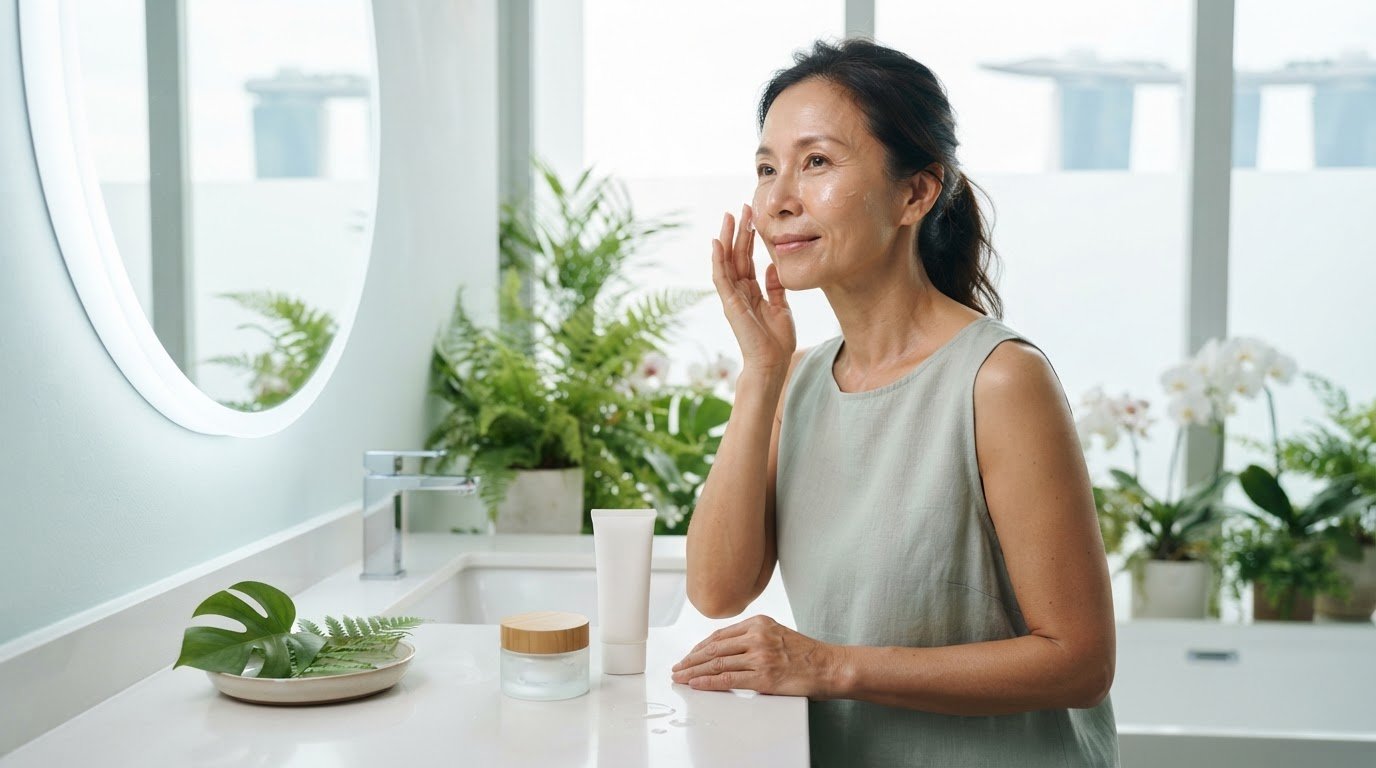
A richer cream may seem like the safer choice for ageing skin, but in Singapore’s humid weather, it can feel heavy and uncomfortable. The challenge is finding anti-ageing skincare for humid weather that supports hydration without leaving a greasy finish or making oily and acne-prone skin feel congested.
If your skin looks shiny by midday, it can be difficult to tell whether humidity, excess oil or a product is the cause. Humidity may slow moisture loss from the skin’s surface, but it doesn’t replace the lipids that support a healthy skin barrier. Heat, sweat and sebum can also affect how comfortable your routine feels, so skipping moisturiser altogether isn’t always the answer.
This guide explains how humid conditions can affect skin comfort and product feel, then shows you how to build a simple routine around your skin’s needs and the climate. You’ll learn how to compare lightweight formulations, support hydration and barrier comfort, and maintain daily sun protection without relying on exaggerated anti-ageing claims.
Key Takeaways
- Adjust anti-ageing skincare for humid weather by choosing comfortable textures and layers, rather than abandoning skincare altogether.
- Understand how hydration and the skin barrier work together while addressing different aspects of skin care.
- Compare lightweight and richer textures by how they feel and layer on your skin, not by assuming one is more effective.
- Build a simple morning routine around cleansing as needed, suitable skincare and broad-spectrum sun protection, following each product’s directions.
- Assess product information carefully: laboratory verification of nanoparticle size and quality is not proof of a specific clinical outcome.
Table of Contents
- How Humid Weather Changes the Feel of Anti-Ageing Skincare
- How Hydration, the Skin Barrier and Anti-Ageing Care Fit Together
- Lightweight or Rich Textures: Choosing Anti-Ageing Skincare for Humid Weather
- How to Build a Humid-Weather Anti-Ageing Skincare Routine
- How to Assess Anti-Ageing Skincare for Humid Weather
How Humid Weather Changes the Feel of Anti-Ageing Skincare
In Singapore’s warm, humid climate, a moisturiser that feels comfortable in an air-conditioned room may feel heavier outdoors. That change in sensation can make a routine seem unsuitable, even when your skin still needs hydration and consistent care. The aim isn’t to drop anti-ageing steps. It’s to adjust texture and layering so the routine feels comfortable enough to use consistently.
Humid-weather skincare means matching product texture and layering to the climate and your skin’s comfort, while maintaining a consistent routine that supports hydration and daily sun protection.
Humidity describes moisture in the air, not the hydration level of your skin. Damp air can affect how quickly products seem to dry down and how your skin feels, but it doesn’t supply the barrier-supporting components a moisturiser can provide. Surface shine is also an unreliable measure of hydration: it may come from sweat, sebum or a product’s finish. Consider how your skin feels over time, not just how it looks at one moment.
Why Skin Can Feel Greasier in Humid Conditions
Heat can increase perspiration, while sebum on the skin’s surface can add to shine. Together, sweat and oil may make skincare layers feel tacky or slick, particularly after time outdoors. A shiny forehead after a commute, for example, doesn’t by itself show that your moisturiser is too rich or that your skin is dehydrated.
People’s responses vary. Skin that tends to feel oily may be more prone to a greasy finish, while someone else may notice little change. Temporary shine or perspiration may settle after gentle cleansing. A persistent change in comfort or skin condition is different and can’t be diagnosed from appearance alone.
What Humidity Does Not Tell You About Skin Ageing
Humid air can’t establish whether your skin is adequately hydrated or whether its barrier feels comfortable. Pay attention to sensations such as tightness, dryness or irritation, as well as how products sit on your skin. These observations can help you adjust texture and layering, but they don’t identify a specific skin condition.
Visible signs of ageing have multiple influences, including cumulative sun exposure, and shouldn’t be attributed to the weather alone. Daily sun protection is a separate part of a considered routine, not a humidity-specific treatment. Choose broad-spectrum sun protection that suits your routine and follow its directions. The aim of anti-ageing skincare for humid weather is a comfortable, repeatable routine, not a quick fix based on shine.
How Hydration, the Skin Barrier and Anti-Ageing Care Fit Together
The outermost layer of skin, the stratum corneum, acts as a protective barrier. It consists of flattened skin cells held within a matrix of lipids, which helps limit water loss and shield the skin from external irritants. Hydration and barrier support are connected, but they aren’t interchangeable: hydration refers to water in the outer skin layers, while barrier care helps maintain the structure that retains moisture and supports skin comfort.
Skin hydration is about water in the outer layers; surface oiliness is about sebum on the skin, so one doesn’t reliably indicate the other. A shiny complexion can still feel tight or uncomfortable. Adding more products doesn’t automatically improve hydration or barrier function, either. Too many layers may feel uncomfortable, particularly in humid conditions, and can make a routine harder to maintain.
Hydration Without an Overly Heavy Finish
Both texture and quantity affect how a product feels. A lighter lotion or gel may suit someone who dislikes a rich finish, while a cream may feel more comfortable to someone whose skin feels dry. Neither texture is right for everyone. Start with the amount indicated on the label, then assess how the product feels once it has settled before adding another layer.
For an overview of commonly used ingredients and their limitations, see the Mayo Clinic guide to anti-aging ingredients. Ingredients and product directions matter more than a texture label alone.
Supporting the Skin Barrier While Introducing Actives
Active ingredients can have different purposes and directions, so introduce one new active product at a time. This makes it easier to notice how your skin responds. Follow the product instructions rather than increasing how often or how much you use it on the assumption that more will work better.
Persistent stinging, burning, redness or worsening dryness can signal that a product isn’t suiting your skin. Pause its use if discomfort continues, and avoid adding other new actives while your skin settles. A gradual, consistent approach is more informative than changing several steps at once.
NanoDoc’s anti-ageing skincare formulations use nano-encapsulation technology, and undergo independent laboratory testing to verify nanoparticle size and quality. This testing describes formulation characteristics; it isn’t proof of a specific clinical outcome. Explore NanoDoc anti-ageing skincare and consider the product information alongside your routine needs.
Lightweight or Rich Textures: Choosing Anti-Ageing Skincare for Humid Weather
Texture affects how skincare feels and layers, but it doesn’t tell you how effective a product is. A rich cream isn’t automatically more anti-ageing than a lotion or gel. When choosing anti-ageing skincare for humid weather, consider the product’s intended use and directions alongside whether its finish feels comfortable in the heat and humidity.
Oily or acne-prone skin can still need comfortable hydration. The goal isn’t to avoid moisturiser by default, but to find a formula that suits your needs and feels manageable. A texture label alone can’t guarantee that a product won’t contribute to congestion.
| Texture | Potential advantages | Considerations in humid weather |
|---|---|---|
| Gel or gel-cream | May feel light and layer easily under other products. | Check whether the finish leaves your skin comfortable; a light feel doesn’t determine suitability for everyone. |
| Lotion or fluid | May feel less rich than a cream and fit into a simple routine. | Consider how it settles and whether you need additional steps, following product directions. |
| Richer cream | May feel more comfortable when skin feels dry or tight. | Can feel heavier or leave more residue in hot, humid conditions, depending on the formula and amount used. |
When a Lightweight Formula May Feel More Comfortable
If you dislike persistent residue, a gel, gel-cream or fluid may feel easier to wear, especially under sun protection. Give a product time to settle before deciding whether the finish suits you. Read the full directions and intended use, and don’t assume that “lightweight” means it prevents acne or guarantees a non-comedogenic result.
When a Richer Texture May Still Suit Your Routine
Skin that feels dry or tight may be more comfortable with a richer texture, even in a humid climate. Your response matters more than a broad skin-type label. If the directions allow, adjust the amount or apply the product only where needed; otherwise, follow the stated use. Reassess comfort rather than rejecting a texture based on climate alone.
Compare products by their formulation information, intended purpose and directions, not by how substantial they feel on the skin. A useful choice is one you can apply as directed and tolerate consistently. Texture helps you judge comfort; it doesn’t, by itself, establish anti-ageing performance.
How to Build a Humid-Weather Anti-Ageing Skincare Routine
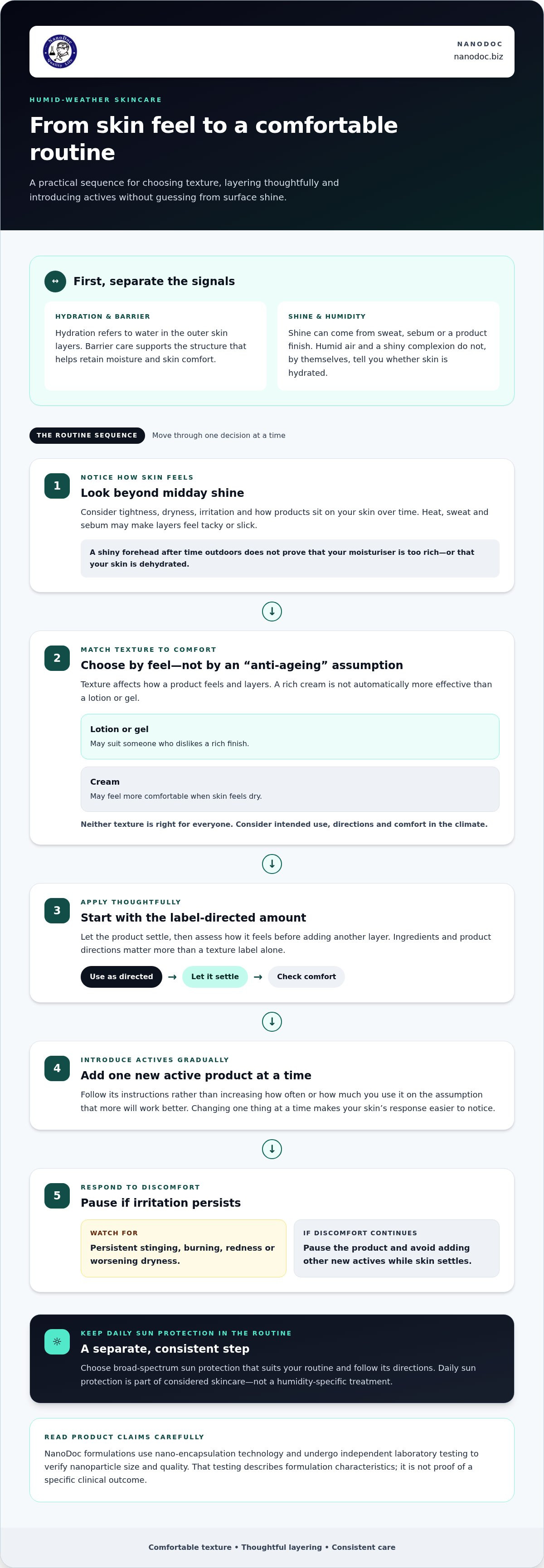
A useful routine doesn’t need a long sequence of layers. In warm, humid conditions, focus on a few steps you can apply comfortably and consistently, then adjust according to your skin’s response and each product’s directions. The sequence below is a framework, not a requirement to use every type of product.
A Simple Morning Routine for Humid Conditions
Keep mornings practical. If your skin feels comfortable, you may not need an intensive cleanse. Choose a gentle cleanse or rinse based on how your skin feels and what you used the night before.
- Cleanse as needed. Use a gentle cleanser or rinse with water, depending on your skin’s comfort and routine.
- Apply selected skincare. Use products suited to your needs, following their label directions and applying them in a manageable order. If layers feel sticky, simplify rather than adding more.
- Finish with broad-spectrum sun protection. Choose a sunscreen that fits your routine, apply it according to its directions, and follow the label for reapplication. Sun protection is a daily consideration, not a step to skip because the weather is cloudy or humid.
An Evening Routine That Prioritises Tolerance
Evening care can remove the day’s sunscreen and residue while making space for chosen anti-ageing products. Keep the sequence straightforward:
- Cleanse gently. Remove sunscreen and daily residue without scrubbing or using a cleanser that leaves your skin feeling uncomfortable.
- Use a selected anti-ageing product. Introduce one new active product at a time, following its verified directions. Avoid adding several unfamiliar actives together, since that makes it harder to identify what your skin tolerates.
- Moisturise if appropriate. Choose a texture that feels comfortable and use it as directed. A humid climate doesn’t mean everyone should skip moisturiser.
If persistent redness, burning, stinging or worsening dryness develops, reduce or pause the product causing discomfort instead of increasing use. Don’t assume that using a product more often will speed up results. Follow its directions and keep your routine stable enough to assess your skin’s response.
Consistency and tolerability matter more than adding steps. A simple routine you can use as directed is a more practical foundation for anti-ageing skincare for humid weather than a complicated sequence that feels unpleasant. NanoDoc’s anti-ageing skincare range is available at NanoDoc.
How to Assess Anti-Ageing Skincare for Humid Weather
Once you know what feels comfortable in your routine, assess a product by its intended use, directions and the information provided about its formulation. For anti-ageing skincare for humid weather, a lightweight feel may be a practical preference, but texture alone doesn’t establish suitability or effectiveness.
Questions to Ask When Comparing Formulations
Use this checklist to compare products without relying on trend language or broad promises:
- Is its intended use clear? Look for information that explains the product’s purpose and where it fits in a routine.
- Do the directions explain use? Check the recommended frequency, layering instructions and any stated precautions. Follow the label rather than assuming more frequent use will improve results.
- Does the texture suit your daily comfort? Consider how it feels in warm, humid conditions, including whether it leaves a finish you can tolerate. Don’t choose based on a trend or skin-type label alone.
- Are claims supported by product information? Treat broad promises cautiously if the formulation details or evidence behind them aren’t clear. A technical term is not, by itself, proof of a particular skin benefit.
These checks help separate useful formulation information from marketing language. They also make it easier to compare products according to your routine needs, rather than expecting one texture or technology to suit everyone.
NanoDoc Formulation Quality and Next Steps
NanoDoc anti-ageing skincare formulations use nano-encapsulation, a delivery approach that involves enclosing components within nanoscale structures. The formulations undergo independent laboratory testing to verify nanoparticle size and quality. This testing relates to measured formulation characteristics; it doesn’t, on its own, demonstrate a specific clinical outcome, guarantee penetration or establish a particular result for every user.
For more context on the approach, read the anti-ageing dermal technology guide. Then review product information and directions alongside your preferred texture and routine requirements. Consider both formulation details and how a product fits into daily use, without treating any single claim as a guarantee.
Explore NanoDoc skincare and learn about the formulations and product range.
Build a Routine Your Skin Can Tolerate
Effective anti-ageing skincare for humid weather isn’t about using the richest cream or the greatest number of steps. It’s about choosing comfortable textures, supporting hydration and the skin barrier, and following product directions consistently. Surface shine alone can’t tell you whether your skin is hydrated, so consider how it feels as well as how products sit throughout the day.
Keep your routine manageable: cleanse according to your needs, use selected skincare as directed, and make broad-spectrum sun protection part of your morning. Introduce active products gradually so you can observe your skin’s response. Product information and formulation testing can inform your choices, but testing nanoparticle size and quality is not proof of a specific clinical outcome.
NanoDoc is the representative of LG Bionano, and its formulations undergo independent laboratory testing to verify nanoparticle size and quality. Explore NanoDoc’s anti-ageing skincare range and choose products that fit your routine. A thoughtful, comfortable approach can help you care for your skin consistently in humid conditions.
Frequently Asked Questions
Is humidity enough to hydrate ageing skin?
No. Humid air doesn’t replace the water and lipids involved in maintaining comfortable, hydrated skin. Humidity can influence how skin and skincare feel, but it can’t confirm whether your skin is adequately hydrated or whether its barrier is comfortable. Notice sensations such as tightness or dryness, not just surface shine, and choose a moisturiser that suits your skin and feels manageable in the climate.
Can anti-ageing skincare feel too heavy in humid weather?
Yes. A cream or several product layers may leave some people feeling sticky or coated in warm, humid conditions. That sensation depends on the formulation, the amount used and individual preference; it doesn’t prove a product is ineffective. Consider a lotion or gel texture if you prefer a lighter finish, and follow product directions rather than assuming a particular texture suits everyone.
How do I build an anti-ageing skincare routine for humid weather?
Keep the routine simple and follow each product’s directions. In the morning, cleanse or rinse according to your needs, apply selected skincare, then finish with broad-spectrum sunscreen. In the evening, gently cleanse away sunscreen and daily residue before using chosen anti-ageing products. Introduce new active products one at a time so you can assess tolerance. Consistency and comfort matter more than adding extra steps.
Should oily or acne-prone skin use moisturiser in humid weather?
A moisturiser can still be part of a routine for oily or acne-prone skin, but choose one whose texture feels comfortable and use it as directed. Humidity and surface oil don’t establish whether skin needs hydration. A lightweight feel may suit your preference, but it doesn’t guarantee that a formula won’t contribute to congestion. Pay attention to your skin’s comfort and response over time.
Can I use anti-ageing products and sunscreen together?
Yes, they can be part of the same morning routine. Apply skincare according to its label directions, then finish with a broad-spectrum sunscreen and follow the sunscreen’s instructions for application and reapplication. If you’re introducing an active product, add it gradually and observe how your skin responds. Sunscreen remains a distinct daily protection step; an anti-ageing product doesn’t replace it.
What should I do if anti-ageing skincare irritates my skin?
If a product causes persistent burning, stinging, redness or worsening dryness, pause its use rather than increasing the amount or frequency. Keep your routine simple while the discomfort settles, and avoid introducing other new active products at the same time. Follow label precautions when restarting, if appropriate. Seek advice from a healthcare professional if irritation is severe, persists after stopping the product or concerns you.
Does nano-encapsulation guarantee better anti-ageing results?
No. Nano-encapsulation is a delivery approach, not a guarantee of a particular clinical result or benefit for every user. NanoDoc represents LG Bionano, and its formulations undergo independent laboratory testing to verify nanoparticle size and quality. That testing verifies formulation characteristics, not a specific anti-ageing outcome. Assess product information, intended use and directions alongside your routine needs.
Frequently Asked Questions
- Is humidity enough to hydrate ageing skin?
- No. Humid air doesn’t replace the water and lipids involved in maintaining comfortable, hydrated skin. Humidity can influence how skin and skincare feel, but it can’t confirm whether your skin is adequately hydrated or whether its barrier is comfortable. Notice sensations such as tightness or dryness, not just surface shine, and choose a moisturiser that suits your skin and feels manageable in the climate.
- Can anti-ageing skincare feel too heavy in humid weather?
- Yes. A cream or several product layers may leave some people feeling sticky or coated in warm, humid conditions. That sensation depends on the formulation, the amount used and individual preference; it doesn’t prove a product is ineffective. Consider a lotion or gel texture if you prefer a lighter finish, and follow product directions rather than assuming a particular texture suits everyone.
- How do I build an anti-ageing skincare routine for humid weather?
- Keep the routine simple and follow each product’s directions. In the morning, cleanse or rinse according to your needs, apply selected skincare, then finish with broad-spectrum sunscreen. In the evening, gently cleanse away sunscreen and daily residue before using chosen anti-ageing products. Introduce new active products one at a time so you can assess tolerance. Consistency and comfort matter more than adding extra steps.
- Should oily or acne-prone skin use moisturiser in humid weather?
- A moisturiser can still be part of a routine for oily or acne-prone skin, but choose one whose texture feels comfortable and use it as directed. Humidity and surface oil don’t establish whether skin needs hydration. A lightweight feel may suit your preference, but it doesn’t guarantee that a formula won’t contribute to congestion. Pay attention to your skin’s comfort and response over time.
- Can I use anti-ageing products and sunscreen together?
- Yes, they can be part of the same morning routine. Apply skincare according to its label directions, then finish with a broad-spectrum sunscreen and follow the sunscreen’s instructions for application and reapplication. If you’re introducing an active product, add it gradually and observe how your skin responds. Sunscreen remains a distinct daily protection step; an anti-ageing product doesn’t replace it.
- What should I do if anti-ageing skincare irritates my skin?
- If a product causes persistent burning, stinging, redness or worsening dryness, pause its use rather than increasing the amount or frequency. Keep your routine simple while the discomfort settles, and avoid introducing other new active products at the same time. Follow label precautions when restarting, if appropriate. Seek advice from a healthcare professional if irritation is severe, persists after stopping the product or concerns you.
- Does nano-encapsulation guarantee better anti-ageing results?
- No. Nano-encapsulation is a delivery approach, not a guarantee of a particular clinical result or benefit for every user. NanoDoc represents LG Bionano, and its formulations undergo independent laboratory testing to verify nanoparticle size and quality. That testing verifies formulation characteristics, not a specific anti-ageing outcome. Assess product information, intended use and directions alongside your routine needs.